The Mississippi River flooding is far from over but the consequences will be far- reaching … particularly if the Mississippi flow shifts to the Atchafalaya River. Here’s Salon:
In a 1987 New Yorker article, which would later become a chapter in the book, “The Control of Nature,” journalist John McPhee speculated about the severe impact of the loss of the Mississippi on New Orleans, a city in no desperate need of another disaster:With its fresh water gone, its harbor a silt bar, its economy disconnected from inland commerce, New Orleans would turn into New Gomorrah.
So significant did the Army Corps of Engineers view the threat of such a course change to be, it produced an information video that bore the following message:
This nation has a large and powerful adversary. Our opponent could cause the United States to lose nearly all her seaborne commerce, to lose her standing as first among trading nations. . . We are fighting Mother Nature. . . .It’s a battle we have to fight day by day, year by year; the health of our economy depends on victory.
That in mind, Congress instructed the Army Corps of Engineers to design a mechanism for trapping the Mississippi River along its current path, without cutting off the Atchafalaya River by damming it up. (Doing so would dry up Louisiana’s signature Cajun swamp lands and deprive a fair portion of the state of a major water source.) In 1963, the Corps completed the Old River Control Structure. The system shunts a strict 30 percent of the river flow down the Atchafalaya, coursing the remaining 70 percent through the Lower Mississippi.
It’s hard to say whether Mother Nature is going to win this particular ‘battle’ next week or thirty years from now. It’s possible the Corps and southern Louisiana will dodge the flood-bullet this time but the shift is inevitable.
The Mississippi River’s course through Baton Rouge and New Orleans is twice the length of the Atchafalaya distributary which is 270km long. The steeper Atchafalaya course would capture the Mississippi’s flow in a heartbeat if allowed.
A permanent shift will have profound effects on the energy business. Southern Louisiana is dotted with critical facilities and criss- crossed with pipelines, highways, railroads and canals. Currently, all of these facilities are oriented toward having the bulk of the water flow though the Mississippi channel. This is a map of the Atchafalaya basin with facilities noted: (Please click on chart for a larger image)
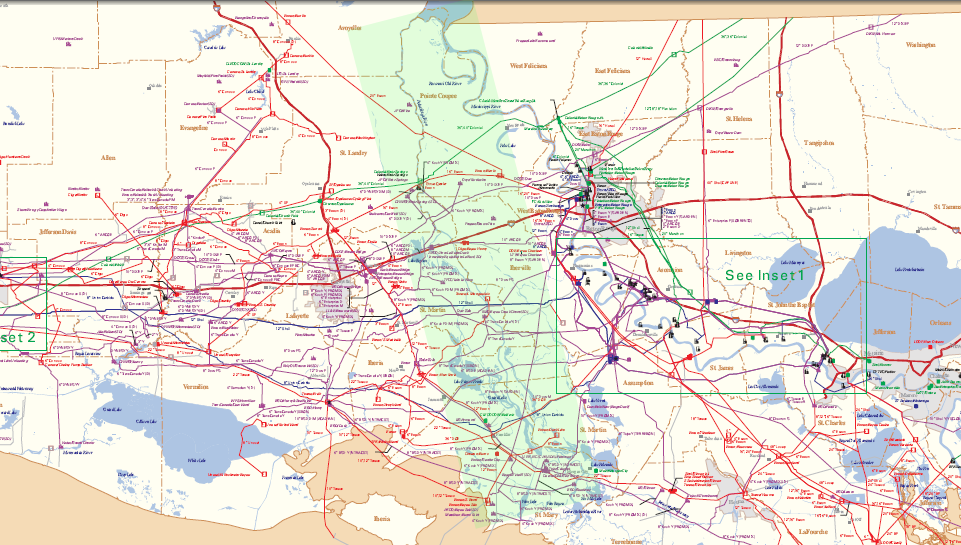
Figure 1: the light green area is the Atchafalaya River basin which is now carrying a large part of the Mississippi’s flow. The control structures which are diverting this flow are at the top of the map.
A zoom- able version of this excellent map of Lousiana’s energy facilities can be found at Map Search.
A Mississippi River re- direct down the Atchafalaya basin would put large numbers of docks, refineries, chemical plants, compressor stations and pipelines on the ‘wrong’ river. The ‘Old Mississippi’ would become a bayou. It would eventually silt up. New/replacement facilities would have to be built at enormous cost including new bridges, railroads and highways. An undetermined amount of Louisiana energy production would be shut in.
Oil Falls on Ebbing Concern the Mississippi to Flood Louisiana RefineriesMark Shenk (First Enercast Financial)
Crude oil fell and gasoline slipped to a two-month low after the opening of spillways reduced concern that the Mississippi River will flood refineries.
Oil dropped 2.3 percent as Louisiana opened nine of the 125 gates at the Morganza floodway, allowing the Mississippi River to pour into the Atchafalaya River basin. The move was designed to save Baton Rouge and New Orleans from inundation. Louisiana refineries are the second-biggest fuel producers in the U.S., following Texas, according to the Energy Department.
“Worries about the Mississippi River overflowing and shutting a number of refineries have dissipated with the opening of the spillway,” said Carl Larry, director of energy derivatives and research at Blue Ocean Brokerage LLC in New York. “The biggest impact has been in the gasoline market, which is dragging the rest of the complex lower.”
Crude oil for June delivery fell $2.28 to $97.37 a barrel on the New York Mercantile Exchange, the lowest settlement since May 6. Futures have risen 36 percent in the past year.
Gasoline for June delivery tumbled 14.33 cents, or 4.7 percent, to end the session at $2.9311 a gallon in New York. It was the lowest settlement since March 16.
Regular gasoline at the pump, averaged nationwide, slipped 0.9 cent to $3.961 a gallon yesterday, AAA said on its website. The price climbed to $3.985 on May 4, the highest level since July 24, 2008.
The Mississippi floodwaters threatened operations at 10 Louisiana refineries that account for about 14 percent of U.S. operating capacity, Anna Dearmon, a spokeswoman for the Louisiana Department of Natural Resources, said last week.
All important gas for the all- important carz.
Good news for Louisiana is the flow of silt will replenish wetlands starved of same since the Mississippi River flood- control efforts began in the 1950s. Toxic sludge from BP’s Macondo well will also be silted over.
Meanwhile, Europe is in the grip of a fierce drought.
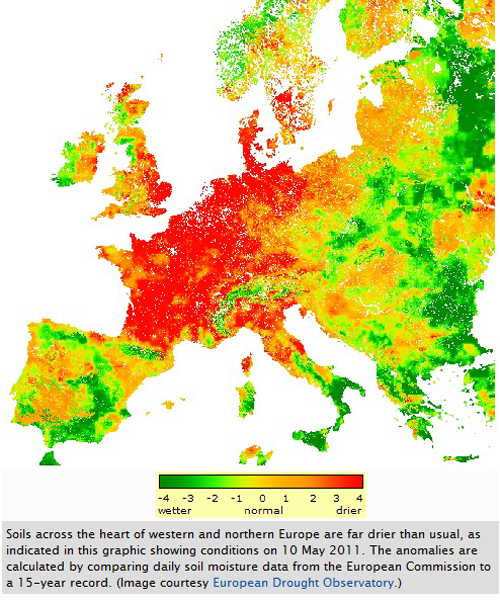
Figure 2: Note the soil dryness in France, which gains almost 80% of its electricity from nuclear reactors. The potential exists for un black-out électrique!
Observatoire du nucléaire – Dossier du jeudi 12 mai 2011
Stéphane Lhomme
Sécheresse : fort risque de black-out nucléaire cet été
– La sécheresse exceptionnelle qui sévit déjà menace le
parc nucléaire français d’un véritable black-out cet été– 44 des 58 réacteurs nucléaires français sont en bord
de rivières et risquent donc de devoir être arrêtés
IntroductionL’option nucléaire, imposée en France depuis 40 ans, est systématiquement présentée par les autorités françaises comme une véritable bénédiction mettant la France à l’abri des mauvaises
surprises concernant son approvisionnement électrique.En réalité, le parc nucléaire français est un colosse aux pieds d’argile : non seulement il est vieillissant – fin 2011, 21 réacteurs sur 58 auront atteint 30 ans de fonctionnement – mais il est fortement menacé par la sécheresse. Il faut se rendre à l’évidence : contrairement à ce qui est souvent affirmé, c’est le changement climatique qui s’attaque au nucléaire et non l’inverse.
Alors que des tempêtes peuvent entraîner des accidents nucléaires (le drame a été frôlé à la centrale du Blayais pendant la tempête de décembre 1999), c’est actuellement la sécheresse qui sévit.
Comme démontré lors des étés 2003, 2005 et 2006, la sécheresse ou la canicule peut contraindre EDF à arrêter de nombreux réacteurs, avec un risque de un black-out électrique. Un accident nucléaire grave est aussi possible: même arrêté, un réacteur doit être refroidi et une fusion de coeur peut se produire si le débit d’une rivière est trop bas pour assurer ce refroidissement minimal.
OUCH!
We aren’t just talking “Un blackout électrique’ but ‘Une fusion de coeur’ … a meltdown. Unlike the reactors lining the mighty Mississippi, 44 of France’s 59 nukes are located alongside teensy- weensy creeks and rivulets. Even when shut down the nukes need cold-ish water to cool the cores! Right now the French are sweating bullets. Without some rain the mighty French reactor establishment will be in serious difficulties: (Google translation with some additions)
Nuclear Observatory – Record Thursday, May 12, 2011Stephane Lhomme
Drought: high risk of Nuclear blackout this summer
– The exceptional drought threatens the French nuclear power industry with a real blackout this summer
– 44 of the 58 French nuclear reactors are on the edge rivers and may therefore need to be shut down.
The nuclear option, imposed in France for 40 years, is systematically presented by French authorities as a blessing preventing France from surprises on its electricity supply.
In reality, the French nuclear power is a colossus with feet of clay: not only is it older – late 2011, 21 out of 58 reactors will have reached 30 years of operation – but it is seriously threatened by drought.
We must face the facts: contrary to what is often said, is climate change that affects the nuclear and not the reverse.
While storms can lead to nuclear accidents (the drama which took place in the Central Blayais during the storm of December 1999) so can drought.
As shown in the summers of 2003, 2005 and 2006, drought or heat waves may force EDF to stop many reactors, with a risk of an electrical blackout.
A severe nuclear accident is also possible: the Order, a reactor must be cooled and a meltdown of the core can occur if the river flow is too low to ensure that minimum cooling.
The situation is even more critical since the closure of seven reactors in Germany following the Fukushima disaster. Contrary to what is often claimed, it is France which is a net importer of electricity from Germany, and it continuously since 2004.
One of the climate observations is that we industrial humans have enjoyed a long period of moderate weather within which to build our ‘stuff’. Because of our use of ‘stuff’ this ‘Great Moderation’ appears to be drawing to a close.
Much of the world’s troubles are the consequence of poor- quality development. An example is the ongoing breakdown of the poorly- designed and incompetently managed credit system. A new and expanding category of ‘problem’ is directly related to the increasingly baleful effects of natural disasters. The costs keep going up for these ‘events’. A trillion here and a trillion there and soon you are talking real money!
Another outcome is less ‘utility’ just when more utility and productivity are needed to meet increasing population pressure. The world needs more fisheries, farmland and forests: our activities take these away. We now are constrained by lands and oceans that are unproductive, or toxic. The drumbeat of natural disasters and their consequences are cumulative.
When Japan has more nuclear ‘difficulties’ what will the people do? Where will the Japanese go?
Of course, the establishment is in denial. Industrialization rations its progress by way of tomorrows: Utopia is always right around the corner. Only a small step is required, then another and another. The future never arrives: now the process is unraveling by the same tomorrows. Nothing will be done until the next disaster, the next and the one after that: the next breakdown, the next black-outes Électrique.