
Maurycy Gottlieb ‘Shylock and Daughter Jessica’ (from Shakespeare)
There are a number of big ideas circulating through our so-called culture, some of which intend to give some meaning to our otherwise pointless and aggravating consumer slumber party and others are the big ideas contained within the biggest of the big. Jump over to always insightful John Michael Greer’s look at ‘the Progress (or Lack of It) Narrative’. Another large idea wrapped around a prediction can be found at The Oil Drum and elsewhere from the estimable Chris Cook.
The Progress Narrative spewed endlessly from every television set across the land (world) insists that technology and ‘development’ have taken the human race from a short, brutish and nasty past to an endlessly new and improved present. A star-studded (product-laden, orgiastic) future is sure to come — at no money down! Greer insists the narrative is incorrect about the past and that the comic book future has already diverged from what promoters promised long ago. Greer suggests a more thoughtful alternative future derived from grimmer, Non-Disney fantasy fiction publishers. There will be no flying cars or robot farms, no Captains Kirk “beaming me up, Scotty” or make-out sessions with hot extraterrestrial babes, instead, Hunter Thompson-esque survivor-types will fight desperate rear-guard actions against the zombie-minions of decayed empires within their crumbling ruins.
Cook dissects the Brent crude futures’ trade and explains the bad behavior, then he sticks his neck out and suggests that fuel prices are on the decline. He has his (good) reasons for this, basically that the crude futures markets are crumbling ruins.
Genuinely bad ideas are commonplace right now, everyone has seen them in print or has heard them at one point or another (from a presidential candidate). Here are the big three:
– Bad Idea Number One is that our Main Street or physical or ‘nuts and bolts’ industrial economy is productive, that it pays for itself and everything else besides. According to this premise, our industries would thrive under ‘normal’ circumstances but for the devious bankers, corrupt politicians, excess credit (devious bankers and corrupt politicians), finance scoundrels, liberals, Keynesian Klowns, the central banker(s), ‘fiat money’ and fractional lending enthusiasts, ‘radical’ environmentalists, those absent of moral fiber (dissipated customers), etc.
Our factories are virtuous. We need more of them and more hard workers (slaves) and fewer Wall Street weasels! Finance is a diseased and corrupt ‘thing apart’ from the hard working industrial ‘innovators’ and ‘entrepreneurs’. We must chop off finance like a gangrenous limb and … let slip our blessed innovators to have their day(s) in the sun (and perhaps toss some crumbs our way while they are at it). We would do just this if it wasn’t for the hated ‘Big Government Socialists’ standing in the way!
– Bad Idea Number Two is that finance has taken on debts in unlimited amounts. We now suffer from an excess of debts-gone-wrong! Meanwhile, sovereign credit providers can produce unlimited credit and by doing so prop up the system and save the status quo.
Ignore that contradiction! If exceptional America does something it must be right: we can indeed borrow ourselves out of debt by way of unlimited central bank and government credit.
– Bad Idea Number Three is that petroleum prices (and by implication availability) have nothing to do with our current credit ‘situation’. Our problems are excess credit and excess credit alone.
Kill the hideous bankers if you must but keep your cotton-picking hands off my cars, my tract house, my vacation ‘home’, my luxury job marketing cars and tract homes, my flat-screen TVs, my gun(s), my bass boat, my ‘professional certifications’, my jet vacations to Orlando, my ‘investments’, my retirement, my Medicare, my childish prejudices and license to rage as long as I do so behind the wheel of my car …

It goes without saying that all three of these big ideas are not just wrong but calamitously wrong. That the great enterprises of the world are religiously adhering to these catastrophically wrong ideas practically guarantees system failure(s) which are already underway in IMPORTANT parts of the world, not just in the nether regions such as within the Arctic Circle (which has problems of its own).
– Idea number one is wrong because industry is simply not productive. It cannot pay for itself.
Credit is the sole product of all industries and all industrial activities.
Not only is credit the sole product of industry but it is the necessary condition from which industries arise: having credit and lacking other resources there will be industry (Japan). Having resources without credit and industry is not possible (Kenya). Credit access before industry and credit expansion afterward is the difference between the developed and ‘non-developed’ parts of the world.
Industrial economies destroy value, industrial products are nothing but fetish objects, instruments by which credit formation is rationalized and debt taken on.
The difference between industry and its decentralized non-industrial precursor is that the industrial form is quantitatively credit-worthy while the other form is not. Concentrating industries increase their credit-worthiness as they expand and engulf their competitors by way of ‘Ruinous Competition’. Credit availability at a favorable price is the instrument by which industries concentrate the economic enterprises of many hands toward the few. Industrial cartels generate credit at lower cost than can competitors which are then cannibalized. Credit cost differential by itself is the instrument of concentration and is integral to the cannibalizing function of all industries.
– Idea number two is is foundationally wrong. Debt being the product of industry it is hardly a problem for industry to produce or take on too much of it. An excess of debt is always and everywhere another’s problem, a surplus of credit is wealth for the industrialist! It can be stored and made use of later, to buy mansions, yachts, private aircraft, whores, cocaine and expensive artworks. Excess credit allows an industrialist to cannibalize another that lacks the same excess.
While there is a limit to indebtedness that exists for all enterprises taken together, limits effect some competitors before others. The economic limit lies outside the ordinary cannibalization process: a business needs only to discover the limit of the enterprise to be devoured.
For the sovereign, the debt limits take different forms. A sovereign can technically take on unlimited debt denominated in its own currency. The sovereign’s limit is reached when citizens realize the sovereign’s managers are insane. At that point, managers lose credibility and additional credit cannot be easily secured. Our ‘managers ‘Я’ insane’ moment has already been reached in the United States.
– Idea three is also completely wrong: credit excess cannot be the problem but diminished credit ACCESS is. There is not too much credit but too little! High fuel prices have the same effect upon industry as do high credit prices! Something has to give. Credit costs cannot be reduced (zero bound) and neither can fuel prices (high cost of new production). Credit cost differential is the instrument by which industries cannibalize each other: high fuel prices effect the ‘cannibalize’ function of industries whether they are credit worthy or not, whether credit is available or not, regardless of credit cost.
Credit-fuel cost equivalence is not part of any ‘economics’ curriculum but the real world cost of fuel hits industry in the same place (balls) as does the cost of credit.
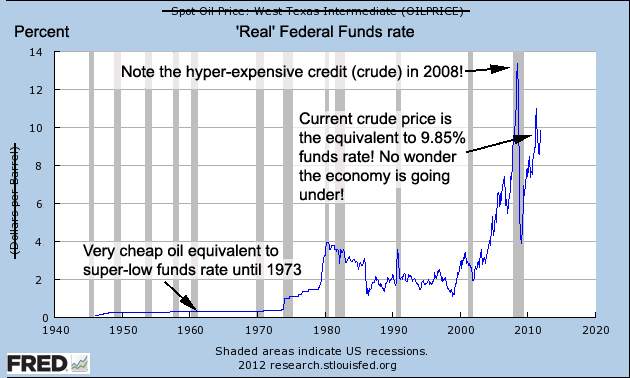
Figure 1: Here is your real f**king interest rate, Baby! The price of oil is ‘altered’ so that it represents Federal Reserve funds rate instead of dollars per barrel. The price of crude has the same effect on our economies as does the funds rate. Current fuel price (WTI spot) is equivalent to 9.85% funds rate. It is hardly surprising that the eurozone, China, Japan, the US and other countries are in difficulty due to the high ‘interest-like rate’ implicit in crude oil price.
It is realistic to add real cost of credit and the oil price equivalent cost of credit together. The current fuel equivalent of 9.85% is added to the current funds rate of 0.10% = 9.95%. Even with world credit rates at the zero-bound the fuel equivalent cost is nearly 10%, horrors for ‘must waste or die’ industrial enterprises. In 2005 the funds rate was 5.5%. The fuel equivalent 6.5% + 5.5% equals a total interest-like cost to industry of 12%! Here is the reason why the US mortgage racket leapt into the toilet. Interest-like costs did not improve with the passage of time, either. The oil price equivalent of the funds rate in June of 2008 was over 13% even though the funds rate was near zero!
Credit worthiness increases the hazards to industry as expansion of credit tends to push fuel bids higher, increasing the credit-like costs to industries across the board.
Other Ideas on Industry and Credit.
Industrialization is the way by which we humans live beyond our means. Ours is the ‘Moderne’ world of waste: we live beyond our energy and resource means as well as beyond the all-important credit means. Industry and ‘progress’ represent the sanctification of the ‘living beyond’ concept, its rationalization as virtuous, as being necessary without possible alternatives. When a politician, economist or other big shot is in the media spouting about ‘growth’ of progress he or she is asserting a ‘natural right’ for listeners (and themselves) to live beyond present means … and that doing so is a very good thing.
We either waste prolifically or wind up living in caves.
The get rich or die trying approach: we waste prolifically, we multiply ourselves our machines our livestock like rabbits or else we have a mass die-off. (We multiply ourselves like rabbits along with the rest of our junk and we will have a mass die-off as a consequence.)
The delusion of numbers approach: we waste prolifically into the future until we are ‘wealthy enough’ when we can the undo all the waste and its consequences at the super low price! Undoing waste right now will cost a lot more than undoing the waste fifty years from now. How about fifty-thousand years from now? Will anyone care about today’s gum wrapper on the sidewalk in fifty thousand years? (Will anyone be around to care about anything?)
Fifty thousand years assumes that credit ‘wealth’ is going to expand continually over that period of time. Fifty thousand years allows industry to uncover the innovation that allows industry to catch up to its promises/debts, for industry to produce a real product!
What brings matters to public attention is that credit is not expanding but is actually shrinking. At the rate we are going, in five years we won’t have any credit at all.
The enterprises that make up industrialization are bits of stagecraft that rationalize the steady increase in credit, which in turn is the primary product of these enterprises. Outside of credit, industries’ ‘goods’ are imaginary, destructive or fetish- manifestations of waste.
The word itself ‘production’ is also false. Industry is not productive but reductive. It concentrates from the many to the few at the point of a pencil. There is no industrial output where it did not exist prior, instead there is the cannibalization of existing distributed output. The cloth factories of 18th century England did not create a product ‘out of thin air’ but concentrated the cloth output of the entire country into the hands of those few who had access to credit. Credit gave the favored industrialists the ability to fill factories with labor (skill) annihilating machines. Possession of the machines and the ‘production’ these represented gave owners access to still more credit in a so-called virtuous cycle.
The i-Pod did not create its own market from nothing but devoured the market that belonged to Sony’s Walkman and other music players that in turn digested the market segment that belonged to transistor- and portable radios. Before radios, the ‘market’ carried banjos and saxophones from house to house, the people made their own music on their own terms for their own pleasure and sense of creative necessity. What the iPod has done is contribute in the annihilation of music making as a vital community endeavor. Music has become a canned good. Where there were once Ernest Tubbs and John Coltranes and Woody Guthries across the country adding value to people’s lives from sea to shining sea there is now noise.
Industrial economies destroy value. This is their purpose, there is no other.
With the passage of time and access to credit, the machines of Merrie Old England and the American hinterland became irrelevant. Credit was able to multiply itself. The product of the credit factory was replacement debt pyramided onto legacy variety without the picayune concerns of output. The 21st economy has become a credit broker or ‘fixer’ with output put ‘under contract’ at (usurious) rates that benefit the broker.
From here it is a small step to economies being made up of criminal organizations.
Without the smoke-belching factories or child-slaves chained to machines in rows the banks, businesses, retail, real estate, educational and services follow the industrial model, that is they manifest economies of scale. This is what industry is and does: manifestation of economies of scale with the intention to access/generate increasing amounts of credit. All other claims on the part of industry are false.
Credit is looting from the future, our children cannot deny us loans. Because the future is worth more than the present (or it wouldn’t be borrowed from) the present is rendered ‘worth less’ by the exercise of the credit instrument. What this means is there is no economic justification for industrialization as its credit-product is ongoing- or present worthlessness.
The ‘Big Lie’ at the core of modern economics emerging from the mouths of practically every policy maker and economist is that industry is productive, but is constrained by defective and excessive debts. This premise is false: industry exists only for the purpose of generating defective and excessive debts. These are the sole means by which industry and industrialists profit. Debt = Wealth: without the endless expansion of universal credit there are no profits to be had. That industrial goods are worthless is self-evident: if they were worth something they would pay for themselves by way of their use!
Industrialization facilitates the substitution of credit-money ‘goods’ for value which is destroyed by way of the process of substitution.
Substitute value is where the idea of the thing has greater appeal than the thing itself. Substitute value requires users to crave goods that become tiresome the instant they are obtained, leading to an endless chase for a potential good that can actually provide the promised satisfaction.
Advertising is manufactured dissatisfaction, it’s the central activity of commerce. The ordinary condition for humans is to be content, to satisfy themselves on their own terms. Industries substitute the satisfying their own needs for those of the individual or the community: the customer is always wrong. As industrial worth ascends, individual and community values vanish. What measures these values is the credit instrument that is the mechanism by which the values are destroyed.
Industrial economies cannot survive unless people are constantly buying ‘goods’ they do not need. Right now industrial economies cannot survive repriced inputs that do not allow profits and diminish collateral values of companies.The way to unravel industrial economies is to ban advertising or permit freedom from it.
Industrial economies destroy value, in the process they monopolize the production of substitute values. Our crisis is taking place because our economies have run out of easy values to destroy, they have been too successful. Economies have turned on themselves leaving a vacuum. A good example of false value are the thousands of apartment and office buildings containing millions of apartments standing empty in China. These do not exist for any purpose other than to destroy prior claims on ancestral lands that would be visible if the original buildings were allowed to stand … and as instruments to steal money of ‘investors’.
Credit is the invention necessary to industrial development, not innovation nor comic-book ‘progress’. Chained to the expansion of credit as its sole good, industrial enterprises are as ‘innovative’ as Shakespeare’s usurious moneylender hunting relentlessly for his pound of flesh. Money-profits flow to the creditor while costs are shifted to the community in the form of lost purchasing power. This becomes the property of the enterprise and is rented back to community members in the form of purchase-money credit at Shylocking rates of return.
Credit that is independent of foreign exchange constraints is the pre-condition for ‘progress’ in developing countries rather than resources, cheap labor, innovations or physical infrastructure. Without natively available credit and robust credit transmission regimes, resources become the property of outside interests. In any event the workers in all of the countries become either slaves or are ‘dis-employed’.
Inputs are currently being repriced by markets to represent value rather than credit-driven worth. Even as fuel prices decline from bubble levels they are high and increasing relative to customers’ diminished ability to pay. (TFC Charts, click on for big):
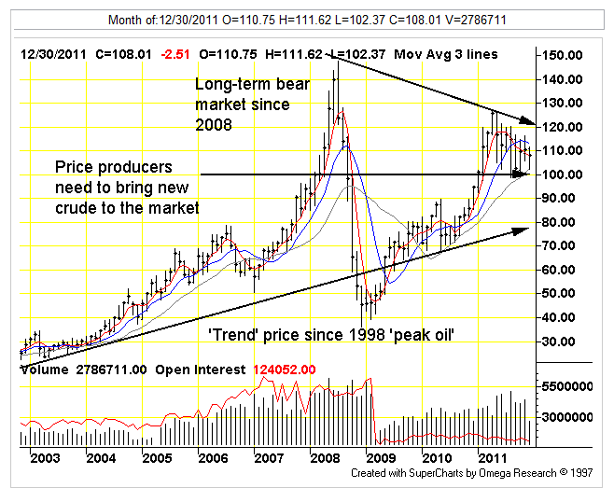
Figure 2: Where is the credit? Prices are steadily declining even with saber rattling in the Middle East between Israel, Iran and the United States. The amount Iran earns from sale of its oil is diminishing relative to what it costs to bring the oil to the market.
Industrial credit supports higher crude prices. The ‘cash price’ for crude oil is much less than the current credit price. What is that cash price? Is it $20 per barrel or $10? We are soon to find out!
Peak oil means declining prices across the board. Not just for oil but for real estate, declining tax revenues for governments, declining immediate- and deferred wages, diminishing credit creation. Credit erodes because the marginally remunerative industrial enterprises become non-performing with higher fuel costs. Extension of credit to impaired firms cannot be justified.
Enterprises are no more productive with $120 oil than they are with the $20 variety. The ‘fuel tax’ falls directly on output which is credit. The outcome is onrushing insolvency which is underway everywhere fuel is consumed.
Insolvency prevents the enterprises from taking advantage of diminished fuel prices when they finally occur. Prices are low because fuel users are defunct, demand is collapsed. There is a price level for crude the economy cannot bear. In 2008 this price was $140 and above. In 2011 the ‘price too far’ was $128. What is the price too far today? Chances are it is $110. The world’s diminished ability to pay high prices is due to the onrushing bankruptcy of its wasting enterprises.
The trend of diminishing credit is impossible to miss. At some point there will be none. The price will be low because the world will be destitute. This is happening now
– There is an ongoing bear market in crude since 2008. There is a short-term bear market that is ongoing since the beginning of 2011. Markets including the ones for crude oil are manipulated but a trend is a trend.
– The secular bull trend that began in 1999 with crude selling for $20 per barrel is credit dependent. There are two factors in the crude market: the oil and what is exchanged for it. The high price of crude is supported by credit both in and out of asset markets. High crude prices undermine credit, this is observable.
– Here is a case of ‘too much of a ‘good’ thing’. Too much credit and not enough oil pushed the oil price too high starting in 2004. Reaction to the high price has damaged credit formation. Unsurprisingly, the world’s finance insolvents are also energy insolvents, unable to support their own consumption out of their own production (of fuel or otherwise).
– Oil prices are too low for producers but still too high for users to ‘grow’. The result is credit shrinkage. For industries NOT to produce credit means that something is seriously wrong: NOT just excess inventories or too-high interest rates.
– Agents have had FIVE YEARS since crisis began to corral inventories, real interest rates (inflation adjusted) in industrial economies are LOW to NEGATIVE.
– Too high crude price means ‘buyers’ strikes’ in tract housing, autos, commercial real estate, highway/infrastructure construction sectors along with general credit revulsion. Without new credit to service/monetize the old, deleveraging is underway. Diminishing credit means less support for high asset prices. Ability to afford is declining faster than prices. This is also observable: job losses, increases in poverty, food stamps usage, business failures. Fuel prices for the moment are stickier than discretionary income.
– Crude market prices are declining toward the cost of production which is increasing at the same time for various reasons including social expenses/inflation inside producers along with difficult drilling environments. As prices fall below production cost the outcome will be shortages. THESE SHORTAGES will further effect industrial output and SHRINK CREDIT rather than force prices higher. Remember, it is credit that supports high prices.
– Shutting in production — creating artificial scarcity — will fail to push prices because this does not create more credit… The only way to lift prices is to add credit to markets. The only way for producers to meet quantitative money income goals will be to pump into shrinking markets pushing prices even lower. This will likely have little effect as the credit transmission structures are destroyed. Should the EU break up for example — an outcome caused by high crude prices — lower crude prices will not put the EU back together.
– Currently, access to crude is ‘rationed’ by access to credit. When credit ceases to ration fuel it will be rationed by physical availability. Before there are super-low crude prices are more likely to be shortages.
– At some point there will be little available credit and oil prices will be very low. At the same time these low prices will be unaffordable to those who have no money, no job(s) no car or house or any other means to waste fuel.
– What is taking place right now in Europe is the road map for the rest of the world including China to follow: insolvent countries will see credit vanish and they de-industrialize. These countries — right now Greece, Portugal, Ireland and soon Spain and Italy — will become car-free. Fuel will only be available on black markets for $50 per gallon … cash only.
– Peak oil ONLY exists in the context of automobile use/waste. Get rid of the cars along with other oil-waste infrastructure and peak oil disappears. There is enough oil in the world right now for 1 million years of WD-40 consumption. Cars are a convenience/luxury not a necessity.
Fuel shortages are likely later this year. The cost/production dynamic is inflexible it relates to EROI and credit availability. Shortages caused by inability to afford crude will be permanent.
Fuel price declines will also accompany dollar preference, hyperinflation in producer countries, loss of currency autonomy and collapsing domestic fuel demand in producer countries. ‘Net Export’ will cease to be an issue as producers will not be able to afford the means of consumption.