Different This Time …


The North Dakota Department of Mineral Resources made a presentation to native peoples’ tribal leaders in the state last fall regarding oil and gas production in the Bakken area, (PDF alert). It’s a comprehensive report and worth the time to examine it. This jumped out:
 
Bakken 020913
 

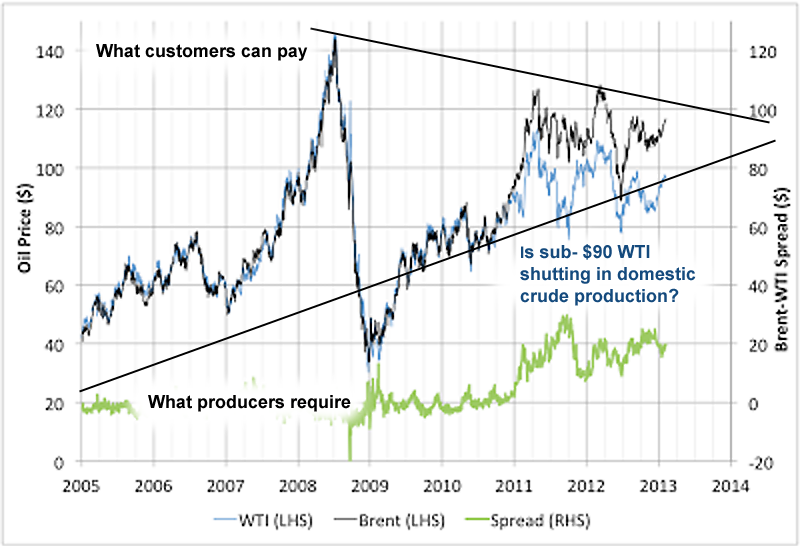
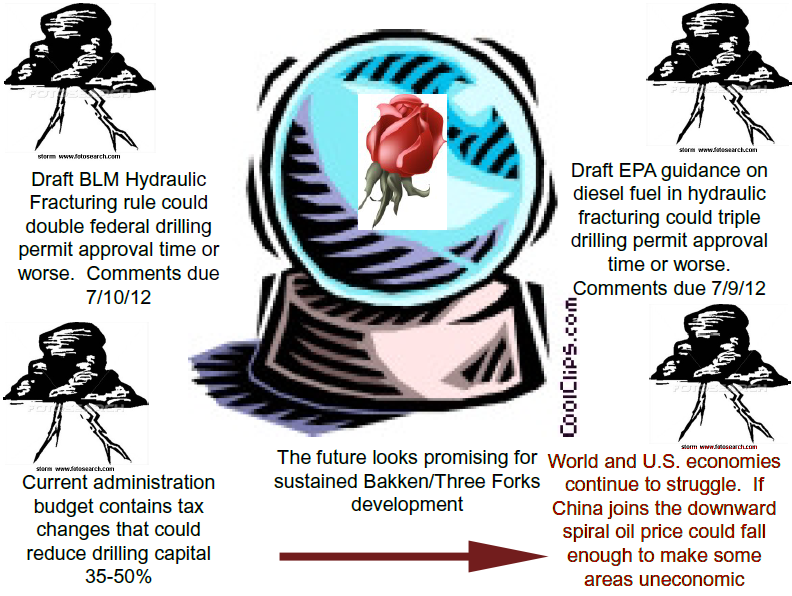
Figure 1: “Oil price could fall enough to make some areas uneconomic” (click on for big). At issue is whether prices in certain areas of the US are low enough to shut in marginal production already.
 
Triangle of Doom 020813
 

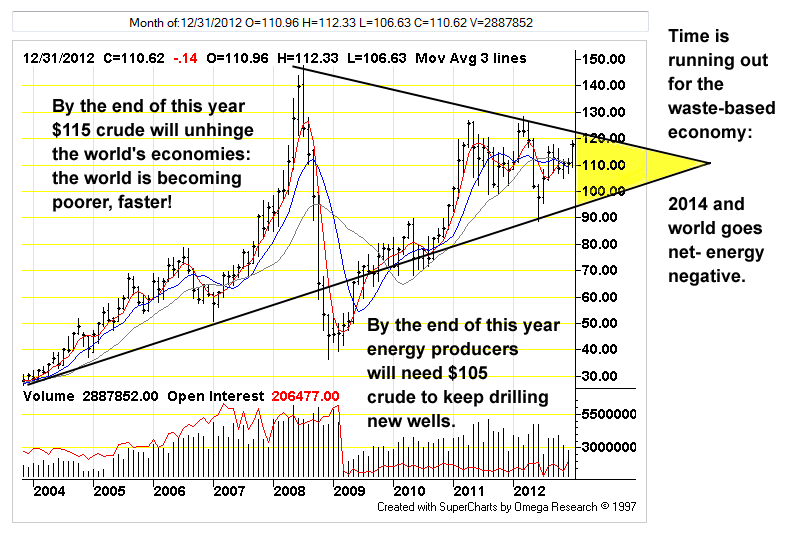
Figure 2: the cost of Brent crude vs. the ability of crude customers to pay for it made graphic, from TFC Charts. What the chart can’t say is that the industrial world is impoverished by the high cost of crude in a vicious cycle. What it also doesn’t show is that real fuel prices will increase relative to other costs, even when nominal prices decline. Funds must be diverted toward obtaining fuel away from the purchase of non-fuel goods and services. When the drillers gain credit the customers are deprived of it … the alternative is less fuel.

Little has changed over the past two weeks except that Brent prices are a little higher due to war fears in the Middle East, moral hazard by central banks and nonsense bullish frenzy that has overtaken asset speculators. Right now, customers are borrowing at the expense of drillers. If the prices climb high enough, listen for ugly noises from the euro-zone or Japan as the higher prices bite hard … and businesses (banks) start to fail. That will be the end of the bullishness.

Keep in mind if the economy starts deleveraging (again), there is little the establishment and central banks can do but stand aside and wring their hands. Everything has been committed already: interest rates are at near zero, governments are at the borrowing limit, there is little in the way of collateral remaining for central banks to take on as security for new loans.

Speculators don’t realize conditions are fundamentally different this time … nations, regions, individuals and firms have experienced temporary shortages of fuel, credit and other resources in the past due to wars, droughts and other disruptions: the world in its entirety has never run out of energy before, which is what is underway right now.

Bloomberg:

Commodity Units Price Change % Change Contract Time(ET)
Crude Oil (WTI) USD/bbl. 95.72 -0.11 -0.11% Mar 13 17:15:00
Crude Oil (Brent) USD/bbl. 118.90 +1.66 +1.42% Mar 13 18:00:00
RBOB Gasoline USd/gal. 305.88 +5.89 +1.96% Mar 13 17:15:00

Is $118 the new $147? Here is another look from Stuart Staniford:
 
CLW 020613
 

Figure 3: Brent and WTI performing together on the same stage (click on for big). The lower West Texas Intermediate price is good for refiners who can sell products outside the Midwest at the world price. This is a burden for drillers as Bakken formation supports the most expensive, fastest depleting wells on Earth. Landlocked wells put the squeeze on drillers: if the Bakken oil field was near the Gulf coast, drillers could sell their crude at the Brent price, putting the squeeze on refiners instead.

– Drillers have to keep pace with depletion in the Bakken and similar tight fields so large numbers of wells have to be drilled continuously.

– Drillers also have to keep pace with depletion in conventional formations which is occurring at a rate + 4% per year.

– Drillers in the US face an inhospitable environment: oil-field labor shortages, skeptical regulators, anti-fracking activists and the price squeeze.

Rune Likvern (Oil Drum) called keeping up with Bakken depletion rates ‘Running With the Red Queen’ Drillers need to punch holes in the ground at ever-increasing rates just to maintain current rates of output. Any slacking in efforts and flows of product decline sharply, says Likvern:


In reality, it was the growth in the oil price to an apparent structurally higher level that secured commercial support for crude oil production from shales. In that respect it was the oil price that was the true game changer and unleashed the “shale/tight oil revolution”. There is a saying that goes like; “Do not listen to what they say (technology). Look at what they are doing! (spending borrowed money)”. This may as well go for the Bakken formation.

The oil service giant Baker Hughes recently expressed concerns about slowing activity levels in shale plays if oil prices moved below $80/Bbl. Further the oil companies Marathon and Occidental recently cut back on their activities in the Bakken formation. Oil and gas companies still care about the colors of the numbers at the bottom line for their projects.


How landlocked is the Bakken crude? Most of the product is shipped by truck to pipeline terminals and railheads, (from the Mineral Resources presentation):
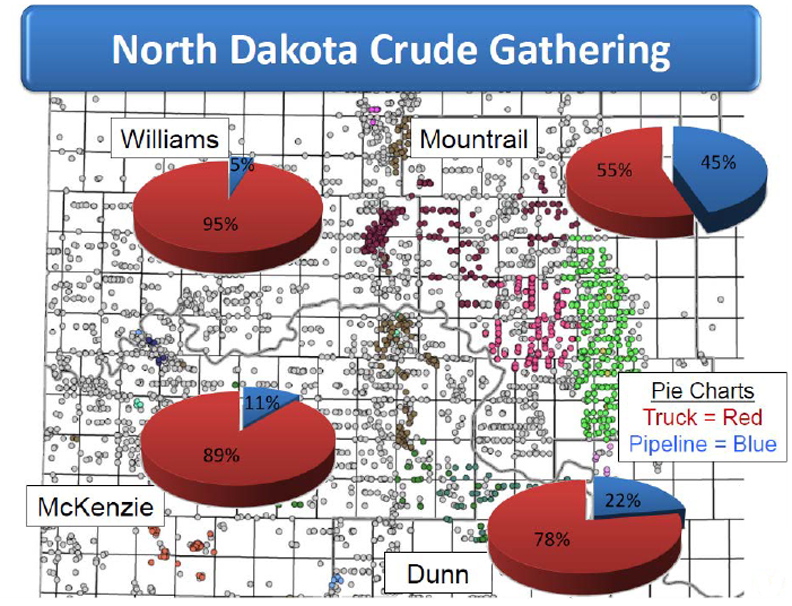
 
Bakken 021013
 

Figure 4: Running with the Ace of Spades: by the time the transportation mess is straightened out the Bakken fields will be depleted.

Coastal refiners must pay world prices for crude while selling high cost products. As a result of the squeeze, coastal refiners are going out of business. Here is a clip from Stillwater Associates:


US East Coast Refinery for Sale: Who’s Buying?

Earlier in September, Sunoco had announced plans to sell its Marcus Hook and Philadelphia, PA refineries, noting that the refineries had been profitable for only two of the last 10 quarters, and stating that both refineries would be idled in July 2012 if buyers have not been found. However, in an early November conference call with analyst, Lynn Elsenhans, Sunoco’s CEO and Chairman, stated that “…if at any point we believe it’s in the best interest of the shareholders to either stop operating (Marcus Hook and Philadelphia) or change their utilization rate, up or down, even if that’s before July, 2012, we would take the appropriate action.” Sunoco Refining and Supply reported a $17 million pretax loss for 3Q 2011, the ninth quarter out of the last 11 for which Sunoco Refining and Supply lost money.

When ConocoPhillips announced that it was seeking a buyer for the Trainer refinery, Willie Chiang, then ConocoPhillips’ Senior Vice President of Refining, Marketing, Transportation and Commercial, noted that their decision to sell, like Sunoco’s, was based on unfavorable economics caused by a competitive and difficult market environment characterized by “…product imports, weakness in motor fuel demand, and costly regulatory requirements.”

So, who will buy these refineries?

Valero has been mentioned by some as a possible buyer, but Valero exited the refining business on the US East Coast when it sold its Paulsboro, NJ and Delaware City, DE refineries in 2010. Valero has said it plans to move gasoline from its recently acquired Pembroke, UK refinery, which can process heavier sour crude, to the US East Coast.


Keep in mind, the transport bottleneck is the reason for so much gas flaring in tight oil formations. Gas does not command a price high enough to support a crash program to build out distribution infrastructure. Meanwhile, enough gas to heat a big city like Minneapolis is wasted.

Keith Schaefer @ Oil and Gas Investment Bulletin says:


A vertical well into a conventional oil field costs something like $1 million. The Bakken’s horizontal, multi-stage frack wells cost an average of $9 million, according to the North Dakota Department of Mineral Resources.

That’s a huge upfront cost. Each well produces approximately 615,000 barrels of oil, meaning the breakeven price for each Bakken well ends up in the $70-$90/barrel range, once taxes, royalties, and expenses are included. If oil prices slump below that level, a lot of people say Bakken wells aren’t worth the cost.


A lot of people like grade school arithmetic teachers. Because businesses cannot lose money perpetually, low prices keep crude in the ground … conservation by other means.


As the wells in the Bakken grow closer together, initial production rates are sliding. According to some sets of data, average first year well output climbed steadily from 2005 to a peak in mid-2010, then declined almost 25% over the following 12 months.

With more wells tapping into the same resources, there is simply less oil pressure available to each well. And when initial well output starts to fall, an accelerating number of new wells must be brought online to sustain overall production volumes.

Such is the heart of the pessimist argument: that sliding initial flow rates will tag-team with the Bakken’s high decline rates to mean that, no matter how many new wells are drilled, production will stagnate.


One thing to keep in mind is when oil-bearing rock is fractured, it is turned into gravel, the stones held apart by propants: sand or ceramic grains. Once rock is fractured, it cannot be fractured a second time. Fracking is ‘one and done’.

Of course, the real problems are on the consumption side, not the production. Consumption is waste, it does not and cannot pay for itself. What does the heavy lifting is debt and lots of it. We’ve had debt around for so long we’ve gotten used to it. What we are starting to realize is the monumental costs that debts impose. Debts are too large to repay, they must be refinanced with new debts. Repayment obligations compound exponentially. We ‘fix’ debt problems by taking on new debts, falling deeper into a hole with each round of debt.

The outlines of our condition are becoming more defined, the clock is ticking … Numerian says (Economic Populist) HT Usman:


Even if another credit blow-out occurred, we all know how that would end – very badly, as in 2008 credit crisis all over again. Unfortunately, without another credit splurge the results are the same. When the credit stops flowing, income is hit hard, because most of the growth in income in the economy is produced by debt, and it is not organic growth that would result from a normal recovery generated through capital investment, wage and benefit increases, revenue advances, and expanded global trade. This is precisely what the Fed understands, and why it is expanding its balance sheet ceaselessly, and enabling the Congress and Administration to build up debt at the tune of a trillion dollars a year. All this credit is the lifeblood of the economy, allowing the government to make Social Security and Medicare/Medicaid payments, feed 48 million people through food stamps, fight wars in multiple hot spots around the world, pay interest on the debt to keep bondholders happy, and shift unemployment money to the states.

The problem for the Fed is that the unraveling is already beginning. The stock market may be testing its highs, and 50 out of 50 economists may be anticipating a solid economic recovery, but without new sources of credit that is going to be impossible to achieve. Credit has already dried up in the real economy, which is why you hear so many retailers say “nobody has any money” …


“Nobody has any money …” should be familiar: What the charts can’t say is that the industrial world is impoverished by the high cost of crude in a vicious cycle.

When credit stops flowing, income is hit hard because ALL of the growth in income in the economy is produced by debt … without it there is no industry!

What we are experiencing are two interrelated phenomena: an energy shortage due to our wonderful economic ‘success’ over a period of 400 years and the consequences of exponential growth of loans needed to ‘buy’ this success..

Debt is taken on to capitalize industries and their customers. More debt is taken on later to fill the pockets of the industrialists and roll over the first rounds of debt. Finally, debt is taken on the service the previous rounds and nothing more, the economy is saturated with debt.

The first round of debt gains the industrialist tools to produce goods and provides customers with purchasing power. The second round gives the industrialist his fortune and repays the venture capitalist: during this round fewer tools are gained and less in the way of goods are produced. The third round pays the moneylenders’ interest and nothing more, customers and industries are bankrupted by their debts.which are unproductive. Eventually, the moneylenders also fail.

‘Moneylenders’ here must also include the central banks.

Our economy is in the third stage and has been here for awhile, perhaps since 1980 and the ‘Reagan Revolution’.

Added to this is the ongoing shortage of liquid fuels which results in higher prices which must be met with debt. The cost of new fuel rises past what customers can borrow using fuel waste … as collateral. Waste of the fuel does not provide an organic return so all returns must be borrowed adding to the demand for debt… during a period when productivity of debt is diminished.

More about central bank-n-market head-fakery and wishful thinking, (Naked Capitalism):


Is the Euro Crisis Over?

By Robert Guttmann, Professor of Economics at Hofstra University and a visiting Professor at University of Paris, Nord. Cross posted from Triple Crisis.

A strange calm has settled over Europe. Following Mr. Draghi’s July 2012 promise “to do whatever it takes” to save the euro, which the head of the European Central Bank followed shortly thereafter with a new program of potentially unlimited bond buying known as “outright monetary transactions,” the market panic evaporated. Since then super-high bond yields have come down to more reasonable levels, allowing fiscally and financially stressed debtor countries in the euro-zone to (re)finance their public-sector borrowing needs a lot more easily than before. Even Greece has been able to borrow in the single-digits for the first time in three years.

This calming of once-panicky debt markets has led to optimistic assessments that the worst of the crisis has passed. Draghi himself declared at the beginning of the new year that the euro-zone economy would start recovering during the second half of 2013. He talked of a “positive contagion” taking root whereby the mutually reinforcing combination of falling bond yields, rising stock markets and historically low volatility would set the positive market environment for a resumption of economic growth across the euro zone. Christine Lagarde, as the head of the IMF part of the “troika” (i.e. ECB, IMF, and European Commission) managing the euro-zone crisis, declared at the World Economic Forum in Davos a few weeks ago that collapse had been avoided, making 2013 a “make-or-break year.”


Here is conventional economic analysis that never gets around to mentioning energy.


– A strange calm has settled over Europe … following Mr. Draghi’s July 2012 promise “to do whatever it takes” to save the euro,


Draghi didn’t actually do anything, he talked about it.


– the market panic evaporated.


That’s an assumption. The more likely is credit strangulation eased a bit.


– This calming of once-panicky debt markets has led to optimistic assessments that the worst of the crisis has passed.


Not by a long shot, the crisis is the cost of energy and the inability of the Europeans to earn anything by wasting it.


– we can see that Ireland, Spain, Portugal or even Greece have been able to lower their current-account deficits substantially,


Automobile sales in these countries along with France have collapsed, petroleum use has significantly declined. Consequently, there is less fuel being imported by these countries. Keep in mind, their fuel use will decline to zero if they do not effect conservation measures. What is underway is not a rehearsal, it is the effects of entropy being felt along with diminishing supply of fuel overall. Fuel is being rationed, conservation by other means.


– renewed turmoil in the sovereign-bond markets will be just a matter of time. Most troubling in this context is the doom-loop dynamic of persistent fiscal austerity across the continent.


Withholding credit is a way to compel the export of European fuel consumption to credit issuers such as the US. Any fuel not burned in Italy or Spain is available to be burned in Los Angeles. America’s energy ‘surplus’ is by way of theft from Europe and elsewhere, not fracking. The problem with the professor is he is not cynical enough!


– This dialectic centers above all on the euro’s trade-adjusted exchange rate.


Not in the sense that the professor implies: the more deflation-priced euro gives those who hold it the means to buy fuel at a bit of a discount … and an incentive to keep the euro. Any replacement currency would be depreciated violently, there would be small likelihood of any petroleum exporter accepting any replacement currency other than d-marks.


– will undermine the competitiveness of the euro-zone’s economies,


The assumption is that countries like Greece or Portugal are industrial countries with factories filled with overpaid proletarian workers like China. Instead, they are senior centers filled with retirees. Peoples’ pensions are being looted, this is called ‘competitiveness’, stealing on a grand scale is what is showing up on the ‘stats’.


– But the euro-zone cannot afford this stop-go pattern of policy-making in the face of a systemic crisis. It will have to undertake far-reaching reform on several fronts beyond what Europe’s leading politicians have been willing to entertain.


Europe is being de-carred by pauperizing the populations. The necessary reform is for governments to take charge of this dynamic and decar the continent on purpose while sparing the citizens. Europe can stand to jettison its useless cars and the fuel waste these things represent. It is the waste that has undermined the European — and world — economies, not trivial real interest rate movements or currency exchange rates. These last are abstractions, petroleum waste is permanent: when the fuel is gone baby, it’s gone, forever.

63 thoughts on “Different This Time …

  1. From Maria van der Hoeven @ Financial Times discussing the ‘depressed’ price of crude in the US midsection:

    But market realities suggest a far simpler decision ahead: either US crude is shipped abroad or it stays in the ground.

    Meanwhile, US gains crude from abroad by depriving overseas customers credit … ‘abroad’ is more broke than the US!

    How does it play out? In the ironic universe, the outcome that causes the greatest misery for the greatest number is the most likely.

  2. The U.S. is getting de -carred as well.I have some marginalized friends i.e. one is on disability and the other is an aging working girl.I have noticed that first they couldnt afford dental care….then their old cars needed repair…..so they lost teeth and transportation.

    • Everything is done the cruelest way possible, pauperizing the people who can least afford it.

      Meanwhile … more official denial and specious ‘hope’ as if nonsense is an antidote to a physical process.

  3. Your chart suggests endgame is around 2015-2016, not 2014. This may be nitpicking but I think it’s useful to be more accurate.

    Having said that I’m not convinced that it means all that much…most likely more depression and financial collapse, this time one that cannot be papered over. If we waste fuel, it stands to reason that we could not waste it, but this would be a big change.

  4. Pahhhty is OVER in the Real World.

    Pahhhty on the Diner takes off next week on the 1 Year Anniversary of the Diner. Now at 11K Page Hits/Day!

    Thanks to Steve for allowing cross posting of EU Blogs on the Diner. We are Inaugurating also a Diner Webzine which will have Monthly compilations of posting, Featuring the articles of the most active Diner Bloggers and Commenters.

    Keep up the Good Work Steve, your Macro Econ is the best on the net! Not that I agree with everything of course…lol.

    RE

    • Yr flattering me, RE. What are you going to do with your week?

      ” … your Macro Econ is the best on the net! Not that I agree with everything of course …”

      Debate is important to illuminate the dark corners, nobody has a monopoly on certainty, I don’t.

      • I’m going to send an email to all the Bloggers I cross posted inviting them to drop in at the Diner and contribute to a cross-disciplinary debate on Collapse topics in a special Anniversary Round Table thread. I’ll attach a copy of the first Diner Webzine also.

        We’ll also hold an Anniversary Concert, where Diners and Guests also can put up their favorite Music Videos. Both threads will be on a special Anniversary Board which will be open to the public for both reading and posting during the Anniversary Week.

        I’ll be online even more than usual to Host the Event in my best Johnny Carson impression. :)

        We are 6 days in a row with 10K+/day Page Hits! Mish territory! Readership Dude! Be there, or Be Square!

        RE

    • PAHHTY is ON over on the Diner!

      This is a completely Off Topic post, I just stopped by to invite old EU friends to the 1 Year Anniversary Party we are holding on the Diner. We have an Anniversary Concert underway and a RoundTable chat open to Guests as well as Diners for posting.

      http://www.doomsteaddiner.org/forum/index.php?board=44.0

      We also Innauguarated a Diner Webzine which features articles from Diner Bloggers on a Monthly basis The first 2 issues are now UP on ScribD.

      http://www.scribd.com/doc/125954476/Doomstead-Diner-Feb-2012

      http://www.scribd.com/doc/125954666/Doomstead-Diner-Mar-2012

      Drop in and say Hi!

      RE

  5. Its official !!!!

    Record trade deficit for silver in the UK for 2012 (proxy for gold imports ?)
    £ millions

    Y2008 : + 1,169
    Y2009 : – 1,560
    Y2010 : – 108
    Y2011 : – 451
    Y2012 : – 4,786 !!! Massive

    It does much to explain the rise in the goods deficit excluding oil relative to 2011

    Trade deficit in goods excluding oil
    Y2008 : -87,581
    Y2009 : -79,415
    Y2010 : -93,790
    Y2011 : – 88,719
    Y2012 : -92,232

    Trade deficit in oil
    Y2003 : +3,386

    Y2008 : – 6,501
    Y2009 : – 3,426
    Y2010 : – 4,719
    Y2011 : – 11,509
    Y2012 : – 14 ,382

    The trade deficit in road vehicles has been cut over the years
    But more as a result of export from the UK after devaluation rather then declining vehicle imports
    Trade Balance vehicles
    Y2007 : -15,499 (peak)
    Y2008 : – 11,434
    Y2009 : – 9,156
    Y2010 : – 10,291
    Y2011 : – 9,359
    Y2012 : – 7,691

    UK road vehicle imports
    Y2007 : 36,580
    Y2008 : 33,916
    Y2009 : 26,185
    Y2010 : 33,664
    Y2011 : 36,779
    Y2012 : 36,638

    So at least in Sterling terms UK car imports remain at Y2007 levels ~

    The UK is the key to understanding Europe’s problems.
    The big bang of the early 80s was directly related to the destruction of UK industry / creation of the Euro and the subsequent export of North Sea oil to the PIIGS so as to earn a higher external income return from the subsequent Grot production.

  6. http://trueeconomics.blogspot.ie/2013/02/1032013-new-car-sales-back-to-future-of.html

    “Not a pretty sight. Current levels of All Vehicles new registrations are running at the levels of 1994, below 1989-1991 and below the levels of 1978-1981″

    The author fails to realize that both the 1978 -81 & 1989 -1991 periods are Ireland were major credit boom / bust events.
    First in the agri sector and the later where huge amounts of credit first flowed to the upper middle class until the Gulf war / first EMU crisis.
    This money leaked into new car sale indirectly during the 70s and more directly after 1987~
    Willing to put money down that the new car regs for Ireland will reach 1957 (Suez crisis) levels in the year of our Lord 2014. (20 – 30 thousand)

  7. I first became economically aware back in the summer of 1990.

    The News of the previous few years was one of fiscal austerity…… closing hospitals and stuff.
    Something must be done to get our house in order , right ?

    But a summer spent down in Glandore (West Cork) had be completely stumped.

    All of the local Lilliputian Cork elite were driving around in Mercs & Volvos .

    Something was just not right…………there was a glut of resources and yet…….

    The first stirrings of the post 1957 volks boom down in West Cork. 1962 ~

    http://www.youtube.com/watch?v=Q7sM3h7X4DA

    New Private cars
    1955 : 23,675
    1957 : 13,589 first oil crisis , but for who ?
    1962 : 31,931
    1978 : 105,582
    1984 : 55,893 post 1970s boom / bust / euro entry deflation crisis
    1990 : 83,420
    1993 : 60 ,792 EMU crisis
    2000 : 225,269 euro rapture / euphoria, all time high.
    Full embrace of all that is modern and good…………………..

    2009 : 54,432 CRASH

    2011: 86 ,932 recovery ?
    2012 : 76,256 severe weakness

    2013 : BIGGER CRASH THEN 2009 ?
    2014 : SUEZ ?

  8. The Industrial boom in the city of Cork in the early 1970s

    http://www.youtube.com/watch?v=dZ1unzW0S7M

    We were much like a mini Turkey of the time……….benefiting from deflation / wage arbitrage industrial growth coming out of the core.

    Looking back now ………whats striking is how pointless everything was in the end.

    The one benefit of that time is that workers spent more in the pub then on house extensions and furniture.
    Recycled Stout flowed out of the harbour to feed the local fishing industry.

    • Upriver Cork looked to be a pretty town in the 70′s, with a lively street scene and many places for people to enjoy themselves.

      The waterfront was a failure, a park for tycoons’ schemes/toys. It all comes across like Taiwan or some mainland Chinese city.

      • Yes , the 70s were good for Cork.
        With Dockers spending all of their money in strange & rough early morning pubs.
        The lower middle class had work in the various factories and stuff

        The early / mid 80s was a total industrial disaster ………..most of real physical damage was of course done post 1987 and the credit hyperinflation.

        The lower harbour on both sides is a suburban wasteland now.

        The compact between the hills / between the rivers nature of Cork is therefore lost now.

        http://www.youtube.com/watch?v=MfP1v2j2Ve8

        The pubs are still good on a friday night
        You just avoid that tinseltown stuff if you can.

  9. 8mm observations of the late 70s inflationary culture

    This time in this much more complex London hothouse.

    What was really happening underneath the bonnet ?

    http://www.youtube.com/watch?v=gxoymq-uah0

    (Interactions between market towns / provincial cities & Capital conurbations have always fascinated me)

    Country girl goes to the big smoke………………….
    She gets vapourized.
    She cannot come home.
    As home & hearth no longer exists.

    Built overcapacity applies to the human brain as much as Gas infrastructure that no longer has any gas to process.

    Stranded people are everywhere now.

  10. Pingback: Different this time… | Doomstead Diner

  11. Pingback: Different This Time … | Fifth Estate

    • Egypt does have some natural gas production (they ship gas to Israel) so that trade could be ended and gas used to provide basic heating-cooking-fertilizing services to Egyptians at cost.

      The rest of Egyptian nonsense is support for the cars and the associated cars vs. humans conflict as in the US and elsewhere. Solar cookers would be too smart (and would certainly work very well in Egypt).

      So smart it’s not likely to happen …

      • There were so many links to studies and designs for solar cookers in Egypt I didn’t bother posting them. BTW, I can tell you my Sun Oven is only useful during cloudless summer days here in VA. Getting that sucker up to baking temperature under a cumulus cloud or during the shoulder seasons is a challenge!

        Not likely to happen indeed; another reminder that solutions are not coming from government. You either have the foresight to start down the road of personal resilience or you’ll stand in line hoping they don’t run out of ___ before you get to the counter.

  12. This could be a European Potemkin village

    or the new French economy (built on Greek capital flight ?) ………who really knows.

    The almost complete Nantes – Chateaubrient light railway line closed in 1980 (200 million +) seen is a series of panoramique photos.

    http://www.vjoncheray.fr/panoramique/exemple/rff/vr/virtualtour1.html

    Building on abandoned 19th century railways is the low hanging fruit in my opinion.

    This could be the first light railway to replace the inter station bus service of the post 1970s France

    Then again perhaps not.

    Anyhow follow the new / old line to get a sense of place and energy dynamics ………..

    The Market town is the bedrock of civilization………

    If that falls all the other urban bricks fall with it.

    Anyhow these are very capital intensive operations……..

    http://www.nantes-chateaubriant.paysdelaloire.fr/news/actualite-detaille

    France will have to abandon the car to rebuilt its old lines or else perhaps crush the PIigs even more.

      • Roughly 20% of Japan’s refining capacity was shut in following their tsunami. Remember what happened next to Japanese GDP?

        If the news report is accurate I’m not sure why they are expecting a different result. If the goal is a specific inflation target, shutting in refineries will have the exact opposite result.

        If behind the scenes they actually see the writing on the wall, and the unstated goal of this is forced conservation, then: *golf clap*… but it is far too late for an easy letdown; all western economies should have been starting such measures decades prior.

        • “I’m not sure why they are expecting a different result.”

          We could say this about fiscal austerity in the EU as well. ‘Are they nuts or are they doing this on purpose?’ At least in the EU, it appears to be the latter. No access to credit = exportable gasoline for consumption elsewhere.

          PM Abe went to the KSA in 2007. Perhaps he got some very bad news while he was there?

  13. http://www.marketwatch.com/Story/story/print?guid=FCF0389A-7149-11E2-A22F-002128040CF6

    Certainly will be different this time when central banks the world over have no policy maneuvers left.. and are revealed to be lame ducks. What’s surprising is that they haven’t already been found out. Odds are good this’ll be the year if markets show any risk to the downside. Interesting that Chartist’s charts suggest the contrary, but this is a betting game.. The macro-market mechanism has long been broken. Just a few weeks ago, every manufacturing index under the sun was a miss, and yet we’re pushing to new highs like there’s no tomorrow… something’s afoot.

    It’s different this time, but very much similar to last time, 2008. Energy costs will (are) first dampen(-ing), then prevent(-ing), then outright impede(-ing) any attempt at a “sustainable” recovery. Wonder’s how long this charade can be kept afloat. My guess is as good as anyone else’s, but running the red queen’s race is tiring at first, and then you suffocate for a lack of breath…

    Steve’s notion of exportable demand is probably much more significant than we give it credit, and may well explain (for the most part) the renewed optimism (the last week or two) on this side of the Atlantic, given the stark European-American disconnect. But let’s not forget the macro situation here isn’t exactly roses and rainbows… Mix the hope-timism with the dissonance, and somebody’s got to end up with the short of the stick. How short… well, let’s just say you wouldn’t like to be the one holding it.

  14. Eurostat energy production and dependence rates 2008 -2011.

    http://epp.eurostat.ec.europa.eu/cache/ITY_PUBLIC/8-13022013-BP/EN/8-13022013-BP-EN.PDF

    Lithuania has gone through what appears a second post Soviet collapse with the closure of its unit 2 reactor in dec 2009.

    A 24.5 % collapse in consumption is major war stuff.

    In marked contrast Estonia has increased its consumption by 4.8%.

    It has a energy import dependence of just 11.7% has a result of its major oil shale deposits and power plants that burn this low quality fuel.

    Of course the 12.3 % drop in consumption of both Ireland & Greece is to be expected.

    My guess is that Italy will be the stand out collapse nation for 2012 as it has been Marioed for a second time.
    I would like to see its Gas consumption figures for 2012……….

    Its annualized GDP is showing all the signs of a second 2009 like collapse.

  15. Lithuania import dependence was 51.2 % in 2009
    81.8 % in 2011

    Wow !!

    Germany is in a very poor energy dependence position.
    Almost as bad as Greece.

    Greece Y2009 : 67.8 %
    Y2011 : 65.3 %

    Germany Y2009 : 61.6 %
    Y2011 : 61.1 %
    Not much of a improvement despite the much vaunted energy fetishes that Germany gets up to.
    2012 is likely to be much worse for Germanys import dependency given their Nuclear shutdown policy.
    It may indeed reach Greek levels soon !!!

    In contrast France seems much more successful for the moment (although the some factions within the socialist party wish to shut down the French nuclear programme also)

    French energy import dep.
    Y2009 : 51.3 %

    Y2011 : 48.9 %

    This is a result of the foundation like sci -fi islands it has built.
    http://www.sytral.fr/

    (on the backs of the Greeks ?) as well as falls in car consumption although before the second major almost 2009 like falls of 2012.

    Ireland however has increased its dependence despite epic falls in consumption.

    Y2009 : 88%
    Y2011 : 88.9 %

    • @ Dork:

      “Lithuania import dependence was 51.2 % in 2009
      81.8 % in 2011 …

      Wow!!”

      The Baltics were raped by the Swedes, raped by the Poles, raped by the Prussians, raped by the Nazis, raped by the Soviets and now it is the West’s turn to do the raping. It’s too early to see how events will play out in the three countries but a trade union and selective tariffs would solve a lot of problems … because the various neighbors are now too poverty stricken to invade.

      “Germany is in a very poor energy dependence position.
      Almost as bad as Greece.

      Greece Y2009 : 67.8 %
      Y2011 : 65.3 %

      Germany Y2009 : 61.6 %
      Y2011 : 61.1 %

      Not much of a improvement despite the much vaunted energy fetishes that Germany gets up to.”

      Germany also is dependent upon external sources of credit so a credit embargo forces Germany out of the EU. Not tomorrow but inevitably.

  16. The Baltics had / have very low car reg figures even during the credit boom……..

    Electricity & heat (its cold up there) therefore make up a much higher % of energy expenditure.

    http://www.airo.ie/news/new-passenger-vehicle-registrations-eu27-1991-2012

    - go to cars reg per 1000 , Germany , Ireland vs the Baltics.

    I actually worked with a girl who came from the Lithuania nuclear town.
    According to her the closure of unit 1 (unit 2 had yet to come) had devastated the town & apparently the national economy.

    OK it was a dangerous reactor but the EU never gave them the resources to built a modern PWR – given the nuclear labour expertise of the area it was a no brainer.

    They are not very politically aware people – the elite within the west just saw them as units to drive down their domestic labour costs / extraction of labour value so there was no need to invest in the region.

    I was never really impressed with the German model – its very much a creature of the Euro since 1980 and before.
    They lack that Physiocrat tap root economic background that still exists in France albeit in a limited fashion now.

    I see Germany completely imploding if the Med countries go national……..given its extreme mercantile focus.
    The problem is of course all of the med national institutions have been taken over by the high preists of the temple who see it as their ultimate goal the creation of the extreme euro market state and thus the likes of Spain must go into surplus to feed Germany also.
    Why starve yourself to feed Augustus Gloop
    I mean he was a nice kid and all but……………..Why ?

    I do not so much see debt people everywhere but I see bank lobbyists everywhere – wrapping themselves around various flags of conveniences

    http://www.fiscalcouncil.ie/about-the-council/members/

    People do not need much heat in the Med coastal towns………….if they take a siesta during those summer afternoons rather then spend money on air conditioning their productivity might go down but so what ?

    Thats a very German concept – who are they creating products for ?

    A breakup of Europe needs to orbit around a rejection of Germany
    Who they themselves are victims of banking extraction operations.
    Never NEVER become the favorite child of the banks.
    It always ends badly.

    • The Europeans have nothing to offer energy suppliers other than euros (essentially subprime mortgages) … and that certain European savoir faire!

      That little tilt to the head … 5 million barrels of oil per day right there!

      The Europeans are Madonna … “gimme the oil and I’ll let you look at my tits … tomorrow.”

      (comes tomorrow and it’s the same empty promise …)

      Eventually, the petro suppliers will see Madonna’s sock-like tits and there will be no more oil as a consequence… the suppliers will have been had.

      No euro = no petroleum, so the euro-folk are desperate to hang on even if the associated austerity costs are unbearable. The euro is a commitment not a currency. If the euro is abandoned, the implicit promise to the energy suppliers will have been broken. Nobody will trust the Europeans any more, whatever currencies they offer in the euro’s place will be spurned.

      The costs of keeping the euro are therefor less than the absence of petroleum or dependence upon black markets and hyperinflation.

      No petroleum = no cars. Horrors!

  17. Yes I have found the IEA Nov report………

    http://www.iea.org/stats/surveys/natgas.pdf

    Italy is indeed imploding (notice its gas market is /was very large)
    Almost as big as Japan in 2010.
    And pretty much of German scale.

    Gross consumption (million cubic metres)

    Y2010 : 82,983
    Y2011 : 77,832
    Y2012 : -4.6 % (Percentage change over corresponding period (beginning of year to current month) of previous year.)
    Nov 12 vs Nov 11 : -16.6 %

    Japans consumption has exploded since nuclear shutdown.
    Y2010 : 100 ,285
    Y2011 : 112,588
    Y2012 : + 11.2 %
    Nov 12 vs Nov 11 : +9.4 % :

    Korea consumption also very much up.

    Dutch consumption is also tanking at -7.7 %
    UK – 5.8 %
    Spain – 3.8 %

    Of the smaller consumers
    Finland down -13.5 %
    Greece – 9.7 %
    Hungary – 8.6%
    Portugal – 11.5 %

    Israel -36.8 % !!!!

    French & German consumption slightly up……………

  18. The entire European gas market is rolling over into the abyss.

    Gas Consumption OECD EUROPE
    Y2008 : 553,541 phony war
    Y2009 : 526 ,936 crisis ……..bombing begins
    Y2010 : 560,387 recovery ? the few bankers save the day.
    Y2011 : 515 ,617 crisis worse then 1940.
    Y2012: by November 1943 : -2.7%

  19. Testing of the new Malaga tram as seen from some island apartment block.

    http://www.youtube.com/watch?v=-rRQAn9gfrk

    Unlike France stuff in Spain does not quite fit together.

    Malaga in early Spring looks very green anyhow – a consequence of serious winter rains.

    http://www.metrodemalaga.info/index.php?id=113

    Lets hope it does not become another Tramway Jaen – now on indefinite hold.

    A functioning nation state rather then the Spanish market state would put all remaining capital into these last chance affairs.

  20. The Velez – Malaga Tram remains closed since June of Last year.

    es.wikipedia.org/wiki/Tranvía_de_Vélez-Málaga

    Weird stuff in Southern Spain
    They close operational lines yet try to open new ones.

    The mayor of Valez Malaga wants to sell those trams to Sydney ?

    Its almost like selling a dam if you could move it.
    These are core capital investments.

    Chaos reigns me thinks.

    • In an email to the Guardian he says: “Climate change is no longer something we can aim to do something about in a few decades’ time, and that we must not only urgently reduce CO2 emissions but must urgently examine other ways of slowing global warming, such as the various geoengineering ideas that have been put forward.”

      These include reflecting the sun’s rays back into space, making clouds whiter and seeding the ocean with minerals to absorb more CO2.

      Human Geoengineering – what could possibly go wrong?

      • The problem now is that it’s no longer a matter-of-choice. We’ve gone past the threshold, beyond which our options start to diminish before they’re extinguished altogether.

        It’s interesting that in a radio interview of his, he admits to accepting geo-engineering as necessary solution, despite technology being the cause of our problems in the first place. Quite a quagmire.

  21. http://www.acea.be/images/uploads/files/20130219_PRPC-FINAL-1301.pdf

    “Brussels, 19/02/2013 – In January, demand for new cars declined by 8.7% in the EU*. New registrations amounted to 885,159 units, reaching a historic low recorded for a month of January, since the start of the series in 1990

    Spain registered 49,671 new cars, which was slightly less than Belgium (50,684 units).”

    The German market continues its decline seen in the last few months of 2012.

    Perhaps something major is happening in Holland also at -31.2 %
    (collapse of credit ?)
    So the core is in decline yet no 2009 like oil price drop………..

  22. As automobile traffic density declines we are on the cusp of a major shift back to rail fixed capital investment at the expense of road Maintenance (if the system holds together of course)

    http://www.rff.fr/fr/le-reseau/pres-de-chez-vous/regions/provence-alpes-cote-d-azur-987/actualites-988/modernisation-de-30-km-de-voie-entre-martigues-et-rassuen

    This is on the famous blue coast line.
    A general trend of improving tourist coastal lines is seen in France……

    A renationalization of money & movement within France will have major implications for Greece and other Med nations.

    en.wikipedia.org/wiki/File:Viaduc-Corbière71.jpg

  23. Interview with Fatih Birol where he describes an extra 200B Euros going to pay for high priced oil. This amount equates to about 1/3rd of the EU’s stability fund. Not much hope for a recovery. In order to have a ‘recovery’ you need another major crash. Rinse and repeat, each time forcing more people out of cars, more industries to close, more people out of work, more demand to print.

    North Africa security and the implementation of new technology for future production is another nail in the coffin. “More than 80% of the oil projects are delayed by three years or (more)” says Mr. Birol. Think the situation will be better in 3 years? More likely it’s oil to be left in the ground or produced by your local warlord. Once the Toyota trucks are fitting with 50cal, dude needs rig!

    http://www.biyokulule.com/view_content.php?articleid=3048

    http://www.sunmachinery.com/1163N_1.jpg

    Interesting mention of using emergency reserves to bring the price down. A last resort that has the potential to fail if repeated too often in the future. The Bloomberg hosts seem….worried.

    http://www.bloomberg.com/video/iea-says-high-oil-prices-major-threat-to-europe-7Q5smdumS0CkvQ8O6xX22Q.html

    • @JB
      Whats the betting something major is happening to the Dutch car market after that nationalization thingy ?

      It only a months data but a -31.2% fall is big stuff.

      As Steve said in his previous post – WATCH THE BANKS

      The banks will fall causing a collapse of the bank credit sensitive car market.
      National credit cannot hope to support car systems inputs and supply chains at their current scale.

      If they can manage the flow (not) local public transport systems will be unable to cope with people throwing away their car keys and only going on holiday to the local seaside town

    • The Totyota Hi-Lux is a great vehicle and well engineered. It’s rugged, durable, easy to repair and the 4 cylinder 22R sips gas and yet offers good power.

      Here is my 1987 Toyota Truck – I welded on it for 2 years, built it up over 10 years through various phases and stages.

      Tim’s Toy

      After my long period of unemployment and unable to sell it, because it had become an impracticable work of art, I took a sledge hammer to it and dismantled it – cut the frame up for scrap with a Partner Saw. Now that it’s gone I don’t miss it, nor the expense of it. With the Blower it sucked gas.

      Racine City Hall Elites can’t get enough and have proposed a 5% increase in property taxes – compounded every year. LOL. Residents get to vote on it April 2nd. Conservation by other means – as the resource wars heat up and one group fights another group to maintain their standard of living.

      Let the plundering begin!

Leave a Reply

Your email address will not be published. Required fields are marked *

You may use these HTML tags and attributes: <a href="" title=""> <abbr title=""> <acronym title=""> <b> <blockquote cite=""> <cite> <code> <del datetime=""> <em> <i> <q cite=""> <strike> <strong>