After almost a week behind an information blockade, the Japanese establishment is starting to acknowledge the situation in Fukushima has gravitated from ‘interesting’ to ‘Dire’.
Kyodo News just now reports that freshwater injected into reactors one and three have resulted in leaks of highly radioactive waste water in basements under turbine buildings. This indicates both the pressure vessels and containments are compromised.
Reactor number two is also compromised as the result of an explosion in or near the suppression pool.
Japan investigation into nuclear plant radiation leakThe Japanese government says an investigation is under way to establish the source of the radiation leak at the quake-hit Fukushima nuclear plant, which left two workers in hospital.
The plant’s operator says dangerously high radiation levels recorded in water at one reactor raise the possibility its core has been damaged.
Fresh coolant injected, high-radiation water leaks in nuke crisisTokyo Electric Power Co. said Friday it has begun injecting freshwater into the No. 1 and No. 3 reactor cores at the crisis-hit Fukushima Daiichi nuclear plant to enhance cooling efficiency, although highly radioactive water was found leaking possibly from both reactors as well as the No. 2 reactor.
The latest efforts to bring the troubled reactors at the plant under control are aimed at preventing crystallized salt from seawater already injected from forming a crust on the fuel rods and hampering smooth water circulation, thus diminishing the cooling effect, the plant’s operator said.
The utility known as TEPCO is also preparing to inject freshwater into the No. 2 reactor core.
But a day after three workers were exposed to water containing radioactive materials 10,000 times the normal level at the turbine building connected to the No. 3 reactor building, highly radioactive water was also found in the turbine buildings of the No. 1 and No. 2 reactors.
To underscore the seriousness of the situation, the Japanese government is quietly recommending citizens within 30km to evacuate, rather than the previous 20km.
The NY Times illuminates the unwillingness of Japan’s establishment to risk the status quo and marshal vast forces to battle the onrunning reactors:
Two workers were burned when water poured over the top of their boots and down around their feet and ankles, Linda Gunter, a spokeswoman for the Tokyo Electric Power Company, said. She said workers on an earlier shift had no problem with low boots, but the water rose between shifts and the injured workers were unprepared for the deeper water. A third worker was wearing higher boots and did not suffer the same exposure.Like the injured workers, many of those risking their lives are subcontractors of Tokyo Electric, paid a small daily wage for hours of work in dangerous conditions. In some cases they are poorly equipped and trained for their task.
A Japanese physicist, who asked not to be identified so as not to damage his relations with the establishment, said it was “ridiculous” that the workers had not been wearing full protective gear.
The National Institue of Radiological Sciences said that 3.9 million becquerels per square centimeter of radiation had been detected in the water that the three workers stepped in — 10,000 times the level normally seen in coolant water at the plant.
The injured workers’ dosimeters suggested exposure to 170 millisieverts of radiation. But the institute said that the actual amount of radiation the workers are thought to have been exposed to in the water is 2 to 6 sievert. Even 2 sievert is eight times the 250 millisievert annual exposure limit set for workers at Daiichi.
Six sievert is a lethal dose of radiation. The turbine building is adjacent and attached to the main reactor buildings:
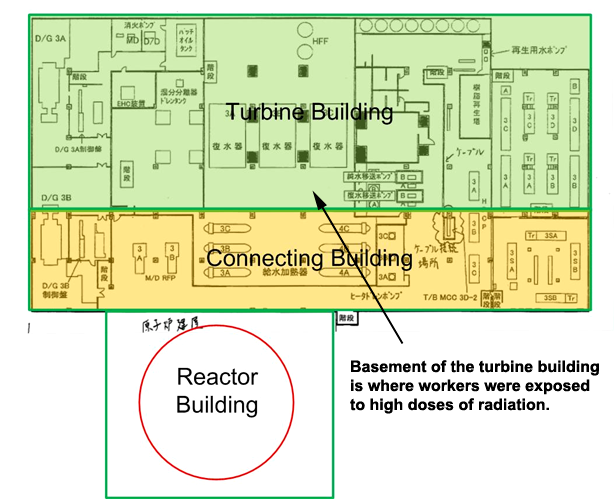
A Japanese nuclear official speaking anonymously reports a crack in the pressure vessel of reactor three from top to below the water level of the reactor.
Radioactive molybdenum and cobalt found in wastewater in the basement are corrosion products that possibly have been put into the environment as a consequence of seawater pumping.
Fast neutrons have been detected within the power station complex.
Zirconium 95 isotope has been detected in the seawater outflow of the reactor complex on Wednesday.
Neutrons signify transuranic isotopes released by fission, zirconium 95 is a radioisotope of the fuel cladding material. It is hard to avoid the conclusion that criticality has taken place or IS taking place in open reactor(s).
Very high temperatures have been recorded at unit one. Temperatures were reduced by pumping more sea water into the reactor core.
Steam has been issuing from all four crippled reactors.
The fire on Wednesday has been suggested as being the outcome of core melt coming into contact with the concrete base of the reactor. Associated releases of high order radioactivity have not been detected, however.
From the French nuclear agency IRSN:
In addition, of the important releases of smoke were noted on this reactor (Number 3). The IRSN analyzes the potential causes of failure of the containment of the reactor n°3. One of the assumptions examined by the IRSN relates to the possibility of a rupture of the reactor vessel followed of an interaction between the corium (mixture of fuel and molten metals) and the concrete at the bottom of the containment.
If the radiation levels in and around the four reactors rise to sievert levels per hour, workers will be unable to tend the plants. The Japanese nuclear authority has raised the exposure level for emergency plant workers to 250 msv per year. A millisievert is one- thousandth of a sievert. Six sieverts is a no- mistake lethal dose of radiation.
Meanwhile, people are fleeing Tokyo.
Americans order evacuation from within 50 miles of the damaged plant.
Japanese industry has lost output due to power shortages and damaged transport links. Japanese car makers and consumer product manufacturers have been most effected.
The Japanese whaling industry has taken a hit from the tsunami.
Many Japanese fishing centers were inundated by the sea wave, with a loss of fish, plus boats destroyed and crews missing. Paybacks are hell, right?
Japanese agriculture looks to take a blow from the increased levels of radiations emitting from Fukushima plant.
The reactors aren’t fixing themselves as seen on TV. The time to get serious is running short, indeed …