People wonder what’s wrong with the world and the answer can be seen in Japan: the people in charge cannot do anything to solve problems because they are actors or figureheads given scripts to read while the issues are left to ‘fix themselves’.
.Japan Tries to Stem Leak of Radioactive WaterDavid Guttenfelder/Associated Press
TOKYO — Workers at Japan’s crippled nuclear plant piled up sandbags and readied emergency storage tanks on Tuesday to stop a fresh leak of highly contaminated water from reaching the ocean, opening up another front in the battle to contain the world’s worst nuclear accident in decades.
As fears of further contamination grew, Prime Minister Naoto Kan said his government was in a state of maximum alert over the situation at the Fukushima Daiichi Nuclear Power Station.
The Japanese government said the discovery of plutonium in the soil near the plant provided new evidence that the fuel in at least one of the plant’s reactors had experienced a partial meltdown. A full meltdown of the fuel rods could release huge amounts of radiation into the environment.
Here is the explosion in reactor Number 3. Keep in mind, the appearance of ‘reactor’ and ‘explosion’ in one sentence is never good, (Sky TV):
Watch this video a few times and look @ the stills: you can come to your own conclusions. This camera is staged at a similar vantage point to the first seen a couple of days ago: about a kilometer away on a clear day with very little wind.
The reactors can be seen in a row with the damaged reactor 1 on the left and unit 4 on the right. Unit 1 is north and the rest are south, the camera faces east toward the ocean.
Unlike unit 1 which had a service area built out of steel framing with metal/composite panels, the service areas atop the other three reactors is made from reinforced concrete with some steel structural members and roof trusses. It is unknown what sort of roof is on these buildings but a non- flammable ‘pavement’- type roof rather than a conventional built-up, slag or metallic commercial roof.
This video has a sound- track. There are five loud sounds in the track: the first is a sound like a metal object being hit @ the extreme beginning of the video, then three explosive bangs, then a sound like gravel being dropped onto a piece of sheet metal.
One interpretation of the track is that three explosions took place in series, leaving out the other sounds. Another explanation is that two of the explosive bangs were echoes of one explosive report, which is unlikely but not impossible. The listening point of the viewer is inland with the camera pointed toward the ocean. There is nothing to the ocean that would cause an echo.
Another possibility is an explosion in stages with different parts of the reactor being effected in turn. The banging sounds are almost identical which would suggest that whatever took place inside the reactor building was repeated over and over.
At the point of this video two days after the earthquake, reactors 2 and 3 have had cooling losses and have overheated like unit 1. An explosion was expected @ unit 3.

The beginning of the video recorded an ‘industrial’ sound of a large, ringing metallic object being struck a heavy blow or dragged. It is possible that this was ‘ambient’ noise from a vehicle or device nearby the camera. It could have been a reactor noise, from equipment or fixtures failing under stress.

Figure 2 Note the fireball shooting out to the side of the roof area of reactor 3.
The fireball could be hydrogen tinctured with some other hydrocarbon such as trace methane from steam effecting the boron carbide control rods. Methane is highly reactive, particularly to iodine so the fiery gas may have been some other hydrocarbon such as fumes from oxidizing paint or vaporized lubricant.
The fireball is gone in an instant the way of a gas/hydrogen explosion.

A closer look of the fireball shows that it is very large, about half the size of the reactor building next to it. The fireball looks to be about 1,200 m3. Whatever caused it involved a fairly large quantity of gas, perhaps several hundred cubic meters.
This was a larger reactor with a larger fuel load. It ran longer without coolant. The outcome would have been higher temperatures, more steam oxidation of the fuel rod cladding and more hydrogen produced within the core.
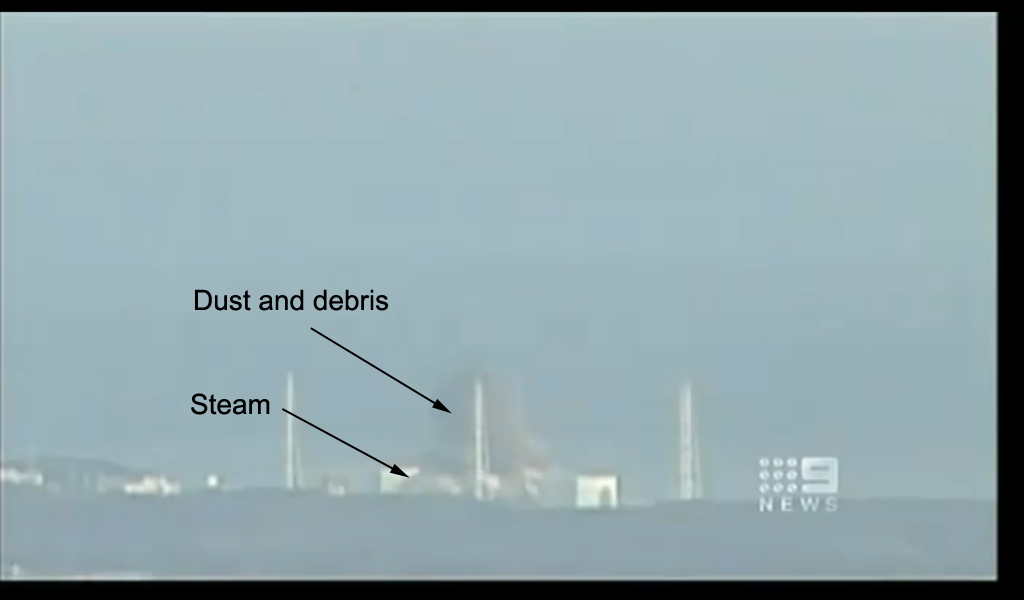
The fireball has vanished and a column of dust and debris is shooting straight up from the roof of the reactor. At the same time a lighter- colored cloud is expanding rapidly from the sides of the roof area. Both clouds are likely steam but the vertical cloud is carrying more dust and debris, probably from the damaged reactor structure. The horizontal vapors are from the roof/service area blasting out the sides.

This is the time of the first loud ‘bang’.

This is the time of the second bang: it both looks and sounds as if there are two different explosions taking place simultaneously. One is a steam/hydrogen explosion centered within the service area atop the reactor containment expanding sideways while a second explosion is expanding from the center of the reactor shooting upward. This explosion is taking with it a lot of dust and debris indicating a lot of structural damage.

This is the third bang. There are large pieces of heavy debris falling out of the cloud along with trailing and falling dust. It looks like the vertical explosion is also primarily a steam explosion from the same suppression pool area as the first but much more energetic. Instead of venting upward into the service area from the basements and blowing the service area apart, this expansion is much more violent, with lower levels of the reactor acting as projectiles to blast higher levels of the containment upward and out of the way.
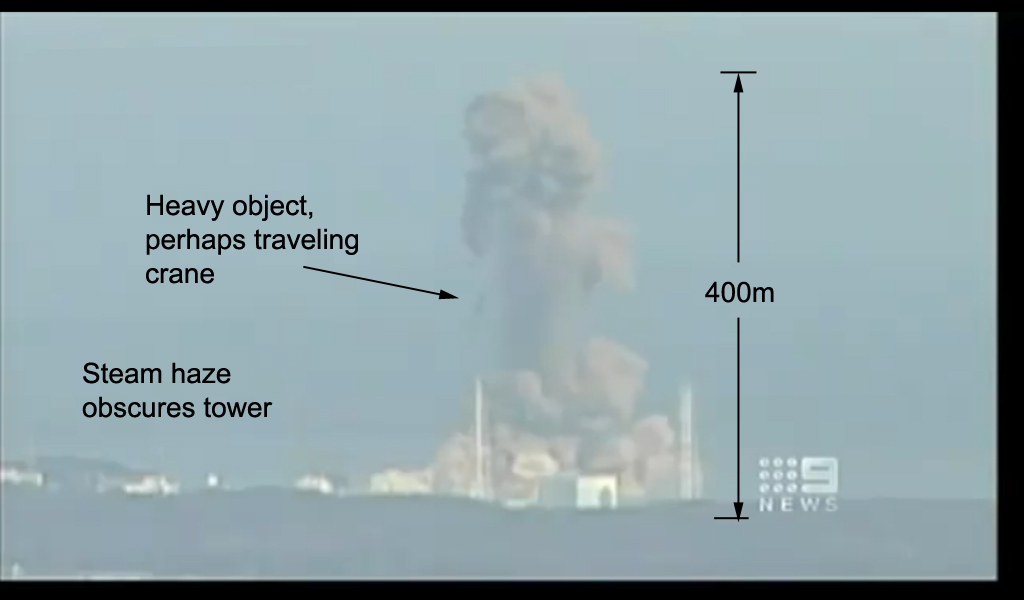
This is the maximum extent of the vertical explosion with what looks to be the traveling crane falling to earth out of the cloud. The crane is used to move the reactor lid(s) and fuel bundles, it spans the entire service area and weighs several tons. It appears to have been blasted vertically as much as 300m (1000 feet) into the air.

Notice the large steam cloud has completely obscured the vent stack tower behind units 1 and 2. It is likely the cloud has expanded in all directions.
Here is a comparison of this explosion with that in unit 1:
- The power of the explosion here is much greater.
- There is a large fireball which was not seen in unit 1
- Like unit 1, there is a steam component to the explosion or complex of explosions.
- There is more structural damage indicated by the flying and falling debris and dust.
- The center of this explosion is low and the axis of the blast vertical. Its source is within the reactor containment. The explosion in unit 1 was similar but lacked the force of this explosion..
- There is a ‘secondary’ explosive component in the service area involving hydrogen.
I believe it is likely that this reactor suffered a complete meltdown of the fuel into the pressure vessel with molten fuel coming into contact with water at the bottom of the vessel or in the suppression pool. This meeting would instantly generate a flash of live steam with explosive power equal to the amount of energy the fuel has available to transfer to the water. If the core is critical — that is, making chain reactions — the energy available could be several megawatts.
Here is a schematic of the meltdown (without the steam explosion) from Ferenc. Dalnoki-Veress:
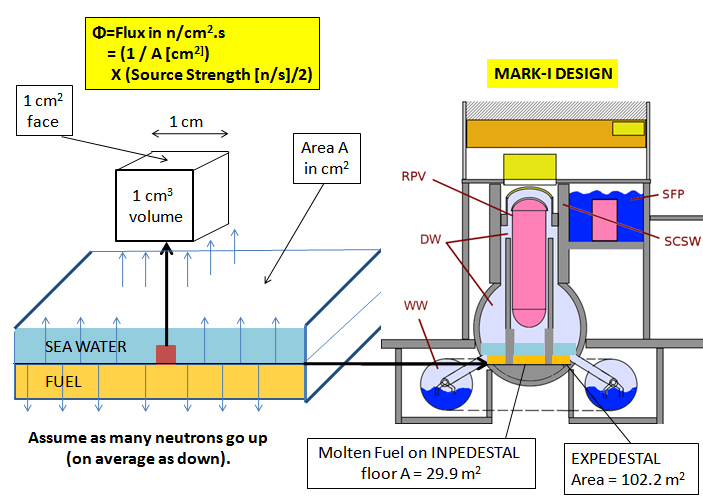
Prof. Dalnoki-Veress arrives at a meltdown conclusion from a different analytical starting point. He wants to find out if a full meltdown would explain the quantity of 38Cl radiation reported by TEPCO at a water discharge tunnel (it doesn’t, more reactions are needed). His premise indicates fuel burning through the bottom of the core would reach water in the bottom of the pressure vessel or suppression pool.
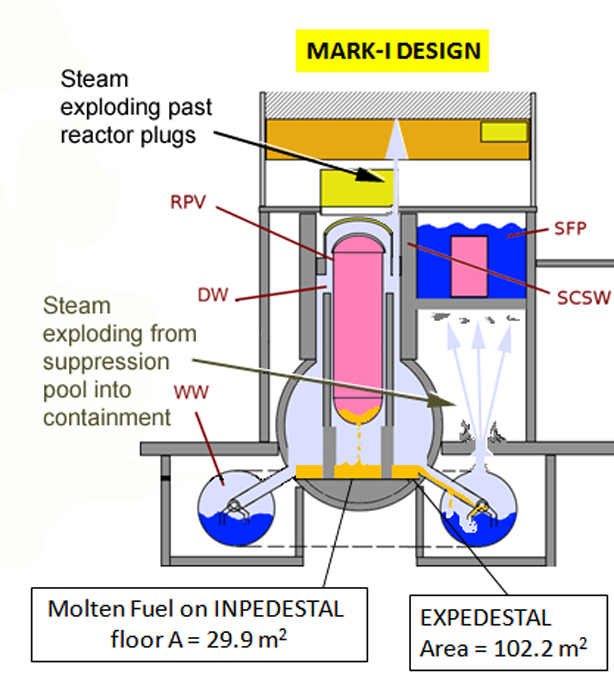
The size and power of the blast indicates a meltdown/steam explosion did indeed take place in the suppression area with a secondary hydrogen explosion taking place in the service area.
A steam explosion in the pressure vessel would either blast through the wall of the suppression pool or straight up past the various lids on top of the reactor as indicated in Figure 11. The suppression pool and related plumbing is an obvious weak area of the pressure vessel complex. The service lids, plugs and gates around the reactor top are the obvious weak areas of the containment.

The meltdown steam explosion would simply have blasted open the suppression pool and smashed aside the different floors between the pool and the top of the reactor containment. Breaching the suppression would be the first blast heard on the video. The steam explosion from containment would be the second blast. The steam- triggered hydrogen fireball would be the third. Because of the source of the first and second blasts there would be large amounts of concrete dust entrained with the steam.
Hydrogen is lighter than air and would collect under the roof of the reactor building. A hydrogen explosion would also tend to propagate in a horizontal direction the same a thermobaric bomb does. The least resistance to this kind of explosion is provided by the service area walls which are much thinner than the containment walls.
A thermobaric explosion is a ‘fuel- air’ type which would cause severe damage if there is sufficient fuel and air mixing. Since the atmosphere within the pressure vessel is steam and nitrogen (within the suppression pool) with little oxygen, the explosive component within the containment would be steam and the component in the service area hydrogen mixed with atmospheric air/oxygen.
Here’s a thermobaric experiment:
Video 2
Here are the thermobaric bombs in action:
Video 3
Note the horizontal propagation of the thermobaric explosion and compare to the steam outflows in the stills and in the unit 1 explosion.
Damage to both service areas would be amplified by hydrogen- air explosions. The combination of explosion stresses from different directions could have caused enough structural damage to allow water to leak out of the spent fuel pools atop the containment. Heat from the thermobaric explosion could also have instantly flashed away some of the water in the pools as more steam. It is not likely that the hydrogen explosion did any damage to the core because of the amount of concrete between the service area and the pressure vessel. The service deck would have been a ‘reflector’ for the force of the thermobaric blast.
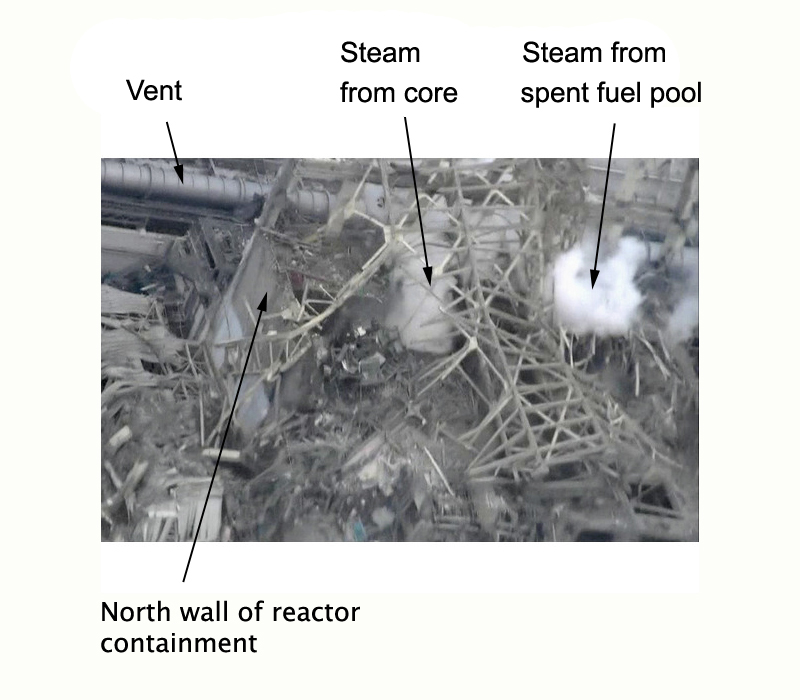
Note the massive amount of damage done to the reactor service area. Lazy steam emerges from parts unknown.. One fume is likely from a spent fuel pool one of which is located on the north side of the building. The fireball emerged @ the southeast corner. The core explosion may have blasted from underneath the spent fuel area or through the zone between the spent fuel pool and the core. This area includes a service gate which is removed to allow fuel components to be shifted between the two areas while keeping them underwater at all times.
There is also stacks of concrete plugs both atop the core and around the drywell area which are removed to allow service to the core itself. Any non- monolithic structure would be vulnerable to explosive forces from below as there is nothing to hold them in place besides their weight.
Here is a take on the radiation: ( from Arms Control Wonk, HT Glen):
WHAT WAS THE CAUSE OF THE HIGH Cl-38 RADIOACTIVITY IN THE FUKUSHIMA DAIICHI REACTOR #1
F. Dalnoki-VeressMarch 28 2011
I have been totally consumed the last few weeks by one thing, day and night, and those are the events unfolding in Japan. I keep on alternating between complete disbelief and acceptance of the gravity of the situation, but mostly disbelief. And I am not the only one. Most of the nuclear physicists and engineers with whom I have spoken since the incident cannot – will not – believe that it is possible that some of the fuel that is melting could somehow produce little pockets that could go critical. I believed them for the longest time until the following came on the Kyodo news website (relevant text italicized below for emphasis) and I did the following analysis.
“Neutron beam observed 13 times at crippled Fukushima nuke plant
TOKYO, March 23, Kyodo
Tokyo Electric Power Co. said Wednesday it has observed a neutron beam, a kind of radioactive ray, 13 times on the premises of the Fukushima Daiichi nuclear plant after it was crippled by the massive March 11 quake-tsunami disaster.
TEPCO, the operator of the nuclear plant, said the neutron beam measured about 1.5 kilometers southwest of the plant’s No. 1 and 2 reactors over three days from March 13 and is equivalent to 0.01 to 0.02 microsieverts per hour and that this is not a dangerous level.The utility firm said it will measure uranium and plutonium, which could emit a neutron beam, as well.
In the 1999 criticality accident at a nuclear fuel processing plant run by JCO Co. in Tokaimura, Ibaraki Prefecture, uranium broke apart continually in nuclear fission, causing a massive amount of neutron beams.
In the latest case at the Fukushima Daiichi nuclear plant, such a criticality accident has yet to happen.But the measured neutron beam may be evidence that uranium and plutonium leaked from the plant’s nuclear reactors and spent nuclear fuels have discharged a small amount of neutron beams through nuclear fission.”
==Kyodo News, http://english.kyodonews.jp/news/2011/03/80539.html
This entire article is worth reading because Prof. Dalnoki-Veress uses the measurements given @ the plant outflow and calculates whether a meltdown of the core would produce the indicated radiation. His conclusion is that it wouldn’t by itself, that there was some other criticality taking place within the core, in his case reactor 1.
With a larger explosion in reactor 3 it is hardly surprising to find more reactivity and and more energetic isotopes hard by the reactors.
This is Meltdown Mania Part Two.
Here is Meltdown Mania Part One.
In Meltdown Mania Part Three, we will take a look at stricken deadboy number 2.