
Yesterday was ‘Black Friday’, not to be confused with various black Thursdays, Wednesdays and Saturdays: it’s the day when all sorts of pre-Christmas (worthless) goods are put on sale. Special for the season is one slightly dented Eurozone.
Mess for Less: fools only will pony up for a Eurozone today when it will be had for a farthing in the very near future, on a (black) Tuesday perhaps. Due to the reductive nature of modern, industrial economies, everything imaginable in the good ol’ EU is an ‘asset’, everything is in the game, everything is over-inflated, mis-allocated, underwritten; strip-mined of any real value, reduced to a hollow entity. Think of a board eaten away by termites. The EU looks like a perfectly fine board on the outside but the inside is dust. How much is that worm-riddled doggie in the window?
Bargain hunters take one look at the European political ‘organization’ and mutter: “I’ve been in barroom brawls/Chinese fire drills/race riots that are better organized.” The markets plead for a European fiscal entity that would allow all the Europeans to borrow in their own currency as do the Japanese or Americans (and the hated Brits). German Chancellor Angela Merkel sez, “Nein”. Markets plead for some liquid cash from the haughty central bank: Merkel sez “Nein”. Merkel’s Herbert Hoover imitation is amazingly spot on: when Merkel finally says, “Ja” it will be too late. We live in hyper-wicked times: problems spring out of the darkness into the consciousness by way of their annihilating all possible solutions.
When Merkel hits the ‘inflation’ panic button there will likely be no euro to inflate. Maybe she believes this is of no consequence, that this is a problem for ‘little people’. This will be the time when Germany’s trillions in euro assets, its decades of capital investments and the hard work of its citizens are rendered worthless. Germany forgets it is a bit part of Europe not its master, the euro is a consensus not a sado-masochist’s club or a license for bankers to steal with impunity. The ‘little people’ it treats with contempt give Germany’s currency and credit what small value these things still possess. Beat the people enough and their willingness to absorb punishment gives value to the euro: it becomes a ‘noble cause’, an idea worthy of sacrifice. Beat those on the margins a bit more and the euro is discovered to be scrip easily replaced with something else.
What remains is the deleveraging which is now underway …
The handwriting on the wall is this last of many failed EU bond auctions.
Did someone say, “failed bond auction”? How about, “Failed bond auction”? Old news, here is another failed bond auction.
Everyone is broke, nobody has any money. There is a cash shortage. The world has entered the age of ‘Non-“: non-job, non-credit, non-currency, non-wealth, non-value … over the entire science experiment looms the darkened thunderhead of debt. Nemesis debt’s power resides in its self-amplifying worthlessness. The central bank is trapped: for it to swap currency for assets that are being demonstrably proven worthless in the marketplace reduces the currency worth to a ‘non-‘. The central bank must (non-)promise to (non-)print any (non-)currency until the (non-)cows come home.
Demonstrably proven worthless: the EU banks are dumping non-cash assets for what euros can be had so as to bolster fictitious ‘capital’.
Assets the banks are eager to sell are over-valued. Dumping them represents a capital loss rather than the desired ‘bolster’. Assets being offered are worth much less than their ‘For Sale’ price.
European banks’ asset sales face disastrous failure
Gareth Gore (IFR)
“European banks have spent far too long saying everything is fine, when it really isn’t,” said one banker at a US bank who has been advising European clients on their options. “They are slowly realising that they just won’t be able to do what the market is expecting. We are edging slowly closer to the depths of the crisis.”
Some of Europe’s largest banks, including BNP Paribas and Societe Generale, have in recent weeks pledged to sell assets. Together, firms are expected to shrink their balance sheets by as much as €5trn over the next three years – equivalent to about 20% of the region’s total annual economic output – through a combination of sales, asset run-off and recapitalisations.
A funding squeeze has prompted the Draconian measures. Since the summer, most banks have been unable to tap traditional sources such as unsecured bond markets. As old debts come due – some €1.7trn will roll over in the next three years alone – banks need to find cash to avoid bankruptcy.”Banks are feeling pain on both sides of the balance sheet,” said Alberto Gallo, head of European credit strategy at RBS. “On the one side you have a funding squeeze with banks unable to raise cash in the capital markets. At the same time, many of the assets they hold are deteriorating in quality.”
“Banks need to reduce their balance sheets as much as €5 trillion in assets over the next three years or so,” he added. “The problem is that there just aren’t enough buyers. Most banks will be forced to hold on to much of this stuff to maturity, which will affect their ability to lend and impact on the real economy.”
People involved in asset sale talks say price is the major sticking point. Lenders want only to sell higher-quality assets near to par value so as to avoid huge write-downs, which would erode capital further. By contrast, potential buyers want high-yielding investments and are offering only knock-down prices.
Merkel is absolutely correct: central banks cannot conjure value out of thin air, only a cheap imitation. ‘Fake money’ suits the requirement of deleveraging, replacing the maturing debt instruments with with the kind that doesn’t mature. The central bank must offer euros, it has nothing else.
If the bank is unwilling to remedy the squeeze and provide a (temporary) surplus of euros the message is that there are no euros to be had. The difference between ‘no euros’ and ‘no need for euros’ is vanishingly small. The refusal of the ECB to provide liquidity on the scale needed to end the panic is ultimately self-fulfilling and self-defeating.
The EU lacks a plan for how to solve the crisis because it lacks understanding of the nature of the problem. What is taking place right now in the Eurozone and elsewhere is energy conservation by other means.
Along with its economists, analysts and policy makers, the EU refuses to appreciate the energy component to the current panic. Ending the immediate panic allows the children to return to the ‘glory days’ of waste and bankruptcy that caused the crisis in the first place. The cycle of liquidity squeeze- to liquidity bailout has characterized the crisis since 2008. Adding liquidity without ending fuel waste is nothing but a turn of the cycle leading to the next squeeze. QE by itself is not enough. Neither is finance ‘reform’. The drain of cash toward fuel imports and zero-return activities such as driving pointlessly in circles from nowhere to nowhere must be brought to an end.
Otherwise, these activities will be brought to an end!
It’s far less destructive to the EU to conserve directly by way of policy action rather than as the outcome of chaotic deleveraging. One way or the other, by hook or crook, conservation is taking place. The ECB can start buying EU debt (quantitative easing) and end the immediate crisis … buying time needed to implement the necessary energy conservation. The EU can start by making gasoline €8 per liter and banning automobiles from cities and towns.
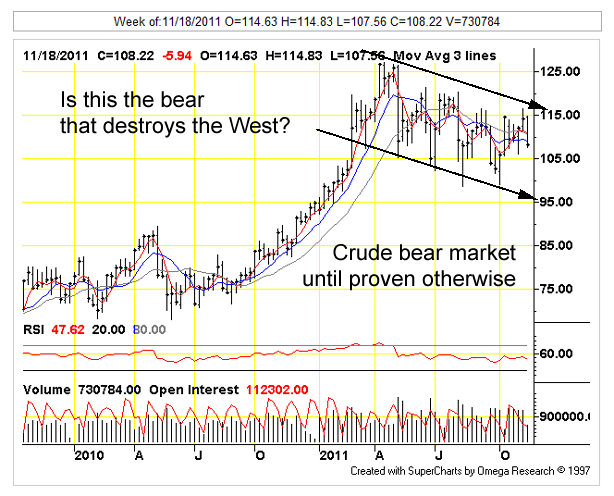
Figure 1: Credit expansion supports the price of crude oil, now that credit is shrinking what will happen with the crude oil price? (Chart by TFC Charts). The declining price mirrors the decline in credit. The danger is where the price needed to bring replacement fuel to market is higher than what the market and its shrunken credit can afford to spend. When that happens, rationing fuel by way of access to credit is replaced by physical rationing of the fuel, itself. This switch in rationing regimes is underway right now.

Analysts toss around “five trillion euros” as the amount of debt that must be made to disappear. The amounts needed are unfathomable. There is so much debt and so many unfunded liabilities, nobody can be sure. What is sure is that the needed amount of ‘Spare Wealth’ in bags, lying around the (Mc)mansions, in the garage, next to the (Mc)Porsches does not exist. It certainly does not exist in China (Patrick Chovanec):
A Chinese decision to ”forgive” the U.S. Treasuries it holds […] would render the PBOC hopelessly bankrupt. The central bank would lose RMB 7.2 trillion worth of assets, against only RMB 22 billion in capital, leaving a massive hole in its balance sheet. That, in turn, would hopelessly bankrupt the entire Chinese banking system, wiping out nearly half of the RMB 16 trillion cash reserve deposits they hold at the central bank (which are essentially claims on its FX reserve assets), against just RMB 2.8 trillion in paid-in capital standing behind the entire system.
The Chinese banks have nowhere to turn. Like their continental cousins, they are massively over-leveraged says Jim Chanos:
Chinese Banks ‘Built on Quicksand’ With Bad Loans, Chanos Says
Ye Xie and Betty Liu (Bloomberg)Chinese banks are “extremely fragile” because the lenders don’t have enough capital to offset bad loans, said Jim Chanos, president and founder of the $6 billion hedge fund Kynikos Associates Ltd.
Chinese lenders are saddled with non-performing loans accumulated in the late 1990s and early 2000s, Chanos, the short seller who predicted the collapse of Enron Corp. in 2001, said in an interview on Bloomberg Television yesterday. The banks are failing to recognize the losses on the bad loans and have carried out a lending binge since 2008, said Chanos.
“The Chinese banking system is built on quicksand and that’s the one thing a lot of people don’t realize,” said Chanos, who is shorting the shares of Agricultural Bank of China. “Everybody seems to think it is a free and clear open checkbook. It’s not. The banking system in China is extremely fragile.”
Debt for debt’s sake: here is debt for debt, for debt, for more and more debt along with debts added along the way to obtain the necessities of life. The chain of debt is now broken. Debt for debt twists in the wind (ZeroHedge, click for big):
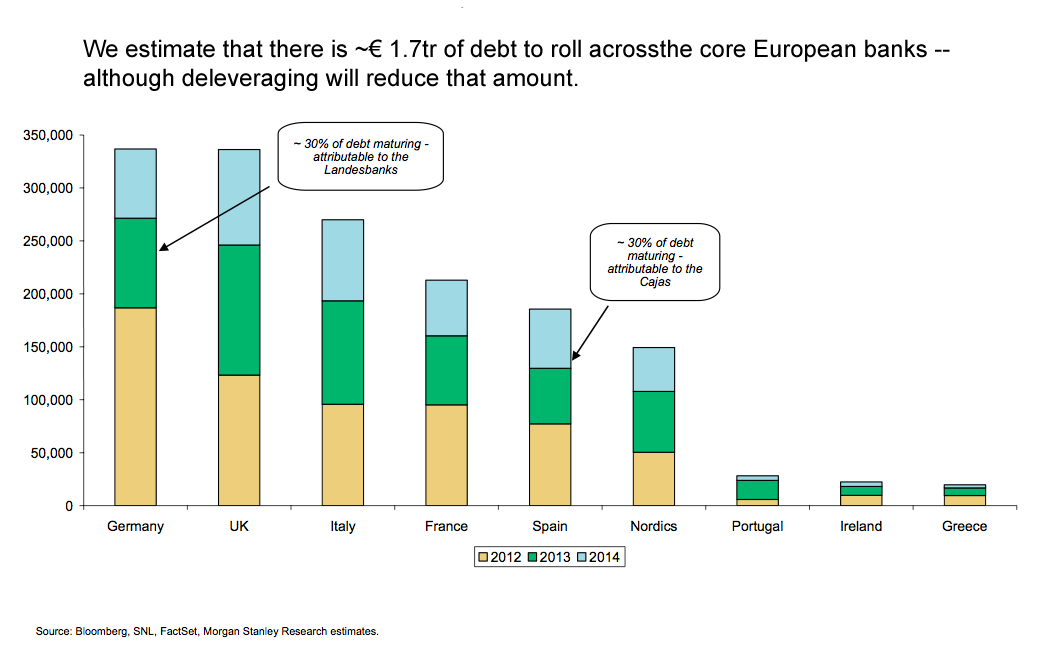
Figure 2: much of Europe’s debt is the residue of long-dead real estate bubbles in Spain and the US. The Europeans have the choice of either paying against these bubbles forever … or going out of business. Greece, Portugal and Ireland are already out of business, they just haven’t admitted it yet.
Waste-based economy is utterly dependent upon debt. Should the debt vanish tomorrow by magic, new debt in the same amount would need to be taken on the day after to allow ‘businesses’ to operate. With high input costs, the return on economic activity is negligible. EU business activity has become finance speculation, firms selling broomsticks and barge poles to each other. This activity appears to be efficient and ‘modern’ but the return needed to service EU debts is absent. Labor is unproductive. Meanwhile, the return on debt taken on to service debt is negative. The EU is stuck with nowhere to turn but to the central bank. This is the consequence of absent real returns on resource waste where resources have become too expensive.
Deleveraging is ugly:
– Many large European banks are going to fail. The individual EU nations lack the means to bail them out while the Eurozone as a single entity lacks the administrative structure to do so.
– As the banks fail and funds are swept up into the inferno there will be a funding squeeze on US debt.
– An unanswered question regards the amount of US bank exposure by way of lending derivatives. According to the latest Bank of International Settlements figures (June, 2011) the overall single-name exposure to Credit Default Swaps in $18 trillion (US). Of that, a likely modest percentage belongs to establishments writing credit ‘protection’ against EU debt. The swaps are written by banks against each other, the exposure could be very large indeed.
– Another German dilemma: any indications of reintroducing the mark would end the euro even as the costs of defending the euro would be fatal to Germany.
– Re-denomination will be chaos, the race to abandon the euro is already taking place. Any of the PIIGS exiting the euro and introducing their own currencies would cause the collapse of the countries’ banks. Another dilemma: there are no public plans for an orderly re-denomination, mention of a public plan would be suicidal. A plan would suggest that Germany is looking to abandon the euro: defaulting on its own euro-denominated debt in the process. If Germany defaults all the other EU countries would do the same thing. Why not?
– The end of deleveraging is default.
– A euro default would bankrupt the China central bank and other Chinese banks which hold hundreds of billions worth of euro-denominated securities as foreign exchange reserves. Here, China faces the same consequences of The First Law as does Germany. Its surplus of reserves represents too large a position on banks’ balance sheets to liquidate without taking wounding losses. At the same time, the euro failure would have the same effect as liquidation, all the costs of the euro surplus coming forward and being felt at once.