Here is an ongoing look at some charts. The ‘fear factor’ cannot be discounted any time and some big moves have been taking place but the overall trends haven’t really changed that much:

Figure 1: This is gold continuous contract from estimable TFC Charts: Gold is taking a dump right this minute because the Eurozone is deleveraging and credit is being stripped out of the world economy. To meet capital requirements and margin calls Eurobankers are selling gold and gold derivatives … and anything else that isn’t nailed down.
Depositors are also fleeing the banks as there are questions about whether the banks will remain in business or whether the banks’ host countries will switch to a currency other than the euro, stranding euro deposits.
Right this second the gold price is about $1,580 per ounce. It’s been hammered down to the tune of almost $100/oz. Silver has also gotten pounded.
Gold is still in a bull market until the price action proves otherwise. should the metal close below $1,600/oz. a reassessment would be in order. $1,600 per ounce is pretty much a trend price, a close @ that price is a reversion to trend. A settling to $1,500/oz. would indicate a new, short-term bear market in gold is underway.
Bear market or short-term correction? Why are markets unpredictable? I don’t know.
Extremely high gold prices are credit-dependent as are the prices of all other assets. Deleveraging lowers the bid at the same time the question of ‘will there be a euro, tomorrow?’ adds to uncertainty. What is the money-substitute for the euro? Will gold be a part of any ‘Niewe Euro?’ Will euro disappearance mean the disappearance of other currencies. What’s next?
There is a conceptual tug-of-war taking place in the metals market right now. Since the banks hold a lot of Europe’s gold-ish assets, agony on the part of the banks translates into bearish turmoil in the gold markets.
One characteristic of the bubble bursting in any market is when a market maker fails in a bull market. During the crude bubble in 2008, there was the failure of Semgroup near the end of the crude run-up. Now, there is the failure of MF Global which puts a question mark on the ongoing commodity bull cycle.
Both companies failed for essentially the same reason: they took contrary market positions with too much leverage, that is, they reacted as professional traders to what they considered to be too-high prices or yields.
Semgroup traders felt the crude bull had gotten ahead of itself @ $130 per barrel. They were right, so what? They were at the mercy of their lenders who happened to have much to gain by their failure.They were short while the longs had momentum and a flood of institutional credit from collapsing markets was looking for a place to hide. Because of the long run-up in prices there was a dearth of organic sellers at the $130 level. The squeeze on Semgroup was fatal, it couldn’t meet margin: a few weeks later, Semgroup’s old positions were ‘good money’ in someone else’s hands.
MFG wasn’t right about its sovereign debt positions which seem to have been taken on a whim … without much analysis. Unlike Semgroup’s shorts, none of MFG’s long sovereign positions are likely to be money good, ever. If this was to be a basis trade, what was the basis? MFG needed to hedge itself but for some reason didn’t. The next step was for customer accounts to vanish. MFG = WTF? Somebody besides Corzine signed off on these trades, undoubtedly an actual trader who understood the risks.
Any failure of a market maker in a strong bull market is a warning. It’s usually a sign the market has gotten ahead of itself and a secular pull-back is on the way.
A question is whether gold and silver will decouple from the other commodities? In a deleveraging period all assets decline relative to currency. Add to this uncertainty is the decline of one currency’s worth relative to others due to questions about its viability.
What is taking place in Europe now is very similar to what took place in Europe in 1931 when the establishment decided the single currency of the day — gold — was more important than the business activity that could be leveraged with it. Within a short period, European and American economies shifted from producing goods and services to the buying and selling gold or buying and selling currencies in order to obtain gold. Those without gold endured extreme hardships while those with little gold endured hardships in order to hold onto what they had. America became a ‘gold or food’ economy. The European productive economy collapsed.
To understand what is underway in Europe right now, substitute the word ‘euro’ for the word ‘gold’.
The outcome of the ‘currency first’ regime was the repudiation of the gold standard in the US and elsewhere. Europe now faces the end of euro as money. The Euromanagers insist on sanctifying currency over productive business activity. As in the 1930s the outcome is likely to be a stupendous, worldwide depression as funds flow toward currency speculation away from productive investment.
This time IS different: the shift today is from pseudo-production and ‘fake’ investment to nothings in particular. Depression is baked into the cake. The real, unacknowledged problem in today’s economy is the absence of any productive ‘modern’ industrial activity anywhere, only the waste of good capital for nothing. Meanwhile, the euro is simply a fancy. Gold and euros can be overvalued, but the euro can vanish completely. Gold may never again be currency but will always have monetary value.
Simply exiting the euro-standard won’t be enough to solve the EU’s economic hardship. A new kind of economy is needed that provides rewards for thrift and husbandry, that penalizes consumption. Right now the West can’t even bring itself to consider anything other than the current waste-based version. Consequently, the depression to come is bound to be painfully long.
For gold prices to rise further, a source of new credit has to emerge from somewhere. A good source would be the Fed which is right now sitting on the sidelines. The swaps program didn’t add enough liquidity to the European economy to make a difference and the central banks in the Eurozone are constrained both by policy and the lack of the necessary lending structures.
A future move might be for the Fed to start buying mortgage-backed securities again under another QE program. Since the Eurobanks still hold a lot of this paper, a QE program could improve the Eurobanks’ balance sheets while providing some desperately needed liquidity.
Another source of credit would be the Peoples Bank of China which needs to shore up its creaky real estate market. The China solution to the last deleveraging leg was to turn on the credit spigot, the solution to the ongoing deleveraging leg is to turn on the credit spigot. The bosses say, “Mo deal” but the proof will be bankrupt Chinese bosses. Turning on the China spigot will put a floor under commodity prices, right now the spigot valve needs a few more turns added to the puny decrease in reserve requirements before there is any effect to be felt.
What to keep in mind is the relative value of gold to assets other than currency. Gold is likely lose less value over time than other assets if for no other reason that it will never lose all of its value.
Here’s petroleum: keep in mind, crude is vital, gold is not:
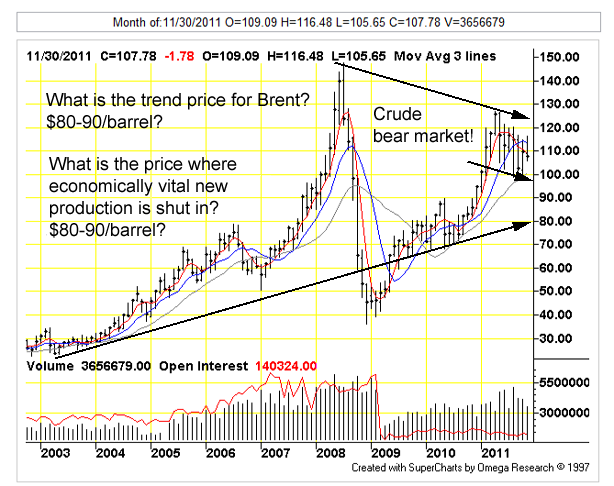
Figure 2: There are several trends that opposed that are in the process of being resolved. One is the gold bull versus the crude oil bear. Another is the longer-shorter price trend conflict within the crude market.
Revenge of the Waste-based Economy: the reason prices are declining is because people are broke. People that are broke cannot afford high-priced petroleum. High prices are nonetheless needed to bring expensive to produce oil to the markets.
– The long-term relationship between increasing demand and non-increasing supply has pushed the price of crude steadily north since 1998. During that year a barrel of crude could be had in some markets for $6.50 per barrel with an overall average price of $12. The average price for this year is over $100. This increase is why the world’s economies are vomiting, crude oil is now too valuable for it to be burned up for nothing. Meanwhile, burning up for nothing is the only use the world’s brain trust has been able to come up with after a hundred and fifty years of ‘innovative’ thinking!
– Since 2008, crude oil has been in a bear market. Since earlier this year, crude oil has been in a short-term bear market, with a peak price of $128 per barrel.
– Setting an arbitrary trend line on crude prices since 2003 it would appear a price of $80-90 per barrel would be a reasonable reversion-to-trend level for crude oil today, a bit above the current price.
– At issue is the price level required by producers to bring new oil in quantity to the marketplace. This is likely to be $80-90 per barrel or higher! Where is the profit for producers at this level? Credit stripping in the West is proving to have greater effect on the price of crude oil than saber rattling on the part of Iran or loss of production in Libya. The implication is that cutting production will not effect the price as it has in the past. Unless the producers extend credit on their own accounts will be less credit available to push the bid.
Better for producers to hold onto their oil until some genius comes up with a better use — and a better price — for it.
– Another problem for producers is the increase in demand in producing countries. The high prices result in a flood of funds. This flow is directed toward the import of fuel waste in the form of automobiles and other guzzling machinery. This in turn cuts into amount of fuel available for export. High prices appear to be the driver of decreasing net exports. Lower prices won’t effect demand in producer countries or increase exports. Fuel waste machinery already imported will be used. Lower prices will not only strand new supplies but will ‘insulate’ the increasing consumption that is taking place within producer countries.
The outcome of supply price-dependency plus exporters’ consumption is fuel shortages. New fuel supplies are unaffordable unless customers bankrupt themselves with debt. What remains outside of the ‘unaffordable’ fields is the exhausted supply from depleting wells, with competition between consumers tilting toward the producers’. High prices allow the increase in exporter consumption leading to diminished supply to the market. Low prices also allow increased exporter consumption alongside supply being shut in as unprofitable … leading to more diminished supply to the market.
Shortages that appear as the result of this dynamic will be permanent as affordability cannot be increased due to credit stripping.
Artificially cutting supply by OPEC action or saber-rattling is no different from affordability-driven shortages. Oil that is unaffordable at $80 per barrel is unaffordable at the theoretical $100 per barrel … or $10,000 per barrel.
– The political systems around the world have completely failed, with the same historical errors being repeated over and over.
– Because the US has provided more liquidity and stands ready to provide more, the effects of deleveraging have been less painful than in the EU. However, the provision of liquidity and tepid fiscal stimulus is support for a self-bankrupting economic regime. Liquidity and stimulus cannot succeed where the process being supported is the destruction of capital.
– Outside of a handful of analysts — and zero policy makers — there is no acknowledgement of the waste-foundation of our ongoing crisis. Humans will make the same errors over and over until they learn not to.
– The panic is underway in Europe whether managers acknowledge it or not. What this means for governments is shell-shock for the current establishment with several more generations of democratically elected incompetents promising a return to consumption until the promise is proven false. Fortunately for Europe and the rest of the world the EU is too broke for it to go to war with others or with itself. Even hegemon-wannabes Russia and China are broke.
– Banks will fail in the EU for various reasons and depositors will lose a lot of money. Deleveraging means loans are paid, euros are extinguished by the process. Eventually, there are few euros left in circulation. ‘Replacements’ for the euro emerge, perhaps in the form of national currencies, perhaps in the form of scrip. Clever governments would issue national currencies now while keeping the euro as a reserve currency. National currency issues — pure fiat issued by a country’s treasury — would augment euro deposits in national banking systems. Pure fiat would end the ongoing increase in national indebtedness. If the countries wanted to avoid over-issue of their currencies and inflation, these would be issued as demurrage money.
This is not going to happen, the EU is destined to the ‘toilet bowl of history’.