Here is another orgy of predictions for the rest of 2012. Ours are challenging times. Will the human race finally step up its game or will if fall on its collective face? (Face)
Phil’s Stock World had no predictions for 2012 citing, “cross-currents”.
Doug Kass @ The Street.com is ‘Mr. Prediction’ as he was last year:
Surprise No. 1: The U.S. stock market approaches its all-time high in 2012. A confluence of events … allows for the S&P 500 to eclipse the 2000 high of 1527.46 during the second half of the year.Surprise No. 2: The growth in the U.S. economy accelerates as the year progresses. The U.S. economy muddles through in early 2012, but, with business, investor and consumer confidence surging in the fall, real GDP accelerates to over 3% in the second half. Unemployment falls slightly more than consensus, but the slack in the labor market continues to constrain wage growth. Domestic automobile industry sales soar well above expectations, benefiting from pent-up demand and an aging U.S. fleet. Inflation is contained but begins to be worrisome (and serves as a market headwind) in late 2012. Corporations’ top-line growth is better than expected, and wage increases are contained. Operating margins rise modestly as sales growth lifts productivity and capacity utilization rates. Operating leverage surprises to the upside as 2012 S&P profits exceed $105 a share.
A noteworthy surprise is that the residential real estate market shows surprising strength.
Surprise No. 3: Former Presidents Bill Clinton and George Bush form a bipartisan coalition that persuades both parties to unite in addressing our fiscal imbalances.
– The annual increase in government spending is limited to the change in the CPI.
– A comprehensive jobs plan includes new training programs — all veterans are made eligible to tuition subsidies to vocational schools and colleges.
– A Marshall Plan for housing is introduced, highlighted by a nationwide refinancing proposal adopted for all mortgagees (regardless of loan-to-values).
– A series of new tax increases, including a plan to raise taxes on the families with an income in excess of $500,000 a year (a two-year income tax surcharge of 5%-10%) and some other more imaginative, outside-the-box proposals (e.g., a tax on sugar products) are introduced.
– Mean test entitlements, freeze entitlement payouts and gradually increase the Social Security retirement age to 70 years old.
– A comprehensive plan is designed to rapidly develop all our energy resources.
Surprise No. 4: Despite the grand compromise, the Republican presidential ticket gains steam as year progresses, and Romney is elected as the forty-fifth President of the United States.
Surprise No. 5: A sloppy start in arresting the European debt crisis leads to far more forceful and successful policy. The EU remains intact after a brief scare in early 2012 caused by Greece’s dissatisfaction (and countrywide riots) with imposed austerity measures. The eurozone experiences only a mild recession, as the ECB introduces large-scale quantitative-easing measures that exceed those introduced by the Fed during our financial crisis in 2008-2009.
Surprise No. 6: The Fed ties monetary policy to the labor market. In order to encourage corporations to invest and to build up consumer and business confidence, the Fed changes its mandate and promises not to tighten monetary policy until the unemployment rate moves below 6.5%,
Surprise No. 7: Sears Holdings declares bankruptcy.
Surprise No. 8: Cyberwarfare intensifies. Our country’s State Department’s defenses are hacked into and compromised by unknown assailants based outside of the U.S. Our armed forces are place on Defcon Three alert.
Surprise No. 9: Financial stocks are a leading market sector. After five years of underperformance, the financial stocks rebound dramatically and outperform the markets, as loan demand recovers, multiple takeovers permeate the financial intermediary scene and domestic institutions enjoy market share gains at the expense of flailing European institutions.
Surprise No. 10: Despite the advance in the U.S. stock market, high-beta stocks underperform. Though counterintuitive within the framework of a new bull-market leg, the market’s lowfliers (low multiple, slower growth) become market highfliers, as their P/E ratios expand.
Surprise No. 11: Mutual fund inflows return in force.
Surprise No. 12: We’ll see merger mania. Cheap money, low valuations and rising confidence are the troika of factors that contribute to 2012 becoming one of the biggest years ever for mergers and takeovers.
Surprise No. 13: The ETF bubble explodes.
Surprise No. 14: China has a soft landing (despite indigestion in the property market), and India has a hard landing. India becomes the emerging-market concern. With India’s trade not a driver to GDP growth, its currency in free-fall, pressure to keep interest rates high by its central bank and signs of a contraction in October Industrial Output, India’s GDP falls to mid-single-digit levels.
Surprise No. 15: Israel Attacks Iran. Iran closes the Strait of Hormuz, and oil prices spike to $125 a barrel.
Surprise No. 16: After it is disclosed that Bank of America (BAC_) is being forced to raise an additional $20 billion to $25 billion of capital, Brian Moynihan resigns as President and CEO of Bank of America.Surprise No. 17: Reflecting upward-trending stock markets around the world, continued improvement in domestic high-frequency economic statistics and a contained European debt crisis, the CBOE Volatility Index (VIX) falls to the 10-15 level during the second half of 2012.
Surprise No. 18: Facebook’s IPO fizzles. The new offering is priced at a $70 billion equity capitalization but opens flat and breaks issue price in the first day of trading.
Surprise No. 19: A second-half growth scare briefly lifts the yield on the 10-year U.S. note to over 3%.
Surprise No. 20: Similar to Hewlett-Packard’s (HPQ_) former CEO Mark Hurd, three very high-profile executives of Fortune 500 companies are forced to resign after sexual harassment allegations.
5 Predictions You Won’t See Elsewhere
Alex Dumortier (Motley Fool)
– U.S. GDP growth will come in below 2%. Since 1930, average annualized GDP growth is 3.3%; in the post-war era it’s 2.9%. With those figures in mind and given the current environment, 2% growth next year would be a good result.– Corporate earnings growth will slow sharply; earnings may even shrink. The S&P 500 will miss its 2012 EPS forecast ($99).
– Volatility will remain high. Expect the VIX to break 35 again this year and the risk on/risk off schizophrenia to remain a fixture in risk asset markets.
– My picks for the three best-performing stocks in the Dow index: Bank of America, Alcoa, and Hewlett-Packard
– My picks for the three worst-performing stocks in the Dow index: Home Depot, Kraft Foods, and McDonald’s. (Note: I hate Home Depot, Kraft Food and McDonald’s as being anti-human.)
David Rosenberg of Gluskin-Sheff has a few easy-to-remember predictions for 2012 (by way of Cullen Roche):
1. Relief from lower gas prices comes to an end.2. The lagged impact from the $2.5T contraction in household net worth in the past two quarters shows through a rising savings rate.
3. The rise in savings rate is compounded through the year by uncertainties surrounding the longevity of the Bush era tax cuts.
4. Employment has picked up over the past year but overall, growth is still tepid by standards of the past and the jobs that are being created (retail, leisure, accommodation) are in low-paying areas as such are not helping provide much of a lift to overall work-based incomes.
5. Ongoing fiscal retrenchment at a state and local government level, including something new – reductions in pension benefits.”
Cullen Roche has his own veritable orgy of predictions at Pragmatic Capitalist:
I’ve linked a few, (highlights are bold) go over and use up his server space!
Macro Outlooks and PredictionsPredictions are hard, especially about the future….
Top equity strategist outlooks for 2012 – Business Insider
Difficult 2012 for fixed income? – Morgan Stanley
How to trade emerging markets in 2012 – CitiGroup
2012 global strategy – Bank of America
2012 Market outlook – Ed Yardeni, Yardeni Research
10 surprises for 2012 – UBS
Recession in 2012? Flip a coin – SF Fed
2012 Forex shocker – Nomura Research
Will 2012 Be Europe’s Minksy Moment? – PIMCO
2012 outlook – Jim Rogers
5 key questions for 2012 – Goldman Sachs
2012 – the year of diminished expectations – Mark Zandi, Moodys
2012 Global outlook – Morgan Stanley
2012 – The Year of the reckoning – Peter Schiff
The 6 biggest questions of 2012 answered – Bob Janjuah, Nomura
Richard Bernstein’s favorite picks for 2012
Bob Doll – 10 predictions for 2012 – BlackRock
Will the shorter business cycle lead to recession in 2012? – Deutsche Bank
Continued volatility, but no recession in 2012 – Jeff Saut, Raymond James
5 Consumer challenges heading into 2012 – Gluskin Sheff
2012 outlook on China – The Telegraph
Forecasting Italy’s Borrowing needs in 2012 – Sober Look
The three recession risks – Credit Suisse
Europe to double dip in 2012? – Capital Economics
Sluggish growth to continue – CEO & CFO surveys
The “Doomsday view of 2012″ – Binghamton University
Eurozone debt redemptions will force Europe to act in 2012 – Credit Agricole
Depression will lead to collapse of the Euro – Felix Zulauf
Recession is still coming – Lakshman Achuthan, ECRI
No way to avoid recession in 2012 – Hoisington
2012 will mirror 2009 – Societe Generale
The global economy to slow in 2012 – ScotiaBank
5 important global trends to watch in 2012 – Nomura Securities
Moderate economic expansion to continue – FedEx Corp
The risk of recession has come down – Goldman Sachs
Still no recession in the foreseeable future, but a balance sheet recession – Cullen Roche
Growing signs of a disinflationary 2012? – Cullen Roche
The 2012 earnings outlook – Zacks.com
5 macro trends for 2012 – Council on Foreign Relations
Strategy, Risks & Top Trades for 2012
Bridgewater – buy treasuries and gold, sell stocks…
7 Calls for 2012 – Nomura Securities
15 surprises for 2012 – Doug Kass
A bullish outlook for gold in 2012 – Deutsche Bank
House prices to drop 30% in 2012? – RBC
8 Risks to equity markets in 2012 – Morgan Stanley
10 outrageous predictions for 2012 – Saxo Bank
4 risks in 2012 – Bank of America
Oil to rally again in 2012 – CitiGroup
10 market risks in 2012 – Nomura
2012 is shaping up to be a good year for equities – David Kotok
Stay in the equity game – PNC
The Dow:Gold ratio will hit 1:1 – Bob Janjuah, Nomura
10 for 2012 – Byron Wien, Blackstone
Gold is the ultimate bubble and could be on the verge of massive bear market – George Soros
2012 investing outlook – Kiplinger
How to invest in 2012 – JP Morgan
Oil prices just can’t fall much – Barclays
Europe’s banks are insolvent – Michael Platt
Credit strategy 2012 – CitiGroup
2 bullish drivers for 2012 – Credit Suisse
Morgan Stanley 2012 commodities outlook – Morgan Stanley
6 reasons to remain bullish – Jeff Saut, Raymond James
The 2012 commodities outlook – Diapason Commodities
Is QE3 on the way? – Cullen Roche
Still long gold and copper – Goldman Sachs
A sober look at natural gas – Sober Look
5 Investment themes for 2012 – Richard Bernstein
The consensus gold outlooks – Zero Hedge
7 investment ideas for 2012 – David Rosenberg, Gluskin Sheff
5 Risks heading into 2012 – David Rosenberg, Gluskin Sheff
Key Euro Crisis milestones ahead – DJ FX Trader
Ambrose Evans-Pritchard: 2012 could be the year Germany lets the euro die
So we enter Year IV of the Long Slump, the cruelest yet though not the most acute.– There will be no Chinese credit explosion this time, no real help from post-bubble India or over-stretched Brazil.
– It will be a global downturn on all fronts, aborting what remains of recovery even before industrial output in the OECD bloc has regained its pre-Lehman peak.
– The second wave will hit with youth unemployment already at 45pc in Greece and 49pc in Spain; and with the US labour participation rate already at depression levels of 64pc.
– We will hear more about Italy’s Red Brigades, Greece’s Sect of Revolutionaries, and America’s militia groups, and how democracies respond. Proto-fascism in Hungary is our warning.
– China’s surgical soft-landing will slip control, like Fed tightening in 1929 and 2007, or Japan’s squeeze in 1990. Once construction has run amok, bears will have their way.
– Since the purpose of New Year predictions is to stick one’s neck out, let me hazard that China will devalue the yuan in 2012. It will export yet more spare capacity into a deflationary world, until the West retaliates and starts to turn its back on globalisation. Capital outflows will accelerate. The idea that China can rescue anybody will seem quaint.
– There is a graveyard full of Gaijin commentators who wrote off Japan too soon. Will the dam break this year at last, with tax covering less than half of spending, public debt at 237pc of GDP, ever fewer workers, and a state pension fund now selling government bonds?
– America will look resilient for a few months. The payroll tax deal has averted a fiscal shock, but that is all. Money growth (M3) has sputtered out, and velocity is falling.
– Politics on Capitol Hill will restrain Ben Bernanke from launching QE3 until the Tea Party can see the eye-whites of deflation. Six-month PCE inflation was 2.9pc in August, 2.4pc in September, 1.6pc in October, and 1.2pc in November. Not there yet. Prepare for a Wall Street squall first.
– … Austro-liquidationists are winning the popular debate.
– The second leg of our Kondratieff Winter comes at an awful moment for Euroland, just as the North-South split turns deadly.
– The European Central Bank has guaranteed trouble by letting M3 money contract. Fiscal tightening into the downward slide will make matters worse. A credit crunch as banks shrink loan books by €1 trillion to meet capital ratios will do the rest. All policy levers are set on deep recession, and deep recession is what Europe will get.
– The ECB’s Mario Draghi will cut interest rates to 0.5pc by February, just to keep pace with passive tightening. Half-hearted purchases of Italian and Spanish bonds will drift on, doing more harm than good. By reducing existing bond-holders to junior status, the ECB will ensure a slow exodus. Draghi knows this. His hands are tied.
– The Bundesbank will wage guerrilla war against money printing through the pages of Die Welt and Handelsblatt, paralyzing the ECB’s Council until Angela Merkel orders Jens Weidmann to desist.
– By then it will be too late, deliberately so. Contraction will play havoc with budgets in Italy, Spain, Portugal, and France. Austerity alone will seem a Sisyphean task. Club Med leaders will not be able to command popular assent for such 1930s scorched-earth strategies.
– Politics will fracture further, splintering to the hard Left and Right. The Front National’s Marie Le Pen’s will beat Maréchal Sarkozy into the French run-off invoking ‘terroir’ and the ancient franc. Escalating levels of coercion will be needed to uphold the Project, with EU commissars eating alone in the administered territories of Greece and Italy.
– Far from protecting credit ratings, Europe’s self-defeating policies will bring a blizzard of downgrades. France’s AAA will go, obviously. So will Austria’s as banking woes deepen in Hungary, Ukraine, and Croatia. Vigilantes will take a closer look at Holland’s household debt, off the charts at 270pc of disposable income.
– The shrinking AAA core will leave Germany propping up the EFSF bail-out fund, until the weight of contingent liabilities endangers Germany itself. That will concentrate minds.
– France’s (new) President Hollande will “triangulate”, playing the pan-Latin card to discomfit Berlin and force a policy change. Portugal’s Troika sacrifices will prove as futile as Greek efforts before. Lisbon’s second bail-out will come just as Greece graduates from riots to insurrection, and Italy’s Silvio Berlusconi will try to snatch power again by whipping up fury against Tedeschi. Bundestag patience will snap at such disorder everywhere.
– Germany will not be able to fudge EMU any longer. It must either immolate itself, accepting a debt union and internal inflation to save a currency it never wanted and doesn’t love; or opt instead to uphold fiscal sovereignty and the essence of its own democracy, and let the Project die.
The shrewd, equivocating, ice-cold Chancellor will quietly oust arch-europhile Wolfgang Schauble and let the Project die, always pretending otherwise.
Just an idle hunch. Guten Rutsch.
Ten Themes for 2012
– Severe European Recession as the sovereign debt crisis escalates: Austerity measures in Italy, Greece, Spain, and Portugal plunges all of Europe into a major recession. Spain and Portugal will follow Greece into an outright depression.– Political Crisis in Europe: French President Sarkozy loses to socialist challenger Francois Hollande. German Chancellor Angela Merkel’s coalition collapses. The Merkozy agreement is either modified to do virtually nothing or is not ratified at all. This chain of events will not be good for European equities or European bonds.
– Relatively Minor US Economic Recession: The US will not avoid a recession in 2012. Retail spending ran its course with the tail-off into Christmas of 2011. The Republican Congress has little incentive for fiscal stimulus measures in 2012 so do not expect any. However, with housing already limping along the bottom in terms of construction and investment (not prices), a US GDP decline will not be severe. The US may see a recession even if GDP barely drops. Certainly the US recession will be far less severe than the recession in Europe and Australia.
– Major Profit Recession in US: Profit margins in the US will be torn to shreds as businesses will be unable to reduce costs the same way they did in 2008 and 2009 (by shedding massive numbers of employees).
– Global Equity Prices Under Huge Pressure: Don’t expect the same degree of reverse decoupling of US equities we saw in 2011. The US economy will be better than Europe, but equities globally will take a hit, including the US. Simply put, stocks are not cheap.
– Fiscal Crisis in Japan Comes to Forefront: Japan’s fiscal crisis and debt to the tune of 200+% of GDP finally matters. The crisis in Japan will start out as a whimper not a bang, but will worsen as the year wears on. If Japan responds by monetizing debt, not a remote possibility at all, Japanese equities will massively outperform in nominal and perhaps even in real terms. “Real” means “yen-adjusted”, not “inflation-adjusted” terms.
– Few Hiding Spots Other than the US Dollar: US treasuries and German bonds were safe havens in 2011, but with yields already depressed don’t expect huge gains. Expect to see a strengthening of the US dollar across the board against all major currencies. Moreover, cash (one the most despised asset classes ever), may outperform nearly everything, even if the dollar goes virtually nowhere. Hiding places will be few and far between for much of 2012.
– US Public Union Pension Plans Under Attack: States finally realize the need to rein in pension plans much to the dismay of public unions. Social and economic tensions in the US rise.
– Regime Change in China has Major Ramifications: China will start a major shift from a growth model dependent on housing and infrastructure to a consumer-driven model. The transition will not be smooth. Property prices in China will collapse and commodity prices will remain under pressure.
– Hyperinflation Calls Once Again Will Look Laughable: Unless there is a major disruption in the Mideast (which I do not rule out by any means), oil prices will drop and food prices will follow. If so, we will once again see silly talk from the Fed about preventing “unwelcome drops in inflation”. As always, the deflation key is not prices at all but rather credit and credit marked-to-market. Expect credit in all forms to come under attack and expect junk bonds take a hit as well. By the way, regardless of what happens to oil prices, hyperinflation calls will look silly.
Several people have asked me to comment on precious metals. I also wanted to mention trade wars and energy.
Trade Wars
– Expect Global Trade Wars: Look for tit-for-tat trade wars to heat up in 2012 as noted previously … Should Mitt Romney win the election, expect global trade to collapse in 2013. Trade wars will not be good for equity prices.
US Election
– US Political Roadmap: If President Obama dumps Joe Biden for Hillary Clinton as his vice presidential candidate as Robert Reich suggests … It’s Obama-Clinton, Obama will win re-election unless the Republican candidate is specifically Ron Paul. Clearly this is not an endorsement of Obama, it is a prediction. Some mistook my 2008 prediction for Obama as an endorsement. It wasn’t. I wrote in Ron Paul in 2008 and will do so again unless he is the nominee. If Ron Paul is the Republican nominee I think Paul would draw enough crossover votes from independents and Democrats who are sick of war and big government to win. If it’s Obama-Biden vs. Newt Gingrich or Mitt Romney then it’s too close to call.
Energy
– Oil is a wildcard. My prediction is cooler heads prevail. However, the election is 11 months away and that is a lot of time for someone to get carried away. The odds the US initiates an attack on Iran under Ron Paul are virtually zero. Unfortunately the same cannot be said for any of the other major candidates. Should the US or Israel attack Iran (I do not believe the US will), then the price of crude will quickly skyrocket by $50 or more. Such an oil shock would immediately send the entire global economy into a severe recession.
Precious Metals
Precious Metals Roadmap: What follows is more of an approach than a prediction. Gold remains a much safer play than silver, something I have said for years. Technically silver is flirting with a breakdown of major support at $27. If that low does not hold, a decline to the low-to-mid $20’s is likely (something I said earlier this year when silver was near $50). I have no target for gold. The longer the US holds off quantitative easing and the ECB lets the sovereign debt crisis simmer without action, the bigger the potential drop in precious metals. Moreover, silver is likely to take a bigger hit than gold (percentage-wise) in a recession or global slowdown because silver is an industrial commodity and Chinese demand for industrial commodities is poised to plunge. Both gold and silver are more likely to be weaker earlier in the year as opposed to the second half given the Bernanke Fed does not look to launch QE3 any time soon. If the stock market and energy prices plunge in the first half of 2012, Bernanke will be more inclined to launch another QE program and that would be beneficial to precious metals.
Fragile and Unbalanced in 2012
The outlook for the global economy in 2012 is clear, but it isn’t pretty: recession in Europe, anemic growth at best in the United States, and a sharp slowdown in China and in most emerging-market economies. Asian economies are exposed to China. Latin America is exposed to lower commodity prices (as both China and the advanced economies slow). Central and Eastern Europe are exposed to the eurozone. And turmoil in the Middle East is causing serious economic risks – both there and elsewhere – as geopolitical risk remains high and thus high oil prices will constrain global growth.The US – growing at a snail’s pace since 2010 – faces considerable downside risks from the eurozone crisis. It must also contend with significant fiscal drag, ongoing deleveraging in the household sector (amid weak job creation, stagnant incomes, and persistent downward pressure on real estate and financial wealth), rising inequality, and political gridlock.
Elsewhere among the major advanced economies, the United Kingdom is double dipping, as front-loaded fiscal consolidation and eurozone exposure undermine growth. In Japan, the post-earthquake recovery will fizzle out as weak governments fail to implement structural reforms.
Meanwhile, flaws in China’s growth model are becoming obvious. Falling property prices are starting a chain reaction that will have a negative effect on developers, investment, and government revenue. The construction boom is starting to stall, just as net exports have become a drag on growth, owing to weakening US and especially eurozone demand. Having sought to cool the property market by reining in runaway prices, Chinese leaders will be hard put to restart growth.
They are not alone. On the policy side, the US, Europe, and Japan, too, have been postponing the serious economic, fiscal, and financial reforms that are needed to restore sustainable and balanced growth.
At the same time, key current-account imbalances – between the US and China (and other emerging-market economies), and within the eurozone between the core and the periphery – remain large. Orderly adjustment requires lower domestic demand in over-spending countries with large current-account deficits and lower trade surpluses in over-saving countries via nominal and real currency appreciation. To maintain growth, over-spending countries need nominal and real depreciation to improve trade balances, while surplus countries need to boost domestic demand, especially consumption.
But this adjustment of relative prices via currency movements is stalled, because surplus countries are resisting exchange-rate appreciation in favor of imposing recessionary deflation on deficit countries. The ensuing currency battles are being fought on several fronts: foreign-exchange intervention, quantitative easing, and capital controls on inflows. And, with global growth weakening further in 2012, those battles could escalate into trade wars.
Restoring robust growth is difficult enough without the ever-present specter of deleveraging and a severe shortage of policy ammunition. But that is the challenge that a fragile and unbalanced global economy faces in 2012. To paraphrase Bette Davis in All About Eve, “Fasten your seatbelts, it’s going to be a bumpy year!”
2012 – Things that will happen
Significant economic and political changes will make 2012 a historical year. The globe has experienced relative calm for the past 24 months. That stability won’t last much longer. Events that are not on anyone’s radar screen will matter the most. The following are the things that I think might happen, but it’s the surprises that worry me.– Silas Kiplagat will win the 1500-meter race at the Summer Olympics in London. The time will be 3:33:22.
– Obama will drop Joe Biden from the ticket. Obama will want a Veep that has a chance to be a viable presidential candidate. He will chose Hillary Clinton.
– Green Bay will beat Denver in the Super Bowl. (Millions of Christians will be disappointed).
– Mitt (the suit) Romney will be the Republican presidential candidate. The nomination will be a fight to the very end. Newt (the fool) Gingrich will come close, but will not get the nod. Romney will announce that his running mate will be South Carolina Governor, Nikki Haley. Her presence on the ticket will give Mitt a chance.
– Ron Paul will run as a third party candidate (Green) He will get 10% of the popular vote. He will upend any chance the Republicans have.
– The presidential election will go to Obama. Ending up with only 44% of the vote, he will not have a mandate. The battleground states will be Pennsylvania and Ohio. Billions will be spent on getting the votes in those states. Pennsylvania will go to Obama. Ohio will go with Romney. The electoral vote margin will be very narrow as a result.
– The Kepler spacecraft (link) will identify a planet that has the capacity to sustain life (the ultimate safe haven). The scientists at CERN will confirm the observation of particles exceeding the speed of light. These developments will result in significant rethinking by the scientific community.
– The Senate will be split evenly between Democrats and Republicans. The new VP will have deciding votes on several key issues.
– Republicans will retain their majority in the House. Gridlock will be the outcome. There will be no new legislation of significance in 2012. A lost year.
– Iran will attempt to disrupt sea traffic in the Straits of Hormuz. Naval exercises by NATO, USA and China will be required to escort tankers through troubled waters. There will be an incident culminating in shots being fired. It will scare the hell out of everyone, but full military action will be avoided.
– Iraq will fall into sectarian violence. Car bombings will beset the country. The Kurds, in the north, will attempt to separate themselves from Baghdad. Turkey will get involved as a result of border problems. In the south (Basra/oil ports), the local Shia government will ask neighboring Iran, to help bring stability. The Iranians will establish a police presence.
– Brent crude prices will swing between a low of $80 and a high of $155. The highest level will be reached in September.
– Australia will suffer from a significant economic slowdown. The A$ will fall to 90 versus the buck.
– Cyprus will make a significant new gas find. This will result in territorial claims by Turkey. The UN, lead by Russia, will get involved in the dispute.
– Europe’s economic problems will not be solved. Every effort will be made to kick the can down the road. Neither the can nor the road will collapse; that will happen in 2013. EU GDP will struggle to hold zero.
– It will be confirmed that Iran has nukes and the capacity to deliver them. Iran will successfully test fire a Shahab 3c missile. Israel will not attack Iran.
– The US housing market will stabilize. Rental costs will rise by 7%. This, coupled with extremely low debt costs, will increase the demand for homes. In addition, the costs of constructing new homes will soar due to rising costs of materials. Virtually everything used to build a home (from cement to shingles) will rise in price by 10%. Construction of new homes will remain muted as a result.
– During the year, the ECB will be forced to actively intervene in the EU bond market on multiple occasions. Ten-year yields for Italy will range from 5 to 8%. Spanish yields will rise to 10% at one point. French bonds will reach 7%. The enormous refinancing requirements of EU countries and banks will be a constant problem. The market will become obsessed with the weekly bond auctions. There will be many disappointing results.
– The EU banks will struggle, kept alive by LTROs and E150B of new equity injections into the banks (a la Tarp). Public assistance to the banks will exceed E1 Trillion. The EU banks will not adopt the Basel Core Tier 1 capital ratio of 9% in June; the planned recapitalization will be shelved for a year. There will be much discussion about the scale of the government’s involvement, which will be recognized as unsustainable. By year’s end, the noose will be tighter and the financial options greatly diminished. By December 2012, the Euro Zone won’t be expected to survive another year.
– The Swiss National Bank will maintain the 1.20 peg to the Euro. By the end of the year, the talk will be about how much longer the peg will continue. The SNB will acknowledge that the peg was a temporary measure. The speculation will be about how long “temporary” actually is.
– The Euro will range from a high of 1.4 to a low of 1.15. The low for the year will occur in November.
– The Yen will (finally) weaken. The low for the USDYEN will be 76.5 the high will be 90. (It’s a great short). The problem for Japan will be its 200% debt to GDP. Global investors will shun the Japanese bond markets. Ten-year yields will rise to over 2% as a result. While Japan has gotten away with its excessive debt for years and global investors always had reasons to park cash in Japanese Government Bonds (JGBs), there will be no reasons left in 2012.
– As the US’s presence in Afghanistan winds down, the Taliban will retake the country. The chaotic US exit will be compared with the end of the Viet Nam war.
– The Syrian government will fall. The country will face an uncertain future. There will be sectarian violence in Libya. Sophisticated weapons, including SAM missiles will be used. In Egypt, Field Marshal Tantawi, will consolidate power. Protests will continue throughout the region. The MENA economies will broadly suffer.
– The S&P will range from a low of 900 to a high of 1400. The high for the year will occur before June.
– The US GDP will languish. Growth will range from 1.5 to 2%. There will be clear evidence of a slowdown by mid-year. Unemployment will fall to as low as 8.5%, but will end the year back above 9%. The BLS will report 1.6mm of new jobs created during the year but the “birth/death” model will reduce that by 600,000. Labor force participation will continue to decline.
– Modest economic activity and core inflation above 2% will tie the Federal Reserve’s hands for the first part of the year. Politics will prevent it from acting prior to the election. In December of 2012, the Fed will be free to initiate another round of QE – an $800 billion Large Scale Asset Purchase (LSAP) will follow. The Fed’s new POMO operations will be divided equally between Treasury bonds and Agency Mortgage paper.
– The Vix will be volatile. The average for the year will be 30. It will exceed 45 twice.
– Greece will continue pretending it wants to be in the EU and tied to the Euro, until July. Its deteriorating economy and inability to service its restructured debt will force Greece to leave the EU and re-establish the Drachma. The New Drachma will trade as high as 1,000 to the dollar (800/Euro). When the Drachma is brought back (over a weekend), the Greeks will formally default on their external debt. This won’t be the crisis that everyone fears, but it will add to the instability in the other peripherals. Populations in Ireland and Portugal will protest that their countries should follow Greece’s steps.
– The Academy Award winners:
Best Movie War Horse Best Director Steven Spielberg Best Actor George Cloony Best Actress Michelle Williams Best Supporting Actor Christopher Plummer Best Supporting Actress Jessica Chastain Best Orig. Screenplay The Tree of Life Best Adapted War Horse
– North Korea will be a problematic. Counter to expectations, Kim Jung-Un will not be the actual ruler. The generals will conspire with Kim’s uncle, Jan Song Taek, to take over leadership. There will be an occasional pop shot from north to south. The real trouble will come when NK boards and then sinks a S. Korean fishing vessel. This will bring US aircraft carriers off the shores of NK. China will hate this development. A nasty incident is the most likely outcome.
– The Miami Heat will fail to make the playoffs. LA will beat Boston.
– Keynesian economic thinking will be further discredited in 2012. The pump-priming Keynesians had their day in the sun, and now people will want a different approach. Paul Krugman will write a total of 100 blogs decrying this development. Larry Summers will write an OpEd for the WSJ warning that the US faces a strategic crisis if it does not contain the trajectory of the national debt.
– Gold will be very volatile. It will fall to below $1400 at one point. It will end the year above $2000.
– There is a significant risk of a big economic hiccup at the end of the year. The election has deferred dozens of tax/spending issues to 1/1/13. There is enough deflationary firepower built into the system to trigger a big slowdown. Post election, there will be just weeks to sort it out, or face the music. The drama and the pain of the just completed election will make it impossible to avoid a conflict.
– Japan will confront two divergent issues. Debates regarding the future development of nuclear energy for civilian use will arise as the true costs of the disaster at Fukushima are realized. Significant portions of the country will have to be abandoned. Costs of encapsulating and cleaning up will exceed $50 billion. At the same time, a growing force within the country will push to develop tactical nuclear weapons. The US’s mandatory budget cuts for its military will elicit an extraordinary change which will take years to play out. Japan will lose confidence that its “protector” will be able to protect it.
– India will surprise everyone. GDP growth will fall from 9% to 3% (well under stall speed). Inflation will exceed 10%. The trade and current account deficit will rise. The Rupee will hit 60 per dollar.
– China’s GDP will fall to 4%. China has already overspent in infrastructure development. The build out of empty cities will slow and unemployment will rise rapidly. This will stress the country and lead to political protests in many cities.
– Tiger Woods will win a major.
– China will continue to fund the west. It will allocate more capital to the core countries of Europe. China will get trade deals in exchange for its willingness to buy bonds. The holdings of US treasury debt will decline modestly for the year. The Chinese will react to the ongoing pressure from the US to force the Yuan to appreciate by doing precisely the opposite. The CHY will be worth the same next year as it is today.
– Bank of America will be forced to pare down its asset base. The stock will spend most of the year under $5. The subordinated debt will trade cheap.
– Goldman Sachs will go private. There will be many layoffs. The Squid will end up stronger than ever.
– The San Francisco Giants will win the World Series. The Yanks will be the loser.
– In March, it will finally be determined that MF Global used re-hypothecation to fund its operations. The customer losses will be attributed to this activity. Realized customer losses will exceed $1B. JPM will be identified as one of the banks that grabbed MFG assets in the final days. Customers will file civil claims against JPM, but those will be dismissed. Criminal charges will not be filed against MFG, Corzine nor JPM. The flaws in the system will be attributed to Reg. T. The Fed will promise a thorough review of the country’s margin rules. Nothing will be completed until 2013.
– AAPL will trade as high as $450. It will end the year under $350. The company will come out with a TV that won’t be much of a success. Apple will lose out to Amazon (and others) in the “Cloud”. This will prove to be a strategic error.
– The cost of solar panels will fall to a level where large scale, privately funded solar farms become viable. The debt for these farms will be functionally secured by a public utility and will be repackaged with shorter maturities that have a AAA rating. The lowest tranches of debt will have returns as high as 20%. Wall Street will love it and so will investors. Some utility stocks will do well as they have secured a source of renewable energy that meets the recently legislated requirements (RECs).
– Boeing’s shares will fall to $55. There will be problems with the Dream Liner.
– Dividend stocks will underperform the broad averages. The observation will (finally) be made that this is a very crowded trade and 2% does not compensate investors for their risks.
– Creative Cause (son of Giant’s Causeway) will win the Kentucky Derby.
– The Chevy volt will suffer from numerous battery problems. There will be fires that result in serious injuries. The future of GM’s electric car will come into question. The stock will fall to the teens. Tesla’s outlook will become uncertain. Obama’s investment in Tesla will be a campaign issue.
– La Nina conditions will persist for the first six months of the year, bringing a series of big storms to Asia. Substantial new flooding will occur in the Philippines and Thailand. West Texas will have another dry year, the central states will have above average rain, and the North East will have a very bad winter.
– Silver will follow gold up and down. It will underperform gold. It won’t hit $50.
– Narco violence in Mexico will escalate. There will be gun play on the border. Mexico will reiterate its position that the problem is the demand from the gringos, not the supply from Mexico. This thinking will lead to renewed discussion on legalization of Marijuana. Phillip Morris’s stock will rise above $90 in anticipation.
– BRIC investments will continue to underperform. Several big hitters will repudiate this investment strategy. That will mark the bottom of these markets on a comparative basis.
– Global food inflation will continue to be a problem. Global growth will advance by 2%, the cost of feeding ourselves will increase by 5%. Asia/India will bear the biggest brunt of the increasing cost of food. Wheat prices will rise 12%.
– US inflation will remain on the high side. Core will average 2.5% (1/2% above the Fed’s target). CPI will come in at 3.8%. Real inflation will be much higher. Treasury Tips will underperform. The Ten-Year Tips/Coupon spread will widen to 2.75%.
– Few countries will avoid social protests and demonstrations. Many will turn violent. America will not be spared. The angst of the people will be directed at their leaders, their lenders and the IMF. A redo of 2011.
– The election will spur debate on the future of America’s entitlement programs. There will be broad based agreement that the time has come to address the problems with Social Security, Medicare and Medicaid. Politicians will try to divert the focus away from Social Security by pointing fingers at the Disability Insurance side of SSA. While it’s correct that this program is a complete disaster, the DI Fund is not the problem. The Retirement Fund is the real problem. The attention that DI will get is just a diversion from what is actually wrong with America’s favorite entitlement program. This will be a “young” versus “old” fight. Both sides will come to understand this.
-The summer of 2012 will bring the largest polar ice melt in history. The Mayan calendar will end with no consequence.
Here’s James Kwak (click for big):
Correction to Long-Term Debt Projections
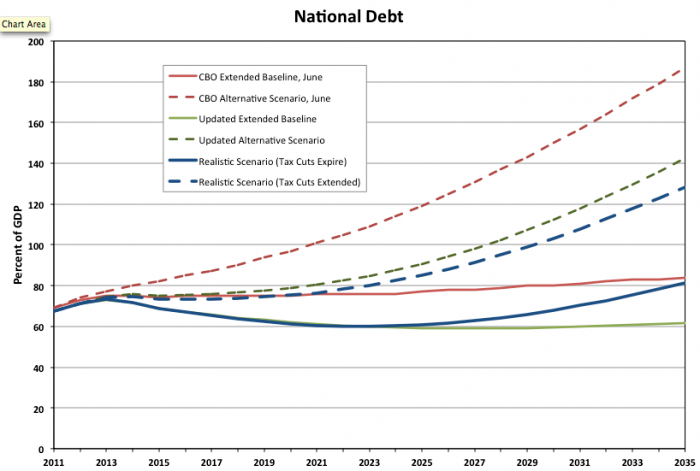
Back in October, I wrote a post laying out my long-term projections for the national debt, which were basically an adjustment to existing CBO projections. Peter Berezin recently pointed out a misleading ambiguity in that post. There, I used the same long-term growth rate of tax revenues in both my extended-baseline scenario and in my “realistic” scenarios. I got that long-term growth rate from the CBO’s extended baseline scenario in its 2011 Long-Term Budget Outlook, which assumes that current law remains unchanged.In my realistic scenarios, I assumed that the AMT would be adjusted through 2021 but that the long-term growth rate would apply thereafter. I didn’t say anything explicitly about the AMT after 2021, but by using the long-term growth rate from the extended baseline, I was implicitly assuming that the AMT would not be indexed after 2021.
2012 Predictions
Last year ASPO-USA brought together a host of leading thinkers and their predictions for what to expect in 2011. While not all the predictions were on target, last year’s thinkers and leaders on energy issues were remarkably prescient, accurately anticipating among other things Arab Spring, the flow of energy prices, the re-emergent world food crisis, and the next step in the Transition movement. While foreseeing the future is a delicate exercise, there are real trends that are evident to eyes prepared to see. Here are their thoughts about the coming year. A Hopeful New Year to all from ASPO-USA!
COLIN CAMPBELL
“Oil and gas are finite resources formed in the geological past, which means that they are subject to depletion. For every gallon used one less remains, and the more we use the steeper the decline. A debate rages as the date when production peaks but misses the point when what matters is the vision of the long decline on the other side of it, which is beyond dispute. The main reason for the uncertainty is the unreliable nature of public data due to lax reporting and ambiguous definitions. For example, the Oil & Gas Journal reports that 66 countries have unchanged reserves at the end this year, although it is manifestly implausible that new discovery and/or so-called reserve growth should exactly match production.
CHRISTINE PATTON
“An increasingly bankrupt American populace, enraged by a weakening economy punctuated by crises various and sundry, begins to boil over with belated recognition of the corruption which now appears endemic to the politico-corporo-financial system. With the presidential election looming, President Obama takes the time-honored path trod by Presidents, Kings, and Emperors before him and (reluctantly) triggers a military action aimed at corralling a desperately sabre-rattling Iran, which happens to have a not-so-subtly expanding nuclear program, a threatened capability to block the Straits of Hormuz, and the third highest amount of world oil reserves. Operation Duck and Cover distracts the public from the country’s growing tent cities and loathsome bail-outs, temporarily gooses a small battalion of corporate stocks with the anticipation of trillions in military spending, and incidentally triggers an apparently insane poison-pill shutdown of Iran’s several million barrels per day from the oil markets. On the bright side, the Pentagon plants an edible landscape. Hey… it could happen …
RAYMOND DE YOUNG
“As it becomes more acceptable to openly talk about the need to downshift our personal material expectations, a few geographic locations (e.g., Flint, Detroit) will come to realize this same need exists at the community level. In 2012, in a few locations, new governmental institutions will emerge (e.g., Departments of Descent) tasked with creating and implementing policies and procedures that intentionally shrink the services, infrastructure and political boundaries of cities, towns and villages.This intentional transition will not initially be driven by an understanding of the limits posed by declining net energy; the sole driver will seem to be local economic constraints. Nonetheless, the process will create a community-level response consistent with emerging bio-physical limits. And the very existence of these new institutions may diminish our psychological confidence in the role and predictability of centralized economic and political systems in our future affairs.”
AARON NEWTON
“The average U.S. citizen will lose one week of 2012 due to the pervasiveness of Presidential campaign commercials on TV. A structural collapse of the global financial system will usher in rationing of key items including some foods. Everyone will be sick of Mayan Calendar jokes by Mid-March.”(Aaron Newton is the Local Food System Program Coordinator for Cabarrus County, NC and raises chickens. He is the coauthor of A Nation of Farmers: Defeating the Food Crisis on American Soil.
JEFFREY J. BROWN
“The actions by many OECD countries aimed at encouraging consumption in the face of declining available global net oil exports can be seen as the OECD ‘Thelma & Louise’ Race to the Edge of the Cliff. I suppose that the ‘winner’ could be viewed as the first country that can no longer borrow enough money, at affordable rates, to maintain their current lifestyle. So, based on this metric, Greece would appear to be currently in the lead, with many other countries not far behind them.” I suspect that we will see a continuation of this trend, as more countries are unable to borrow enough money, at least from non-central bank sources, to fully fund their deficit spending. As this trend continues, I have concluded that there may be a global shortage of calculators, because most of the world seems either unable or unwilling to subtract domestic oil consumption numbers from domestic production numbers in oil exporting countries, in order to derive net export numbers, which are calculated in terms of total petroleum liquids. While it is true that the EIA shows that total liquids production worldwide, inclusive of low net energy biofuels, increased at 0.5%/year from 2005 to 2010, the use of a calculator shows that the global supply of net oil exports available to importers other than China and India (what I call Available Net Exports, or ANE) fell at 2.8%/year from 2005 to 2010. I estimate that the ANE decline rate will accelerate to between 5%/year and 8%/year in the 2010 to 2020 time frame.”
BART ANDERSON
“I’m looking at the Occupy and similar movements across the world. My prediction is that these movements will change the political landscape, more quickly and on a larger scale than most of us imagine. This is not a hard prediction to make, since power has become polarized and political opposition has been neutered. This is true not only in the US, but in Russia, China, Europe and the Middle East. My co-editor Simone has her eye on China.In good times, a population will put up with this, but we are facing continued bad times and cutbacks of some sort are inevitable. As in the 30s, we can expect something like Occupy on the left, and nationalism and scapegoating on the right.
STEVEN KOPITS
“In 2012, US natural gas prices finally bottom and start turning around, beginning a bull market in natural gas that reaches $6 / mmbtu or above. Shale oils continue to power the US economy. US crude oil production rises by 250 kbpd and breaks 6 mbpd barrier for the first time since 1998. The Chinese take notice and drill their first shale oil well during the year. The US economy stills wants to recover, but will it? Europe may collapse, and if so, oil prices will collapse in tandem, bottoming below $60/barrel. If Europe muddles through, then Brent oil tests the $130 threshold. US oil consumption, down 1.5% in 2011, drifts down another 1% in 2012, averaging 18.75 mbpd for the year and a full 2 mbpd less than 2007 levels.”
BOB WALDROP
“I predict that in 2012, things will go from bad to worse for lower income households, as they are targeted with a tsunami of austerity by rent-seeking elites acting to protect and expand their privileged economic positions and their access to government cash. The significant cuts programmed for the coming year in funding for programs at all levels of government that benefit lower income households, coupled with the continued deliberate suppression of free economic activity that would promote abundance for all, will accelerate the on-going devolution of the bottom 40% of the population. Homelessness, family dissolution, crime, domestic violence against women and children, alcoholism and drug abuse, abortion, and food insecurity will increase. We may see some beginnings of social unrest as people object and attempt to evade the collective fate programmed for them by the economic managers on Wall Street and at the Fed. In other words, in 2012 it will become increasingly evident that since there isn’t enough to go around, the preferred choice of our economic and political elites will be to leave the poor behind for the wolves to devour.”
HIRSCH, BEZDEK, & WENDLING
“We prefer to think in terms of the impending decline in world oil production, because world liquid fuels production has been on a fluctuating plateau since mid-2004 and because a small upward fluctuation in production is not of major economic importance. We expect the current plateau to continue. As to the timing of the onset of decline, we see no reason to change our conclusion of a year ago, when we forecast that the decline would occur in 2-5 years. That’s now 1-4 years. Note that the onset of decline will be masked by production fluctuations, so the actual onset date will necessarily have to be back dated. As we said previously, the realization of the decline in world liquid fuels production could occur at any time, triggered by political or market events.”
THOMAS PRINCEN
“My prediction is that the taboo against questioning material and economic growth will wane. Brought on in part by the inability of policymakers to “restart” European and American economies, people across the spectrum-from workers and mom-and-pop shopkeepers to oil company executives and hedge fund managers (ok, how about mutual fund managers? insurance executives? local bankers?) will be asking, What has a century of rampant growth done for me, for my community, for our planet? (Others of us will keep asking, What has a century of boom-and-bust mining operations, otherwise known as a “strong economy,” done for my children and grandchildren?)As the growth icon topples we can begin the conversation about living well by living well within the capacity limits of ecosystems, waste sinks, human cognition and social organization. We can begin to learn, dare I say, humility.”
RON SWENSON
“While Solyndra (with questionable technology at best) created a tempest in a (largish) teapot in 2011, the big story is that the solar energy industry continued its blistering double digit growth again with 24% more installations and 50% more manufacturing capacity globally, according to IMS Research.From the buyer’s perspective, the steep decline in solar (PV) prices was welcomed. At about $1/watt for panels, grid parity* without subsidies seems well within reach. But everything comes with a price; case in point, the price/share for many public solar companies has dropped an order of magnitude in one year. This is not sustainable, so there will be “corrections” in 2012 — temporary price increases, more bankruptcies, mergers and acquisitions — common growing pains in hot growth markets. The Chinese government will come to the rescue at a run and create aggressive incentives within its own domestic market. In the USA, in spite of impoverished Federal energy policy, the solar market will grow less aggressively in 2012 at 10% or more, with support at the local and state levels. In Europe, with higher prices for electricity and far keener awareness of fossil fuel limits (Peak Oil, Climate Change) the improved hardware prices will support continued renewable energy market growth albeit at lower rates than 2011.”
* electricity prices the same as that generated from coal or natural gas
RICHARD HEINBERG
“Last year, in a contribution to ASPO’s annual predictions for the coming year, I played it safe with a forecast for a 30 percent increase in Asia Pacific coal prices. Check. A less cautious reading of omens is called for in 2012: even though the variety and severity of risks at play makes for uncertainty, mapping those risks may at least help us prepare ourselves psychologically, if not practically, for what’s in store.It will be truly miraculous for Europe to avoid at least a recession this coming year, if not a fully-fledged financial meltdown, and ensuing economic contagion from the EU will almost certainly infect US markets. This makes forecasts for oil prices difficult-to-pointless. Tightness of supply-which would otherwise push prices up-may be more than counterbalanced by an economic downturn, which will reduce energy demand and therefore energy prices. Gold and silver prices may likewise take a hit. Look for continued low natural gas prices in the US to take a toll on the fracking gas industry, with at least one major player selling out or going bankrupt.
Look also for declining economic strength in China. That country is aiming for a soft landing, but events in Europe and in Beijing’s own real estate markets may turn cushions to anvils.
Predicting when and whether tensions between Iran and Israel will go ballistic is a fool’s game. However, only someone on an extended media fast could have failed to notice that those tensions ratcheted up way beyond factory specs in 2011. If hostilities erupt, all bets are off. No doubt there are trolls in Langley and the State Department hard at work this very moment trying to figure out how to keep an isolated aerial attack from spinning into global economic and geopolitical mayhem, but it will be a challenge to keep even the best-laid contingency plans on track. Relations between the US and Pakistan seem set to deteriorate further, and disputes surrounding oil and mineral rights in the South China Sea are likely to intensify, clouding the geopolitical crystal ball to opacity and making nasty surprises more likely.
With the US lurching inexorably toward elections in November, expect the current administration to make every effort to keep the lid on the economy over the short run, no matter what the long-term cost-and, given the penurious condition of the Treasury, that means all the heavy lifting will be up to the Fed. As austerity measures take hold, US states, counties, and cities will take the brunt of the economic impact. Households around the world will increasingly feel pinched. Despite police and army crackdowns, the global end-of-growth uprising (otherwise known as the Arab Spring, the European economic riots, and the Occupy Wall Street movement) can do nothing but grow.
Expect a series of disasters this year to rival or perhaps even surpass the floods, fires, droughts, and industrial accidents (Deepwater Horizon, Fukushima) of 2010 and 2011. Specifics are impossible to predict in this regard, but the momentum of global climate change is increasing, while the environmental costs of maintaining the world’s energy supply are burgeoning.
Do not expect the fulfillment of a faked-up Mayan prophecy of doom in December. We have many more years to look forward to, though they’ll be mostly characterized by economic, political, social, and geopolitical turmoil-and environmental degradation-until the world finally begins to adapt proactively to tightening resource limits. However, 2012 will probably feel a bit scarier than the last couple of years, during which the world’s political leaders and central bankers made extraordinary efforts to temporarily halt the unraveling that started in 2008 with a historic oil price spike and the popping of the world’s biggest-ever credit bubble. The available ammunition (stimulus and bailout packages) is nearly used up, while inherent problems (towering debt burdens and a shrinking resource base) are only intensifying.”
2012 looks to be an interesting year …