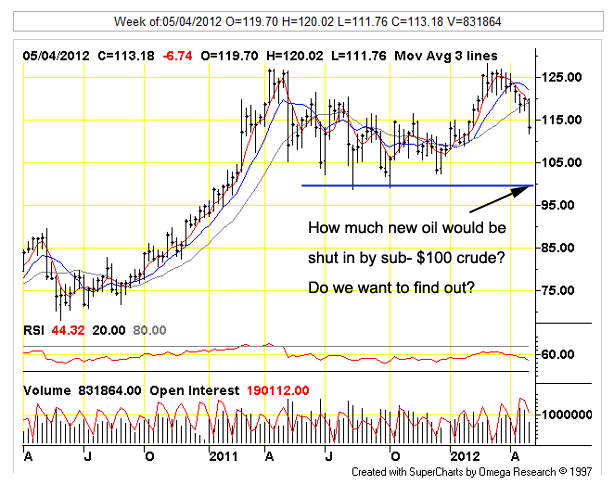
Figure 1: Brent crude weekly futures chart by TFC Charts (click on for big): Fuel prices decline because there is less credit available to support the price, yadda, yadda, yadda …
Estimable Gregor Macdonald had an interesting bit the other day regarding the last TED circus. For those unfamiliar The TED, here is their webpage:
“TED is a nonprofit devoted to Ideas Worth Spreading. It started out (in 1984) as a conference bringing together people from three worlds: Technology, Entertainment, Design. Since then its scope has become ever broader. Along with two annual conferences — the TED Conference in Long Beach and Palm Springs each spring, and the TEDGlobal conference in Edinburgh UK each summer — TED includes the award-winning TEDTalks video site, the Open Translation Project and TED Conversations, the inspiring TED Fellows and TEDx programs, and the annual TED Prize.
The prize being a shiny new car no doubt. Basically the TED is ignorable waste of time due to self-congratulation-without-limit and its hammer-meets-nail fixation on computers. It is a launch pad for tomorrow’s crop of wannabe technology oligarchs who have no real products but highly developed marketing skills. The TED events give pilgrims a chance to hone their skills on defenseless victims: each other.
Gregor introduced a new kid on the Economic Undertow block: Paul Gilding:
… it was perhaps surprising but also encouraging that the January 2012 TED conference finally addressed the subject of Collapse, by inviting Paul Gilding to give his talk The Earth is Full (opens to video).I’d actually seen a version of Gilding’s talk at the Ilhahee Lecture Series here in Portland last fall. Gilding’s view is that we’ve reached a relationship between global population and available natural resources, that makes it inevitable that the economy—a converter of natural resources into goods—will sharply slow down, if it has not started to slow down already. Gilding can be thought of not as a neo-Malthusian, or a doomer, but rather as an ecological economist. (As most readers know, I share this same view.) Gilding looks at trailing historical growth rates — again, the rate at which natural resources are converted to industrial and population growth — and concludes that the future size of the economy at these growth rates would create a machine that the earth simply cannot sustain. Again, I agree.
Gilding’s observations regards limits and are familiar to readers here, at the same time he doesn’t scare the horses:
There are two key issues to making this the case. Ecosystem lags – the delay between action e.g. emitting CO2 pollution and response e.g. the climate changing – and the inherent risks in a highly integrated global economy i.e. the low margin for error when a globally impactful crisis hits.We learnt the latter in 2007/8, which many now believe was triggered by record oil prices sucking money out of the US economy, causing sub-prime mortgages to default and almost bringing down the global financial system. This is a good example of systemic risk vs theoretical markets. In theory higher oil prices just reduce demand and encourage alternatives but in reality change happens fast and markets can’t respond, leading to complicated impacts. As we saw, our now tightly wound and integrated global economy can thus be easily shaken to the core by a relatively normal event such as high oil prices.
This argument is not idle, having been similarly made by James Hamilton and Jeff Rubin. What happens on the crude and related markets matters.
It’s semantics whether the current price run up/mini-spike in Brent futures prices is/was a ‘shock’ or equivalent to the 2008 spike: I say ‘tomayto’ you say ‘tomahto’. There have been a series mini-spikes and retreats, of smaller price run ups and consequent declines; this post-2008 interval has been punctuated by firm- then market- now sovereign bankruptcies. These bankruptcies appear to be closely coupled to rising fuel prices: demand destruction is more serious now than it was in 2008 which primarily effected firms and households. The bolt to $128 two months ago might have been sufficient to unhinge the Chinese economy and send it over the edge.
There are two opposing forces at work: China is dependent upon external sources of credit and foreign exchange. Its economy is an integral part of the overseas supply chain, its trade — the bulk of its economy — almost entirely takes place using euros and dollars rather than in its own currency. Difficulties among China’s customers reduces capital flows to China. Europe is in a recession, China feels pain because she can’t sell as many goods nor can it gain as many euros.
China like Greece must pay increasing amounts of hard (overseas) currency for fuel and other inputs. Its bid moves the price: here is the First Law of economics in action: the costs associated with China’s existing euro surplus are greater than the euros’ worth … and are increasing. China must diminish its surplus by spending euros but its overall currency position — like that of JP Morgan-Chase’ London Whale — is too large to liquidate.
China instead swaps some of its currency surplus into slightly smaller but still large commodity surpluses. The surplus-related costs haven’t been eliminated, instead they has been spread around China’s economy. The effect of the increased costs is inflation inside China.
Meanwhile, China cannot spend euros it does not earn. Having spent on commodities as stores of wealth, China must spend more to support price. China now lacks the new euros to do so. China is trapped by her own mercantile dynamic: she must sell goods for euros at the same time she has too many euros!
What China should do is buy more EU and US finished goods but she cannot. China can buy commodities and store them but not finished goods as her workers cannot afford them: China is a selling machine, only.
China’s past euro earnings pushed commodity prices higher while China’s current euro non-earning undercuts the same prices. How this turns out is anyone’s guess but right now the process indicates lower bids for commodities in China: the bids strangled by diminished credit in Europe caused by high prices of crude, the slowdown in capital flows chokes the Chinese capital-dependent economy while it must manage the high costs of currency surpluses. As Gilding points out: “the inherent risks in a highly integrated global economy”.
This leaves out entirely the matter of whether the euro itself will vanish and what will become of China’s euro hoard under the circumstance. For China to save herself ahead of the onrushing debacle would mean dumping euros at the market and precipitating the cataclysm she seeks to postpone.
Here’s gold:
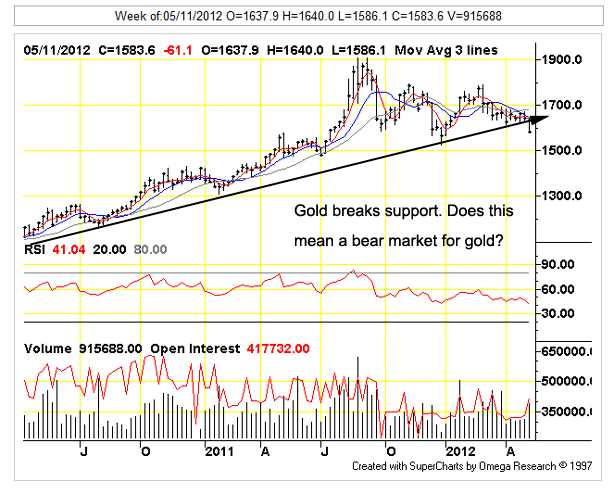
Figure 2: This is the cumulative weekly gold chart: in the short term, gold has been in a bearish market for the past ten months. This is something to watch as metal prices declined during the ‘crash’ phase in 2008: the bear market in gold remained intact with no new highs until late Autumn of 2009:

Figure 3: this is the gold monthly chart: this chart and others from TFC Charts (click on for big). The 2008 decline in gold began while fuel prices were sharply increasing. The current consolidation began in September, 2011, while petroleum prices were likewise increasing. While past performance does not assure future results, it is necessary to consider whether gold is sending the same sort of economic signal it offered during the Spring of 2008. Gold is a core asset for finance firms: unlike shares or mortgage-backed securities it is not generally offered unless margin calls must be met and other assets are either unavailable or not worth enough.
The indication is that there are margin stresses building up within establishments that leverage gold or gold- derivatives. There are arguments offered that there is paper selling against the buying of physical but the price speaks for itself: there are more sellers than buyers with funds. The same means of support for crude prices exist for the gold prices. While the high price of gold does not effect availability of credit — nobody burns their gold for fun — the high price of crude reduces the amount of credit available to bid for gold.
The implications are serious: the ongoing cheerleading efforts on the part of the establishment effects assets. This includes endless moral hazard, foreign-exchange rate manipulation, ZIRP and various ‘easing’ programs. Funds flow from finance toward assets for the purpose of finding speculative returns. Some of these assets are economically vital inputs. Economists airily suggests that one input will substitute for another at some price level: what is not understood by economists is that the required price level to effect the substitution is probably unaffordable. For instance, it is technically possible to have nuclear powered automobiles if for no other reason than we have already nuclear powered ships and submarines.
(Un)fortunately, nobody can afford a nuclear-powered car so there is no economic cause to build one. What remains is alternate substitutions: in place of cheap petroleum, autos, freeways, fly-overs, parking garages, suburbs, retail malls and office towers and all that go with these things … there is shoe leather.