
From the ‘No policy is in effect until it is officially denied’ department, the latest word is the US is close to becoming the world’s Number One at something besides porn and college football:
US may soon become world’s top oil producerJonathan Fahey, (AP)
U.S. oil output is surging so fast that the United States could soon overtake Saudi Arabia as the world’s biggest producer.
Driven by high prices and new drilling methods, U.S. production of crude and other liquid hydrocarbons is on track to rise 7 percent this year to an average of 10.9 million barrels per day. This will be the fourth straight year of crude increases and the biggest single-year gain since 1951.
The boom has surprised even the experts.
“Five years ago, if I or anyone had predicted today’s production growth, people would have thought we were crazy,” says Jim Burkhard, head of oil markets research at IHS CERA, an energy consulting firm.
The Energy Department forecasts that U.S. production of crude and other liquid hydrocarbons, which includes biofuels, will average 11.4 million barrels per day next year. That would be a record for the U.S. and just below Saudi Arabia’s output of 11.6 million barrels. Citibank forecasts U.S. production could reach 13 million to 15 million barrels per day by 2020, helping to make North America “the new Middle East.”
That story was picked up by Ezra Klein at the Washington Post, followed shortly by the back-tracking:
The U.S. isn’t quite ready to catch up with Saudi Arabia on oil…Posted by Brad Plumer (WaPo)
Here’s an eye-catching lede from the AP’s Jonathan Fahey: “U.S. oil output is surging so fast that the United States could soon overtake Saudi Arabia as the world’s biggest producer.”
It’s a great story, but it could use a bit of dissecting. There’s no question that U.S. oil output has surged in recent years. But we’re not quite ready to catch up with Saudi Arabia just yet. There’s a tiny asterisk in here that warrants a fuller explanation.
U.S. crude oil production has increased dramatically in the past year, thanks to a drilling boom in places like North Dakota. That’s helped the U.S. reduce its imports. But we’re not likely to catch up to Saudi Arabia anytime soon. What’s more, Saudi crude is generally cheaper and easier to produce than America’s “unconventional” oil from shale rock. That gives the Saudis enormous sway over oil markets.
So what is the AP referring to? The trick is to look at what the EIA calls “total oil supply.” This isn’t just crude oil. It also includes natural gas liquids, biofuels, and the processing gains from refineries.
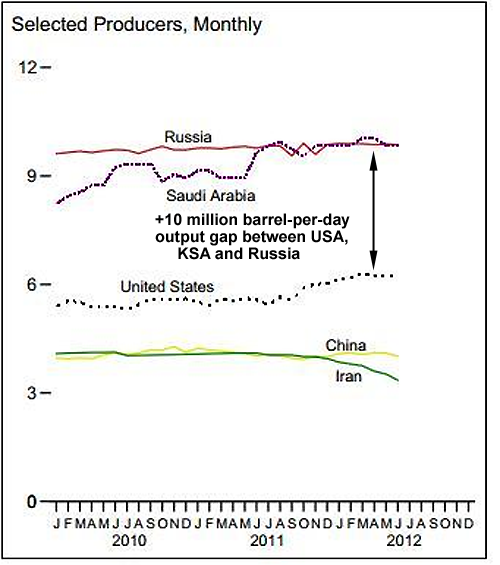
Feel the rippling power of that surge: note those weasel words. The establishment has no pleasant answers so it simply lies. When the lies prove laughable, it puts itself on all sides of the issue. Unsurprisingly, citizens develop a cynical attitude regarding the establishment themselves, they really don’t have a clear idea where to turn.
Imagine the National Weather Service being run the same way as the US Department of Energy. Instead of clear warnings of droughts, floods, tornadoes and hurricanes there would be misleading suggestions … for families with children to take vacations at the beach. Reality would be rationalized: not quite high surf, just yet rip currents, tiny asterisk heavy rain and winds. Models would show all storms heading out to sea … vacations would surge …
Instead of facts, there are self-serving manipulations. Here is Kurt Cobb (Resource Insights):
Oil And Gas Industry Uses Deceptive Energy Independence Message to Push U.S. ExportsWith gasoline scaling $4 a gallon recently, plans announced last week by international oil giant BP to export U.S.-produced crude oil ought to have Americans howling. For such a plan to be good energy policy–rather than merely profitable for the oil industry–the United States would have to be producing more than enough oil to meet its own needs. But the country produces nowhere near that amount. Nevertheless, the industry’s deceptive campaign to make the public and policymakers believe that the United States is on the verge of energy independence seems to be succeeding–a push that is really just a smokescreen for selling the country’s oil and natural gas to the highest bidder.
So far this year the United States has produced 6.2 million barrels per day (mbpd) of crude oil plus lease condensate (which is the definition of oil) versus daily net consumption of 13.6 mbpd of finished petroleum products. The country is a long way from being free of oil imports, and as I’ll discuss below, there is no realistic prospect that we’ll ever produce enough oil domestically to satisfy our needs at the current level of consumption.
That’s why to date, except for minor sporadic shipments to a few countries and regular small shipments across the Canadian border, the U.S. government has allowed no other domestic crude oil to be exported. The BP request is presumed to be an attempt to bring oil produced in North Dakota to Canada’s refineries on its east coast. The oil produced in North Dakota trades at a $20 discount to oil currently being imported from Europe by Canadian refineries.
The plan is for executives to remove whatever resources are available here in the US and sell them to the highest bidder. In a way, the process is a form of resource conservation … something not likely to go over with consumers … if they were to understand.
Lying is the American Way: Rebecca Solnit (Tom Dispatch):
Against the Destruction of the World by GreedChange the language and you’ve begun to change the reality or at least to open the status quo to question. Here is Confucius on the rectification of names:
“If language is not correct, then what is said is not what is meant; if what is said is not what is meant, then what must be done remains undone; if this remains undone, morals and art will deteriorate; if justice goes astray, the people will stand about in helpless confusion. Hence there must be no arbitrariness in what is said. This matters above everything.”
So let’s start calling manifestations of greed by their true name. By greed, I mean the attempt of those who have plenty to get more, not the attempts of the rest of us to survive or lead a decent life. Look at the Waltons of Wal-Mart fame: the four main heirs are among the dozen richest people on the planet, each holding about $24 billion. Their wealth is equivalent to that of the bottom 40% of Americans. The corporation Sam Walton founded now employs 2.2 million workers, two-thirds of them in the U.S., and the great majority are poorly paid, intimidated, often underemployed people who routinely depend on government benefits to survive.
You would think that $24,000,000,000 apiece would be enough, but the Walton family sits atop a machine intent upon brutalizing tens of millions of people — the suppliers of Wal-Mart notorious for their abysmal working conditions, as well as the employees of the stores — only to add to piles of wealth already obscenely vast. Of course, what we call corporations are, in fact, perpetual motion machines, set up to endlessly extract wealth (and leave slagheaps of poverty behind) no matter what.
They are generally organized in such a way that the brutality that leads to wealth extraction is committed by subcontractors at a distance or described in euphemisms, so that the stockholders, board members, and senior executives never really have to know what’s being done in their names. And yet it is their job to know — just as it is each of our jobs to know what systems feed us and exploit or defend us, and the job of writers, historians, and journalists to rectify the names for all these things.
Here is the problem: everything human in the world is reduced to machines that operate under machine rules with machine outcomes. The owners can claim with straight faces they have no say in the processes and results. They can also claim — and do — there is no alternative to the machines. While the first step includes putting the proper labels on the proper parts, the next step has to be deciding which machines are indispensable. Those would be the ones that pay their own way … a hard school indeed.
This is the intermediate stage of what will become the New Economic Undertow. The advantage of this version is it can be updated when necessary without my having to remember old formatting code needed to recreate the pages. However, the final version has to be installed over top of this one: it’s a complex process (and I have to figure out how to do it). The final version will have characteristics of both the old blog and this one, that is, it will look more like the old blog but will have features of this new one. For example, the article pages are good, the final version will be de-cluttered. The front page will have summaries instead of complete articles. The only external links (outside of those in articles) will only be with those who link back here. Right now, the various feeds and whatnot should work. As always, there will be no ads except for Economic Undertow merch and related whatnot. I haven’t decided whether to keep the comment section or not.
🙂
Thanks for everyone’s patience.
I am in the process of writing what will become the New Economic Undertow Book (that’s not the title). I cannot predict how long it will take to finish (because I have never written a book before). In the meantime, I will write here as well as work on the book, since I say the same things over and over on the blog, most of you won’t notice.