The following articles and videos need little in the way of explanation:
Gail Tverberg on petroleum fuel:
Lower Oil Prices – Not a Good Sign!
Are lower oil prices good news? Not really, if it means the world is sinking into recession.
We know from recent past experience and from common sense that higher oil prices are a drag on oil importing economies, since if more $$$ are spent on the same amount of oil, there is less to spend on discretionary goods and services. In addition, oil money sent to oil exporting countries is likely to be spent within those economies, rather than being reinvested in the oil importing country that the funds came from.
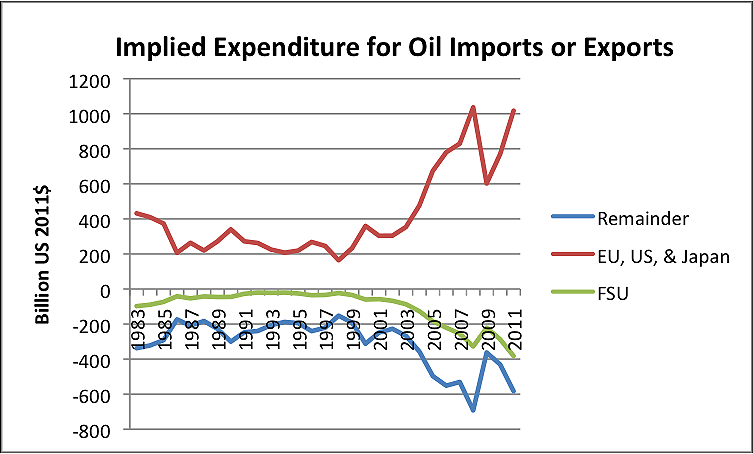
Figure 1. A rough calculation of expenditure (in 2011$) associated with oil imports or exports, based on 2012 BP Statistical Review data, for three areas of the world: the Former Soviet Union (FSU), the sum of EU-27, United States, and Japan, and the Remainder of the World. (Negative values are revenue from exports.)
A rough calculation based on 2012 BP Statistical Review data indicates that the combination of the EU-27, the United States, and Japan spent a little over $1 trillion dollars in oil imports in 2011–roughly the same amount as in 2008. Governments have been running up huge deficits and have been keeping interest rates very low to cover up this damage, but it is hard to make this strategy work. The deficit soon becomes unmanageable, as the PIIGS (Portugal, Italy, Ireland, Greece, and Spain) countries in Europe have recently been recently been discovering. The US government is facing automatic spending cuts, as of January 2, 2013, because of its continuing deficits.
Anyone paying attention @ Economic Undertow is familiar with Gail’s argument: the same high price of crude oil that unravels the waste-based economy is the price needed to bring new oil to markets. Here is another economic paradox: we burn value so as to ‘afford’ more value to burn. This is as pointlessly counterproductive as burning gold.
Nouriel Roubini on money (Bloomberg):
Roubini excoriates system management, the absence of banking system accountability, the inherent conflicts of interest within banks and institutional bloat: The ‘Too Big to Fail’ banks are bigger than they were in 2008:
“The core of the Eurozone does not want to take on the credit risk involved in any variance of credit mutualization … you will have a worse crisis, not six months from now but another, bigger crisis in the next two-weeks … It’s a perfect storm … you could have a collapse of the Eurozone, a US double-dip, a hard-landing of China, a hard-landing of emerging markets and war in the Middle East …”
David Roberts explains climate change simply enough even an economist can understand (TEDx, The Evergreen State College):
If we keep the pedal to the metal we blow up the entire human science experiment. Humans give ‘intelligent life’ a bad name.
The outcome of a measly 0.8° C (from Bloomberg): How about $10 corn?
U.S. Corn Growers Farming in Hell as Midwest Heat Spreads
Jeff Wilson (Bloomberg)
The worst U.S. drought since Ronald Reagan was president is withering the world’s largest corn crop, and the speed of the damage may spur the government to make a record cut in its July estimate for domestic inventories.
Tumbling yields will combine with the greatest-ever global demand to leave U.S. stockpiles on Sept. 1, 2013, at 1.216 billion bushels (30.89 million metric tons), according to the average of 31 analyst estimates compiled by Bloomberg. That’s 35 percent below the U.S. Department of Agriculture’s June 12 forecast, implying the biggest reduction since at least 1973. The USDA updates its harvest and inventory estimates July 11.
The Dust Bowl drought period lasted from 1932 until 1939. Imagine seasons-long heat waves and continuous droughts from now until 2020 across the US. Farmers irrigate using water pumped from the Ogallala Aquifer however this requires diesel fuel for the pumps as well as water in the ground. Expensive diesel fuel means very pricey corn or corn that bankrupts the customers who buy it. Absence of ground water means no farms at all and serious declines in yields.
A small adjustment of price at the margins is all that is necessary to make a particular venture unaffordable. Food price increases have outsized rebound effects on politics in the developing world where there are either droughts or massive floods. Compensating for climate effects requires more energy which in turn effects the credit markets. Attempting to resolve one set of problems amplifies others elsewhere, meanwhile large numbers of people are vulnerable.
Swiss reserves jumped an incredible CHF 59B ($61B) in June. The only question in my mind is, “How long can this last?” Switzerland can’t increase reserves on an unlimited basis; they can’t absorb Euro60B a month.The current boss at the Swiss National Bank (SNB), Thomas Jordan is responsible for the Peg policy that is behind the unwanted reserve creation. It’s important to remember that Jordon is relatively new to the job. He stumbled into the hot seat when the former head of the SNB, Philippe Hildebrand’s wife got nailed trading currency when she shouldn’t have been.
Jordan is a well-educated technocrat who is also an old hand at the SNB. He inherited the currency peg policy from Hildebrand, but history will mark his name in the books if the policy fails. I’m sure that Jordon is aware of this. What’s his state of mind?
Jordan doesn’t have the full support of the government behind him. The same domestic politics that successfully dumped Hildebrand are working against Jordon.
If Switzerland is to maintain the current 1.2000 peg to the Euro, there has to be something more in the offing. The endless intervention is not going to work. The FX market is much bigger than the capacity of the SNB. The only option left for Jordon is exchange controls and a complete shutdown of the Swiss border. Jordon has hinted that these steps are coming on several occasion in the past month.
When Switzerland adopts exchange controls, the rest of Europe will soon follow. What will be the global market response from these measures? It will scare the crap out of capital. I think exchange controls will bring a panic; there is no safe place to hide in a panic. The possibility of this happening is not in the price of assets today.
Here we go again: as Greeks and others remove euros to Switzerland, the central bank exchanges them at a fixed rate so that the franc does not become scarce/expensive. The outcome of a pricey Swiss franc is a teetering balance sheet along with hyper-expensive exports: ‘Heidi’ videos, leather shorts, cuckoo clocks and cheese with holes in it.
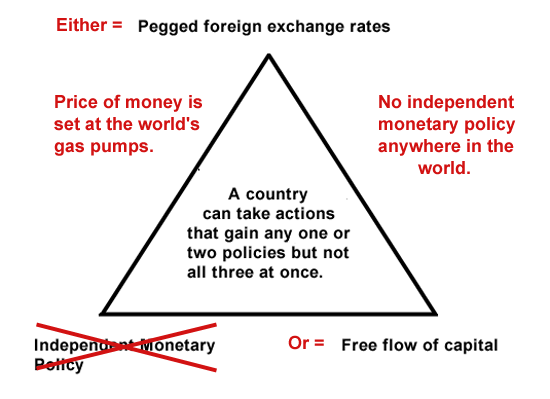
The petroleum swap is able to set the money price effectively is because there is an upper bound: a fuel price where the economy stops working. There are few other goods with upper bound effects, interest rates on borrowed money is another one.
Central banks and others attempt to set the price of money by ‘fixing’ or manipulating interest rates: there are ‘bond vigilantes’, ‘Libor rigging’, central bank bond-buying and ‘Quantitative Easing/QE’. Meanwhile, petroleum mass-consumption has shifted the credit-cost of money toward the petroleum-cost of it. Central bankers are fringe players in this new game: zero-percent reserve rates and other policies don’t work any more. There is the hated liquidity trap, the pushing of the string, central banks without relevance.
Credit costs push higher as lenders vanish. In Spain and the other Mediterranean states there is a credit embargo and rate arbitrage between countries. The effect of high rates is identical to the effect of high petroleum prices: one can be considered a proxy for the other.
The underlying meme is complex: the shift is from endogenous to exogenous ‘money’. Instead of the fiat variety we have resource-based ‘petro-money’ that is no different from the gold-standard. The world is stuck hyper-deflationary money and a pitiful helpless establishment.
What happens next? The short answer is there will be no more euro. Exchange controls would be a repudiation of the basic euro principle, its reason to exist in the first place. All the European countries face the same flows of flight capital as the currency peg is destroying the euro-economies one by one. Controls would be the signal to panic. There would be the race for the exits at one time. The countries would install controls to keep what capital they have from fleeing. At that point there is only the name, euro.
Price Data Suggest Specter of Deflation in China
Keith Bradsher (NY Times)
Prices are tumbling across the Chinese economy, according to government data released Monday, as a flood of goods pouring out of the country’s factories and farms exceeds anemic demand from Chinese households and businesses.
The downward trend makes it much harder for businesses to sell enough goods to repay loans that they took out, usually on the expectation of rising prices. Falling prices also discourage investment, which had slowed sharply this spring, and gave consumers an incentive to delay purchases until prices could fall further.
The news of falling prices, together with a pledge by Prime Minister Wen Jiabao on Saturday to maintain stringent bans on real estate speculation, produced a slide Monday in mainland Chinese stock markets. The main index of the Shanghai stock market dropped 2.4 percent, while the Shenzhen stock market’s benchmark fell 2.2 percent.
China has been a candidate for hyperinflation to occur and still might, however declining interest rates and the slowdown of Wall Street lending in general mean the long-running carry trade bringing dollars to China has run its course. Without a flow of new capital, hyperinflation appears to be less likely. Fewer funds are also being imported by manufacturers as sales slow in Europe and the US.
The popular idea has been that money would fail first, then peak oil would arrive. Ten or twenty years down the road the first effects of climate change would be felt. The schedule gave us plenty of time to keep partying with the hangover put off as long as possible.
Peak oil in meaningful terms has occurred already. In 1998 a barrel of West Texas crude cost a little more than ten dollars. The world’s tank has been emptying ever since. The climate problem is emerging here and now … and money worth is vanishing fast. We’re running out of tools … and time … to make a difference.
The climate situation is probably the most challenging, to voluntarily cease business activities that will ultimately bring the end to business activities and pretty much everything else.
For thousands of years the human race has been managed by military men, adventurers and clergy. Bound by traditions, by often-contradictory internal rules, honor codes and the absence of institutional imagination, these two cadres directed human ambitions toward/against other humans. For thousands of years armies marched and empires rose and fell, shrines were raised up then toppled or abandoned. Meanwhile, the humans were never in danger of eradicating themselves because they lacked to tools to do so. The internal contradictions of management left the tools out of reach.
With modernity the management of society has devolved to merchants: ad managers, shopkeepers and money-lenders. As a consequence, human ambition has been directed against anything and everything indiscriminately and without any restraint. There is nothing in the way of tradition or honor to bind merchants and ‘entrepreneurs’ who only know how to steal, and promoters who only know how to lie.
It is past time to remove merchants from management roles and perhaps give them to farmers or some other group with more restraint. This is something that needs to be done before time runs out.