Now that the Wicked Witch of the North (Angela Merkel) has been turned to stone/burned at the stake and Europe saved for the next five minutes, all eyes turn toward China.
Falling Star
Jonathan R. Laing (Barrons)
The Chinese economy is slowing and is likely to slow a lot more. Get ready for a hard landing.
After three decades of annual growth averaging 10%, China’s bullet-train economy is slowing markedly. Economic problems in Europe and the U.S. are stunting export growth, long the primary driver of China’s economic miracle. Growth in industrial production has likewise been decelerating for months. This year growth in gross domestic product could slip to 8%—and it may get a lot worse from there. Though recently announced interest-rate cuts and a ramp-up in the government’s already massive infrastructure spending could postpone the day of reckoning, to us it looks like the Great China Growth Story may be falling apart.
A comprehensive report by Nomura Global Economics issued late last year entitled “China Risks” paints at least one scenario in which China’s growth would fall in half to under 4%.
The Euro-zone is just as far away from Euro-bonds, Euro-reform, Euro-conservation and Euro-salvation as it was two weeks ago, Merkel is just as belligerent, the region is just as broke and dependent upon external sources of both credit and fuel as it was two weeks ago … certainly none of these problems apply to China, right?
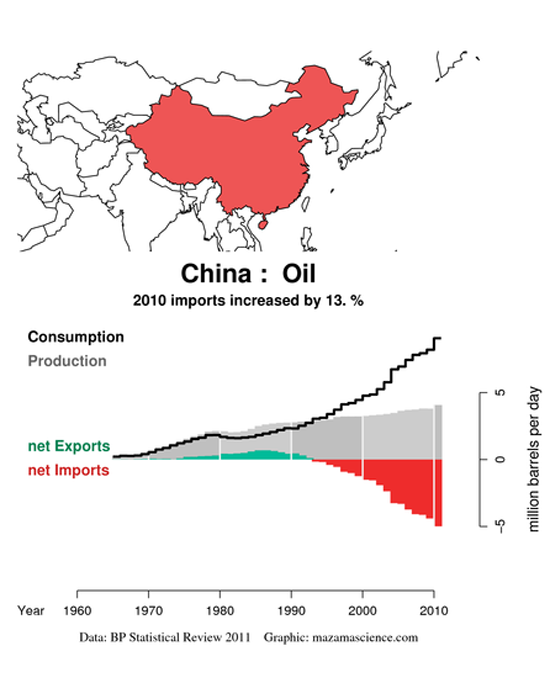
Figure 1: China’s petroleum consumption massively increases, it does so at the expense of China’s overseas customers. We can see how this works in the unraveling markets outside of China. Analysts believe non-remunerative fuel waste can increase endlessly into the future, one look at China’s exponential consumption should put an end to such nonsense. China depends on overseas merchandise sales to the same countries that China’s expansion starves of fuel.
Here is distributed vulnerability in a zero-sum world: China is as dependent as Greece on outside capital, almost as dependent as the US on petroleum imports. China isn’t support for the world economy, it cannibalizes the world economy instead: petroleum consumption chart is from Jonathan Callahan’s excellent Mazama Science Energy Export Databrowzer (BP Data).
China is no slouch in the production department but its consumption is out of this world, with a proportion of imports to domestic production similar to the US. With its ballooning auto fleet China is increasingly dependent upon petroleum imports. China also requires a flow of hard currency from outside the country which it uses to purchase the fuel. The yuan does not trade in forex markets: China is unable to ‘borrow’ fuel or gain it by seigniorage as do the US and the EU. It is left with the ‘poison dog food for oil’ trade.
Here are the US and Chinese energy consumption charts side-by-side, (Click on chart for big):
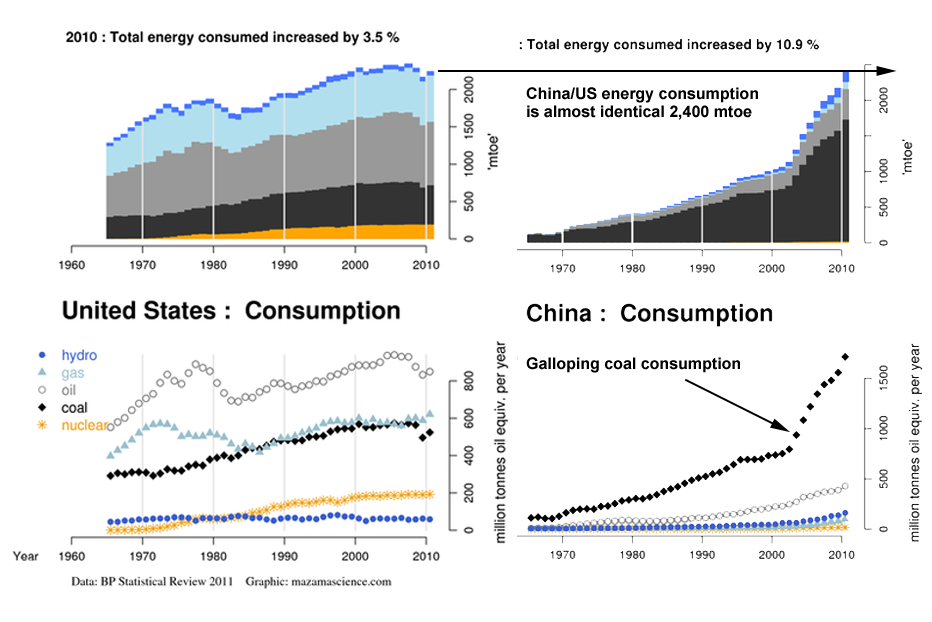
Figure 2: US and China consumption is virtually identical, the Chinese burn much more coal. Waste-begets-waste: China export trade is cheap coal in the guise of near-worthless consumables, an energy subsidy to US ‘consumers’.
| According to the International Monetary Fund the US nominal GDP for last year was: | US$15.094 trillion. |
| According to the IMF the China nominal GDP in US dollars for last year was: | US$7.298 trillion. |
What this means is China is structurally half as productive as the US: to obtain the same unit of output as super-guzzler USA China must burn twice as much fuel. For China to have the same level of goods- output as the US it must double its already staggering fossil fuel waste or reconfigure its energy use infrastructure to be twice as efficient. It is hard to see how the Chinese can do this on top of the massive (mal)investments already made in the capital-intensive sectors.
The use of coal speaks for itself: China has built the cheapest possible energy base for a Victorian-style manufacturing economy. According to a 2007 MIT report:
China is currently constructing the equivalent of two, 500
megawatt, coal-fired power plants per week and a capacity
comparable to the entire UK power grid each year.
Power plants have life-spans of 50 years or more. The Chinese cannot afford to replace inefficient current plants with newer versions of the same plants, nor can China afford to abandon them. Nevertheless, to cut fuel use the Chinese have little choice but to do without, they have put themselves into the American ‘sunk capital’ quagmire. As Chinese resource waste declines, so must GDP.
It is hard to imagine Chinese industry having the capacity to physically move energy goods into- and within the country at much more than the current rate. Like everything else, fuel acquisition and handling is subject to diminishing returns.
China burning twice as much coal would blow out our planetary life-support due to excess CO2 emissions and knock-on effects. Chinese fuel waste processes are collateral for loans to Chinese oligarchs and nothing more: burning more coal would be the equivalent to robbing a bank by blowing up the city where the bank is located with a nuclear weapon.
Because China is dependent upon capital flows from outside the country, slowdowns elsewhere such as Europe adversely effects China company sales, this in turn effects consumption within China. The slowdown in capital flows follows flows in goods which bounces back into capital flows in a self-reinforcing cycle.
Slowdowns emerge among China vendors such as coal exporter Australia which is staring at a recession (Fureyous):

Figure 3: Yields on Australian credit issues, the inverted yield curve is an alarm bell. Anyone looking for signs of the 2008 credit crisis would have predicted it after seeing the obvious negative Treasury yields in 2007. The curve is inverted when longer duration government debt trades at a higher price (lower yield) than rediscounted debt, the price of which is defended by the central bank. Inverted yield curves indicate lower long term interest rates — and a recession — in the future.
Australia is in the middle of a credit-driven real estate ‘bubble’[1] which makes that country vulnerable to declines in asset prices and increases in unemployment. Capital flowing into Australia rewarded miners and real estate lenders, the capital flowing out of Australia is in the process of stranding the same businesses: look for a sharp decline in house prices and many defaults on high-priced mortgages, look for subsequent Australian banking failures.
Energy constraints are amplified by currency repatriation and dollar-preference worldwide. Priced in crude, dollars have worth: here is the world’s inadvertent monetary policy. The ‘price’ of money is set at gas pumps by millions every single day.
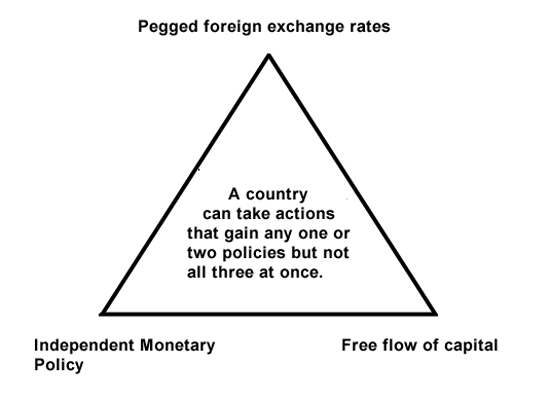
Figure 4: Here is China’s Unholy Trinity along with everyone else’: there are currency pegs with China and her trading partners, monetary policy is set in the world’s filling stations.[2] The world’s monetary regime has become inflexible. What remains for China and its vendors is the free flow of capital: bank runs and cross-border capital flight which are underway right now.
The same conditions hold true in the EU with its fixed exchange rate nonsense and Europe’s fuel waste setting monetary policy. These areas have the choice of conserving energy — to sever the relationship between fuel and money, to ‘go off’ crude as nations went ‘off gold’ in the early 1930s. Or they can endure fatal bank runs leading to financial system collapse.
None of this is optional or subject to negotiation. The rigidities that the establishment appears willing to support to the bitter end allow for no other outcome. The argument is that economies can grow without increasing energy waste, that money can be decoupled from fuel. It can, but not in the way that the establishment hopes for. One way or the other there will be conservation of energy and other resources. It will be accepted voluntarily or it will be imposed at the (empty) ATM machine or at the point of a bayonet.
Additional symptoms of China distress emerge as the various Ponzi schemes that make up the Chinese economy are exposed. If resource waste was truly productive there would be no need for such schemes in the first place as running wasteful machines in circles would pay for itself. The emergence of these schemes — and others — is suggestive of the fundamental earning incapacity of the waste-based regime.
Anyone looking for evidence that money is brain poison has to look no further than China: Craig Tinsdale notes The Looting of China by the Kleptokapitalist Bourgeoisie Roaders, long-time China expert Patrick Chovanek describes how Chinese non-response to US complaints about China company bookkeeping threatens to have all Chinese companies deregistered from US exchanges. While this last step is unlikely, it is reasonable that most if not all US-listed Chinese companies are accounting control frauds created specifically to take advantage of the ‘Super-China economic growth miracle narrative’ and the associated suckers. Here is John Hempton’s take:
China is a kleptocracy. Get used to it.I start this analysis with China being a kleptocracy – a country ruled by thieves. That is a bold assertion – but I am going to have to assert it. People I know deep in the weeds (that is people who have to deal with the PRC and the children of the PRC elite) accept it. My personal experience is more limited but includes the following:
(a). The children and relatives of CPC Central Committee members are amongst the beneficiaries of the wave of stock fraud in the US,
(b). The response to the wave of stock fraud in the US and Hong Kong has not been to crack down on the perpetrators of the stock fraud (so to make markets work better). It has been to make Chinese statutory accounts less available to make it harder to detect stock fraud.
There are also banking system alarms in Chinese media, that finance is over-leveraged with bad loans multiplying.
The ongoing China exposé is suggestive: Warren Buffett’s naked swimmers appear therefore the tide must be going out. What is seen right now is the tip of the crime iceberg: as deflation takes hold more naked swimmers and deformed monsters emerge. Consequently, the public loses confidence while the process feeds on itself. It will be interesting to see whether the Chinese crooks are more effective than their European- and American counterparts at the arts of finance can-kicking, ‘key-man propping’ and promulgating false hopes.
It is possible the Chinese — unlike the Greeks, Irish, Spanish and Americans — will explode in a blind fury and turn the country into a large and bloody version of Syria. Keep in mind that a large part of China’s petroleum consumption is immediately exportable …
Wasting resources produced an immediate short-lived statistical revolution at the expense of long-term stability. The future has been spent into the atmosphere for some easily stolen ‘wealth’, the outcome is inevitable resource starvation. Swapping poisoned dog food for the Disney-fied US-style waste-based economy turns out to be a horrible long-term trade for the Chinese.
Conventional remedies dance around reality. People presume the Eternal Kingdom is not subject to physical laws and natural conditions: that it cannot have recessions with negative-growth like all the other economies. An entire saga of economic rationalizations has been erected around the fantasy of endless Chinese positive GDP growth. When other economies flatten out the Chinese will be there with their 8% GDP to bail everyone out. This gives economic agents the luxury of doing nothing but wait for the Chinese to show up with bags of money.
While the waiting is underway, the idea is for the downtrodden Euro-zone to become more like China. How this is supposed to work is never explained but Spain, France and the rest are to become a source of cheap industrial labor, ready to slug it out in wage competition with the Chinese — or Bangladeshi — sweatshops. Here is the conventional remedy in the New York Times dolled up with some currency ‘devaluation’:
To Save the Euro, Leave It
By Kenneth C. Griffin and Anil K. Kashyap
A better, bolder and, until now, almost inconceivable solution is for Germany to reintroduce the mark, which would cause the euro to immediately decline in value. Such a devaluation would give troubled economies, especially those of Greece, Italy and Spain, the financial flexibility they need to stabilize themselves.
Although repeated currency devaluations are not the path to prosperity, a weaker euro would give a boost in competitiveness to all members of the monetary union, including France and the Netherlands, which is why they might very well choose to remain in it even if Germany were to gradually leave. A resurgence of manufacturing would also allow the vast unemployment rolls of Spain, Portugal, Greece and other countries to begin to decline. The tremendous loss of human capital and human dignity we are witnessing would ease.
Left out of this discussion is that Europeans cannot produce China-like GDP numbers unless they can waste energy at the same rate as China.
The Europeans are supposed to become China just as China implodes! The recycled solutions are easy mercantilism, easy currency depreciation, easy ‘flexibility’ and competitiveness. Mercantilism is rent-seeking at the national scale: it fails when everyone intends to become mercantile states. Currency depreciation fails when everyone tries to cheapen their currency at the same time. Doctrinal flexibility avoids non-industrial choices: the unintended consequence is self-reinforced rigidity.
The competitiveness concept applied to labor is intellectually dishonest. It is nothing more or less than industrial slavery, the race to the bottom. The term is a gross distortion of language: the idea suggests labor as a harmless child’s game. In the real world, the competitiveness ‘winners’ are entrepreneurs who use management monopoly and wage arbitrage to repress workers. The endgame is revolution because industrial slavery is intolerable.
Americans encountering wage competition cannot be counted on to endlessly consume: their rate of energy waste declines along with the Europeans. This impairs China capital flows: they find themselves in a competition with the US establishment for dollars needed to obtain fuel.
Minuscule manufacturing profits don’t matter because the infrastructure allows Chinese entrepreneurs to borrow vast personal fortunes leaving to the West’s customers and Chinese labor/depositors the burdens of repayment.
Mercantile ‘wealth’ is is skimmed from Chinese accounts and spirited elsewhere. The rats are fleeing another sinking economic ship.
China’s Rich Head for the Exit
Pan Kwan Yuk (Financial Times)
According to the two surveys … by rich list publisher Hurun Report and Bain & Co. … 60 per cent of about 960,000 Chinese people with assets of over Rmb10m ($1.6m) have already begun the process of emigrating or are considering doing so. The US was the top destination, followed by Canada, Singapore and Europe. But immigration officials in less obvious destinations such as St. Kitts and Nevis in the Caribbeans, as well as Bulgaria, are also reportedly seeing a sharp increase in interest from well-off Chinese.
Those in the best position to know inform by way of their actions the countries supposed to become more like it that China is not the plutocrats’ paradise it has been made out to be. Filling a country with malcontents, smokestack industries, racketeers and the world’s most monstrous real estate ‘developments’ makes Bulgaria a paradise by comparison.
While the discussion circles around the unscrupulous Chinese establishment, what unravels the Chinese economy is its own operation. Waste provides many opportunities to steal but less is gained with the passage of time. In twenty years the Chinese have built a colossus, they have little choice but to pick away at its margins while waiting for it to collapse under the weight of its own waste.
The remedy is to reduce centralized industrial production altogether so that distributed community supply can meet community demand. Without single-source manufacturing there is less distribution rents (mercantilism), this results in the elimination of middlemen and ‘fixers’ along with a diminution of the power of advertising as well as the end of industrial China as the economic model for everyone else.
Says Pu Zhiqiang (lawyer):
“No matter what, we must not lose confidence in justice and human nature. We believe this will overwhelm the leviathon (China establishment). Our aim is not to knock it off, but to ensure a peaceful transition after the fall.”
Sounds like Economic Undertow.
[1]
Debtonomics does not support ‘bubbles’, that is: bubbles do not exist within the framework of debtonomics as all credit expansion represents a bubble, rather there are changes in the rate of the supply of credit (Keen).
[2]
Note the pointlessness of central bank policies. Of the three points of the triangle, one cannot exist because there are no independent monetary policies: there are never such policies anywhere within the fuel-consuming (auto driving) world. The worth of money is determined continually by drivers voluntarily swapping it (or not) for a valuable resource. Petroleum is as gold was during the 1930s: the material basis for the world’s currencies … some more so than others.
The impossible trinity has the eurozone with a fixed exchange rate regime within the zone and the free flow of capital within (and without).
The impossible trinity has China with fixed exchange rates with its trading partners and the free flow of capital. When the Europeans install capital controls to address bank runs that will be the automatic end of the euro which is nothing more or less than a fixed exchange mechanism.
Capital controls in China means currency peg breakdown and successful speculative attacks on the yuan leading to China’s loss of forex reserves. At that point China — like Greece — will have difficulty importing fuel.