Let’s look at the new fuel-rationing dynamic, what substitutes in 2012 for reasoned energy policy built around conservation.
The Spanish banks are being leveled getting a bailout. The sources of bailout funds are ‘other’ banks, somehow this is supposed to matter. It doesn’t: we’re all Spanish banks now:
Spain Seeks $125 Billion Bailout as Bank Crisis Worsens
Emma Ross-Thomas, Charles Penty and Ben Sills (Bloomberg)
Spain asked euro region governments for a bailout worth as much as 100 billion euros ($125 billion) to rescue its banking system as the country became the biggest euro economy so far to seek international aid.
“The Spanish government declares its intention of seeking European financing for the recapitalization of the Spanish banks that need it,” Spanish Economy Minister Luis de Guindos told reporters in Madrid today. A statement by euro region finance ministers said the loan amount will “cover estimated capital requirements with an additional safety margin.”
Just seven months after winning a landslide victory, Prime Minister Mariano Rajoy was forced to abandon his bid to recapitalize Spanish banks without recourse to external help as a deepening recession forced lenders to recognize spiraling losses. Today’s move means Spain has a firewall in case the Greek election on June 17 unleashes a fresh round of market turmoil.
At least there are no illusions about this latest in the long series of bailouts being the ‘solution’ to anything. Rather, it is part of the sliding-down-the-drain process, where one futile gesture follows the next until the whole edifice of key-man props, bails, lies, unsecured-loans, coat-hanger wire and duct tape comes crashing down. Mercifully absent — so far — are the austerity theatrics that were foisted upon the hapless Greeks by Troika bogeymen. Instead austerity materializes as a poisonous vapor from the shadows where monsters lurk: chronic high unemployment with non-existent job creation, failed dependence upon real estate ponzi schemes and bankrupt government finance.
Here is a graphic that shows the real cause of the distress:
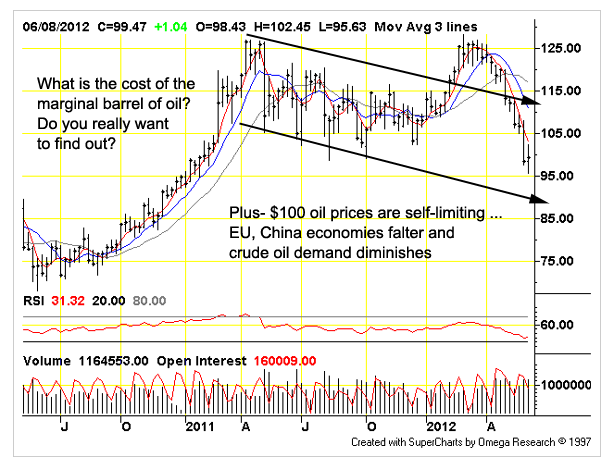
Figure 1: The weekly cumulative Brent futures contract by TFC Charts (click on for big). Markets rule, the price always tells the story. When crude prices rise, countries/companies/groups of workers/banking systems take twenty mortal murders on their crowns. The most-recent surge earlier this year parallels ongoing economic ‘slowdowns’ in Spain and China. The high price last Spring accompanied agony in Greece. The assumption is that high priced crude has no real effect outside of gas-customers’ attitudes and political leanings. A better assumption is that people pay for high-priced crude the way they pay for high-priced everything else: they borrow. This becomes self-defeating as the increase of lending pushes prices higher which requires still more loans.
Lenders eye precarious borrowers and mushrooming risk: instead of rolling over loans they demand repayment. This requires borrowing to take place outside of the ordinary transmission channels, by which the bulk of loans were made in the first place. New channels simply do not exist. Extend and pretend has been institutionalized over a period of decades across the modern world. The two-year loan is now the ten-year loan. The ten-year loan is the twenty. The loaned amounts in question expand exponentially as both principal and interest are financed.
As the borrow-to-repay charade expands both the borrower and the lender realize they’ve been had: borrowers cannot roll over their debts while lenders see principal investments vanish and are wiped out.
Finance channels are saturated, debt is unproductive. All new debts taken on are to service old debts rather than afford goods and services. Debts are ‘dead money’: the only way to retire them are by way of Ponzi schemes and loan-shark lending. Borrowers cannot find lenders because all sources have been tapped already. Lenders cannot find creditable borrowers. This was the entire point of globalization, to tap all sources of world capital, benefits lasted only until global demand for capital ballooned to consume it.
Finance-level lenders ration credit leaving vulnerable borrowers to crash and burn. This results in the destruction of borrowers’ petroleum consumption which is then exported to lenders’ countries. This is the dog-eat-cat dynamic underway both within- and between countries. The fact of the dynamic speaks for itself: there isn’t enough fuel on the markets to satisfy demand, access to credit becomes the means to ration access to fuel.
Here is the longer-term monthly chart where two mega-trends jump out:
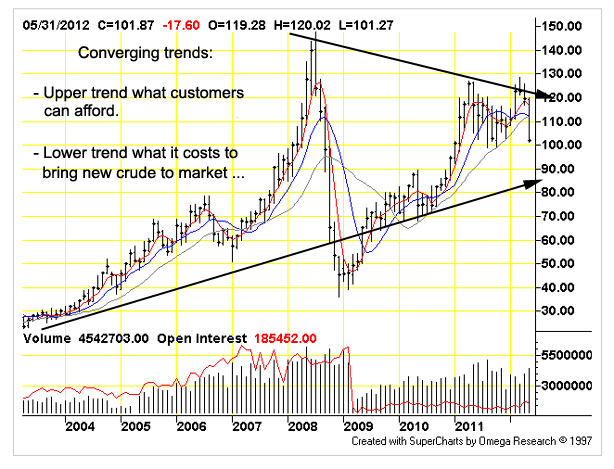
Figure 2: here is the monthly Brent continuous futures contract: high fuel extraction costs have to be paid by deadbeats. Come to your own conclusions regarding the outcome.
Fuel extraction costs can be expressed as energy return on (energy) investment or EROI. As easy-to-extract fuels are consumed, what remain are fuels that require increasing amounts of energy to access. That energy cost is measured against the amount of energy gained, represented as a fraction. Deep water, arctic, ‘tight’, heavy and sour, non-conventional hydrocarbons cost more to bring to market as usable fuels than ordinary light sweet forms that are easily extracted from dry-land reservoirs at low (energy) cost.
Left out of the EROI conversation is that increased fuel costs must be met by the use/waste of the same fuels: the return on consumption. $120 fuel is no more productive than $20 fuel: the only difference is cost. The use of the fuel is assumed to be remunerative but this is an illusion, there is little or no economic return on fuel consumption. Driving a car does not pay for the car or the fuel. Instead, there must be continuous access to credit, when fuel costs are low, the burden upon finance is modest. As costs rise so does the need for credit. Meanwhile, cash flows from fuel use — which are assumed to service the loans — remain the same or decrease.
Energy return is important: more so is the quantity of credit that can be leveraged against consumption as that consumption must fund itself as well as needed energy extraction:
Energy independence, or impending oil shocks?
Chris Nelder (Smart Planet)
A deluge of recent articles have asserted that the U.S. is on its way to energy independence thanks to the miracle of shale oil, or “tight oil.” (Shale oil is actual crude oil produced from tight shale formations like the Bakken. Tight oil is a broader term including shale oil and natural gas liquids produced from shale gas plays. Horizontal drilling and “fracking” are used in both kinds of shale production.) None of them, however, have demonstrated how we would get there.
An amateurish report from Citigroup last week entitled “Resurging North American Oil Production and the Death of the Peak Oil Hypothesis,” garnered the most attention, perhaps because it claimed that the U.S. could achieve energy independence this decade. Here’s what they called their “back-of-the-envelope” calculation:
U.S. crude and product imports are now about 11 million barrels a day, with about 3 million barrels a day of product exports. This leaves import reliance at 8 million barrels a day. If shale oil grows by 2 million barrels a day, which we think is conservative, and California adds its 1 million barrels a day to the Gulf of Mexico’s 2 million barrels a day, we reduce import reliance to 3 million barrels a day. Canadian production is expected to rise by 1.6 million barrels a day by 2020, and much of this will effectively be stranded in North America, and there is the potential to cut demand both through conservation and a shift in transportation demand to natural gas by at least 1 million barrels a day and by some calculations by 2 million barrels a day.
Naturally, most of the subsequent coverage of the report just repeated and amplified these extremely dubious claims under headlines blaring the dawn of our new energy independence, but a few energy journalists offered more balanced and skeptical views, notably Steve LeVine in Foreign Policy, Brad Plumer in the Washington Post, and James Herron in the Wall Street Journal …
The narrow ledge of tight oil
In short, increasing our already-frenetic rate of drilling for tight oil requires sustained high oil prices. At today’s $105 a barrel for West Texas Intermediate, that’s no problem. But if prices were to fall to $70 a barrel, LeVine’s source says, drilling in the Bakken would become unprofitable and would cease, causing production to fall rapidly.
At the same time, the last few years have shown us that $100 oil translates to roughly $4 gasoline, and that’s the pain tolerance limit for most of America. Gasoline demand in the U.S. tends to fall off beyond $4, as does economic activity in general.
This is what analyst Steven Kopits of Douglas-Westwood call the “narrow ledge” of oil prices, as I detailed in 2009. Given the extremely volatile global marketplace for oil, influenced by everything from geopolitical aggression, to climate change, to the headline risk of Greece defaulting and being forced out of the Eurozone, it will be very difficult for the oil industry to cling to that ledge for a sustained decade or more as the Citi analysts breezily project. They simply wave away cost inflation, and don’t acknowledge a price ceiling at all.
The energy return trap is right now the province of peak oil analysts such as Nelder and academics such as Charles Hall (King and Hall), Euan Mearns and Tom Murphy. This is unfortunate because the cost-return dynamic is the central issue of the industrial world that billions depend upon utterly.
Instead of policy there is the triage approach: access to fuel is rationed indirectly by access to the credit needed to purchase the fuel. There is no credit for corrupt tax evaders (Greece), speculators (Ireland, Spain, Italy) and socialists (France). Along with the rationing are the push-button wars against Islamists (Libya, Syria, Yemen), pirates, al Qaeda, terrorists, drug kingpins, etc.
At the local level, credit is withheld from welfare cheats, liberals, democrats, defaulted homeowners as well as from unions and union members, pensioners and school children. The exclusionary dynamic is attractive and politically potent. The process is driven by resentment: as credit shrinks generally, consumption is allocated toward those able to claim social privileges for themselves. These privileges are gained by supporting the allocators’ ambitions.
By the time anyone notices there is insufficient fuel for the economy to function it is too late. Notice the recall election that just took place in Wisconsin (Naked Capitalism):
Mop-Up Operations Resume As Voters Reject Public Pensions, Worker Rights, Liberalism
Matt Stoller, (Roosevelt Institute)
The big story on Tuesday was Wisconsin Governor Scott Walker’s win over unions and liberals, as voters ratified his attacks on public workers, the young, and women’s rights. But that vote was relatively close. Two other voter initiatives, in deep blue California, were not. San Diego and San Jose residents voted overwhelmingly to cut the pensions of city workers. In San Diego, the measure passed with two thirds of the vote, and in San Jose, the measure passed with seventy percent of the vote …
Now voters are making their own choice. Once again, this is a direct consequence of how Barack Obama has led the Democratic Party and redefined liberalism, into a party and an ideology that is defined by wage cuts, foreclosures, debt, and acceptance of dramatic political and economic inequality. Voters don’t want to pay for a government and for government workers who they perceive as out of step with their interests.
These pension cuts and the victory of Scott Walker-like candidates are consistent with the overall trend of liberals losing or throwing in the towel nationally. For example, prominent progressive incumbent Congresswoman Lynn Woolsey, who chaired the progressive caucus in the House, just endorsed the establishment candidate in Northern California over the more outspoken anti-corporate candidate, Norman Solomon. Solomon is behind by a little over a thousand votes, with tens of thousands remaining to be counted. Meanwhile, New Mexico liberal Democrat Eric Griego, who ran ads demanding Wall Street bankers be sent to jail, lost his primary to a more moderate candidate. Sending bankers to jail is a popular position, so why didn’t Griego’s message work? It’s simple. Voters don’t trust any Democrat to credibly deliver on that or really any promise on economic justice. Obama has designed the party’s policy framework specifically in opposition to economic justice.
There is more, none of the commentary acknowledges the energy component. Here is Andy Kroll (Tom Dispatch):
Getting Rolled in Wisconsin
Why Electoral Politics Sold Out the Popular Uprising in the Badger State — and Why It’s Not All Over …
The post-election challenge for the members of Wisconsin’s uprising is finding a new way to fight for and achieve needed change without simply pinning their hopes on a candidate or an election. After all, that’s part of what absorbed the nation when a bunch of students first moved into the Wisconsin state capitol and wouldn’t go home, or when a ragtag crew of protesters camped out in lower Manhattan’s Zuccotti Park and wouldn’t leave either. In both cases, they had harnessed the outrage felt by so many Americans for a cause other than what’s usually called “politics” in this country.
Here is Jeffrey Sommers (Counterpunch)
What the Rest of the US Must Learn …How Walker Really Won Wisconsin
Much ink has been spilt and punditry hot air vented in explaining the failure to recall Scott Walker in this week’s election. Yet nearly all of it fails to address the appeal of Scott Walker and his policies for much of Wisconsin’s working and middle class. Walker was able to capitalize on the frustration over the continued erosion of living standards and insecurity felt by most Wisconsinites.
Stoller and the rest miss the point with their versions of peak oil denial which is little different from other analysts. At least they don’t accuse central banks of printing money.
The question is who can best deliver on the promise of continued living-beyond-means: unions or neo-liberals? Fifty years ago labor unions gave working families the chance at consumption lifestyles. Today, the problems lie with lifestyles themselves, union representation is irrelevant. Unions cannot deliver jobs that are exported overseas by business owners. The point has shifted from who can deliver wages and social justice to who can deliver $2 gasoline.
Unionists and progressives have little idea of the kind of contest that has been forced upon them. The US and the rest of the world have reached the end of a seventy-year run of a waste-based economy that cannot afford itself. Progressives demand a chance to make a difference when ‘different’ means more of the same, more consumption. This can be had from the business establishment which offers better empty promises.
Citizens choose waste lifestyle over abstract ‘liberalism’, ‘feel-good-ism’ and ‘equality’. In Wisconsin and elsewhere, car ads are more effective than unions’ ads. This is how our economy works; the marginal utility of one group’s marketing relative to that of others’ determines outcomes. At the same time, all the so-called progressives are co-opted, they waste the same resources as everyone else. They inadvertently sell the same platform as the car dealers, bankers and developers. They come across is hypocritical and ineffective losers.
Harshness over time shifts from being exploitive to being a civic virtue. A component of neo-liberalism is the embrace of viciousness for its own sake which creates spaces for vicious opportunists. Social justice is irrelevant compared to shiny toys. Choices boil down to who will protect the toys, the cars and the mobility-idea, who can bring forth cheap gas and more consumption. Neo-liberals offer these things packaged alongside political ascendancy, progressives and unions cannot.
Here is the emergence of social Darwinism as the world’s energy policy … indirect rationing and cynicism along with a blindness on the part of citizens to what they are facing.