It is well enough that people of the nation do not understand our banking and monetary system, for if they did, I believe there would be a revolution before tomorrow morning.
— Henry Ford
Q: How would you describe the economy?
A: It is a system that allows a select few to borrow immense fortunes. The rest of us … you, me, everyone else … repay the debts.
…
Q: That’s it?
A: That’s it.

The face of Peak Oil. [1]
We are in the middle of a crisis that has been ongoing for almost five years now: the managers demand the economic system be bailed out. Of whom do they make demands? Entrepreneurs? Innovators? The finest minds of a generation?
A: Pensioners.
The economies must become more productive which means increasing the efficiency of output. Consequently, pensioners are called upon to sacrifice their retirements in the UK, Greece, Ireland, Portugal, in the US … in cities and states pensions everywhere are under attack.
Why not more machines? If machines are productive, wouldn’t deploying more machines solve the economic problems around the world rather than deploying pensioners? Technology is supposed to save us but the raiding of pensions insists otherwise: the scraping of the bottom of the barrel in real time. It’s an admission that technology won’t work, from the people who are in a position to know.
What happens after the retirements are pilfered? Who knows? Nobody has a plan.
The world is shocked to discover a shortage of capital, not for investments but to prop sagging balance sheets. Who could have guessed as capital has been shoveled into the furnaces of ‘development’ for decades? Only economists and bureaucrats believe that we never run out of inputs.
China’s Biggest Banks Are Squeezed for Capital
Neil Gough (NY Times)
China’s banks are among the biggest and most profitable financial institutions in the world. But the state-backed banks are also starved for capital after an aggressive lending spree that was encouraged by the government.
Maybe they are profitable and maybe not. “Starved for capital,” suggests not. The operating idea is that capital is money rather than material inputs. These inputs are mispriced so that the money-equations used by industrialists add up to something ‘positive’. Cheating works until it doesn’t any more: substituting debt for unaffordable inputs doesn’t produce anything. Debt isn’t capital and self-delusion isn’t capitalism. Maybe we should call our economic system ‘Delusionism’ and be done with it.
Within the last year, seven of the biggest Chinese banks tapped the markets for 323.8 billion renminbi ($51.4 billion ) in new funds, according to Citigroup estimates. Several financial firms are expected to raise another $17.7 billion in the next few months, with China’s fifth-biggest lender, the Bank of Communications, accounting for $9 billion.Banks around the world have been tapping investors for new funds as they struggle with slumping share prices and waning profits. But Chinese firms have maintained that their profit growth is strong and their balance sheets are solid, raising red flags among some analysts about the banks’ persistent capital needs.
Chinese bankers and business tycoons, each more corrupt than the last: raise that Red Flag high! The Chinese need capital because so many are stealing it and removing themselves overseas.
The problem is that paying out high dividends blows holes in their base capital. Thus, banks need to continue tapping the markets for fresh funds, often diluting minority shareholders by issuing new shares. The finance ministry, the banks’ ultimate controlling shareholder, always buys in, keeping its stakes topped up.
Somebody at the bottom always takes it in the neck. Today, it’s the minority shareholders, tomorrow it will be the junior bondholders or the pensioners or the schoolchildren forced to eat radioactive school lunches. This is part of an ongoing process, not a new feature within delusionism. It was invisible when everyone was busy getting rich: now that the abuses are visible it can only be on account that fewer are getting rich. The endgame heaves into view.
The amount of cash that is churned in the process is staggering. In 2010, China’s five biggest banks (the Big Four plus the Bank of Communications) paid more than 144 billion renminbi in dividends and raised more than 199 billion renminbi on the capital markets, according to GaveKal.“This is the nonsense of it,” says Fraser Howie, a managing director at CLSA Asia-Pacific Markets, who is based in Singapore and is a co-author of “Red Capitalism: The Fragile Financial Foundation of China’s Extraordinary Rise.” “There’s an awful lot of money just going round and round from one pocket to another, giving the appearance of strength when it’s really not there.”
Fraser Howie cannot see what is under his nose. What else is he missing? How about Peak Oil? The owners of industrial enterprises borrow (steal) their fortunes and oblige the rest of us to repay the loans. The lending-go-round is the reason for industrial economies, their purpose in the first place. “Money just going round and round from one pocket to another,” is the theatrical production that is collateral for the loans. More appearances of strength means more loans — and bigger fortunes — for the owners. The churning of the bank funds is a feature, not a bug: modern finance villainy hiding in plain sight!
The public must accept the process at face value otherwise loans to ‘entrepreneurs’ could not be justified. There would be nobody able to commit to debt-service. As it is, the public has over-bought, the cost of fuel crowds out debt service. The solution is to chop off pensions with a samurai sword.
It’s not just Chinese banks that are starved for capital and it is not just banks. The world is capital constrained.
Europe’s Capital Flight Betrays Currency’s Fragility
(Bloomberg)
The euro area’s financial troubles appear to be flaring up again, as this week’s gyrations in the Spanish bond market show. In reality, they never went away. And judging from the flood of money moving across borders in the region, Europeans are increasingly losing faith that the currency union will hold together at all.
The flows are tough to quantify, but they can be estimated by parsing the balance sheets of euro-area central banks. When money moves from one country to another, the central bank of the receiving sovereign must lend an offsetting amount to its counterpart in the source country — a mechanism that keeps the currency union’s accounts in balance. The Bank of Spain, for example, ends up owing the Bundesbank when Spanish depositors move their euros to German banks. By looking at the changes in such cross-border claims, we can figure out how much money is leaving which euro nation and where it’s going.
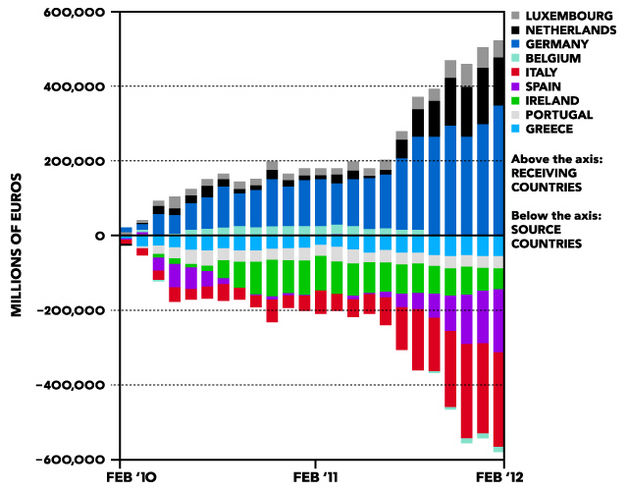
Figure 1: Surprisingly, there is still capital in Greece and Ireland remaining to flee. Perhaps the last capital out the door in these countries will please turn out the lights.
This analysis suggests that capital flight is happening on a scale unprecedented in the euro era — mainly from Spain and Italy to Germany, the Netherlands and Luxembourg. In March alone, about 65 billion euros left Spain for other euro- zone countries.The idea that Europe’s current incremental approach has the advantage of saving money is an illusion, and not just because the disintegration of the currency union could trigger a global financial meltdown. As the capital flight figures demonstrate, the stricken nations of the euro area are bleeding private money and becoming increasingly dependent on taxpayers. In all, the debts of struggling banks and sovereigns to official creditors such as the EU, the ECB and national central banks now exceed 2 trillion euros, much of which would be lost if the debtor nations dropped out of the currency union.
What isn’t mentioned is the flight out of euros into other currencies or assets such as US equities. Wait until the euros start flowing out of France. Bloomberg will have to draw a much larger chart.
What have you … done for your car, today? [2]
Resource nationalism should be giving more billionaires reason to pause. The game has instantly become much more interesting:
Argentine government to pay Repsol ‘zero pesos’ for YPF seizure as Spanish oil company issues legal warning
Fiona Govan (Telegraph, UK)
Spain’s Repsol has threatened legal action against any company that attempts to invest in YPF following its expropriation by Argentina last week as the government expressed determination to “pay nothing at all” in compensation to the Spanish oil company.
The move would discourage external partners from providing the investment YPF needs to exploit vast shale oil deposits discovered within the Latin American country and is the latest attempt by Repsol to fight back against the illegal seizure of its subsidiary.
“We reserve the right to take legal action against any party investing in the YPF and its assets following the unlawful expropriation of the company,” Kristian Rix, a spokesman for Repsol in Madrid, told the Daily Telegraph on Monday.
The Spanish energy company believes billions of dollars are required to develop Argentina’s prospects including at least €25bn a year over the next decade to exploit the Vaca Muerta shale discovery made last year.
Resource colonialism on a foundation of paper promises and graft will prove to be worthless as the distances to overcome are too great and leverage of the colonialists insufficient. The Argentine example is appropriate for the various biofuel plantations landgrabbed in Africa and elsewhere by the Saudis, Chinese and others. When the locals decide the renege on the contracts and expropriate the ‘goods’ there will be nothing the ‘New colonialists’ — and their Blackwater-esque goons — can do about it.
Hiding in plain sight: peak oil.
Nobody mentions that the reason for the Greek economic unraveling and that of the Eurozone is caused by peak oil. The blame is fixed on Greece’s debt exceeding it GDP by a few percentage points. Ditto the other countries under siege around the world.
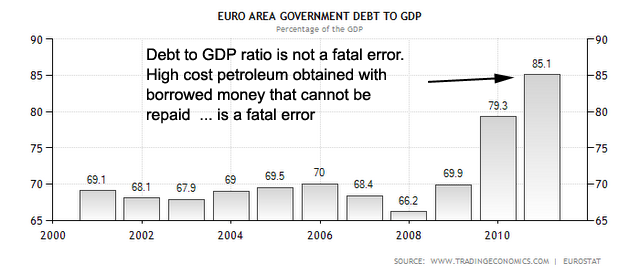
Figure 2: Chart by Jon Stewart/the Bonddad: Greece borrowed euros hand over fist for ten years to import fuel that increased in price 600% since the beginning of the euro. All the other countries in Europe (except Norway and Denmark) did the same thing. Why did the price increase from $20 per barrel to $120? Because of diminishing supply relative to exploding demand. Meanwhile, Greece earned absolutely nothing from burning/wasting the fuel. Greece also has little in the way of non-fuel output to pay for imports: it’s ‘Uncompetitive’.
The Greeks were conned into believing that they could live like Americans. That they could borrow as do other large debtors at very low cost. That they had exorbitant privilege and could roll over their debts as they came due just like other ‘reserve currency’ states. They believed they could monetize pyramiding debt the way the Japanese and other large debtors do.
They would have been able to do so if the Eurozone was a country instead of a Ponzi scheme with the euro a sub-prime mortgage, if the industrial economy wasn’t a debtonomy and capitalism a delusion. Greece gulped the Kool Aid and ignored its own absence of real output and the structural deficiencies of the EU. Greece’s lenders did the same thing: once these lenders got cold feet and strangled cash flow the credit Greece depended on was cut off.
No credit and fuel is cut off, the Greek cash flow diminishes further, there is less output in a vicious, self-amplifying cycle. The outcome of peak oil process is Greece, destitute.
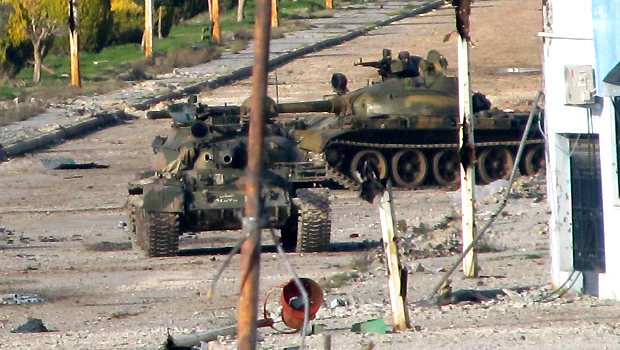
It’s also Ireland, Spain, Belgium, France … and Syria. Those who believe that the endgame of peak oil is Mad Max are wrong. The outcome for the unlucky is ten- times worse. The movie warriors did not have armor or heavy artillery and the willingness to turn it loose on civilians.
[1] Unidentified cinematographer, ‘The Character Humongous from the film, Road Warrior’.
[2] Unidentified photographer, ‘Syrian armor on the streets of Homs’.