Analysts and managers discuss credit problems in the Eurozone. They pretend/hope the economies are fixed and that growth will start soon. The same analysts and managers discuss crude oil prices and make excuses. There is no chance of the managers connecting the credit problems-crude oil dots. The blame for crude prices is fixed on central banks, the same central banks that have presumably ‘solved’ the European economic problems.
It may be that the recent petroleum mini-spike is starting to wind down. There have been a series of these small spikes then retreats since the ‘Big One’ in 2008. The premise here is that prices rise due to supply constraints then fall as the customers sit on their wallets … or go out of business. Unlike the ‘Brand X’ analysts, it says here the tie that binds economies to oil prices is the bank, not the gas pump.
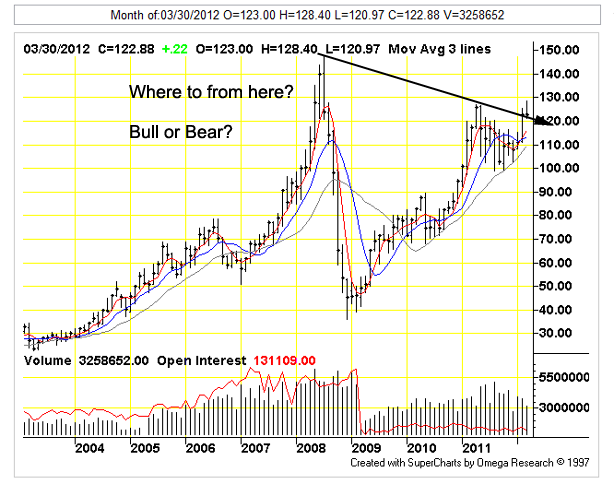
Figure 1: Brent crude front month by way of TFC Charts: The market is really at a crossroads, here. If funds can be found to push the price higher, it would signal a trend change. Right now, the current spike has not exceeded last year’s high price of $128/barrel. It may never arrive: most of the world is facing financial difficulty … broke!
A trend change would indicate new credit/more credit. What is the collateral, the crude itself or the instrument by which it is destroyed? Where is the capital? The central banks can push out credit but their expanding balance sheets correspond to shrinking balance sheets elsewhere. The banks cannot create new capital only additional claims against what meager capital remains. New credit emerges from impaired banking. Smaller banks are either careful and unwilling to make risky investments or are capital constrained which is a reason why they are small. There are few endeavors that are investment-worthy: certainly nothing that wastes as the costs are too high at today’s prices. Waste-cost-revulsion is a simple dynamic but has overtaken the world’s economies. Central banks and governments cannot induce businesses to lose money which is what waste does today.
The price in euros is higher today than it was in 2008: the 2013 euro futures contract is the same price as the current month, how could it be otherwise? Would anyone hold euros if the currency futures were in backwardation?
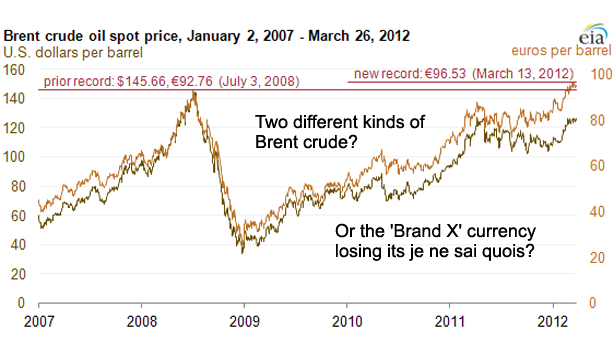
Figure 2: Crude priced in euros: ‘It’s a Boy!’. Chart by EIA: the oil producers seem to have differing opinions about the euro and the dollar. this may reflect oil producers’ opinion on what the euro is worth today compared to what it might be (or not) worth tomorrow. Whether or how they might be hedging is impossible to say: this would effect the current price in euros to some degree. There has to be some realization that the risk of a vanishing euro is more than insignificant.
The oil producers might be simply charging the Europeans more for their oil than they are charging Americans.
A purpose for the euro was to give ordinary Europeans (Greeks, Spanish, etc.) an organic, hard currency alternative to the dollar. It gave them brain-damage instead: with either a euro shortage or a potential defunct euro, the crude market is poised to take a massive hit. If the euro fails, much of Europe’s bid will simply vanish. Survivors with little to sell will have to buy dollars in brutal currency markets. With Irving Fisher-esque intentional debt-deflation currently underway, the outcome is European states having to rent euros in brutal credit markets.
This becomes a distinction without difference: there will either be no more euros at all or too few euros in circulation except within banking. This potential absence may be why crude markets are looking soft. As with the other mini-spikes, the declines that follow are signs of demand unraveling and bankruptcies rather than increased petroleum supply pushing prices down.
Despite the deflation the flood of euros into crude is obvious. It may be that China is swapping its euro cache for crude. The worst-case scenario for China would be for its banks to be caught holding hundreds of billions of worthless euros. What we may be seeing is ‘currency hot potato’ with China trying to exit a massive currency position, dumping euros at a discount. China would put oil into strategic reserves just as it stockpiles copper and zinc. The China-euro dumping would explain the price push we have seen. The Chinese are careful: too much euro dumping would be suggestive of a dead euro. China can’t buy enough crude to make up for the loss of European crude customers and precipitating a run out of euros would be self-defeating. A slowdown in euro sales may be what we are seeing reflected in the softening price.
How many euros does the Federal Reserve hold as a consequence of its ongoing swap operations? Probably a lot but not enough to move any of the markets. The US isn’t buying crude with euros. It is hard to say what the US refiners are ‘buying’ with the Brent/WTI spread at nearly $20 per barrel.
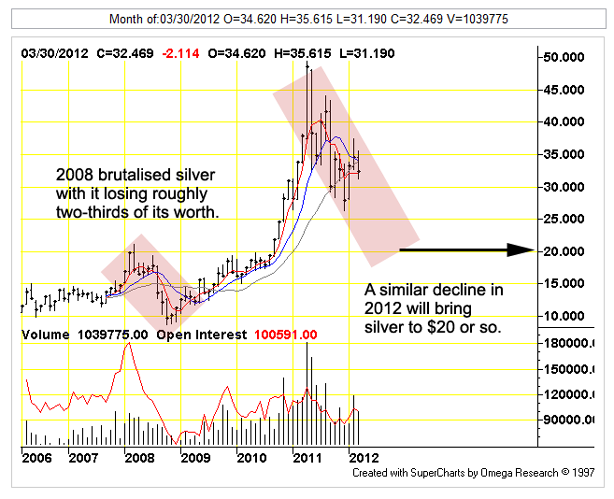
Figure 3: Silver has been extremely volatile, it has also exhibited some ‘bubble’ characteristics. Keep in mind, in debtonomics there are no such things as bubbles, only periods when credit expands faster or slower along with short periods of credit shrinkage. Asset prices follow credit availability so price increases depend on whether the finance sector believes silver is a good hedge against something or other.
Silver was hammered by selling as industrial users’ customers sat out the market and monetary longs were faced with margin calls. A credit shrinkage scenario following a petroleum price decline/crash would have silver near $20 an ounce.
Silver will be worth something because it is ‘portable wealth’ that does not rot, burn or crinkle. Silver-the-metal is resistant to ‘computer error’. It is hard to see silver at $50 again any time soon. More likely are margin calls and bank failures in countries as the euro unravels even as citizens rush buy physical silver as a hedge against … euro unraveling. If/when the euro turns to dust, there will be a myriad of currencies arising to take its place. First among them will be the national currencies as well as the dollar. Second will be various local currencies, scrip and older silver and base-metal coins. Unofficial exchanges will emerge with rates for the coins based on metal content.
To provide the illusion of ‘stability’ there might be gold backing of national currencies but this is likely to be a form of public relations. That is, any convertibility will be strictly limited. It is far more likely that the new currencies will be wildly inflationary: existing external euro debts will be repudiated (see ‘Greece’). Internal euro debts will be re-denominated into the new currencies then repaid (overnight?) with newly issued national currencies. The aim will be to cram down debts to a manageable level (zero). There will also be float problems. Countries won’t have enough currency in circulation because citizens will be buying hard currency such as the dollar with the national varieties. This trade will take place in black markets: the hard currencies will be in increasing demand. The worth of the new currencies will decline accordingly as issuers put more new bills onto the streets.
Forget about credit, the only source of credit will be citizens who will have just been robbed and the IMF. The only banks to survive will be those that have good relationships with both depositors and borrowers. With currency upheaval even the best-managed banks may find themselves without the tools to work with.
European nations will counterfeit their neighbors’ currencies. The combination of currency arbitrage and the absence of restraint will generate massive amounts of inflation. Europe is likely to experience a lawless period. The establishment has failed and left a gaping leadership gap, it’s also a criminal enterprise. There will have to be a reckoning from which a new establishment to emerge. The outcome will be a conservation economy whether it is desired or not. Couple the lack of useful or worthwhile currencies, the shortage of ‘hard’ currencies and an accompanying desire to hoard them, low producer prices will ‘shut in’ crude at the wellhead. There will be shortages. Instead of rationing fuel by way of credit, the fuel will be physically rationed, instead.
From this time forward the important outcome to be aware of is any oil consumption ‘problems’ with credit or foreign exchange will ricochet through the economy to remove support for new petroleum prices and supply. What supports prices supports the means to meet them.
The European management has been able to white-wash the Greek collapse and pretend business as usual. Absent from the discussion is energy constraints and Peak Oil, the other Mediterranean nations are quavering, there will be no hiding the truth.
NOTE: Massive contretemps online between Paul Krugman, Randall Wray, Steve Keen and Scott Fullwiler. The argument started with a bit of bloggy nonsense from Krugman about Hyman Minsky. This led to Krugman’s description of banking and creation of assets/loans … a description of lending that made sense in the 1800s. This fits into our ongoing discussion over here @ Debtonomics. Links are here or can be found at Fullwiler’s article.
The economists really don’t have a clue. Not one mention of peak oil anywhere …