
Eduard Manet ‘Monet Painting in his Floating Studio’. Those living in the 19th century before the widespread use of petroleum fuels certainly had it short, brutish and nasty. The painter Monet actually had to row himself and his wife by hand to where he would spend the day painting and being entertained. It is hard to imagine how difficult and unpleasant life was before unleaded gasoline, how far Americans in particular have advanced since 1874. Note the factories belching coal smoke in the background: a shorter, nastier, more brutal ‘lifestyle’ for tens of millions — World War One — was only forty years away.
It’s clear what is taking place both in the United States and elsewhere is a sea-change or more accurately, THE sea-change, the ‘Great Slide’. The ancient virtues of unlimited free parking and quaint segregation of work away from leisure are useful only when petroleum is worth very little more than what can be gained by its waste. This narrow difference can then be made up with inexpensive debt: as the margin widens debt becomes unaffordably costly. Debt becomes unable to bridge the ‘waste gap’ between what fuel costs and what the waste of the fuel returns.
The system as designed: cheap inputs + cheap credit = marginal system returns.
This leaves out the returns to ‘entrepreneurs’ that are independent of marginal system returns to a large degree.
Now: expensive inputs + expensive credit = negative system returns.
Negative real returns here weigh down the entire interconnected system. Increasing the amount of credit within the system increases both input- and credit costs. Credit does not exist (or is allowed to exist) outside the system: the expansion of debt cannot outrun increased input costs — which are a feedback outcome of debt expansion. There are obvious limits to credit forcing, beyond these limits system returns are unaffected.
Debt itself has become the obsession du jour: the problem is not the sufficiency of debt or even its costs but the defective structure within which debt subsidizes profitless waste. We love our waste, it makes us feel human: right now the world’s economies are at the point where debt can just barely stretch to fill the waste gap. We can just barely afford the costs of the debt, provided we put to use every sort of extraordinary tactic to manage them. We add more debt, we borrow our way out of it, we shuffle it around: running faster and faster to remain in one place.
Debts can be managed this way only because the state can always run faster: as long as there is a marginal return somewhere within the debt-y universe the system will continue to lend to itself ever-larger nominal amounts. Unfortunately, the real capital that the debt is supposed to represent diminishes while the claims made against capital increase. The efforts to manage debt by ‘renewing’ it become counterproductive. Adding debt becomes another form of waste with costs that cannot be met.
A decline in nominal price of petroleum is no cure: temporary declines allow price-thwarted demand to rush back into the markets and push up the price. This decline-push dynamic remains in force until the ability of customers to meet the high price price is exhausted, when the credit runs out. The producers must then lower the price to meet a diminishing cash market. What supports a price also supports the ability to meet it, the waste gap persists and continues to expand. Marginal costs swell to become the entire costs. Before that point is reached the system stops working as inputs cannot be had at prices users are able to afford.
Demand shifts from the purchase of goods to the purchase of fuel to support legacy ‘investments’. Demand destruction takes place first within the goods-producing sectors rather than in energy sectors, it takes place even as fuel prices decline. Demand declines faster because the fuel-waste goods production is a dependency upon low priced fuel. At current prices, the entire consumption infrastructure — built assuming $20 crude in perpetuity — is underwater.
In 2008 the WTI price spiked then collapsed. The fuel price could have been supported at very high levels for a long time, but not all prices across the entire economy. Fuel prices undermined marginal businesses particularly those related to automobiles, real estate and off-balance sheet financing. To satisfy demand represented by the existing auto fleet, funds were shifted away from the purchase of new cars and houses in far-distant suburbs. Fuel not purchased in exurbia was purchased instead in China and India.
Right now the price for fuel is still high even as the economy unsurprisingly displays signs of a severe slowdown within China and its dependencies, the European Union, Japan and the United States. Cannibalism works that way: the cannibal gets fat at the expense of his ‘lunch’. Given the choice between driving a car and having a functioning economy (that depends to a large degree on driving) the choice is made to drive.
The current regime runs aground on its costs. These are increased by (driving-created) scarcity and over-reliance upon credit to keep driving more. We allocate ourselves into a sinkhole. Wherever one takes the time or pleasure to look, the cost of driving exceeds what the customer is able to pay doing everything else. Having emptied our accounts at the gasoline pump, the returns on our non-driving endeavors are insufficient to service the debt needed to drive … or do much else.
What is underway is a margin call against the entire unproductive enterprise.
Closing the floating studio gap

James Jacques Tissot ‘Seaside (Portrait of Kathleen Newton)’. The largest real improvements to take place during the middle-19th century and afterward were sanitation and clean water supplies in cities and better understanding of disease. Tissot’s mistress Kathleen Newton died by her own hand in 1882 at the age of twenty-eight, the consequence of her tuberculosis infection. Tuberculosis also claimed Monet’s wife Camille at the age of thirty-two.
Tuberculosis is an illness that is largely treated today with antibiotics. Unfortunately, the widespread recent use of the same antibiotics as additives to animal feed along with the improper (placebo) medicinal use has allowed antibiotic-resistant superbugs to evolve. There are now forms of tuberculosis that are unaffected by any drug. The end result is to undo the entire improvement, to bring conditions outside to the point where they were before antibiotics appeared.
This sort of dynamic takes place across the entire economy: we uncover or create an ‘improvement’ with one hand and mismanage its use with the other. We constantly act at cross-purposes to ourselves.
As the system winds down, what next? Everyone is looking for a way to manage future risks while being completely in the dark as to what forms the risks will take.
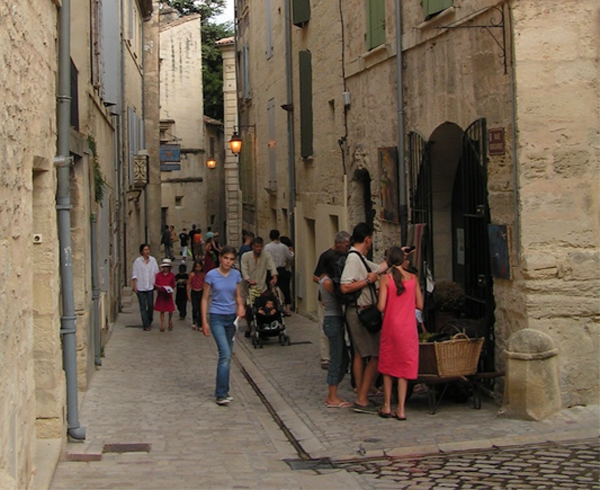
Unknown photographer, ‘Street in Uzès, France’ (New World Economics). The pre-petroleum Neanderthals of the 16th century and earlier certainly knew how to build beautiful towns.
Energy waste for its own sake pushes aside everything unrelated to itself. This consigns all but a few fragments such as the occasional Uzès to the ash-heap of progress. We frame the fragments even as doing so puts them out of context. While the markets attempt to make measure, the markets themselves fail apart. Everything we rely upon to do our critical thinking for us is resource-dependent and undone by negative real returns.
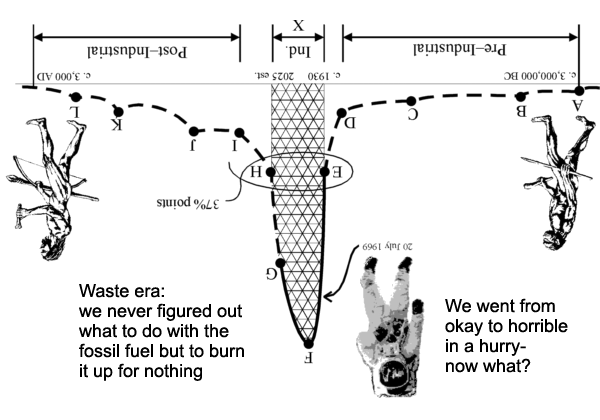
Richard Duncan’s original, 1995 conceptualization of the rise and fall of industrialization. We are what we consume per-capita sez Richard. This is completely paradoxical: we have created for ourselves a petroleum-driven dark age that we have but the smallest chance of escaping! The problem isn’t the primitive, it is our mis-managed progress. Propaganda pimps modernity as the race toward a scarcely-to-be-believed wonderland of Chinese made crap consumer goods sure to arrive tomorrow. The record of one industrial failure after another speaks for itself: if we are done in it will be on account of our stupendous successes revealed as the follies they turned out to be.
The entire Futurama concept runs aground on its own absurdity. How is sitting stalled in traffic or not stalled within an environment created specifically for machines progress? How is sitting behind a wheel for three hours any different from sitting behind a sewing machine in a sweatshop? The answer is the sewing machine produces a (small) return for the sewer while the wheel is a privilege purchased at an unaffordable price.
Any sort of civilization beyond what is unraveling around us — or any higher form elsewhere — would certainly be driven by inner resources rather than what can be bought in a store.
Any higher intelligence in the universe would be unrecognizable to moderns who can only consider civilization within the context of self-destructive industrialization: weapons and conquest, machine exploitation and lazy transformation of resources into waste for no purpose other than to make someone ‘rich’ who is a bit greedier than the others … The artifact of any civilization more advanced than ‘ours’ would be the rendering of the universe devoid of life or even the possibility for life to exist. How, in fact, we now perceive the universe to be: an enormous vacuum buzzing with radiation and the occasional black hole.
Those searching the radio spectrum for signs of intelligence in the universe peer under the wrong rocks: ‘Advanced civilization’ would manifest itself as a bizarre negative space-like non-space guarded by silent well-cloaked microorganismic killing machines. Perhaps this is what our precious God concept represents when distilled to its essence: the conquest of life by death (machines) out of envy.
Our God tricks us: everything and everyone else within modernity lies, why not God?
The belching factories and a handful of billionaires put twelve Americans on the moon, after the same factories and billionaires killed tens of millions in a world war. The astronauts drove a car in circles and hit a couple of golf balls. They didn’t even play a legitimate game of golf: the entire enterprise was a pointless cold-war finger to the rest of the ‘undeveloped’ world. “We can put a man on the Moon but …” We can’t think to do anything else because our empty anticulture does not allow anyone to come up with something better. An actual civilization would have sent Monet on the moon in a floating studio, but our gulag-on-wheels stuffs nascent Monets into investment banking instead, ‘greeding them down’.
Modernity’s first demand is the annihilation of art as being subversively human and anti-modern. So far that strategy has been a resounding success …
Our space adventures enabled bigger rockets upon which our wonderful entrepreneurs mounted larger numbers of more accurate thermonuclear warheads. Add to that the incurable illnesses and multiple total wars, the cannibalizing the natural world in the chase for resources and much more of such progress will be the end of us. The sooner we use up our energy supplies the better.
The waste gap widens: the USA has ‘invested’ trillions into guaranteed capital losses. Notice that the Chinese have followed. The Soviets bankrupting themselves trying to outspend the US on military hardware. The Chinese bankrupt themselves outspending on autos and high-rise office buildings.
The entire system requires restructuring, not just bits and pieces.
The emerging system: valuable inputs = zero-risk use.
Expensive credit = narrowly distributed returns
Inputs would be so valuable that the entire enterprise would be designed around managing the risks associated with their possible economic loss. Better uses would be found for resources or they would remain unaffordable in the ground. There would be no ‘consumption’ of non-renewable resources, only non-consumption uses would provide sufficient returns to meet the high costs of accessing them. The implication is an economy that is more wealthy rather than less wealthy: an economy which carefully husbands rather than squanders capital and makes highest and best use of it.
What will be required is a return on resource use rather than subsidized waste.
Credit would be tasked with amplifying the increase in capital by any means necessary. This might mean borrowing to pay individuals not to waste or to not generate certain kinds of demand. This also suggests an economy that becomes wealthier over time allowing even high-cost credit to pay for itself.
At the end of the Age of Waste it must be noted that all of the materials considered to be in dire short supply will still exist but not in ‘industrial quantities’ or in concentrations that are economical for industry to waste. It will simply not be possible for billions of people to waste resources for negative real returns. The absence of industrial inputs does not mean the absence of inputs. Even after a century- and a half of waste, over half of all the discovered fossil fuel will remain in the ground, along with gold and silver, potash and phosphorus, rare-earth metals: there will be topsoil and water too, and much more besides.
Easy resources are transformed: into both ‘by-products’ and life-lessons: whoever uses resources in the future will have to bring more to the table besides carelessness and the ability to wheedle his friends into lending to him. Any material use will have to pay for itself on its own account. No more grand delusions about risk-free growth paid for by ‘nobody in particular’ because the structures to support such nonsense will be impossible.