Climate change- and Peak Oil deniers are like turkeys who gather in a corner of the farm convincing each other that this mysterious circumstance called ‘Thanksgiving’ is a fraud. According to rumors that race like wildfires through the community then evaporate just as quickly, when this ‘giving of thanks’ event draws near The Great Turkey God stuffs everyone into a truck (whatever that is), takes them somewhere and has them all put to death! Turkey corpses are then wrapped in plastic (whatever that is) and shipped to supermarkets (whatever these might be). The rumors are highly disturbing to the turkeys even as some of the more perceptive among them notice that turkeys who leave the community never return.
“Pay no attention,” cry the deniers. “This obviously cannot be so: God is the turkeys’ best friend. Every day he brings more and more delicious food, as much as the turkeys can eat. The more food we eat the more we have available to eat. All this food and much more has been provided by God for as long as us turkeys can remember.”
“Certain as one day follows the next, this incredible bounty will go on forever. We dare not change anything or leave. To do so would have us … living like savages in caves!”
“Where are the old turkeys?” asks a thoughtful, young turkey. Where are they indeed: there are old turkeys and bold turkeys but no old, bold turkeys. Recently the climate denying-gobblers had a chance to see that the turkey-god is a farmer with an ax and a calculating mind. This came in the form of Senate testimony from the insurance industry.
It’s one thing for the pimply-faced teenaged brigade of energy company shills/morons to scorn scientists and for middle-American turkeys to believe them. It’s another thing altogether for the shills to smear the insurance industry. The warming-related disasters are costing the top insurance gangsters real money, these costs ricochet through related real estate and finance rackets:
Climate Change: Insurers Confirm Growing Risks, Costs
Stakeholders from the insurance industry met with members of the U.S. Senate to acknowledge the role global warming plays in extreme weather-related losses, and to issue a call for action.
Pat Speer
The politics of global warming have typically involved much debate as to the role climate change plays in growing weather-related risk. Yesterday, however, at a Capital Hill a press conference on the cost of climate change, debate was not on the agenda. Pointing to a year of history-making, $1 billion-plus natural disasters, representatives of Tier 1 insurance companies took a definitive stance with members of the U.S. Senate to confirm that costs to taxpayers and businesses from extreme weather will continue to soar because of climate change.
Representatives from The Reinsurance Association of America, Swiss Re and Willis Re and Ceres, a nonprofit organization that leads a national coalition of investors, environmental organizations and other public interest groups working with companies to address a variety of sustainability challenges, joined Sens. Bernie Sanders (I-Vt.) and Sheldon Whitehouse (D-R.I.) yesterday to discuss the growing financial impact of global warming.
Reality about energy supplies begins to emerge and it’s as ugly for ‘Autoworld’ as Thanksgiving is for turkeys. Peak Oil has blitzed the Greek economy into the dumpster with stunning dispatch, so much so it seems beyond the ability of sensible Greeks to understand what happened to them. Greece isn’t a hedge fund or an over-leveraged investment bank peddling fubar MBS out of a back room but a modern, middle-class nation with a (semi)functioning government and a four-thousand year history: all that except for the history is gone … in a heartbeat. Fall asleep in Greece, wake up in Angola.
During the period of the Asian credit contraction or the Argentina default and the Latin American crisis that took place during the late 1990s there were exceptions to malaise. The industrialized economies such as Japan and the US performed well. In 2012, the economy of entire world finds itself stuffed into the back of the truck heading for the freezer.
It really is different this time!
Forget the turkey gobble about ‘Peak oil in 2035’ or ‘energy self-sufficiency’. Without drastic change in attitude, the world is never going to get to 2015 in one piece. From an energy standpoint there is no difference between Germany and Greece … or Japan! Berlin (Tokyo) must sell cars to millions of turkeys or the lights go out. Peak oil drives a stake through the heart of the auto-sexy sales pitch. What happens next? Both Japan and Germany have carefully constructed the model post-modern energy-arbitrage value-added economy: Peak Oil destroys it. What rampages through Greece is getting ready to cum inside quivering Germany, possibly within months.
Ominously, fuel prices are rising to record levels even as the world slips into recession. There is a slowdown in credit expansion, without credit there are less funds available ‘on the sidelines’ to push up crude prices. What pushes prices now is the world’s spare change … being burned up for nothing.
There are output declines in the UK, outliers in once-booming China, ongoing deflation as well as a new trade deficit in Japan, slowdowns in the countries which have depended on commodities sales to China and India: the EU is collapsing and the US is pincered between the need for more easing to keep debt costs under control and the steadily rising fuel prices amplified by more easing:
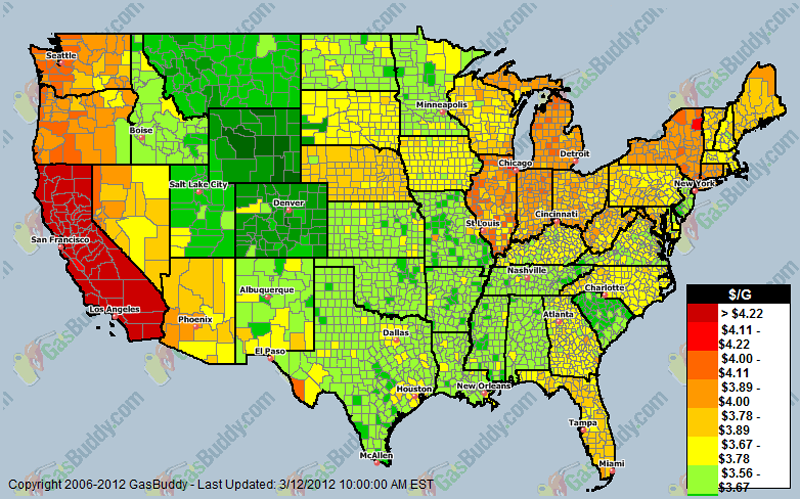
Figure 1: here is your Gasbuddy gift, red spreads across the US in the form of plus-four dollar gas prices. What sort of turkey will Gasbuddy bring in the future? Plus-five dollar gas or declining prices and faster declining ability to pay? Best to bet on declining employment and more poverty.
Energy
| PRICE* | CHANGE | % CHANGE | TIME | |
|---|---|---|---|---|
| BRENT CRUDE FUTR (USD/bbl.) | 125.520 | 0.180 | 0.14% | 20:00 |
| GAS OIL FUT (ICE) (USD/MT) | 1,030.000 | 1.750 | 0.17% | 20:00 |
| HEATING OIL FUTR (USd/gal.) | 325.400 | 1.110 | 0.34% | 20:01 |
| NATURAL GAS FUTR (USD/MMBtu) | 2.263 | -0.006 | -0.26% | 19:58 |
| GASOLINE RBOB FUT (USd/gal.) | 333.630 | 1.330 | 0.40% | 20:01 |
| WTI CRUDE FUTURE (USD/bbl.) | 106.640 | 0.300 | 0.28% | 20:00 |
Table from Bloomberg has Brent crude at a economy-crushing $125./barrel. The economic infrastructure has been built around an assumed $20./barrel forever. Crude costing more than $40 per barrel or so strands the entire fuel-wasting enterprise, this includes China. Meanwhile, the high fuel prices represent/require massively expanded credit. The reason for the credit in the first place was because there wasn’t enough cheap crude to satisfy all demand starting ten years ago! Credit access became a substitute for fuel and a way to ration it at the same time.
So far the current mini-spike hasn’t been able to push past last April’s high of $128./barrel for Brent. If the $128 level holds it indicates the world is too broke to afford higher prices. Prices pushing above that level indicate the turkeys’ best chances of buying their way past the consequences of their own waste are being hurled into the fire.
Greece’s oil problems were examined last June:

From an energy standpoint Greece is insolvent. It once borrowed — euros — from banks to buy fuel. Now it has to borrow from new banks to pay off the old banks AND to buy the fuel. Greece is on the road to oblivion. It buys less fuel even as it falls further into debt. Without some drastic change Greece will not only default but collapse.
Like the other countries, Greece obviously failed to earn enough from using the fuel to pay its energy bill otherwise it would not be insolvent.
Last Summer was really the EU’s last chance to put its energy house in order and get serious about conservation. It is too late when economies are stripped out there are no funds with which to ‘buy’ the saved btu’s. Greece from the ground:
“A harder Default To Come”
Wolf Richter
“We owed it to our children and grandchildren to rid them of the burden of this debt,” said Greek Finance Minister Evangelos Venizelos about the bond swap that had just whacked private sector investors with a 72% loss. While everyone other than the bondholders was applauding, the drumbeat of Greece’s economic horror show continued in its relentless manner.
In central Athens, a stunning 29.6% of the businesses ceased operations, up from 24.4% in August; in Piraeus 27.3%, a 10-point jump since March. The whole Attica region lost 25.6% of its businesses. “This worsening of the survival index in the commercial sector … shows that resistance is waning,” said Vasilis Korkidis, president of the National Confederation of Hellenic Commerce. “We must continue the battle of daily survival and keep our shops open,” he pleaded—while fourth quarter GDP was being revised down to -7.5% on an annual basis. The Greek economy has shrunk about 20% since 2008.
Unemployment is veering toward disaster. The overall rate of 21% in December, announced Thursday, was horrid enough, but youth unemployment rose to a shocking 51.1%, double the rate before the crisis. A record 1,033,507 people were unemployed, up 41% over prior year. Only 3,899,319 people had jobs—a mere 36.1% of a total population of 10.8 million!
No economy can service a gargantuan—and rapidly growing—mountain of debt when only 36.1% of its people contribute (by comparison, the US employment population ratio is 58.6%, down from 64.7% in 2000). Hence, another bout of red ink. The “cash deficit” at the end of 2011 hit €24.9 billion, 11.5% of GDP, far above the general budget deficit. Government-owned enterprises, such as the public healthcare sector, couldn’t pay their bills. Total owed their suppliers: €5.73 billion.
What a nightmare! Richter doesn’t mention that the only way for Greece to escape its straitjacket is to either borrow more and roll over debt or to repudiate it. There is no way for Greece — or Germany — to repay Greece’s finance debts even if 100% of its citizens hold jobs. The debts are simply too enormous.
Greece Undergoes An Energy Cramdown.
Greece’s GDP has declined right along with energy consumption. This is no accident or coincidence. The fairy-tale increase in GDP that everyone loved so much was powered by credit expansion which leaked into fuel bourses. Credit enabled the virtuous cycle of bull markets and ever-rising asset prices. Customers could meet the cost of expensive fuel (and everything else) by taking on more debt. At the same time credit expanded — as it must — so that internal costs of that credit could be managed.
The problem is that expensive fuel is that it returns the same ‘nothing’ by its use as does the cheap stuff! $20 fuel is a bagatelle to waste, it subsidizes the $50,000 automobile and the $500,000 tract house. Burning $125 per barrel crude oil is the same as burning a Jackson Pollock in the fireplace to keep warm. The mindless waste on a planet-wide scale digs a bottomless pit that economies are unable to climb out of; the automobiles and tract houses cease to be assets but become liabilities instead: ‘Welcome to Greece’.
Here is what the world’s economists ignore: that our Number One Investment for the past two-hundred years has been non-remunerative waste, paid for with an instrument that mandates its own ceaseless and perpetual increase. The beneficiaries of this waste have been a handful of very special turkeys. Like them, the economists insist that the waste is ‘productive’ and ‘progress’: that the wasting process is so fundamental to our way of life as to defy scrutiny.
Just like the turkey farmer, credit has been our best friend, the ready enabler of all our wants. The Credit God stuffed us with everything our hearts and stomachs desired, even as these became perverse then self-destructive. Waste for its own sake was elevated to a virtue, it became the basis of our economies.
With supply constrained relative to increasing worldwide demand, fuel costs rise until something important steps working, in 2008 it was the securitization industry and shadow banking, now looks to be repos and sovereign credit. The costs of fuel plus the debt needed to bid for it are breaking costs, countries can no longer borrow. Without credit there are vanishing chances of expanding GDP or to roll-over maturing debt … or to import fuel.
Here is the EU gas buddy (HT Zero Hedge):


Figure 3: Adding insult to injury: gasoline in Greece costs about $8.75 per US gallon, on the way to $50 per US gallon by way of black market profiteering and diminishing fuel supply. In the future, if Greeks want gas they will have to sell their children in order to afford it.
– Europe must borrow in order to obtain fuel even as the continent’s defective borrowing structure breaks down.
– The mercantile states such as Germany have been able to borrow against the accounts of their EU trading partners but now these partners are bankrupt. Unsurprisingly, the German economy is starting to contract.
– Europeans afford high priced fuel by cutting back on car purchases.
– Europe’s liabilities in euros are expanding dramatically along with the euro ‘rescues’ and bank bailouts. Germany has little choice but to exit the euro to escape mounting peripheral liabilities. Germany chooses its poison: defending the euro would be as suicidal for Germany as abandoning it.
– Euro-finance is a Ponzi-scheme, he who exits first escapes with something, the rest hold the bag. UK has exited the euro-concordat already, Spain looks to exit along with the Netherlands, France; Finland, Portugal and Italy are vulnerable. Germany cannot carry the bailout costs these other countries represent. As EU countries exit or default Germany will ditch the euro for the D-mark.
Germany is partially responsible for the multi-trillion euro ECB balance sheet. The collateral held by the ECB for its LTRO is deteriorating: there are margin calls. The central bank’s balance sheet is becoming largely unsecured debt: there is no lender of last resort, there are bank runs. Germany encounters the First Law of Economics: the cost of managing surpluses becomes greater than the surpluses are worth. Selling all those cars turns out to be worse than a dead loss; more costly than not selling the cars.
Germany has been running persistent current account surpluses with the peripheral states since the introduction of the euro. Now that the Europeans need money it is natural for them to look toward Germany, (click on for big):
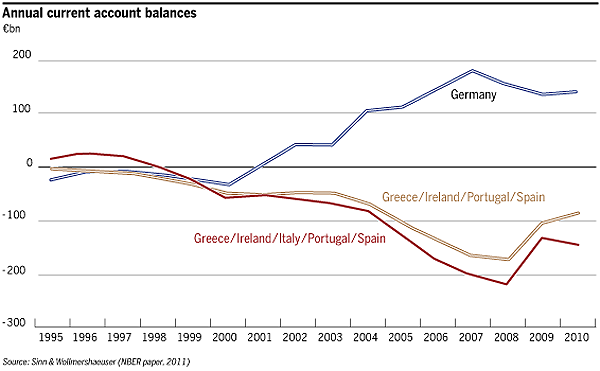
Figure 4: Europeans have bankrupted themselves with their consumer luxuries; their automobiles. Current accounts don’t lie, the credit imbalances are vendor financing within a fixed exchange rate regime, all for the benefit of German industrial firms. As European managers remain silent about the need to conserve energy, energy conservation as a natural consequence of credit breakdown is scything through the turkeys.
It is astounding that the Europeans would throw Greece into the pit, it is certain that they did not mean to do so, circumstances forced them to it. Too bad nobody is willing to face reality and throw the automobiles into the pit, instead.
Next goes Europe, itself. The Greek default closes the book on Europe in its current form, which is a lost cause. It is the end of the beginning: there is not going to be any ‘recovery’ or way back from the abyss that is now engulfing the continent. Some fragments here and there might save themselves for a little while, then like sparks from a bonfire be swept away by the wind. The crisis must now burn itself out: Europeans, look to yourselves and may your turkey-God have mercy on your souls.