All over the world there are rapacious business enterprises and machines hunting for a mission, something actually useful to do. Investments are made in these enterprises, arguments are made that they are productive. This is beyond superficial dispute: a factory of five-hundred workers emits the same number of cars or lawyers or mortgage loans or athletic shoes as would five-thousand individuals working on their own in the same amount of time; far more than that for the cars. How can organizations such as these not be productive?
At some glorious day in the future these enterprises are to become ‘efficient’: not only will they pay for themselves going forward but will also repay the staggering accumulation of debts that have been taken on since the factory enterprise idea emerged in the first place hundreds of years ago.
The debts are astounding, yet the myth of repayment is a fixed point of reference within industrial capitalism. It must be without question: to not repay or to consider non-payment is to unravel the entire enterprise. There are no other reasons to proceed with it. Our businesses exist to repay debts instead they create more of them. As the debts grow, so does our attachment to the debt-taking process. It is an endless vicious cycle: debts lead to the debt-sucking businesses which in turn lead to more debts and to more businesses: I borrow, therefore I am!
Debt is taken on the kick-start enterprise: here is the Kick Start From Hell. When does it stop? When does the firm arrive that does not need trillions to ‘get off the ground’? Every form of capital has been invested against the false promises of tomorrows that never arrive, promises made by those who take the money-forms of capital and stuff it into their pockets, leaving just enough for those who believe in the promises to give those forms some validity …
Anyone who has been paying attention knows that this Kick Start Process has left Greece an economic corpse. It borrowed to pay for its energy tab. Then it borrowed more to pay off the old debts. Now Greece is ruined in the ‘Great Gatsby’ sense. The next order of business is for Greece to fade from the consciousness of the Europeans and fall under the jurisdiction of the IMF like other backwaters Ukraine and Sri Lanka. Best for the Greeks right now for them to burn their houses to the ground for the insurance money then walk away. They are going to have to move pretty fast as the flood of European emigration to these same IMF backwaters is certain to intensify.
Outward migration of the previously-bourgeoisie has been so far the only effective response to the World’s energy/finance misery.
Weep for the Greeks: they don’t have a government. There are a handful of buildings in Athens and elsewhere with a bunch of people scurrying around inside, a cabal of banking apparatchiks wedded to the status quo and to maintaining the vanished euro at all cost. It does not matter that the Greeks cannot bear the cost, the establishment insists that all alternatives are worse.
Here is the old international finance ‘in and out’, the inevitable outcome of a country not in possession of the instruments of organic credit creation within its own borders. Easy finance capital flows into a country from elsewhere promising citizens cheap progress. As soon as the new capital is deployed and the country is dependent upon it, the capital flows out again! The outflow strands the citizens and all of their fabulous ‘investments’. Funds to service or retire external debts cannot be had, the country becomes an effective colony of the lenders.
Weep for the Europeans: if the Greeks somehow escape the euro straitjacket, depositors in other countries will understand that theirs’ is next country into the euro air lock. This is a large reason why the apparatchiks are determined to hold Greece within the eurozone: a Greek exit and accompanying bank run is likely the end of the euro.
Germany won’t tolerate any exchange-rate losses: both euros and euro-denominated private credit are vanishing from widespread circulation. Funds injected by the central bank (including any into the European clearinghouse Target 2 system) are redeposited with the European central bank. Look for the dollar to gain traction in Greece and the other deficit-riddled euro-states.
Here we have the old energy in-and-out. Energy flows into countries: waste at two-percent looks to be a good deal. Times turn hard when the energy flows start slowing down as can be seen here in Germany:

Figure 1: Germany has zero domestic oil production, it may have an oil well somewhere, perhaps in a museum. Deutschland is another one of Europe’s hopeless energy basket-cases. (This and other charts is from Jonathan Callahan’s Energy Databrowser data by way of BP). According to the media, Germany is possessed of the strongest economy in the Eurozone. According to this chart, Germany is Greece with bad food.
The only reason Germany has fuel imports at all is because it can re-export some of that fuel in ‘value-added’ form to other countries for gain. The gain in turn allows Germany to borrow. The problem is the value-added form increase consumption pressure on petroleum. Germany is the classic example of the capitalist who sells the rope used to hang capitalists.
German industry has been synonymous for decades with German coal and iron. Germany is now required to import ever-larger amounts of coal, there is a lot of red on this German coal chart:

Figure 2: German coal consumption has steadily declined over the past decades but coal available in German coal-fields has declined much faster. To obtain coal the Germans borrow against the accounts of their trading partners. The question is: for how long will the Germans be able to do so?
The German ‘coal budget’ is the consequences of decades of over-consumption, largely to subsidize German industrialized warfare waged against those very same trading partners. The last time Germany exported coal was during the early 1980s. It has been downhill ever since. At current rates of consumption there will be no more coal left in Germany after another twenty-five years. Then what? No more coal means no coal forever which is a very long time …
Germany repaying its coal debt is a concept that simply does not exist is ignored. Perhaps this is why Germany is frantic for Greece to repay its finance debts, because Germany cannot repay its energy debts.

Figure 3: Natural gas represents another energy debt that the Germans along with the rest of Europe can never hope to repay. Germany is just as dependent upon external debt-based natural gas flows as are the Greeks. The Germans are equally unwilling to abandon an economy built around the waste of capital for negative real returns.
Like the energy-wasting Americans, the Germans have taken up the belief in the existence of ‘vast quantities’ of shale gas. This is paper gas: no doubt the Germans will discover the worth of this form of gas in the very near future …
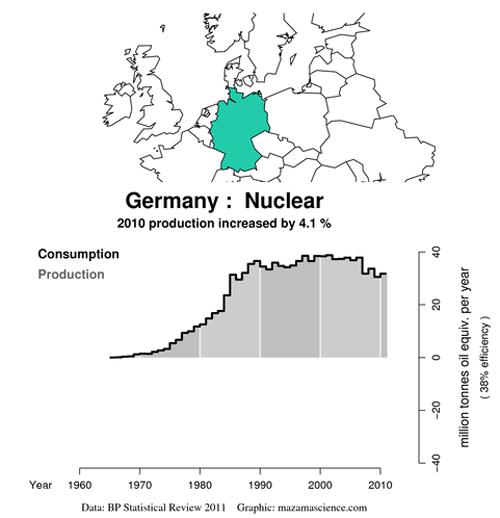
Figure 4: A major effort was made in Germany several decades ago to construct a number of nuclear power stations to provide baseload electricity. Currently, the reactors are providing a surplus of electricity that will continue until the plants reach the end of their service lives and are shut down. The German government has decided not to build any more nuclear plants. This is sensible as the unsubsidized cost of replacement plants is unsupportable. Better for the Germans to follow the example of the Greeks and cut back on the waste.
Burn their fuel-waste industries to the ground to collect the insurance. The fires will keep the people warm for a little while. In the longer term there is not so much else the Germans can do, they are broke. Like the Greeks but on a larger scale, the Germans are energy deadbeats.
The Germans must be chagrined to see a trillion new euros created by their pet European Central Bank in the past few months: scant few of these trillions have gone toward the purchase of German luxury automobiles. Instead, funds flow toward dead-money debts on the accounts of derelict banks, for fuel long-ago guzzled for nothing.
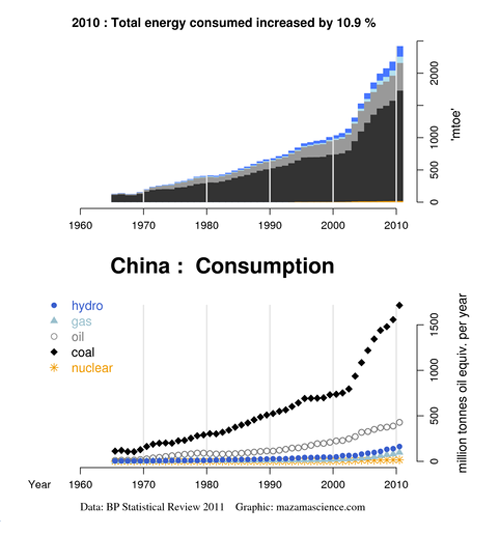
Figure 5: Here is China energy consumption breakdown for comparison. Note the massive China coal consumption. It is hard to see the Chinese maintaining this breakneck increase in the amount of coal consumption for more than another year or two. The question never asked is ‘What are the Chinese going to do with the coal?’ There are only so many useful things that can be done at any one time in the world. Anything done in excess of these useful things — particularly in one country — is waste for its own sake. Waste weighs down on output, it becomes excess capacity. China consumes as much energy as the United States, but with half the GDP. It is hard to see how wasting more coal is going to improve anything other than to pad the accounts of a handful of mining- shipping- and power company executives.
At the same time, China has an easily-grasped ‘growth story’, integral to that story is the country’s colossal waste. China borrows against all accounts within reach to grab as much resources as possible so these can be burned up for nothing right away. People believe in China, in China capitalism and uber-wasteful China modernity. That nobody knows for sure what the stories are about or whether they are worth anything doesn’t matter. China can monetize its narrative and turn the funds into coal and other fuel which in turn allows for more Chinese leverage.
Germany and China are both mercantile countries draw funds from their customers. China draws funds from US finance which can issue debt against various accounts in unlimited amounts. Standing behind finance is the US Federal Reserve. Germany will draw funds from Greece, Portugal and the reast as soon as those deadbeats get around to paying their bills. China in fact draws from the same deadbeats, yet the growth story has not gotten to the point where China bankrupts its customers.
This bankrupting process is becoming the German story, how this fits into the overall modern narrative of care-free waste remains to be seen.
Right now China is the world’s number one coal importer: As in all things mercantile, Germany must compete with China for coal and petroleum. It must also compete for external funds. China is a magnet for funds with a very high official real interest rate compared to the rest of the world. The ‘unofficial’ or black-market currency exchange rates are even higher: they have to be otherwise the Chinese currency would appreciate rapidly and adversely effect exports. Currency appreciation would cause mayhem for millions of Chinese motorists and manufacturing interests.
Because of the rate-differentials, carry-trade funds flow from the greater world to China. Germany with its collaborative euro is structurally disadvantaged: China has the organic means to defend interest rates. There is a fiscal counter-party to the Chinese central bank and a Chinese treasury, there is a large ‘shadow’ economy as well. To compete with China, the real interest rates in the euro-area must be high otherwise capital will bypass Germany and flow straight to China and other ‘carry trade’ states such as Australia. The high real interest rates are impossible burden for the weaker euro states. Because of China’s mercantile success — and the structural flaws in the European Union — the lesser- euro states are thrown into the fire so that Germany can afford fuel. Meanwhile, these same weaker states have bankrupted themselves borrowing to purchase high priced fuel as well as the ‘value added’ varieties obtained from Germany.
The outcome is the Germans face a revolt in Europe and a clampdown on their profligacy. Germany has wasted itself into a corner. China’s ability to ‘finance’ itself on its finance account as well as its energy account gives it an advantage which Germany cannot overcome.
Here is the world’s fuel waste black hole: a different strategy but much more effective PR:
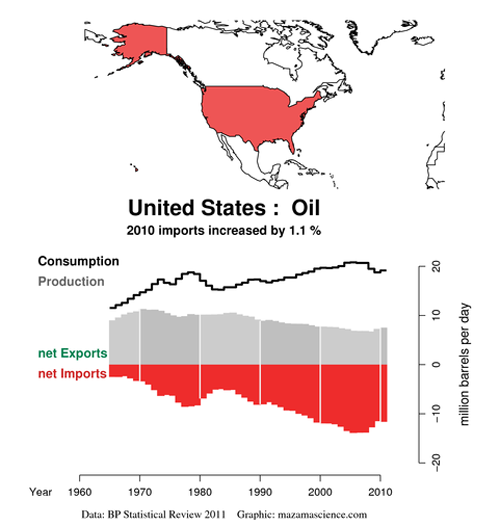
Figure 6: the USA is on its way to that car-crusher in the sky, before then it will delude itself with notions of ‘energy independence’. Note the last time US imports matched US domestic production was in the early 1990s. Also note, the US imports twice as much crude oil as it produces. Arguments that the US exports more crude oil than it imports are simply nonsense. Anyone who can read a chart can see for themselves that the US is in no way energy independent or even close to it.
Unlike the Germans, the US is possessed of both native sources of energy as well as the instruments of organic credit within its own borders. America can borrow in amounts limited only by the ‘dead money’ debt on its books. The Germans can borrow in unlimited amounts against its own account but only outside the the euro. If such a thing were allowed by the incredible euro rules, Greece would do this very thing and end its debt crisis!
Because the US can borrow on world- and US accounts, because of dollar seigniorage, the US can out-compete Germany for fuel. This is a gigantic problem for the countries that use the euro. The countries cannot borrow further, at the same time there are more depositor withdrawals from banks and increased flight out of the euro. Currency-related expenses become so high the euro becomes too costly to defend. The path of Greek decline is the German path: too-high costs of external financing of wasteful enterprises that cannot be arbitraged or leveraged by way of the euro.
Exit from the euro is no panacea: countries would be forced to depreciate their currencies to manage legacy debts. Germany would depreciate in order to export, offering goods that few can make use of because of unaffordable real fuel prices … rendered so by widespread currency depreciation!
The problem is the fixation on enterprises that cannot pay their own way, toys that cannot pay for themselves. The last time the United States did not have to import fuel was off this chart! To be free of the ongoing financial/energy deflation the US will have to not only live within its energy means — without imports — but also conserve its reserves for future generations.