Dmitri Orlov has an interesting article or rather a collaboration with Ugo Bardi about what Bardi calls the ‘Seneca Cliff’. The likelihood is that the decline rate of fuel consumption (production) will be much faster than was the increase in fuel consumption. This is a re-thinking of the famous M. King Hubbert peak oil curve, you know, the curve that looks like a bell …
It is our Wile E. Coyote head first over the energy waste cliff or ‘overshoot’ moment. Doomers call this the ‘shark’s fin’, others refer to the cliff as a ‘stair-step’, presumably down. We do fine for a blissfully short period of time then we are destroyed. The economic accompaniment is credit collapse and an ecological wipeout. A the end of the day there are machine-gun battles in the streets over cans of dog food.
The bell-curve people suggest (hopefully) that the ‘downside’ of oil consumption after the peak is reached will be similar to the upside rate. Now is a good time to rush out and buy a new car: since it took a long time to get to current rates of production (rape) you will have shuffled off this mortal coil before production significantly declines. There might even be a plateau in 2035. One reason these apologists offer up is the ability of the petroleum industry to find new forms of greasy water it can call ‘crude oil’.
Here’s Orlov:
I started thinking along these lines when I was invited to speak at the annual conference of ASPO (Association for the Study of Peak Oil), which was held in Washington in October of last year. It was shaping up to be something of a victory lap for the Peak Oil movement, now that the moment when global conventional oil production reached its historical peak is well and truly behind us, while the newer unconventional sources of liquid fuels have turned out to be insufficiently abundant and too costly both to the pocketbook and the environment. I wanted to use this opportunity to try yet again to correct what I see as a major flaw in the narrative of Peak Oil: the idea of a gentle, geologically-driven decline in oil production, which seems quite unrealistic, which I had detailed in my article “Peak Oil is History” more than a year before. But I also wanted to look beyond it and sketch out some plans that would work after oil production dives off a cliff, and what it would take to get them off the ground.
Sez Bardi in reply to Orlov:
Let me see if I understand your point: you say that a Gaussian (curve) is no good; that the descent on the “other side” of the peak should be much faster than the growth. Am I right?“If so, it is curious that I was working right on this concept today—and I think I cracked the problem just one hour ago! Maybe it was already obvious to other people, but it wasn’t to me; maybe I am not so smart but, at least I am happy now. So, I can tell you that you are right on the basis of my system dynamics model. Descent IS much faster than ascent!
“When I received your message I was just starting to prepare a post for my blog “Cassandra’s legacy” on this subject. So, if you can wait a couple of days, I am going to complete my post and publish it. Then you may give a look to it and we can discuss the matter more in depth. And I’ll make sure to cite your post, because I think it is right on target.”
Here are graphics for Ugo Bardi’s energy cliff:
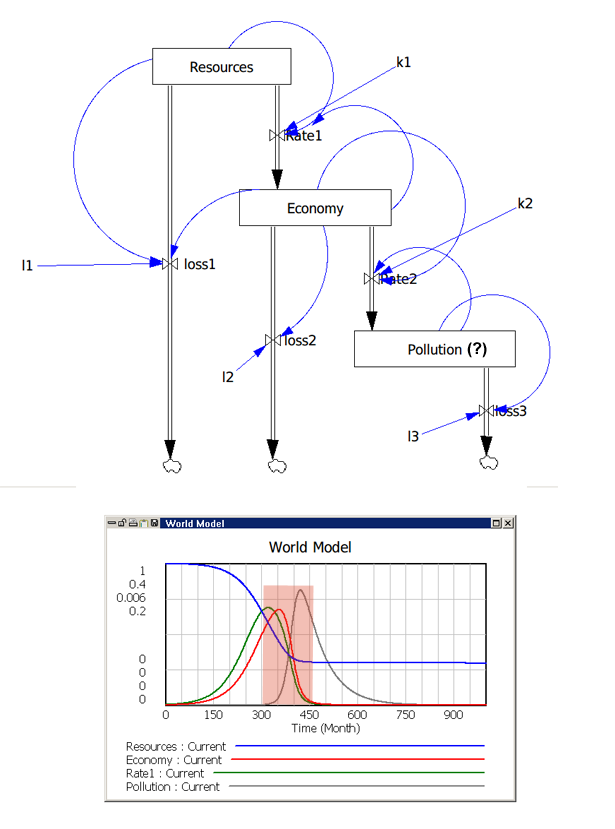
Figure 1: The pinkish area is where decline rates steepen. The pollution argument doesn’t fit the scheme. The term can be used to represent (undetermined) costs overhanging depletion of fuel. The blue arrows represent feedback loops that control the level of waste or entropy within the system. As in the real world, everything is wasted with a bit of work being done here and there to entertain the children.
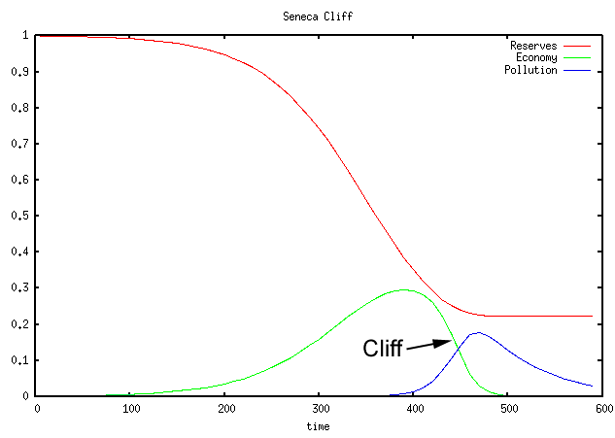
Figure 2: Bardi’s energy cliff is not that much different from the Net Energy or EROI cliff which has energy cost of gaining new fuel:
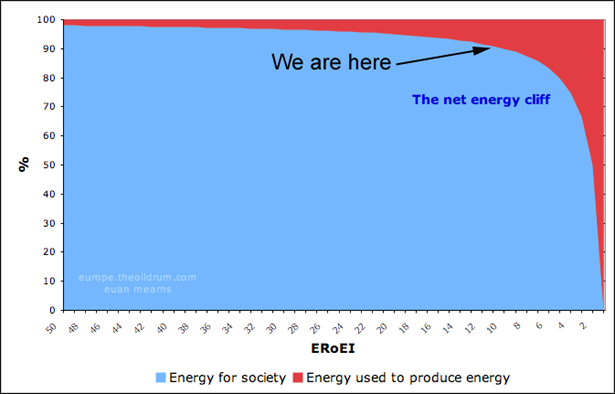
Figure 3: Here can be seen what happens when the energy returns on energy expenditures near zero (which is when energy returns have to stop altogether). This chart is from Kurt Cobb/Energy Bulletin and Euan Mearns. All of these are good articles to read, by the way.
One way to keep this cliff business straight is to focus on the price.
For the bulk of the oil age starting at the beginning of the 20th century, the cost of crude oil fuel in the market has been very low: $20 per barrel in constant dollars or much less. The easy fields to discover and exploit had crude deposits a few hundred or thousand feet straight down in regions close by refiners and markets. These ‘low hanging’ fields were massive, containing tens- or hundreds of billions of barrels, such as the Spindletop field in Texas and Ghawar in Saudi Arabia. The great bulk of the world’s oil used to date has been the $20 oil. Without spending hours fact-checking 90% of all the oil that has been extracted and burned up so far out of the world has been the $20 variety.
The interest of the petroleum industry has been since the beginning to keep product costs as low as possible, which meant the highest rates of production as possible. The pricing structure for petroleum products was both the invention of monopolist John D. Rockefeller in the late- 19th century and the happy consequence of improvements in oil prospecting and drilling technology, refining and transportation.
When mass-produced automobiles became available in the form of Henry Ford’s Model T there was plenty of cheap gasoline to power them. Gasoline was the ‘loss-leader’ for both the auto manufacturers but also road-builders and developers of new suburbs. Cheap fuel contributed to the massive credit expansion/boom that took place during the 1920s (it probably had something to do with the crash that followed as well). The entire focus of the producing industry along with government and finance to keep prices as low as possible by any necessary means. This included but was not limited to overproducing from domestic and allied countries’ oil fields, finance manipulations including generous subsidies, foreign policy initiatives, over-development of finance sector and war … both the price- and the other kind.
Efforts have been wildly successful: what has taken place in the century between the Rockefeller monopoly and the year 2000 has been the exhaustion of the $20 per barrel conventional crude oil. Not only is the $20 oil gone but so is the $30 and the $50: all that remains is the $100 and $120 and above.
A reason for the current nose-bleed prices is above ground factors that include fuel subsidies for wasteful consumption in oil-producing countries. These costs are not direct energy investments as EREOI would suggest but their effect in the marketplace is very similar. Once subsidies are in force it is hazardous to the health of government officials to remove or modify them (except to make them larger). Producer countries with capital inflows have the means by which millions of new cars are bought along with the roads to drive them on, American-style suburbs within which to meander aimlessly. There are also the American-style shopping centers with desert-indoor ski slopes. Not to be overlooked are the military establishments, the promotions of this or that religious lifestyle(s) in neighboring countries, the massively over-built concrete high-rise financial centers: there is the need to pacify restive citizens at great costs. In Saudi Arabia, the establishment has seen fit to turn the city Mecca into a knock-off version of Las Vegas complete with unimaginably ugly hotel development. The egalitarian Mohammad certainly spins in his tomb: this luxurious excess and over-spending is added to the price of every barrel of oil.
As the world’s motoring publics’ pockets are turned out empty there is the $100 oil and nothing else. As the publics becomes broke(r), the world cannot go back to using $20 crude again because there is very little more cheap crude remaining. The + $100 oil stays in the ground because the publics do not have the funds with which to buy it. It is the absence of cheap crude that represents the onrushing energy cliff.
To bring above-ground costs down to allow greater affordability requires ‘restructuring’ of the producers, presumably with cruise missiles and commandos, to create ‘failed states’ out of functioning societies. Aside from being presumptuous, restructuring that effects the producers significantly negatively effects consumers. The number-one presumption is that costs can be eliminated, rather the costs are shifted and multiplied in unpredictable ways. Restructuring other countries has been the losing proposition for the United States since the end of World War Two, this includes the Cold War. Best for the US to begin restructuring itself while it has some resources remaining to allow it to do so.
Comes now the the Iranian government official waving a nuclear fuel rod threatening to cut off fuel supply, insisting that Iran may or may not have nuclear weapons. The $110 price is obviously insufficient, Iran cannot pay its bills. The likely outcome of Mr. Fuel Rod’s actions is to precipitate the Iranian lunge over the energy price cliff that he desperately seeks to avoid. Fuel customers are flat broke and the American-style credit system the world has relied upon for the past fifty years or so is flat broken. The Yankees and the Europeans play the game of chicken imposing sanctions on Iran. The end are consequences that nobody can afford, the entire enterprise is theater.
If money flows into Mr. Fuel Rod’s oil account because the theater is (semi)effective, the funds avoid some other needy account. In the zero-sum world, the strictures on funds work their way back through the global economy to adversely effect Iran’s customers, then Iran itself.
Look at the relationship between supply and demand indicated by price. In general, demand is quite inelastic until the price point is reached when demand goes on strike and elasticity is ‘discovered’.
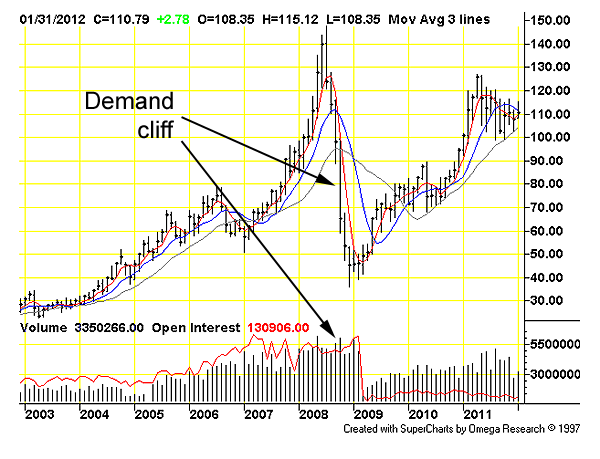
Figure 4: Fuel prices in flux by way of TFC Charts: In 2008, the price collapsed from $147 to $34 along with futures market open interest. What the latter price represented was the shocking diminution of demand or the ‘demand cliff’. This was caused by the unraveling of the shadow banking (non)system, resolving imbalances in the crude oil futures market and the effects of the very high prices on an infrastructure built assuming $20 per barrel crude. For a short period, + $100 crude pushed the waste-based economy over the demand cliff which led to the price cliff. Be prepared for something similar in the next few weeks or so .
Energy
| PRICE* | CHANGE | % CHANGE | TIME | |
|---|---|---|---|---|
| BRENT CRUDE FUTR (USD/bbl.) | 124.060 | -1.410 | -1.12% | 11:51 |
| GAS OIL FUT (ICE) (USD/MT) | 1,029.500 | -1.000 | -0.10% | 11:51 |
| HEATING OIL FUTR (USd/gal.) | 328.490 | -3.100 | -0.93% | 11:51 |
| NATURAL GAS FUTR (USD/MMBtu) | 2.502 | -0.048 | -1.88% | 11:51 |
| GASOLINE RBOB FUT (USd/gal.) | 312.520 | -2.760 | -0.88% | 11:50 |
| WTI CRUDE FUTURE (USD/bbl.) | 108.930 | -0.840 | -0.77% | 11:52 |
(Bloomberg) Brent crude stands at $124 per barrel. If the past is a guide, the current minispike will fail and prices will decline from here. Ominously, this spike is underway when much of the world is either in deflationary recession or teetering at the edge. All else being equal, an expanding world economy would pay $150 per barrel crude oil. $150 will not allow economic expansion, it is hard to see $120 allowing it.
There are two problems that extend outside of the petroleum energy regime, three:
– Peak oil is almost entirely an automobile problem. The almighty automobile is the axle around which modernity rotates. Its manufacture is the world’s single greatest industry, there is the required roads-and destinations construction, there is the advertising industry, the finance and insurance industries: the expansion of government into every corner of every persons’ life with the hated rules, laws, un-earned benefits and taxation: all of this is absolutely integral to automobilization of the world.
Much of government expansion has to do with the increasing importance of military and internal security forces to guarantee ‘low’ pump prices and to manage the effects of auto-driven suburbanization. Expansion of government reach parallels the increasing penetration of automobiles into every corner of the world. Take away the automobile and all that goes with it and there is not a peak oil problem. There is enough petroleum in the ground for use as high-quality lubricant and chemical feedstock — this excludes automobile uses — and at the most reasonable and affordable price for thousands of years at current rates of consumption, this forgoing leaves out that chemicals, plastics and lubricants can be recycled.
Chemists and lubricant refiners can afford to pay much more for their petroleum input than can the wasteful guzzlers who — as a matter of first principle — require the cheapest of all possible resources to burn up for nothing.
– It is possible/likely that the price peak cliff is on us now.
– Management is ‘all in’ with the current regime of pointless waste for abstract public benefits (and money wealth for themselves). Once current management is swept away by circumstance, a regime that accurately prices inputs, that uses credit for longer-term capital enhancement and husbandry can emerge in its place. It’s not that hard: any effort that husbands capital and improves it by way of conservation or by other means shall have access to credit. No other kinds of efforts will be financed. Put another way, the repricing phenomenon is underway and cannot be stopped. Investment financing for short-term returns has nowhere to go, there are no investments! This is particularly so within (credit thirsty) industry. All that is needed to emerge is the predatory conservationist.
Meanwhile, Prof. Bardi remarked:
Interesting story, Dmitri! I am still working at these models; now I discovered that there are other ways besides pollution to obtain the “Seneca” shape. It can be obtained by transferring resources from one source to another; which may be closer to what’s happening now. Pollution is something that hits us more on the long run.Interesting also that your presentation at ASPO-USA was met with polite silence. People just don’t care about understanding what’s going on and what’s going to happen. If they are rich they care about how to make money on oil; if they are poor they care about miracle devices that will save us from the brink of the cliff.
Then, as we start falling, interest in understanding what’s going to happen will fade even more. I remember that you said something like that in your book, “Reinventing Collapse” – that in the Soviet Union, when the collapse started, nobody cared any more on why everything was collapsing.
Anyway, I am trying to write an academic paper on the Seneca effect. It is an exercise in futility, given the situation. But, in the end, it is not just my job. It is fun!