In the North-East, in the wake of Hurricane Sandy, there are emergency workers, linemen, construction crews clearing roadways of fallen trees and sand, pumping water, replacing electric lines, and trying bring back services to the stricken New York-New Jersey areas. Meanwhile, thousands of irate drivers are waiting in long gasoline lines such as this one pictured below:
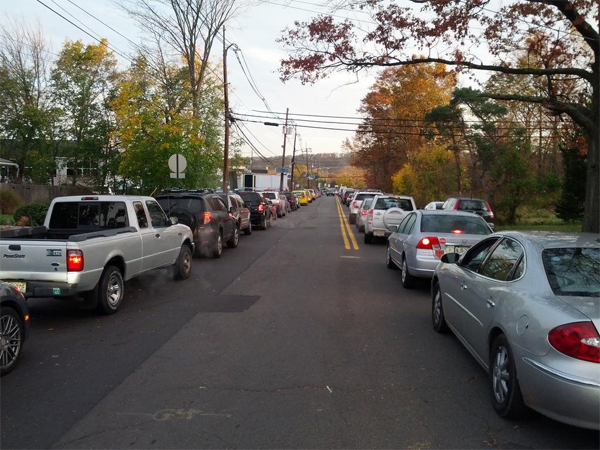
Gas lineup of cars in New Jersey (Jeff Jarvis) Heaven forbid that Americans be deprived of the means to drive where and when they please! Certainly, the citizens of New York and New Jersey have the God-given right to cruise around and ‘see what’s open’/what’s destroyed.
Question? How will the same citizens cope with permanent crude oil shortages? If not during a disaster, when? Here is what James Howard Kunstler’s ‘long emergency’ looks like in its initial stages. Americans are indoctrinated to where cars are central to every possible activity. No gas = no car = (c)armageddon.
Notice the gasoline shortage that first appeared in California has migrated to the East Coast. The proposition is always the same: a defect in delivery mechanism, a refinery- or refineries shut down for various reasons yet with ‘plenty of gas’ in the delivery pipeline.
Is there really plenty of gas? If there is, why lines?
In California there were very high pump prices in areas with less gasoline, in New Jersey the gas is still cheap by mandate … where gasoline can be found. Why not market clearing prices? $20/gallon gasoline and there are no lines, and no frivolous waste of gas, either.
After the storm the river crossings into New York City were reopened to traffic, the streets were immediately jammed with single-occupant vehicles. Service vehicles and buses were unable to move until authorities began turning away all cars with fewer than three occupants, the 2d day after the storm.
– The city should ban all private vehicles from operating on New York City streets except for transit, emergency and delivery vehicles. The city should also ban any parking on arterial streets and free up space for buses. Oops! Can’t be done, the governments are all too ‘pro-car’.
– People waiting in long lines suggests the need for a rationing regime: odd-even days with the last number on the license plate being the determinant.
– People waiting in long standee- lines with gas cans in hand represents the triumph of marketing over common sense. The ongoing sequence of damaging storms since 2000 has convinced tract-house residents to ‘invest’ in portable generators. Users don’t realize how much fuel even a small, 3kw generator uses … A generator large enough to supply a tract house ‘normal’ power (Watts) uses more fuel in a day than a person can carry easily. People buy generators the way they buy cars: they obtain the largest and most powerful units they can afford … they run the refrigerator and the big-screen television and have lights on all over, they must also burn a gallon of gasoline per hour while doing so … a five-gallon Jerry-can weighs 45lbs filled … which is too heavy for most to carry more than a few hundred feet … this means daily trips in the car looking for large amounts of gas.
– The sensible approach is to use the smallest generator rather than the largest … run it sparingly … only when needed to charge telephones and laptops and use essential devices … the television is not essential.
– Keep yourself and your car off the roads until the emergency is over, period! Emergency services have enough to do without dealing with YOUR car wreck. In an emergency there is no need to drive anywhere … provided driving isn’t necessary to escape immediate danger.
– In an emergency stick close to your house. Check on your neighbors and make sure they are not ill or hurt. After hurricane Katrina, a great problem in New Orleans was the 100+ degree heat, high humidity and absence of water and power. Neighbors helped neighbors, there was no one else to whom to turn.
– Comparisons will be made between New York and New Orleans post- their respective hurricanes.
– The level of damage to both places and surrounding areas is very similar. The actual level of physical destruction won’t be accurately determined for months (if New Orleans is a guide).
– The bosses have learned: New Jersey, New York and Connecticut governments plus FEMA are more effective now than Louisiana, Mississippi and Alabama plus FEMA were post-Katrina. In New Orleans many police ran away, others looted or formed ad-hoc death squads that randomly shot at- and killed negroes. Later, ‘security duties’ were given over to private security goons who harassed and abused inhabitants. Meanwhile, road-blocks and miscommunication kept food and water trucks out of the city.
– Many rooftop rescues took place because Louisiana locals ignored police/military commands to stay out of the city and patrolled areas with small boats.
– Cleanup after the storm was a bonanza for well-connected ‘contractors’ who subcontracted- and subcontracted again and again much of the public work. So far, none of this seems to be taking place in the NY-NJ area … but it is too soon to claim that such abuses won’t take place in the future.
– Most of the storm destruction in the south was outside of New Orleans: coastal Mississippi was particularly hard hit. Ditto the coastal areas of New Jersey and Long Island. Right now there is little information about LI damage but it is likely to be severe.
– Reports of looting made no mention that even rescued persons lacked access to food or water or means of travel (boats). There was no violence @ Superdome or Civic Center even with these places packed with thousands without food, water or working toilets … despite numerous wild tales of violence at these places in the news media.
– New Orleans was closed to all for about 6 weeks … this allowed for a second major hurricane to smash the city and add more flood water … but kill no more people.
– Much of the traffic on New York-area roads is gawkers. How about arrests?
– A household should have enough basic supplies, food and water to function without refrigeration/power for at least 30 days without needing trips to the store. 30 days isn’t an extreme period of time and was considered basic household preparation only a couple of generations ago. Dried vegetables, starches, grains, smoked and salted meats keep intact for long periods without refrigeration. In cold weather, perishable items can be put outdoors in sealed containers (to keep roving pests out of your food).
– Every household should have a good supply of soap, salt, toilet paper, water, towels and blankets. Sweaters, long woolen undergarments and blankets are zero-energy solutions to cold/wet weather. They are more effective than running a 7KW generator to power a space heater. A small fan can be a life-saver in hot climates.
– Water should be stored in glass bottles not plastic or plastic-coated metal containers. Plasticizers contained therein leach into the water and accumulate, these are highly toxic. One-gallon glass bottles for vegetable oil are good after cleanup for water storage. Rotate your water storage periodically and keep it away from light … this keeps algae from growing in the water and making it slimy. Stored water can be rendered potable by use of purification tablets or by boiling.
– Before a disaster, seal and fill the bathtub to the overflow. This will be a source of washing and toilet-flushing water. 2 gallons of water are all that is needed to flush the modern toilet. Use the tub water for cleaning and rinsing first, then the wash water for toilet flushing. Flush the toilet once a day, close the lid when not in use.
– In any emergency closely ration your drinking water! DO NOT WASTE WATER you don’t know when clean water will be available. New Yorkers are learning the hard way how little fun it is to hump five gallon buckets from fire hydrants up twenty or more flights of stairs in the dark in high-rise buildings …
– Backup heating: a woodstove or fireplace with some firewood is the best backup. If there is no fireplace, the wick-type kerosene heaters are thrifty and newer models are safe. Do not use ‘salamanders’ or job-site kerosene heaters as these gobble electricity. Neither the generator nor the heater should be used in confined spaces due to carbon monoxide emissions. Do not use electrical space heaters.
– In a hurricane, there is little a homeowner can do when the storm is raging outside. Inside, some tarps, drop-cloths, duct tape, plywood, a hammer and some nails can be used to temporarily close an opening that allows the wind and rain to enter.
– In a snowstorm, the owner should be aware of snow loading his roof and be ready to shovel snow.
– During emergencies, commuters form car pools. Fortunately, the surface commuter rail systems in the New York City area are likely to be back in operation next week.
– In an emergency, the most useful tool is the shovel. It can be used as a pry bar, to remove mud, sand and water and to dig snow and ice. The second most useful is a flashlight.
– In an emergency, the greatest problem is not danger but boredom. Americans are used to being continually entertained. The demand for entertainment is such that content sources are exhausted … Keep some ‘old-fashioned’ games, cards, books (the paper kind), drawing materials, musical instruments and puzzles. Everyone in a household should be given chores to do including cleanup which is essential. Provided the house isn’t destroyed or seriously damaged, an orderly environment is helpful for morale, particularly over extended periods. Looking after neighbors is part of expanding the orderly environment beyond the house.
It is likely that most filling the roads in the New York-New Jersey hurricane zone are simply bored with being in a house with no lights, a droning generator and no junk food to gobble … Americans need to get over this need for outside stimulus … most will be spending extended periods inside one house … within one town … likely to be a small and boring town … for their entire lives. The gasoline shortages will be permanent … what then?
???