A look @ the reactor info from TEPCO is sobering. The temperature in reactor unit 3 is increasing along with the temperature in the unit 4 spent fuel pool. High humidity within the reactor buildings is making work increasingly difficult for the crews tasked with bringing the cores under some kind of control.
It is hard to determine the morale of TEPCO’s staff, whether the ‘human resources’ are being effected by the foolishness (privilege) of their superiors. Certainly, workers can sense whether their efforts will bear fruit or not. The image of the Japanese worker is of a highly motivated team player ready to make whatever sacrifice is demanded by his company. Since many at the plants are low-wage hourly contract workers with no direct connections to TEPCO, assumptions cannot be made.
From the USA perspective it appears that TEPCO’s efforts are more of the same- public relations. It seems that the company doesn’t care about workers or persons living near the plants … that the workers are pawns and customers are a resource to strip-mine.
- TEPCO has still not reported the level of radioactivity in the wastewater that is accumulating in basements and service areas of the reactor complex.
-
TEPCO’s tardy admission of the complete ‘melt through’ of the reactor cores indicates waste water in the buildings carries more radioactivity than TEPCO admits.
-
The Areva waste water treatment is not likely to work due to the level of contamination in the water.
-
Meanwhile, TEPCO is running out of places to put the water.
-
Radioactive waste water is accumulating in the basement of the Fukushima Daini plant.
Here is the temperature schematic for reactor unit 3 (click on image to enlarge):
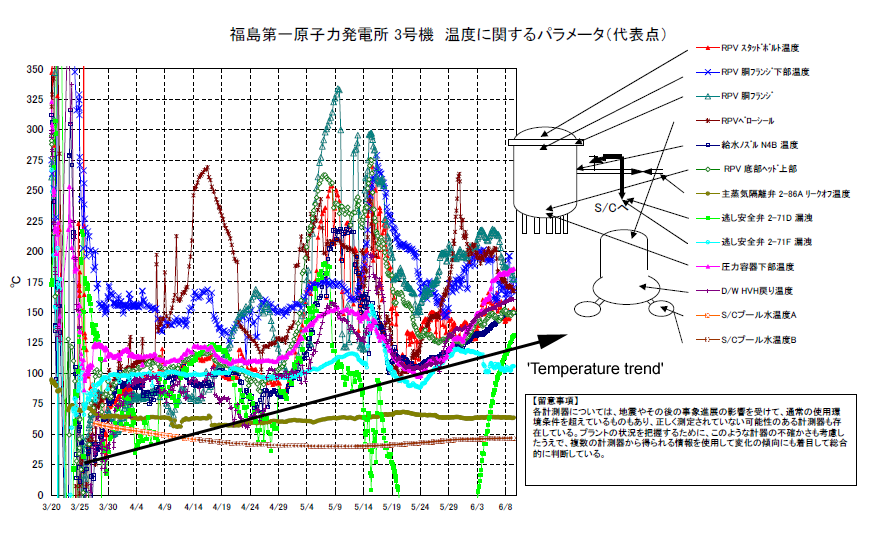
Figure 1: Reactor unit 3 temperatures.
Temperatures have been steadily rising since the original emergency and explosion. In May there was a large temperature spike. The core appears to be critical even though the meltdown would have destroyed the core’s structure of supports, separators, fuel and control rods. The temperatures suggest the nuclear materials in the (MOX) core mass are organized atomically in some way, perhaps as particles within a matrix of molten metal. The metal would act as a moderator and allow a chain reaction to take place.
‘Corium’ debris likely includes molten stainless- steel that made up much of the core support structures inside the pressure vessels as well as parts of the vessels themselves. Each core mass is approximately 200 tons or more. The material is probably in the spaces under the dry wells in the form of ‘blobs’ having lava- like liquid centers. Cores have become uber- toxic ‘science experiments which contain isotopes, compounds and solutions of concrete, seawater salts, leftover corrosion products from ordinary reactor operation (Cobalt 60) and debris from the control rods and drive mechanisms. It is unknown whether the cores are melting through the concrete reactor foundations.
Also unknown is whether ad-hoc core structures would allow reactions to self- amplify or whether the neutron cross- section of the nuclear fuel would dampen reactions after a certain temperature is reached.
The foregoing presumes criticality is taking place within the reactors and not something else: particularly the unit 3 core. Nuclear expert Arnie Gunderson suggests core criticality is unlikely due to the absence of any proper structure. He suggests reactions are taking place in spent fuel pools. The question then becomes, what is causing the pressure vessel temperatures to continually rise?
A source of heat could be exothermic reactions taking place between certain corium materials and concrete or between the different exotic alloys used in the cores and water. It is possible these reactions plus the decay heat of the MOX fuel together account for the temperature increase.
This is important because an unpleasant outcome of core re-criticality is a runaway core- or prompt- criticality event which explosively reconfigures the material and destroys the containment.
For all intents and purposes this core is out of control. TEPCO can either pump a lot of water or less water into the reactor. Not pumping is not an option. There is nothing else the company appears prepared to do. Current water flow is 10.5 – 14 cubic meters/hr. The (elephant in the room) problem for TEPCO is where to put the water.
Here is reactor unit 2 for comparison (click on image to enlarge):
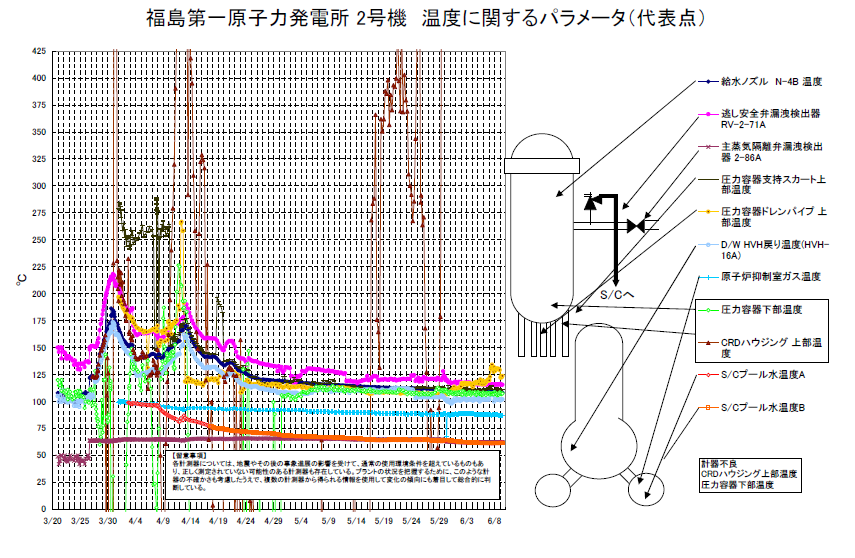
Figure 2: Reactor unit 2 temperatures.
Both reactors are destroyed: unit 2 is less active than unit 3. What these schematics don’t tell is where the cores are or what their condition is.
TEPCO has so far been unable or unwilling to probe the reactors to find out. Figuring out what is taking place within the buildings is a guessing game based on imperfect (useless) information provided by unreliable instruments relayed by an unreliable company: (click on image to enlarge):
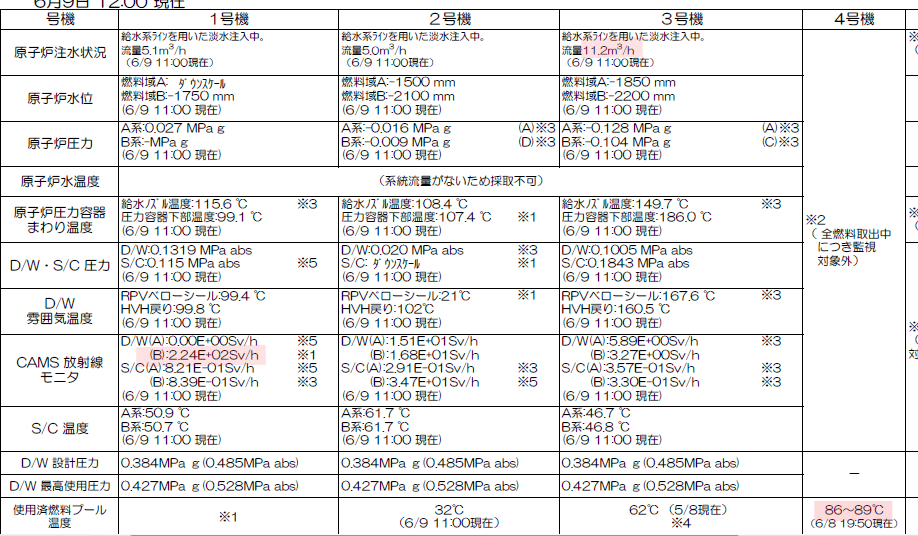
Figure 3: Temperature, water flow, radiation and other levels in three unit cores and unit 4 spent fuel pool.
The highlight at the top of the page indicates the current water flow into reactor unit 3. A higher flow would likely reduce the temperature within the unit, then again it might not.
Another highlight is the radiation reading in the unit 1 drywell which is the item labeled ‘CAMS’. The number is “(B)2.24E+02Sv/h *1”
This can be interpreted to mean 224 Sieverts per hour: occasional very high readings have been published but it is unknown whether the instrument is defective.
Also note the temperature of the spent fuel pool in unit 4 on the right hand- bottom of the chart. This temperature has also been rising slightly over the past few days although TEPCO suggests this structure has some cooling function.
TEPCO’s painted itself into a corner with its soothing prior statements about the core condition. TEPCO insisted that damage was contained within pressure vessels and that there has always been cooling function in all three cores and that the cores were somewhat intact.
TEPCO’s plan to recycle cooling water was predicated to some degree on contained cores that did not release large amounts of radioactivity into the cooling water. From the beginning the company has promoted the ‘best- case scenario’ and has planned- and acted accordingly.
Months later comes the company admitting that cores had no cooling and have melted completely through the pressure vessels onto the floors of the reactors. It is also obvious that the containments of all three reactors have been compromised. Yet TEPCO insists it can recycle waste water to cool the reactors.
The 100,000+ tons of water used to cool the cores is stuffed into every nook and cranny of the facility with more water to come. Because the water has come into contact with disintegrated cores, the radiation level is certainly very high.
TEPCO does not indicate how radioactive the water is. However, 4 Sv/h steam detected in unit 1 indicates the water is also emitting 4 Sv/h or more.
Cycling this water through pumps, hoses and filtering equipment will leave the equipment too radioactive to approach: material will ‘stay behind’ in the equipment. Damage to the equipment by radiation or due to ordinary wear and tear would be difficult to address. Additionally, the hose-and-tank array will not work for unit 3 because overall temperatures are too high.
More time is lost as TEPCO fumbles.