
Bernanke and his Ponzi- Laundry operation are hanging in the balance. While ringing endorsements are not an art well- practiced by the Obama regime, support here seems more tenuous than usual. Consequently, the MSM has stock markets on tenterhooks. After all, if the Wall Street gravy train ends, what is ‘Plan B’?
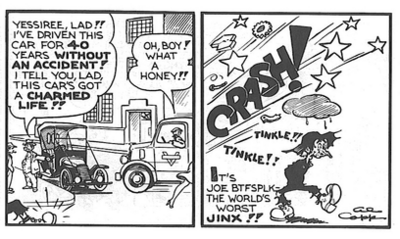
There is none, and that has much of the finance community anxious. Who could the next Fed chari be? Paul Volcker? Janet Yellen? William Dudley? ‘Honest’ Paul Volcker as Fed Chairman is the stuff of nightmares. The last time Volcker was Fed chair, interest rates topped 20 percent. High rates follow him around like the perpetually dark cloud that follows Joe Btfsplk:
There are still trillions of illiquid, worthless securities along with the hedge funds and firms that own them waiting for the opportunity to trade and be traded to the Fed – no questions asked – for crisp, new US dollars. Even more such securities are being created every single day. This is innovation; how can government stand in the way of progress? What will happen to these poor, orphan securities?
The answer is, nothing! The Fed is now irrelevant; it cannot control its own destiny and the money- laundry’s days are numbered, regardless who holds the chair. As usual, the issues have outraced the Establishment’s perception of the issues.
Chris Cook over @ The Oil Drum has outlined a mechanism by which Saudi Arabia – as the major swing producer of crude oil – can fix/manipulate the relationship between crude oil and the US dollar:
“Saudi Arabia and the oil bank”
Reprinted from the Asia Times.
As crude oil prices climbed back over $80.00 per barrel during 2009 – after the dramatic spike to $147 and subsequent collapse to $35/bbl – US politicians and regulators are in no doubt who to blame. They accuse ‘speculators’ such as Exchange Traded Funds (ETFs) and hedge funds of manipulating oil prices through the use of futures and options contracts not only on the dominant exchanges – the New York Mercantile Exchange and the Intercontinental Exchange – but also off exchange, through bilateral ‘over the counter’ (OTC) contracts. But the truth lies elsewhere.
Introducing Oil LeasingIn 2005 Shell had a brainwave. They agreed with ETF Securities – a provider of Exchange Traded Funds – that a new oil fund could invest directly in Shell’s oil production. Whereas most ETFs which are exposed to the oil price use the oil futures markets, this initiative cut out the middlemen, and all of the costs associated with maintaining a position in a futures market over time.
The outcome was that Shell borrowed dollars from the fund, while the fund borrowed, or leased, oil from Shell through forward sale agreements or otherwise. Everything was, and remains, above board and relatively transparent, but this innovative form of financial oil leasing appears to have been turned to other uses by other market participants.
Macro ManipulationSimply stated, producers have an interest in high prices. Cartels of producers have therefore often been created to openly manipulate prices by artificially supporting them. A classic example was the International Tin Council which supported the tin price by buying tin – and stockpiling it – if and when the price fell to its ‘floor’ price. Unfortunately, the high prices stimulated new production; eventually the ITC ran out of money; and the tin price collapsed in 1985 – literally overnight – from $8000/ tonne to $4000/tonne.
In the late 80s and early 90s Yasuo Hamanaka, a Japanese copper trader acting for Sumitomo Corporation, successfully manipulated the copper market not only for five years before someone blew the whistle, but even for another five years afterwards. The mechanism used was for investment banks to loan dollars to Sumitomo, who in return loaned copper through forward sales on the London Metal Exchange.
The only way to manipulate commodity prices is through the ability to secure supply. In the oil markets, funds, whether ETFs or hedge funds, are categorically unable to make or take delivery of the underlying commodity, and are therefore unable to manipulate the price. It is only ‘end user’ producers and distributors, or the few traders with the capability to make and take delivery, who are in a position to manipulate oil prices, and in order to do so they require funding, or leverage.
I believe that it is macro manipulation by oil producers, funded by cheap money from investors, which has been the principal reason for recent movements in the oil price. The advantage which producers have over oil traders is that producers are able to store their oil in the ground for free.
The Brent ComplexOver 60% of global oil production is priced against the price of UK’s North Sea Brent, Forties, Oseberg, Ekofisk (BFOE) quality crude oil. Most of the rest is priced against the US West Texas Intermediate (WTI) price, but in the past 10 years the WTI price has increasingly become the tail on the BFOE dog through ‘arbitrage’ trading.
There are typically 70 or less cargoes, each of 600,000 barrels, which are produced by the BFOE fields each month, and in order to support the global oil price it is necessary to ensure that BFOE ‘spot’ cargo transactions take place at the or above the support level. This may be achieved by forward purchases or other contracts in the opaque BFOE complex of contracts where transactions take place off-exchange.
By the standards of the relatively few major market participants involved in the market, this is easily achievable if the funding is available. As the Credit Crunch unfolded from late 2007, fund money began to pour in to existing and new ETFs.
The Zero Bound
As short term dollar interest rates fell to zero – “the zero bound” – investors switched their dollars into other assets, and particularly commodities, which also carry zero income, but which at least have intrinsic value, unlike the dollar or indeed any other ‘fiat’ currency. We therefore saw simultaneous spikes in the oil markets, agricultural markets and metals markets which had nothing whatever to do with underlying supply and demand.
These rises in price continued until the destruction of demand created surpluses beyond global storage capacity, and prices thereupon collapsed as the bubble of leverage funded by investors deflated. The oil price collapsed to about $35 per barrel, and since short term interest rates remained at 0% the conditions were ripe for a repeat.
And so it goes; the entire article is worth reading and the comments as well as the Max Keiser interview:
Chris argues that that the dollar can only devalue against materials. This is true up to a point; the mechanism that Cook describes allows the crude oil swing producer (Saudi Arabia) to hold the value relationship between dollars and oil steady at a high nominal price level. This has been the situation with the dollar/crude trade over the past several months. The high money price appears acceptable to customers as long as there is little volatility. Applying a fixed and arbitrary upper limit to the dollar price serves the interest of the producer on its face. One hundred or two hundred dollar oil looks ‘expensive’ and ‘profitable’ on paper, but represents a massive decline in real dollar value. The higher dollar figures manifest in producer countries as inflation. A steady price and a valuable dollars means low inflation. A very low nominal price as was the case last Spring does not allow sufficient returns for producers to maintain oil fields or develop new ones.
The manipulation restrains volatility which gains the swing producer a ‘volatility premium’.
Unfortunately, this runs head- first into Bernanke’s ‘Dollar Destruction Strategy’ which is the text- book response to deflationary circumstances. Here, the short- dollar is a more of a publicity stunt than a real strategy. Ben has been handing out hundreds of billions to his Wall Street ‘clients’ who – like the Saudis – want dollars that are worth something. The Bernanke Dollar Laundry makes him valuable to Wall Street – at the same time, he’s poisonously destructive to Main Street. It is the hard dollar created by Saudia’s dollar/oil peg that makes him irrelevant.
Whether he stays or goes or who replaces him does not matter. Saudia makes US monetary policy, now. They have oil, we have nothing but more and more debt. The oil dollar is deflationary. All trade orbits around the dollar/oil relationship. The deflationary dollar means low interest rates and declining stock prices. As I have been saying for months, it is past time to close all short- dollar trades. The smart money has long since exited the markets. Momentum will shift against investors very rapidly and those waiting until the last minute to exit positions will be ruined.
Oil consumption matters. If you look at the countries that are currently in dire credit circumstances – Greece, Italy, Spain, Portugal, Dubai, Japan, California – all are major net oil/energy consumers. The finance media focuses on the debt, the real issue is the energy consumption. If the sovereigns are broken down to administrative districts – the US into California, Michigan, Nevada, New York – the parallels with their Eurozone counterparts becomes obvious. California is to the US as Greece is to Europe. New York is to Spain. Michigan is to Belarus. All are poised to slip into the abyss as the costs to run their hypertrophic economies outrun any energy- based production native to them. Adding the 4 or more percent of GDP that oil consumption represents to the percentages that debt service represents makes it impossible to conceive a successful economic outcome that does not mandate significant oil conservation.
Of course, in the short- term there will be bailouts. California is too big to fail and so is Greece. The issue reaches beyond the two in immediate jeopardy. Moral hazard requires the bailout of all and the energy depletion issue is permanent. How does one bail out China or Japan; how can Germany bail out the rest of Europe? Japan has been self- bailing from its savers and foreign customers for decades to little effect. At some point the bailouts have to end if only because no one will honor the instruments of the bailouts.
Bailouts in dollars will also have to end because the money will be too valuable to waste on non- productive enterprises. This will mark the end of many industries: house- building and commercial real estate as well as the auto industry as a whole. Auto use is unproductive as it provides almost no returns compared to transport alternatives including no auto use at all. Because the public is ahead of government and the establishment, auto sales and the growth of auto use in the US is declining.
Japan seems to have reached peak auto consumption. The media makes this trend to be an economic liability, but this is false. There can be no economic recovery – or much of an economy at all – with cars as the instruments of unproductive, non- remunerative energy waste. It is certain that Greece is flooded with autos, with little manufacturing or other production, what is being bailed at bottom in Greece are its landfills.
Meanwhile, here in the US, Wall Street interests can certainly manipulate the US government just as well as can the Saudis in the short term. A sharp decline in stocks will indicate its (childish) distemper and the Treasury and Obama will rush to soothe it. The question is what will happen when the soothing stops.