I decided to give this its own space, since it is more on the transition side rather than the consumption side. My sister Suzanne works in the local community in Oakland, California. (Oakland Local) Like many, she is taking steps away from the dependence upon a corporate ‘system’ that does not provide very much in the way of returns in exchange for very large costs.
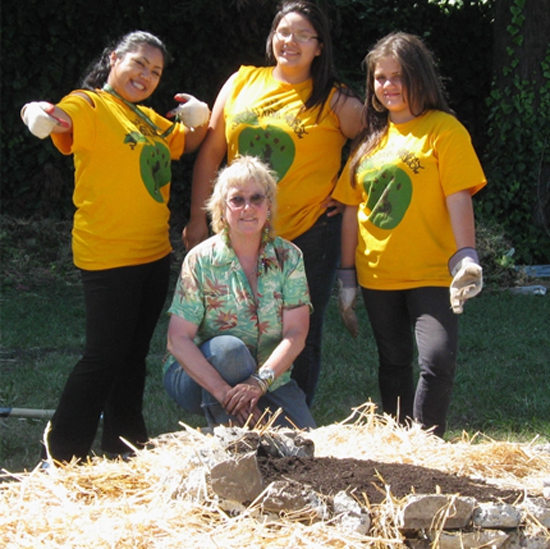
East Oakland schools, community come together thanks to edible schoolyardTransforming a park into an edible schoolyard and community garden can be a tough task for anyone. It requires time, money and community participation.
However, the city of Oakland Office of Parks and Recreation, Oakland Organizing Committee, Alameda County Nutritional Services Department and All Ah We/All of Us are working together to do just that at Stonehurst Park.
The park is located near and serves as a recreation area for students at Esperanza Academy and Fred T. Korematsu Discovery Academy, two elementary schools located at 10315 E. St. in East Oakland. According to Suzanne Ludlum, educator and executive director for Ah We/All of US Oakland Worms project, the transformation began this summer. Ah We/All of US – a nonprofit organization founded in 1992 – develops strategies to address the needs of families in Oakland who are struggling for food security, environment justice and sustainability in their communities.
All Ah We/All of Us is currently negotiating a contract with the city of Oakland Parks and Recreation Department to transform Stonehurst Park into an edible schoolyard and community garden. Permaculture is a design system for creating sustainable human environments. All Ah We/All of Us has also designed sheet-mulching projects for the city and food forest gardens for Inside2Out, a social enterprise dedicated to providing holistic programs and economic opportunities for women in recovery.
It’s exponential: an inch at a time, a community garden at time, an organic farm at a time, a TV in the trash at a time, a car taken to the shredder at a time … one truth at a time.
Meanwhile, the government of Slovakia is a gatekeeper to the EU bailout machine. Not everyone likes the bailouts: they don’t solve anything.
The EU has asked members to ratify participation in the EFSF, which is a fund to be used to bail out EU members (and the members’ banks). Among the last to ratify are the governments of Malta and Slovakia. A minority party within the Slovakian government ruling coalition has promised a ‘no vote’. Here’s an interview with the Freedom and Solidarity Party boss Richard Sulik (Maria Marquart: Spiegel):
Hard to believe but he doesn’t seem to care if the stock market goes down! What about the bond market?
SPIEGEL ONLINE: Mr. Sulik, do you want to go down in European Union history as the man who destroyed the euro?
Richard Sulik : No. Where did you get that idea?
SPIEGEL ONLINE: Slovakia has yet to approve the expansion of the euro backstop fund, the European Financial Stability Facility (EFSF), because your Freedom and Solidarity (SaS) party is blocking the reform. If a majority of Slovak parliamentarians don’t support the EFSF expansion, it could ultimately mean the end of the common currency.
Sulik: The opposite is actually the case. The greatest threat to the euro is the bailout fund itself.
SPIEGEL ONLINE: How so?
Sulik: It’s an attempt to use fresh debt to solve the debt crisis. That will never work. But, for me, the main issue is protecting the money of Slovak taxpayers. We’re supposed to contribute the largest share of the bailout fund measured in terms of economic strength. That’s unacceptable.
SPIEGEL ONLINE: That sounds almost nationalist. But, at the same time, you’ve had what might be considered an ideal European career. When you were 12, you came to Germany and attended school and university here. After the Cold War ended, you returned home to help build up your homeland. Do you care nothing about European solidarity?
Sulik: If we now choose to follow our own path, the solidarity of the others will also crumble. And that would be for the best. Once that happens, we would finally stop with all this debt nonsense. Continuously taking on more debts hurts the euro. Every country has to help itself. That’s very easy; one just has to make it happen.
SPIEGEL ONLINE: Slovakia’s parliament is scheduled to vote on the bailout fund expansion on Oct. 11. How do you predict the vote will turn out?
Sulik: It’s still open. The ruling coalition is composed of four parties. My party will vote “no”; the other three coalition parties intend to say “yes.” What the opposition says is decisive.
SPIEGEL ONLINE: The Social Democrats have offered your coalition partners to support the reform in return for new elections. Do you think the coalition is in danger of collapse?
Sulik: I don’t see any reason why it would.
SPIEGEL ONLINE: What will you do should the EFSF reform pass despite your opposition?
Sulik: For Slovakia, it would be best not to join the bailout fund. Our membership in the euro zone, after all, was not conditional on us becoming members of strange associations like the EFSF, which damage the currency.
SPIEGEL ONLINE: If the euro only causes problems, why doesn’t Slovakia’s government just pull the country out of the euro zone?
Sulik: I don’t see the euro as the problem. It’s a good project. Everyone involved can benefit from it — but only if they stick to the ground rules. And that’s exactly what we’re demanding.
SPIEGEL ONLINE: Which ground rules should we be following?
Sulik: We have to observe three points: First, we have to strictly adhere to the existing rules, such as not being liable for others’ debts, just as it’s spelled out in Article 125 of the Lisbon Treaty. Second, we have to let Greece go bankrupt and have the banks involved in the debt-restructuring. The creditors will have to relinquish 50 to perhaps 70 percent of their claims. So far, the agreements on that have been a joke. Third, we have to be adamant about cost-cutting and manage budgets in a responsible way.
SPIEGEL ONLINE: Many experts fear that a conflagration would break out across Europe should Greece go bankrupt and that the crisis will spill over into other countries, including Portugal, Spain and Italy.
Sulik: Politicians can’t allow themselves to be pressured by the financial markets. Just because equity prices fall and the euro loses value against the dollar is no reason for giving in to panic.
SPIEGEL ONLINE: But do you really believe that politicians can calm the financial markets by stubbornly sticking to their principles?
Sulik: Let’s just ignore the markets. It’s ridiculous how politicians orient themselves based on whether stock prices rise or fall a few percentage points.
SPIEGEL ONLINE: You’re not afraid that a Greek insolvency could mark the beginning of the crisis instead of the end?
Sulik: No. There’s not going to be a domino effect along the lines of “first Greece, then Portugal and finally Italy.” Just because one country goes broke doesn’t mean the other ones automatically will.
SPIEGEL ONLINE: Nevertheless, banks could run into significant problems should they be forced to write down billions in sovereign bond holdings.
Sulik: So what? They took on too much risk. That one might go broke as a consequence of bad decisions is just part of the market economy. Of course, states have to protect the savings of their populations. But that’s much cheaper than bailing banks out. And that, in turn, is much cheaper than bailing entire states out.
SPIEGEL ONLINE: Does one of your reasons for not wanting to help Greece have to do with the fact that Slovakia itself is one of the poorest countries in the EU?
Sulík: A few years back, we survived an economic crisis. With great effort and tough reforms, we put it behind us. Today, Slovakia has the lowest average salaries in the euro zone. How am I supposed to explain to people that they are going to have to pay a higher value-added tax (VAT) so that Greeks can get pensions three times as high as the ones in Slovakia?
SPIEGEL ONLINE: What can the Greeks learn from the reforms carried out in Slovakia?
Sulik: They have to make cuts in the state apparatus. The Slovaks could also give them a few good ideas about the tax system. We have a flat tax when it comes to income taxes. Our tax system is simple and clear.
SPIEGEL ONLINE: One last time: Do you honestly believe the euro has any future at all?
Sulík: I believe the euro has a future. But only if the rules are followed.
Interview conducted by Maria Marquart
Slovakia has become a center of automobile assembly, it is a micro version of Germany with a nascent trade surplus. One wonders what the Slovaks will say once fuel costs balloon in real terms and auto consumption declines.
Bailouts, anyone?