“Only when the tide goes out do you discover who’s been swimming naked”, sez Warren Buffett. As the economy unravels, the rackets and schemes emerge: those that have flourished behind the scrim of ‘growth’ and ‘prosperity’ for the past thirty years. This video — from the National Inflation Association — pitches silver and hyperinflation, it also examines the ‘higher education racket’ that a lot of Occupy Wall Street people are screaming about (NY Times).
“What did I spend the last four years doing?” asked Becky De Freitas, a recent graduate of Gordon College in Wenham, Mass. “Fluent in Mandarin and French and no one wants to go for that? And it’s like, now what?”
The establishment will not undo what they have created on purpose; the children will subsist on dog food, billie clubs to the head and knees to the groin for ‘Old Glory’. The promised high paying jobs that students took on debt to ‘buy’ simply do not exist. The jobs are now in India and China, the New Promised Land.
The education loan racket is a massive bubble ready to burst:
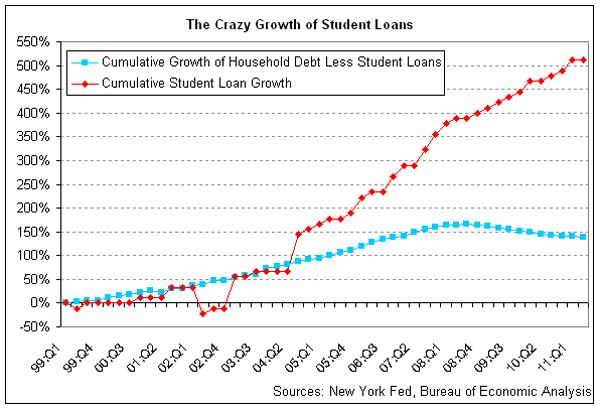
Figure 1: The only thing that goes up like student loans is silver … hmmm! I guess the kids are going to refuse to pay: old news for those who religiously read my articles:
Our grandchildren cannot deny us this loan, just as they did not deny the funding for TARP. They certainly can refuse to pay for it.
The credit albatrosses around the neck of yesterday’s grandchildren — today’s college graduates — are the legacy debts of the Reagan years. Loans were extended at the dawn of ‘Unlimited Credit’, during the second or third or fifth wave of Keyenesian militarism. These loans have come due, dead-money loans rolled over into now unserviceable student loans, intended to be rolled into mortgages upon houses with prices that were only supposed to go up.
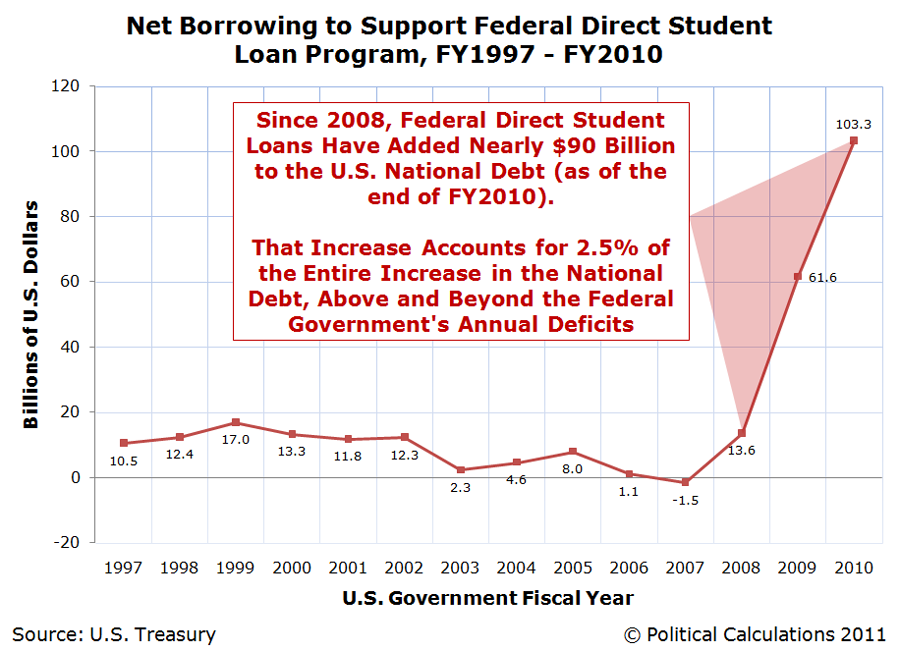
Figure 2: Increase in direct student loan funding by the US government to 2010 (click on for big).

Both public and private student loan debt exceeds $800 billion, is greater than revolving credit.
“As soon as you get out of college you are indentured for life,” Guy McPherson, University of Arizona
Perhaps young people can be hired to write on pieces of cardboard! That is the only job they are likely to get.
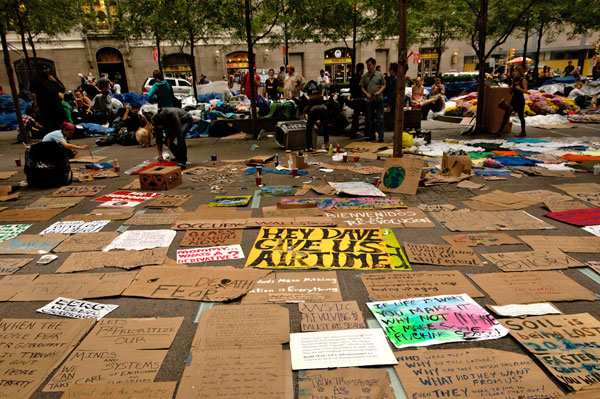
Unknown photographer (Chicago Magazine)
Not long ago Bruce Krasting suggested that Social Security was a Ponzi scheme. Ponzis are are named after the indefatigable Italian Carlo Pietro Giovanni Guglielmo Tebaldo Ponzi who literally made his name selling international return postage coupons. Ponzi did not profit from the sale of these coupons but rather from investors in the company he set up to market them. He paid early investors with investments from those coming after, spending the bulk of the money on himself. Ponzi’s scheme collapsed when bank examiners discovered his business was hopelessly insolvent. He spent much of his remaining years in prison before dying a pauper.
Ponzi schemes can be difficult to describe but easy to illustrate:

Figure 4: A Ponzi scheme is the transfer of funds from individuals to a promoter who promises larger than ordinary returns: it’s a non-violent form of robbery.
Ponzi schemes have very simple structures and depend on human greed. The promoter lures speculators with promises of ‘secret investment strategies’ or ‘finance insider knowledge’ or ‘high-tech shortcuts’ to unearned wealth. The promoter is often someone or some entity that is trustworthy such as the head of a bank, a business or a government administrator. Often Ponzi operators are infamous criminals (offering shares of ill-gotten gains). The promoter will spend enough funds to put on a convincing ‘front’ and craft a compelling narrative. Ponzis come in all varieties: some involve salting real estate parcels with gold or silver, others involve some new technological marvel. As speculators line up, the promoter diverts a small percentage of the incoming flow of funds toward shills who loudly advertise their success within the scheme. Once speculators see real money in the hands of other ‘investors’ they cannot be restrained from putting up their own funds, often offering their entire life-savings. Outside of initial expenses and the small payments to shills, the promoter keeps all the speculators’ money: he either leaves town with it or the scheme collapses under its own weight.
This happens when the speculators start asking questions about their lack of returns. Mature schemes end when new contributors cannot be found, when all speculators are ‘fully invested’. In both instances, the promoter has absconded with the funds.
Ponzis take on every shape: most appear to be legitimate. The obvious example is Bernie Madoff’s classic scheme, so to would be the Enron scheme. Many/most accounting control frauds are also Ponzi schemes. State- and national lotteries are simple Ponzi schemes as is casino gambling. Casinos offer a small percentage of the thefts to the state for its benediction or exist within special jurisdictions, such as the American Indian casinos.
Ponzis share certain characteristics:
– There are NEVER any 3d party beneficiaries to Ponzi schemes, only shills who market the scheme. The promoter pays the shills and keeps the rest of the money!
– Ponzis depend upon voluntary payments from speculators to a promoter, never the other way around.
– The promised benefit is ‘in kind’: the promoter demands money in order to return more money.
– The promoter has no product or the product has little real value: the product is ‘secret’ or proprietary.
– The promoter has no investment ‘method’, he simply accepts free money, paying out only as little as necessary to ‘shills’ to attract new ‘money for nothing’ speculators.
Shills are absolutely necessary to promote the Ponzi. Somebody has to win the lottery or no one would play: there are no organic beneficiaries to Ponzi schemes outside the promoter. It does not matter whether the promoter has ‘good intentions’ or not: funds always flow in one direction from speculators to the promoter. Shills will sometimes be rewarded for bringing to the promoter set number of speculators able to offer funds. In this way, shills become promoters-in-miniature. If the promoter has actual products to sell to the speculators, these ‘multi-level marketing schemes’ are legal.
The finance markets on Wall Street, in the City of London and elsewhere in the world are Ponzi schemes. The people who work in finance are the shills. Outside of funds spent to market the Ponzi — shills — there are never any distributions. Those clever enough to recognize Ponzis during their formation can often position themselves as successful shills. State lottery winners are shills, the promoters are the states and various contractors. Winners at casino games including poker are also shills: no amount of skill or strategy can earn anything in a casino. The ‘house’ is the promoter who keeps the largest part of the funds contributed by all those gambling within the casino. Games of chance promising cash ‘returns on cash’ are Ponzi schemes. Parimutuel betting and similar schemes — including options trading — where the funds ‘invested’ appear to predict the percentages available to the shills are Ponzi schemes. Winners at these schemes are shills. A characteristic of Ponzi schemes is that they are always something other than what is promoted: transfers from the gullible to the unscrupulous encouraged by shills.
Bruce Krasting on Social Security:
Social Security a Ponzi? – I think so
Rick Perry teed this up. I’m amazed at how much traction this has gotten. Clearly both sides of this issue are stirring the pot.
I’ve looked up a few definitions of what a Ponzi scheme is. This one is from an excellent source. The Securities and Exchange Commission defines a Ponzi as:
A Ponzi scheme is an investment fraud that involves the payment of purported returns to existing investors from funds contributed by new investors.
Does Social Security constitute a Ponzi based on that definition? I think it does.
There are two ways to look at this:
I) If there are no changes in the current laws regarding Social Security does the projected future financial results support the conclusion that it is a Ponzi?
II) If changes are made to Social Security will the consequence of those changes result in the conclusion that it is still a Ponzi?
(I) is easy to answer. Based on the SEC definition, Social Security is a Ponzi. If you want proof of that go to the Social Security Trust Fund May 2011 report to Congress. [On page 10 (of the report) you find the following chart.] Somewhere around 2036 (I think much sooner) SS benefits will be cut by 25%. That is the law as it is written today.
Conclusion: Anyone under 45 today is paying for something that they should expect to get 75 cent on the dollar. Clearly a Ponzi.
Ponzi schemes are hard to describe in a few words: Bruce trips over an inadequate SEC definition which doesn’t mention the role of the shill. If Social is a Ponzi, it is one that works in reverse: not only are there beneficiaries, these outnumber the contributors!
Social is only partly a retirement plan. It is impossible to know exactly what future Social benefits might be because nobody can tell what the future itself is going to be.
Best to look at Social is as a jobs exchange. The government- plus younger workers ‘buy’ job openings by offering modest payments to aged and disabled workers so that they might retire. Social is the jobs-purchase plan that college lending is supposed to be! The ingenious promotion of Social as a pension for the elderly has given it an enduring constituency. One can see in Liberty Square and on the streets of New York what sort of (non)constituency unemployed younger workers represent!
This is what the Social Schematic looks like:
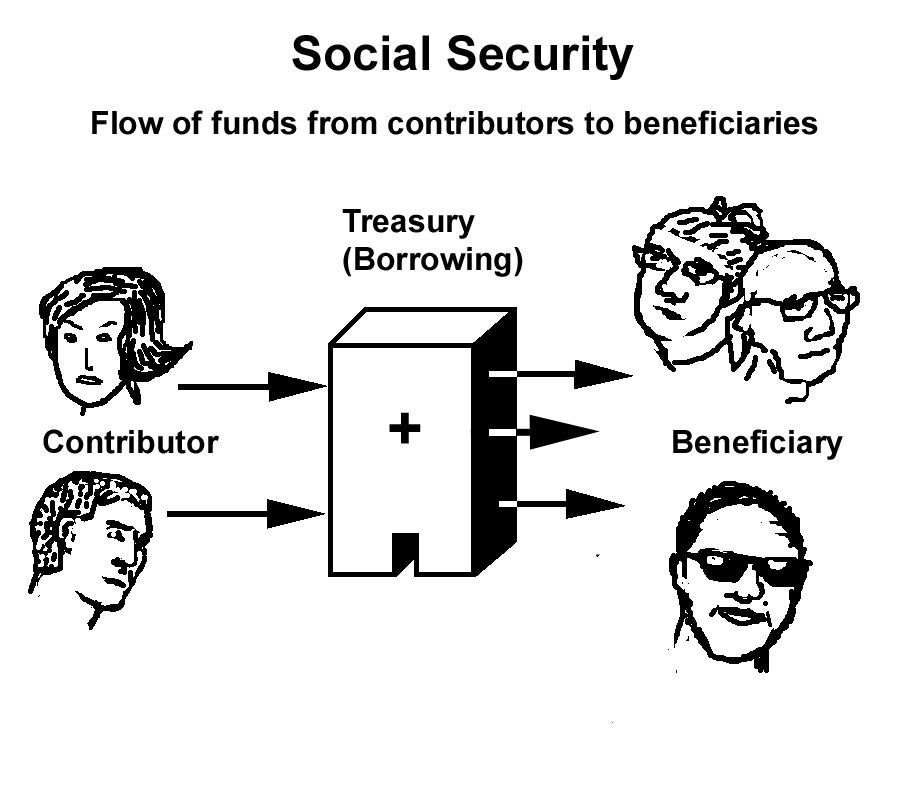
Figure 5: Social Security is an income transfer, from contributors to beneficiaries. Any difference between what contributors are taxed and what beneficiaries are scheduled to receive is made up with Treasury borrowing. Since the Treasury can borrow dollars in unlimited amounts, the payments to beneficiaries is unrelated to contributions.
Bruce treats Social as a kind of defined benefit pension plan which it’s not. It’s easy to see the difference between Social and a Madoff. The Treasury and government are promoters but have no interest in keeping the funds. The (ostensible) problem is that the Treasury is scheduled to distribute far more funds than it takes in! Social Security is no different from other industrial enterprises that do the same thing. The difference is that the (borrowed) distribution within industrial enterprises is toward the tycoons who own the industries rather than toward the workers.
Most of the largest-scale frauds today aren’t Ponzi schemes at all. Ponzis depend on gullible contributors encouraged by false promises. ‘Conduit Schemes’ are sophisticated, large scale frauds named after Carlo Pietro Giovanni Guglielmo Tebaldo Conduit, who happened to live next door to Ponzi. The contributors and the promoters/final recipients work together to take advantage of the conduits — the persons in the middle who are the promoters’ unwitting victims.
Where Ponzis involve the transfer of savings, Conduits are debt transfer machines. Repayment obligations are assigned to the conduit with the benefits directed from the lender to third-party recipients. The conduit is responsible for servicing and retiring the debt: it’s his debt, someone else’s benefit.
Here is the student landing scam:

Figure 6: Unlike with the Social, the college graduate can’t even take Grandma’s needlework factory job: no more needlework factories! The graduate is offered instead an abstraction with negligible value — a college ‘degree’. The student is the conduit by which vast sums are transferred from one group to the other. What is different between this scam and similar versions run by New York’s Tammany Hall and William Magear ‘Boss’ Tweed is the conduits in Tweed’s rackets were always in on the take.
Conduit schemes have certain characteristics:
– The payments from a contributor to a final recipient are loans directed through a conduit. Unlike Ponzis which require voluntary participation, conduit schemes are coercive, gate-keeping regimes. Whether the participant borrows from the contributor or not, the costs to access the scheme’s services are set by the scheme, the conduit has no ‘bargaining power’.
– The benefit promised to the conduit is an abstraction: a ‘common good’ such as ‘education’ or ‘medical insurance’ which is unrelated to the actual funds-transfer.
– The transfer from the contributor to the recipient is always money, often in staggeringly large amounts.
– The contributors are always entities with large capacity to generate funds such as banks/finance sector(s) and/or governments.
– Both lender-contributors and final recipients are aware of the scheme at hand and both actively promote it: falsely to the conduit (and the public), accurately to each other.
– The final recipients who are part of the scam have no investment ‘method’, they simply accept the free money offered in the conduit’s name.
The conduit is necessary but is incapable of acting in any interest other than those of the contributor/recipient. Taking on loans and accompanying repayment obligations are conditions of using the system in question! The process is self-limiting: those unwilling or unable to act in the scam promoter’s interest exclude themselves. The recipients gain enormous amounts of money, what the conduits receive has no worth outside of what they brought to the scam in the first place. Like the rest of the economy, the product of the education factories is waste.
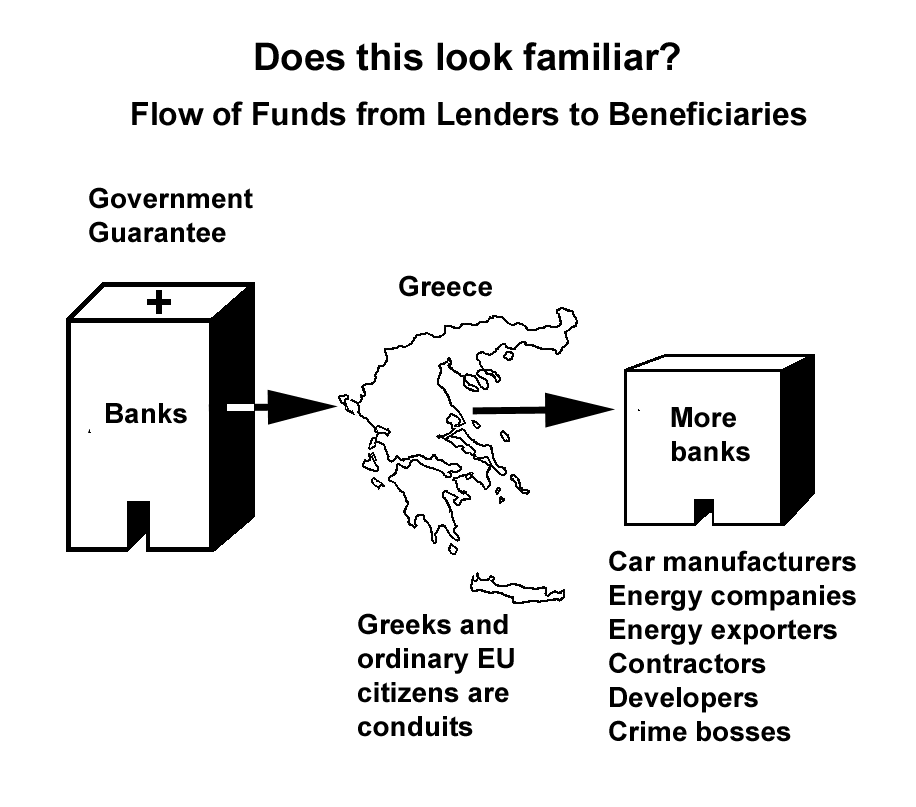
Figure 7: The same scam can be altered to fit any number of different players or contingencies. Here is a conduit scam on a continental scale. The amount of funds to be transferred from one group of banks to others to the ‘benefit’ of euro-users is over € 2 trillion! The college racket is almost $1 trillion. Mr. Conduit would be proud!
You can see the EU schematic is identical to student lending schematic. In the case of Greece (and Portugal, Spain, Italy, Ireland, Belgium, etc.) the contributors and recipients are the very same banking entities. The conduits are the taxpayers and ordinary citizens who have been offered abstractions with negative values; a “European Union” and a “euro”. The same conduits are on the hook for the cost of the funds shuffled from one bank to another!
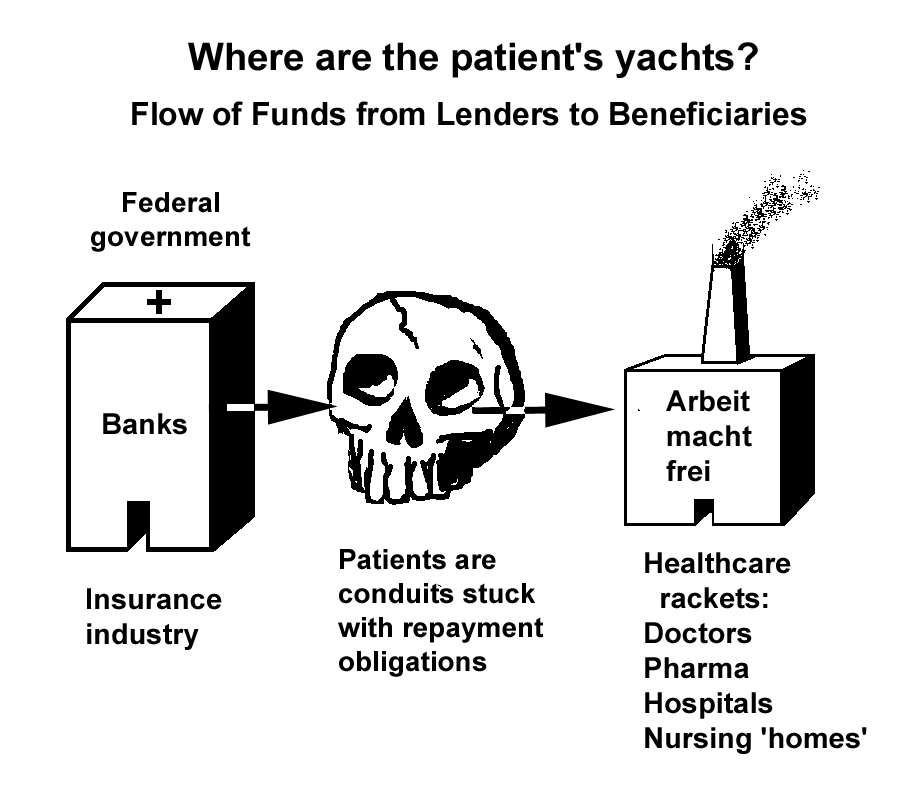
Figure 8: Enter the unspeakable: the US healthcare racket offers the baleful abstractions of better ripoff ‘insurance’ and cruel ‘care’. The promoters of this racket should be tried for crimes against humanity. The strategy is to keep alive elderly conduits suffering from Alzheimer’s or some other degenerative disease a few days- or months longer to enable racketeers to gain funds from contributors. Right now, the current overpayment for health ‘services’ in the United States is estimated to be 10% or GDP or over $1.5 trillion.
Sticking with the current system is a bit like sticking with the Titanic because it has a nice piano bar. Best thing to do is walk away from the system and its false promises en mass and start thinking and acting independently. If enough people step aside the Conduit rackets will unravel. Schemes and bubbles require a constant flow of new funds/credit; conduit schemes require willing recruits. The education racket insists its product has value, how much value can it have when police are breaking heads in its defense?
The next step is for the establishment to imprison people so as to ‘insure’ that these same people have adequate (whatever that means) health care! There is something absurd when education and medical care can only be delivered at gunpoint.