These articles are starting to write themselves, all that is necessary is to turn on the robot and drink more beer.
The European Union inches closer to the edge of the abyss … blah, blah blah …
What do people expect? Everything made by humans falls apart. Why should the ‘euro’ be any different.
It’s slowly dawning on the ‘citizens’ is that the entire world is flat broke and its promises are empty. Not surprising as ‘the world’ for all of its energy waste and self-important blah, blah, blah produces nothing of value.
Didn’t used to be this way:

Titian ‘Man In a Red Cap’ (1516): ugly people lived in caves and dressed in rags during pre-industrial, pre-Made in China times, didn’t they? This isn’t a king but some anonymous dude who could afford to hire Titian to paint his portrait.
It probably didn’t cost that much, either! In the sixteenth century people had little in the way of crap to spend ‘money’ on so a little cash would go a long way. After basic needs were met, what remained was directed toward nice clothes, community building … and artists like Titian.
Because money was directed toward artists like Titian, there were artists like Titian, unlike today where there is a lot of worthless ‘Titian Substitutes’ to spend money on.
Made in USA:
Made in Deutschland:
Blah, blah, blah …
It’s instructive when the only people with the luke warm courage of their convictions are fiends … the rest have no convictions at all.
The first thing a fiend learns how to do is rationalize his or her own behavior and minimize themselves within the grand scheme of things, intimating that the grand scheme is something other than what it actually is. It would take generations of Nuremberg Trials to expunge the villainy of German modernity which is little different from the American, French, Russian, Japanese or Chinese varieties. Nothing changes, the differences in villainy are simply matters of style.
When the levee breaks the outcome is going to be a sharp decline in the availability of credit. That’s all. Nothing more. This is like saying after Hurricane Katrina the streets in New Orleans are going to be wet.
As credit declines so will prices, to the level that can be supported by currency, the quantity of which is also effected by the availability of credit. What we can say about the entire European crisis is that prices in Europe are too high, also in America and elsewhere the prices of all goods and services are too high and the prices must come down. What people will feel as the crisis are prices coming down, being forced downward by the stripping of credit out of the economy.
That’s all, nothing more …
The support of high prices is credit-dependent, that is what can be provided by the credit platform as a whole. This is why there is no inflation, the transmission mechanisms outside the reach of the central banks are impaired. Credit from the center is caught up in institutional deleveraging leaving nothing to reach ‘end users’ who are necessary participants in any wage-push inflation.
It is also why the Fed cannot bail out the Eurozone and won’t try. The ECB and EFSF transmission is broken. Germany won’t allow transfers, whether they are internally funded of sourced elsewhere because doing so would jeopardize German credit. If Germany was willing to put its credit in harm’s way the Bundesbank could provide funds to the rest of the Eurozone by itself.
Price support across a continental credit platform requires gigantic credit management facilities. These gigantic facilities are all on track to fail. Credit isn’t going to diminish, it is going to evaporate pulling under legacy establishments along with those needed to create new ‘replacement’ credit. Across the platform there is more defective credit than their is currency ‘wealth’: credit-worthy would-be borrowers are also going to vanish. To some degree, the Europeans are going to wind up with the credit that was available to them in the sixteenth century … with a less amount of useful products. After all, there are no more great artists like Titian.
Taking place under everyone’s noses is a reassessment of goods’ usefulness. Goods’ value is being measured by their actual ability to provide some sort of return rather than bankers’ subjective value as lending collateral. This reassessment takes place despite the best contrary efforts of politicians, bankers including the central banks and advertising directors. Mergers and acquisitions, equity buy-backs, pensioners, American-style suburban ‘villas’, health-care and education ‘factories’, automobiles, air ports, concrete block tourist ‘hotels’ — are seen as useless because they cannot pay their own way, these things and others besides are nothing other than collateral for loans that cannot now be made.
The goods priced by way of credit and acquired thereby are static or they diminish: they are stocks. The credit required to keep the prices of these items increasing in ‘value’ — is a flow. The goods themselves cannot earn, only the constant increase in credit creates an illusion. The Establishment has been arguing that this bankrupt dynamic is ‘sustainable growth’ for years. Europe and the rest have put themselves squarely into the stock-flow trap: debtors must pedal faster so as to keep standing in place, now they cannot and the creditors are doomed by the same very large numbers that were recently so reassuring.
Without the flow of new credit Europe’s so-called productive enterprises are exposed as fakes: the industrial detritus cannot earn for itself, it has never been able to do so. This is the essence of ‘creative destruction’ a zero-sum game, the Big Lie of industrialization: that shrinking labor and quality and replacement by machines is ‘more efficient’. The only product of industrialization is ‘cheaper’, along with ruinous competition, the concentration of wealth and the advertising which insists that something is produced which is not available elsewhere. What industrialization actually produces is anti-value that cannibalizes output from others on a widening scale … or from the future.
There is never a net excess of output: this is the ‘growth fairy tale’. There cannot be an excess in output because any such becomes ‘inventory build’ and cause of a recession. What really takes place is marketing creating artificial demand which is met by manufactured artificial shortages, including the artificial shortage of money.
Meanwhile, our childrens’ resource patrimony along with their futures sent is ‘up the chimney’. Confronted with the most marginal of real shortages — the result of coveted ‘efficiency’ — the entire system collapses onto itself! Blah! Blah! Blah!
The establishment received trillion$ since 2008 to ‘restart growth’: how many more trillions actually are necessary before the so-called growth actually arrives as promised? After decades of credit subsidy one would think an answer would be forthcoming! Modernity is the bottomless rat hole: the answer is always ‘More, more’. We’ve run out, now what? The hunt for the euro salvation is the hunt for something else of value to shovel into the abyss in place of ourselves, the hunt for what scraps are left of the future to sacrifice to our own vanity.
The specter of ruin has been stalking the Modern Enterprise since the Industrial Revolution, the massive flow of capital from the future into the past has been wasted. There is nothing to show for the waste besides numberless Chinese-made counterfeit Louis Vuitton bags at rock bottom prices … and villains.
There is no difference between the credit structure of Europe and that of the US or Japan. Prices are supported everywhere by credit, without access to credit high prices demanded for goods and services cannot be met. Goods are being repriced to much lower levels as credit disappears in the US and Japan and the process is just underway in China.
Exeunt the euro, the industries that have never paid for themselves they will follow banks and credit into the abyss. Germany’s vaunted export industries are no different from French banks — or Detroit real estate — as to their fundamental usefulness. They provide an illusion of value while what is real is directed to the managers of the factories. We live the ‘Nothing for Something Economy’
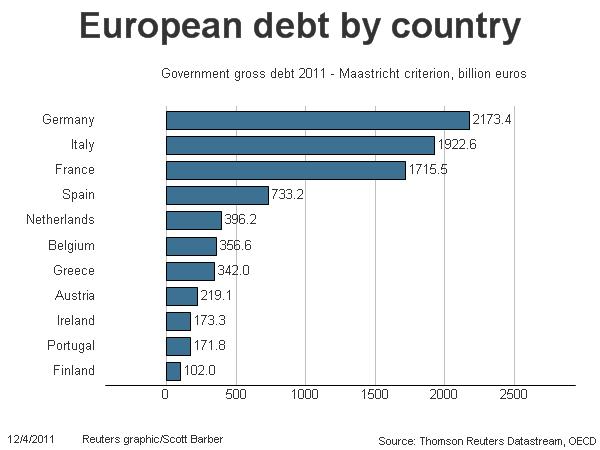
Figure 1: Triple-A Germany is an illusion: German abandonment of the euro is a default, if Germany does nothing it is also a default because the others will abandon the euro leaving Germany holding the bag. The first rule of Ponzi schemes is to be the first out the door. The Germans are caught in an ‘instant morality’ trap they have set for themselves! Germans represent themselves as virtuous and the ‘best of Europe’. They dare not be the first out the door, so they are set to be the fool in the market(s).
The crisis emerges from a false narrative: that economic problems are the consequence of too-high labor costs rather than too-high energy costs. The heavily-promoted solution has been outsourcing and wage arbitrage, the breaking of labor unions, the use of child labor, unrestricted immigration, ‘right to work’ laws, reducing employee benefits along with neo-liberal ‘banks first’ policies and automation. These policies intend to shift the earning capacity of labor to the leverage provided by petroleum amplified by credit. High wages and skilled labor are exchanged for sweat labor wages plus the cost of international shipping with the skill taking residence within the machines.
Unfortunately, the narrative is wrong: the proposed cure is the disease. Output demands are made of human workers that are never made of the machines.
Nobody demands that automobiles or other ‘marvels’ pay for themselves. Diminished labor is required not only to pay for itself but also pay for everything else as well including the profits of the bosses. Labor must buy the cars, the fuel that is burned up in them, pay the interest on the loans that are taken out by everyone in the chain of manufacture and support that are needed to put them into service. The managers have to be paid for, the governments and the banks that lend to the governments. No wonder the credit system is broken, it’s too stupid to survive.
That so much is demanded of labor and so little is required of machines that are set to replace the labor is one of the absurdities of modernity. Now it’s going, gone, blah, blah blah.