News from Tehran the other day is that the Iranian government has succeeded in making a nuclear fuel rod. Unsaid is whether this particular fuel rod was ‘hand crafted’ by hardworking Iranian pre-teen girls in a sweatshop or by political prisoners shackled together in an Iranian gulag. Regardless, the mullahs are making a big deal of this, almost as big as when they introduced their first domestically produced rubber band, their first vacuum cleaner, their first mullah-approved dog biscuit.
Spare the fuel rod, spoil the child. The despised Iranian government promises a chicken in every pot and Islamic nuclear ‘progress’ in every garage. This triggers the urge to drop everything and catch the next flight to the Iranian holy city of Qum and start growing a beard.
Be careful: should your gaze accidentally fall upon a member of the ‘opposite sex’ who is not your close relative the religious authorities will flog the soles of your feet until you pass out from shock. Otherwise, you will have a source of ‘limitless fission energy’ that you can brandish like a mujahedeen. What is there not to like?
Within other oil producing countries one can only gesticulate with a Kalashnikov. Feh …
Imagine a large cardboard box of nuclear fuel rods stamped ‘Made in Iran’. You better run! Only thing scarier is a cardboard box filled with nuclear fuel rods stamped ‘Made in China’. Coming soon to a spent fuel pool near you!
The domestically made rod was inserted into the core of Tehran’s atomic research reactor after performance tests, the Iranian Students News Agency reported, citing the country’s atomic energy agency. The Tehran reactor produces radioisotopes for cancer treatment, according to Mehr news agency. Nuclear fuel rods contain pellets of enriched uranium that provide fuel for nuclear power plants.The U.S. and allies are increasing pressure on Iran to halt what they say may be a covert nuclear weapons program. Sanctions signed into law by President Barack Obama on Dec. 31 aim to deter dealings with the Iranian central bank. The European Union, which is considering a ban on imports of oil from Iran, will be ready by Jan. 30 to take a decision on extending sanctions, Michael Mann, a spokesman for the EU, said today in an e-mailed statement. Iran, the world’s third-largest oil exporter, denies seeking to develop atomic weapons.
The Iranians are pimping that fuel rod fear for all it is worth! The obvious target is petroleum prices. Iranian expenses for military hardware, secret police, gasoline subsidies and nuclear fuel rods have reached the level that requires + $110 crude. The Iranians look over that $107 price and start sweating. Next step is to rattle the saber and promise holy war against the Great Satan … to manipulate the Brent market.
The Great Satan plays along (EconMatters):
US Signs Iran Central Bank Sanctions Into LawBy Central Bank News
The US President, Barack Obama, has signed into law new sanctions on Iran’s central bank that will punish foreign financial institutions that do business with Iran’s central bank, The Central Bank of the Islamic Republic of Iran. The new sanctions will begin taking effect in 60 days, but the tougher sanctions will come in around 6 months from now. The sanctions will essentially shut off access of a non-compliant institution to the US financial markets and banking system.
The sanctions target both private and government-controlled financial institutions (including central banks). The President is able to grant 120-day waivers if it is in the national security interest of the US, or for the sake of energy market stability. The President can also exempt institutions in a country that has significantly reduced its dealings with Iran.
The EU demands an embargo on Iranian crude and restrictions on trade. An outcome has been a flight within Iran into dollars and an accompanying decline of the Iranian currency’s worth.
Accompanying the decline in worth is the decline in Iranian driving. This is because dollars are not subsidized and the Iranian fuel cannot be subsidized in dollars (except at great cost to the Iranian government). Today’s dollars also will be worth more tomorrow. This keeps them in hand which means it costs more in Iranian ‘money’ to buy them with every passing day.
As ‘real money’ becomes scarce for whatever reason, petroleum or other goods cannot be had by anyone without it. An unintended consequence of the ongoing dollarization of the Iran economy will be freeing up of more crude for export.
Meanwhile, the Iranians are unlikely to go to war with the West and thereby cut these exports off. The Iranian bosses aren’t fools. They see what is taking place all over the Middle East and in Northern Africa. The West has at hand cheap ways of creating third world ‘failed states’, dollarization is one of these ways. The Iranian public hates the leadership with a passion and would murder the mullahs if given a chance: the leadership is careful not to give the dangerous public any chances.
Going to war isn’t necessary: bank sanctions shift money-trade from one bourse to another, from the suites of banking crooks in New York to others in London. Iranian crude not sold to France is sold to China while crude from elsewhere is shipped to France. Iranians threaten US and European shippers, these never enter the Persian Gulf. What matters is the overall demand for crude oil. This is declining for reasons unconnected with sanctions which are theater intended to ‘fool’ the prices higher.
There is nothing the Iranians can do about their currency which will be exchanged for dollars at every opportunity. There are no realistic alternatives to the dollar: the euro is at death’s door. Iranians hoarding dollars while spurning their own currency is by itself another nail in the euro’s coffin.
The US doesn’t have to follow China and make bilateral deals with anyone except on its own terms. The massive dollar float and fuel scarcity do the heavy lifting as deflation tightens its grip. As credit and limited currencies evaporate the alternative is the ubiquitous cash dollar.
Some fun is when dollars start getting scarce.
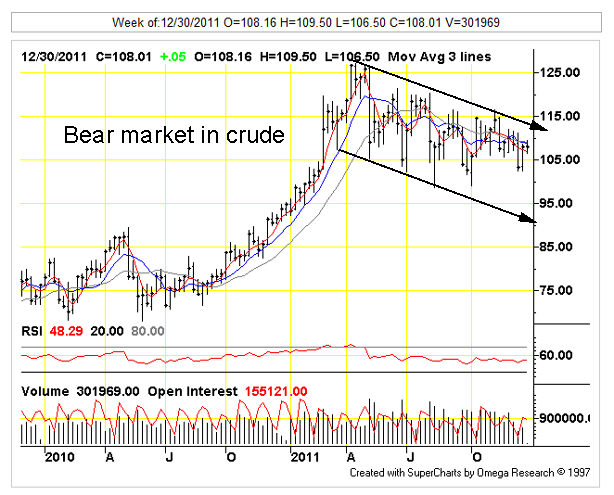
Figure 1: The Iranians can read the chart (TFC Charts) as well as anyone, they can see the bear market in crude. What they refuse to understand is that wasting fuel does not pay for itself. There is no such thing as a ‘sustainable industrial economy’. Industrial economies lose money, the only way for them to stay afloat is for them to endlessly take on increasing amounts of debt.
Decades of wasting fuel has left Iran’s Western customers unable to bear the debt burdens. The Europeans threaten to embargo Iranian fuel which is silly. the EU simply uses less. As noted here repeatedly, the end of European credit leaves the periphery car-free (by way of Mike Shedlock).
Portugal Car Sales Plunge 60% in December Compared to Year Ago
Via Google Translate, please consider The sale of passenger cars dropped 31.3% in Portugal in 2011
The sale of passenger cars in Portugal fell to 31.3 percent in 2011 compared with the previous year to sell a total of 153,433 units, reported the Automobile Association of Portugal (ACAP)
Spain Car Sales Plunge 17.7% to 1993 Levels
Also from El Economista via Google Translate, please consider Car sales fell 17.7% in 2011 in Spain, near 1993 levels.
Registrations of cars and SUVs in Spain stood at 808,059 units in 2011, resulting in a decrease of 17.7% compared to previous year’s figure, according to manufacturers’ associations (Anfac) and sellers (Ganvam).
During the last month of last year, deliveries of cars in the Spanish market reached 66,458 units, representing a decrease of 3.6% compared to data recorded in December 2010.
These figures show that 2011 was one of the worst year ever in terms of volume of registrations in Spain and Spanish car market place at levels close to those recorded in 1993 when 792,500 units were delivered.
Channels, the supply of private cars to customers stood at 387,831 units in 2011, representing a cumulative decline of 33.6%, while in December the figure was reduced by 8% to 35,657 units.
Told-ya so! Here is energy conservation by other means (HT reader Ric):
Refinery Crunch In EuropeTyler Durden (Zero Hedge)
A few weeks ago we discussed the pressure the Greeks were under to source their energy needs from Iran since no one else would extend them credit. The European credit strain contagion now appears to be spreading rapidly as Europe’s largest independent refiner by capacity, Petroplus Holdings AG, is suspending operations at three plants as banks freeze a $1bn revolving loan facility. S&P cut its rating from B to CCC+ citing a sharp deterioration in the firm’s liquidity position.
Without available funds there is nothing to to exchange for crude except empty gestures and fuel rods.
The Iranians cutting supply will not add credit, it will only cause shortages which in turn will constrain credit further. What matters isn’t price ‘per se’ but affordability. Cheap fuel cannot be bought if customers are penniless.
The oil producers are painted into the same corners as are their customers. As the flow of crude declines the (unintended) consequence is an accompanying collapse of demand. A shortage cannot bring money out of hiding, it instead turns customers away from the fuel markets. Demand is falling faster than the fuel supplies can be shut in. The result is the ongoing bear market in crude.
Meanwhile, the central banks act to support their rotting empire of credit dependencies. If they succeed they push the price of crude oil. A cutoff in supply that concentrates demand also pushes the price of crude … for a little while. Sufficient push and the demand collapses due to unaffordability. There is a fuel price governor to economic activity. In the United States $4 per gallon gasoline represents the upper limit.
Right now gas is cheap(ish) (GasBuddy):
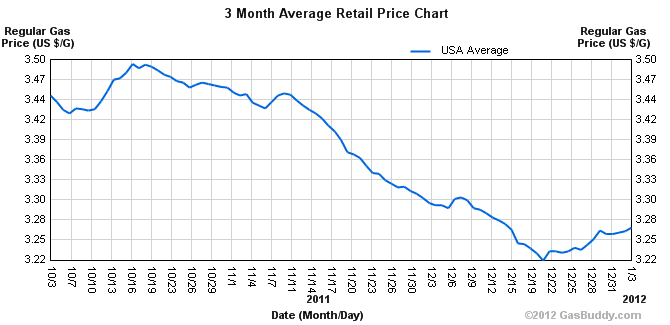
Americans, like the pitiful Portuguese, are driving less, cutting demand.
Since 2008 the market ‘players’ have repeatedly attempted to exceed the high price of $147 per barrel. The last attempt was in April of last year during the QE and the beginning overthrow of Qaddafi in Libya. The attempt fell far short at $128 per barrel. It is likely any attempt now … would fall short of $128. The funds simply aren’t there:
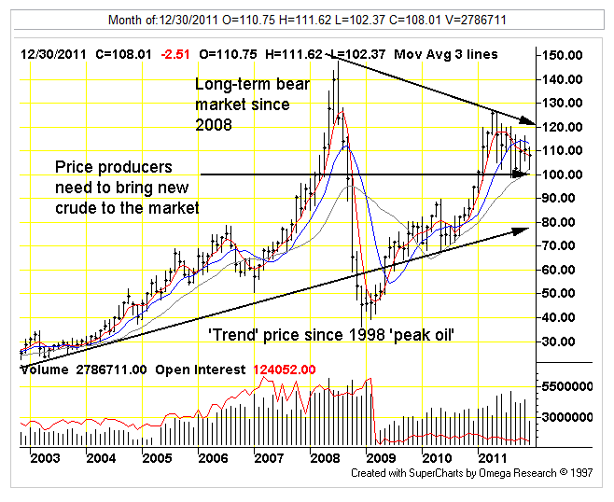
Figure 2: until events prove otherwise, there is a bear market in crude. The problem to come is when the market price declines below what is needed to bring replacement fuel to market.
In the run-up to 2008, the trend in the West was higher prices, driven by inflation and the increase in credit. Credit propelled prices and enabled those with access to more credit to meet those prices. Increases took place across all asset classes: commodities, real estate, equities and debt itself.
Organized waste of fuel was the collateral for massively expanding credit: one asset was willingly annihilated so that the ‘worth’ of other assets could be expanded — this arbitrage is what made up ‘the modern economy’ and modernity, itself. Sadly, the destruction of the one vital asset left behind nothing of value. With less fuel to waste, the credit rationalizations are now faltering across the board.
Along with the rationalizations falters the prices.
Because the entire credit system including currencies is leveraged to credit expansion; because credit has been pyramided onto credit its decline will have non-linear consequences. These can be seen in shadow banking which has collapsed, within real estate bubbles which have also collapsed or are collapsing and within the energy market itself. There is not much left to work with: bear markets and Islamic fuel rods.