
The world holds its breath as a waves of discontent spiral across the continents of Asia and Africa. Heretofore stable clients of US hegemony are under severe stress as citizens of these countries demand food, jobs and freedom from police repression.
We seeing the arrival of an idea whose time has come. Millions around the world are demanding “Dignity”. The words that matter are “millions, demanding”. What is revealed is the ‘Big Lie’ at the center of the progress narrative: that commercial and industrial growth eliminates poverty.
The growth casino that makes up the world economy redistributes poverty away from the center, toward the fringes. This takes place even as economy- driven population growth expands poverty at the same time.
There are more people in poverty in this world currently than there have ever been. Even in the mighty US, the number of poor is increasing, this after a multi- decade explosion of development from coast to coast. Increasing millions of Americans are on food stamps, a stubborn 16% of the nation’s workforce is un- or under employed with relief in the form of better jobs nowhere in sight.
As long as the poor are silent and at the margins, they are not counted and the growth casino’s claim is never challenged. The upheaval hard by the oil- wealthy Middle East is making it obvious that there is something fundamentally wrong with the economy.
This is so even as the central banks and stock exchanges of the world insist that all is fair weather again and that another speculative bubble is wanting to be inflated! “Happy, happy, joy, joy!” scream the promoters. Meanwhile, the nascent bubble’s effects — jumps in food and energy costs driving millions into the streets demanding the removal of governments and their pet cronies — suggests the bull market con- game has little room left to run. There are too many fire alarms being sounded in too many different parts of the world and within too many economic sectors. Like Spain or Pakistan, Cairo is a Key Man that is impossible to prop up with any amount of money. At the same time, a population of millions with millions more attending around the world have come to demand that they must have their bailout. Now what?
These millions want something more serious in addition: like their counterparts in the banking industry they demand to matter.
The establishment has proven it cannot contemplate any reality outside that presented by the Walt Disney/Andy Warhol ‘worry- free consumption’ advertising machine. The people in the street will probably find the new reality difficult to grasp as well. Modernity’s blandishments are ingrained after decades of ‘progress propaganda’. Nevertheless, these peoples’ actions indicate a willingness to defy modernity’s Kabuki- like constraints in ways that are suggestive.
Anyone willing to take on armed security forces with rocks and Twitter is capable of rethinking tract houses, automobiles and hamburgers as the solutions to all problems. The next step is admitting these things are not the solutions to any anything at all. That these are on both ends contrived and that the real problem of demand- constraining shortages is amplified and made worse by the fake solutions.
By the simple act of thinking outside the modernist box, Egypt’s Insurrectionistas render the West’s demand rationing zeitgeist impotent: what the Egyptians have learned to want is the same thing Irish bondholders want and what AIG counterparties wanted in 2008. They all have learned to make the identical complaint. “Bail us out or we will destroy the system”: anyone with a cell- phone and the willingness to wear a cooking pot as a hat can now play the Hank Paulson game!
Isn’t democracy wonderful?
Meanwhile, all of this putatively new ‘reality’ has taken form outside culturally derived ‘reality programming’ which crafts happy endings agreeable to corporation sponsors and media cartels. Notable is the cartels’ silence about what was unfolding on the streets of Cairo, leaving the leg work to Osama bin Laden’s old mouthpiece, Al Jazeera. This network seized the opportunity to rise to the occasion and did so at the expense of its Western counterparts. Also notable was the decision on the part of the West- supported Cairo establishment to harass reporters and to restrict the flow of information. What is suggested by this is that the Western recipients of Egypt’s exported demand are the next group likely to hold the system hostage and to make their own bailout demands.
It’s not just China or Saudi Arabia which are nervous about what is taking place in Cairo. The information blockade is aimed at the West itself: a million people on the streets of Washington, DC or Paris demanding the ouster of Wall Street cronies and their trial would be ‘uncomfortable’ to the status quo. This is so, even as removal of the finance’s criminal oligarchy would be good for the economy and add confidence. Bereft of taxpayer support, the darling stock market would crash. This would be unendurable to the Wall Street racketeers, as much or more so than the naming of William Black as Treasury Secretary and Paul Volcker as Chairman of the Fed.
With a tin pot hat on my head I can go outside and demand dignity along with millions of others. Where is my goddamned bailout? I’ve already picked out the color of my Ferrari.
Demand rationing is an idea that deserves more attention than it receives. The West’s support for autocracies has been an effective way to suppress demand within nations so that it is made available for export. ‘Security states’ characteristically have little organic demand outside of that required to support their militaries and keep populations quiescent. Surplus resources are sold into export markets to obtain hard currency which is spirited (typically) into Swiss banks. Strategies effected in nations around the world of economic ‘non- development’ enables demand in these ‘struggling’ economies to be exported to the West.
Developing nations such as Egypt, Argentina, Indonesia and Yemen become the subjects of the West’s military and diplomatic intrigues. Crony- capitalist regimes emerge that ‘talk the capitalist talk’ but are kleptocracies which exist for the benefit of the Mubaraks who run them along with their overseas patrons. The establishment proclaims the intent of an supporting an expanding global economy and economic growth. This is false on its face: the fact of multiple sclerotic third- world autocracies propped up as Key Men by the West speaks louder than the empty words.
‘Fair share’ demand for resources is channeled away from populations toward top down, anti- responsive institutions which ‘rent away’ demand from individuals toward predatory international finance partners. This is not a phenomenon limited to the third world nor is it an innovation, but rather a residual yet effective instrument of colonialism which has been updated by the world’s finance masters. As in the developed West, jobs are ‘outsourced’ by exchange rate mechanisms and current account- deficits. Demand is rendered stagnant, even as populations explode. The outcome is sagging standards of living behind a scrim of modernity: gigantic, smog- bound ‘Blade Runner- esque’ super- cities swamped with auto traffic devouring the landscape in all directions. (Click on chart for a sharper image.)

This is a chart from Pragmatic Capitalism of US labor force participation. Is this demand rationing or the new face of energy conservation?
Any progress in the developing world is overwhelmed by exponential population increases. Egyptian poverty has a large fraction of the population living under $2 per day, much of that directed toward the purchase of food. In Egypt, even subsidies for food and fuel are captured by the wealthy: (Click on chart for a sharper image)
On a general government basis, Egypt spent about 12 percent of GDP during FY 2007 on subsidies, grants, and social benefits. More than half of this spending consists in subsidies for selected energy and food products. These programs are poorly targeted, result in substantial leakage of resources to high-income households, and incur a high cost of delivering assistance to the poor. For instance, the World Bank estimated that the lowest quintile of the income distribution receives just 16 percent of the resources allocated to the social safety net in Egypt compared to 28 percent consumed by the highest income quintile. Energy subsidies are the most regressive of the in-kind subsidies. Overall, poverty has continued to rise despite higher spending on the social safety net. Almost 45 percent of the population subsists on less than US$2 per day in purchasing-power-parity (PPP) adjusted terms compared to less than 10 percent of the population in Jordan.Similarly, the prevalence of malnutrition in children more than doubles that of Jordan, Tunisia, and Turkey despite the longstanding provision of in-kind food subsidies in Egypt.
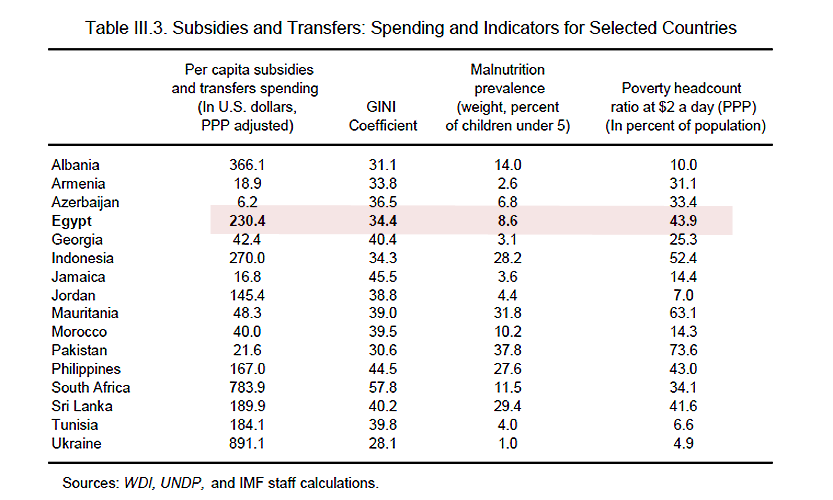
This chart is from the International Monetary Fund’s 2007 IMF Country Report No. 07/381
Forty- five percent of Egyptians living on $2 per day or less results in multiple- dollars worth of demand that can be sold overseas to Americans. Without the world’s ‘Two Dollar Army’ there would be far less of the waste- based American economy to unravel.
Even as this economy has unraveled itself as a consequence of its own success and ‘efficiency’. Catapulting input prices have instantly made exporting demand prohibitively expensive. Demand. like the genie, has jumped out of the bottle, where it is unlikely to return. The hungry today will be hungrier still tomorrow and more desperate and angry the following day. Tomorrow’s unemployed will be out of work a year hence and shortly afterward unemployable. There is no low- cost way out of this box: the wealth required to address poverty and unemployment is grown larger than the amounts demand- rationing makes available.
Within wealthy resource producers, price driven cost-allocation reclaims demand and propels the shrinkage of resource exports. This forms the basis of the Jeffrey Brown- Sam Foucher Net Export Model. Increased resource prices allow producers to import demand from advanced countries in the form of energy- consuming goods such as automobiles, factories, water desalinization, power- driven toys and the infrastructure upon which to run them. Use of these goods reduces the amounts of fuel or other resources available for export. At some point the rate of domestic consumption exceeds the rate of extraction leaving nothing to export. Here, resource constraints and resulting high prices become the amplifier of depletion as the high prices provide incentives to keep demand at home rather than exporting it.
The Establishment finds itself trapped by the consequences of expanding modernity and the free flow of demand. Instead of the four or more Saudi Arabias needed to increase fuel supply, the world discovers the emergence of dozens more Chinas. Popping out of the woodwork like bedbugs, these dynamic developing countries make ready to outstrip demand in the geriatric OECD. Development and income for the one- billion unemployed youths is set to drive prices to the point of deflationary collapse, cannibalizing itself along with the West’s beloved auto- centric waste- based economies.
This takes place at the same time rising costs have created a zero- sum economic environment where growth in one area is at the expense of expansion elsewhere. Rising costs of inputs shrink margins everywhere. The ability of the economy to provide for all has been exceeded by the increase in the ‘all’ part along with the diminution of the material needed by the ‘provide’ part.
Zero- sum leaves as the remaining component of US foreign policy the institutional tolerance/backdoor support for failed states. These states have negligible organic demand for resources leaving the bulk for trans- national consumers. Only the necessary minimum of ‘security’ is required so that raw materials can be exported to the West. This implies a hierarchy of policy tactics. When the ‘Dictator-in-a-suit’ veneer of modernity and endless empty promises proves insufficient to stifle restive populations and allow controversy- free export of demand, the alternative becomes pseudo- religious ‘mullah regimes’ followed by the arming and pitching of factions against each other. In these purposefully ruined places, bandits flourish while US- trained and equipped mercenary forces keep a watchful eye over petroleum and mineral infrastructures as in Iraq, Nigeria and Democratic Republic of Congo.
Even if nations have little in the way of resources to exploit, reducing populations to destitution as is the case of Somalia effectively rations demand and makes it available elsewhere. Fuel not used in Haiti or Pakistan becomes fuel available for sale cheaply in California or Rotterdam.
This is the challenge for those who would replace the Mubaraks of this world. “Apres moi, le deluge”; after me comes the storm; after Mubarak comes Islamist gangs supported by shadowy intelligence agencies and commandos- for- hire exporting chaos, seeking to eradicate demand. Can the democratic idealists cope?
They have few allies: The comfortable in the West are miniature Mubaraks, clinging desperately to the 20th century advertising ideals of excess personal consumption, luxury and pointless mobility- as- an- entitlement. There is no incentive for America’s viceroys refuse to surrender their prerogatives when their clients overseas refuse to even consider theirs.