Since the days of the earthquake, tsunami and reactor ‘troubles’ of the March 11- 15 period, the world has moved on to ‘important’ questions such as those surrounding Charlie Sheen’s marketability.
Here are some ‘frame by frame’ looks at last week’s reactor explosion. Here’s one that needs no introduction, we’ll call this item the ‘Mel Gibson’:
This is the Stratfor version which gives the time of the explosion — 3:30 pm Japan time on Saturday, March 12th — and shows about ten seconds of the aftermath.
The following time series made from the videos breaks down frames of the explosion, to get some idea as to what took place inside these reactor buildings.

This was seconds before the blast in unit 1. The camera is about a kilometer away facing east toward the ocean. It’s absolutely clear but humid due to the ocean’s proximity along with the waterlogging effect of the previous day’s tsunami. If you look carefully you can see a fog or haze bank in the video about 7/8th distance above the tops of the venting stack towers. The sun is illuminating the west sides of the reactor buildings with the turbine hall behind. The three towers are between the reactor buildings and the video camera.
Unit 1 blew up less than 24 hours after the tsunami struck. The reactor core was being cooled with chemically pure water at the time of the explosion.
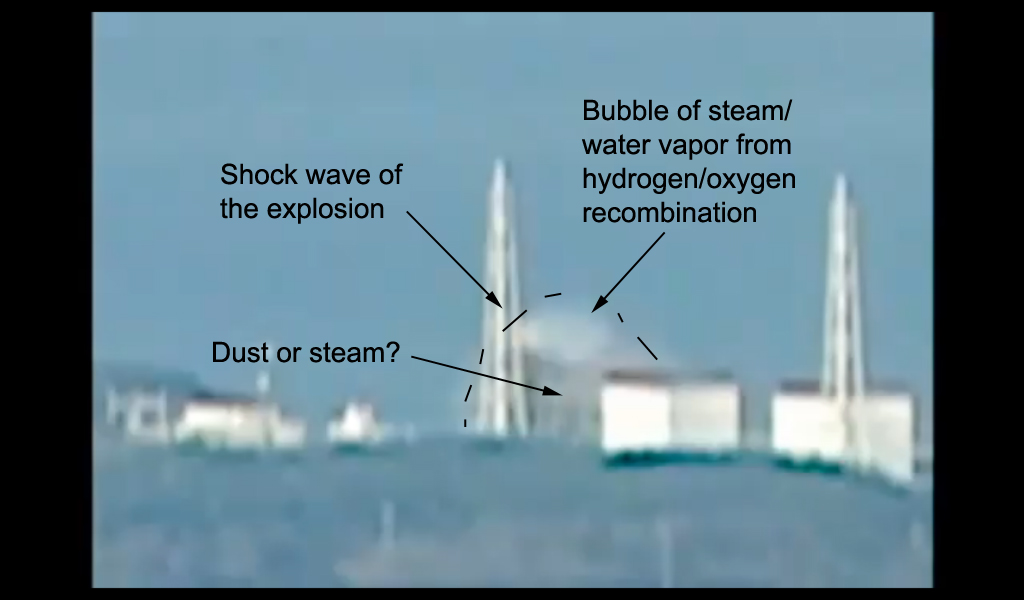
You can see in the video an instant flash of white steam blasting upward. In Figure 2 the white steam or vapor bubble is rising from the roof of reactor 1, probably through a tear in the roof or where it had been blasted apart. This is the hydrogen explosion: the recombination of that gas and the oxygen in the air within the containment. When hydrogen ‘burns’ it turns to water in the form of very energetic steam.
Underneath the light- colored bubble is the cloud of dust or steam vapor following the explosion shock wave. A hydrogen explosion is indicated by the lack of a fireball and an instantly vanishing bubble of steam vapor as seen in the video and in figures 2 and 5.
Whether the cloud is steam or dust is ambiguous at the beginning of the video. Dust has to come from somewhere: in a conventional building its materials would include acoustical ceiling tile, drywall, carpeting, plaster and cementous spray- on fireproofing, none of which would be present in any part of the reactor building outside of the control room.
It is possible that enough force brought to bear on the concrete reactor structure, some of this concrete might be reduced to dust. The metal shed atop this reactor’s service deck has very little that would emit or turn to dust. At the same time, the video cloud is darker than the steam cloud. It is possible that some dust from crumbling concrete from within the containment building was mixed with the steam.
Figure 3 is a diagram of an identical reactor located in the US. Please click on this or any other image to get a full- sized version (from Physics Forums):
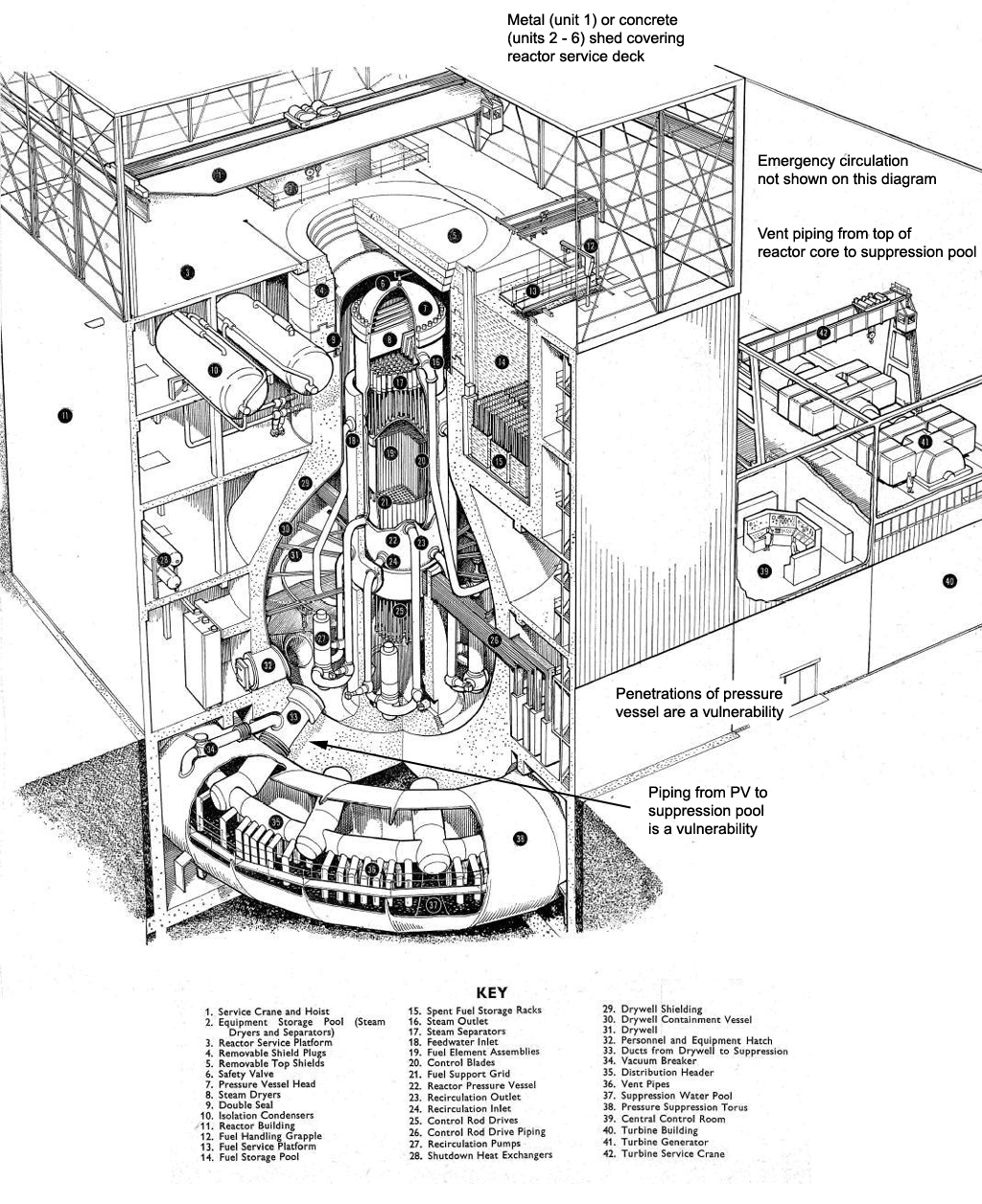
Figure 4 is a cross- section diagram from jlduh @ Physics Forums:

After the tsunami hit, the power was disabled to emergency pumps used to cool the reactor after shutdown These pumps are located outside the reactor containment in the turbine building. Without heat transfer mechanism provided by the emergency pumps and condensors or heat exchangers the temperatures and pressures within the cores and pressure vessels continued to increase. This is identical of the operational cycle where boiling water is directed past a turbine to a condenser which removes core heat.
Unlike a coal or gas- powered plant, when a nuclear plant is shut down the fuel continues to release massive amounts of heat. This is from the decay of ‘daughter’ isotopes within the fuel splitting and becoming stable. The reactor is shut down by inserting control rods into the core which absorb neutrons and ‘poison’ the chain reactions. Control rods do not effect decay heat. When the reactor is shut down, this heat must be removed from the core or the temperature will build, damaging the reactor and melting the fuel.
In the post- tsunami shutdown the steam produced by decay heat was vented by a pipe from the top of the core area into the wetwell or suppression pool (No. 38 in figure 3, the ‘Torus’ in Figure 4). During ordinary operation, the suppression pool helps to control reactor pressure: here was a very- short- term sink for core decay heat. In the suppression pool steam condensed in the cooler water. The tsunami left the reactor operators without a way to remove heat from the core. As time passed without heat transfer the core, the suppression pool and the connecting plumbing became hotter and more pressurized.
Rising steam temperatures in the core acted to shift water from the core to the suppression pool. The declining water level exposed fuel rods. Steam under intense pressure interacted with the zircaloy cladding surrounding the uranium fuel pellets, oxidizing the metal and producing hydrogen. Some of the hydrogen remained @ the top of the pressure vessel while the rest was vented into the suppression pool along with steam to be absorbed by the increasingly hot water.
Where did the oxygen come from to allow our Mel Gibson hyper- blast to take place? Here is the reaction between zirconium and steam @ high temperature:
With this reaction, there is no oxygen produced. It is likely hydrogen combined with air within the containment or inside the shed over the service deck atop the containment. Steam and gas were vented under the roof but inside the building so as to allow some time for radiation in the steam and hydrogen to decrease. It appears there was enough oxygen in the air and sufficient mixing to allow an explosive ratio to form inside the service area.
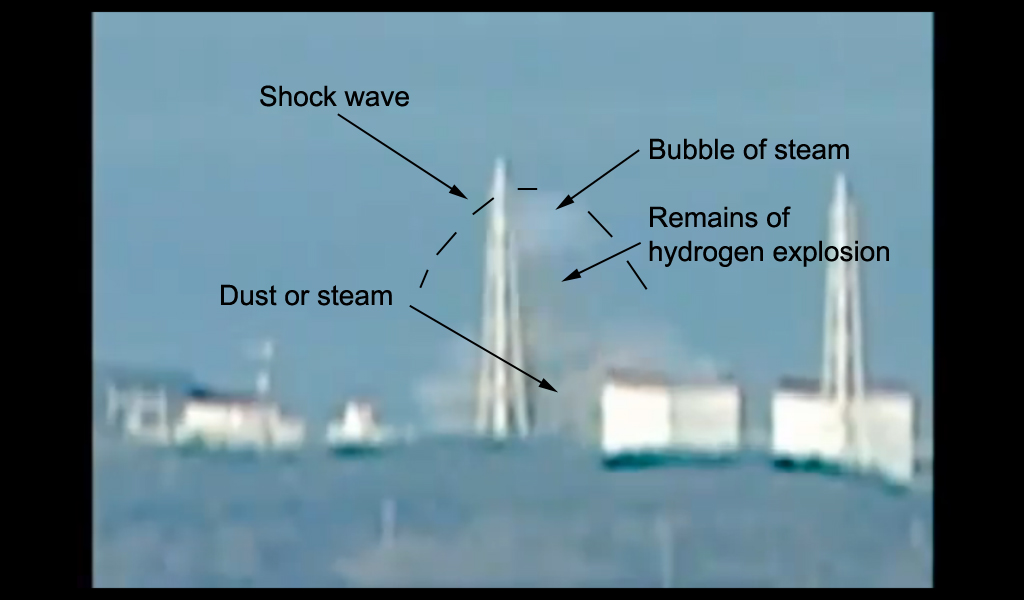
In figure 5 you can see the rapidly vanishing vapor bubble rising vertically. The rest of the explosive force is directed in all directions. The cloud close to the reactor is darker, either it is cooler or is not purely steam but includes dust from the reactor.
The clear ‘air’ under the bubble of steam is what a hydrogen explosion looks like! The explosive combination of hydrogen and oxygen results in water vapor which has no color. There is no fireball associated with a hydrogen explosion.
Other than the steam bubble, the rapidly expanding cloud atop reactor 1 is ambiguous as to whether it is dust or steam. It is hard to tell by looking at the video to this point:
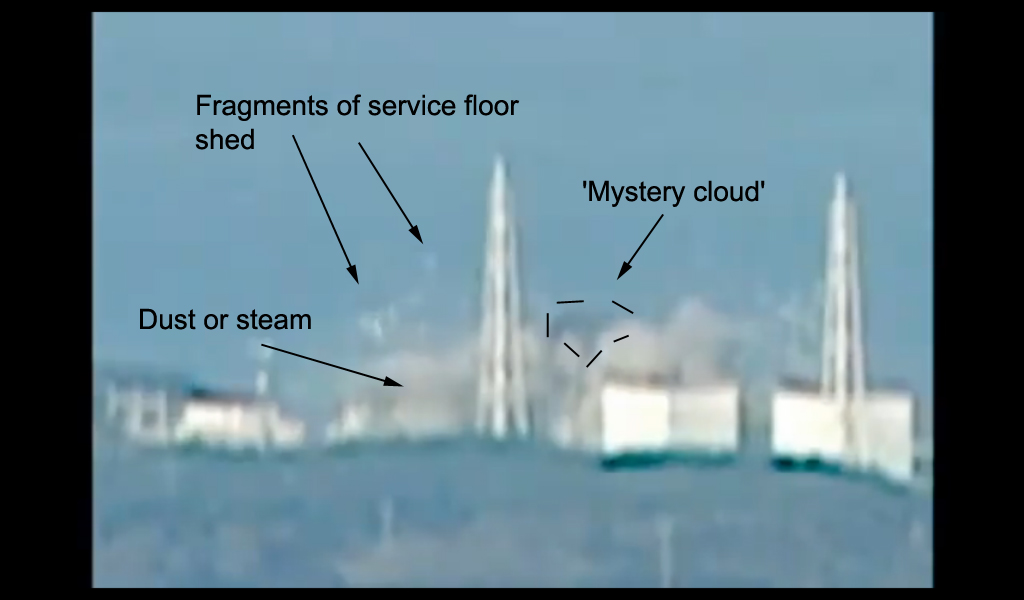
Figure 6 shows some large pieces of building material flying out roughly parallel to the ground. In addition to the expanding cloud or light gray steam or dust, there is a ‘mystery’ cloud that is much darker than the rest. Because it is higher than the rest of the cloud, there is nothing to cast a shadow onto it. It is possible this was the roof bouncing in the air before it fell back onto the deck. It may also have been concrete bits and dust from the service deck itself.
The explosion is expanding outward, horizontally with little upward force. There is no black smoke from this explosion and nothing to suggest any source of an explosion other than steam and hydrogen.
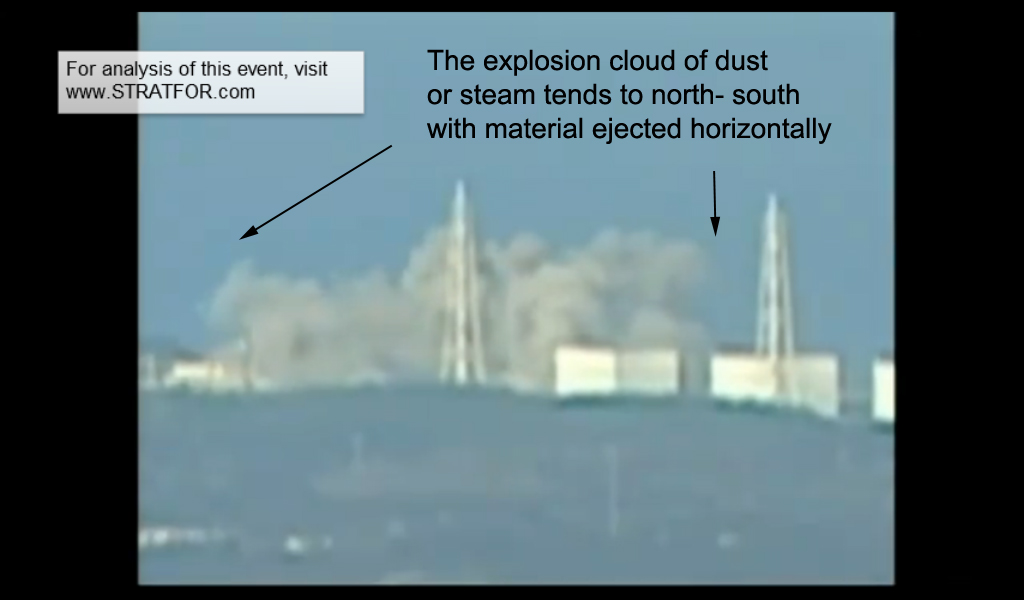
The cloud of steam expands more or less horizontally from the reactor building in figure 7. There is no sign of a fire. The edit versions of the blast video tend to end at this point. The composition of the cloud is unclear. In the longer version it is more obvious the cloud is water vapor rather than dust.
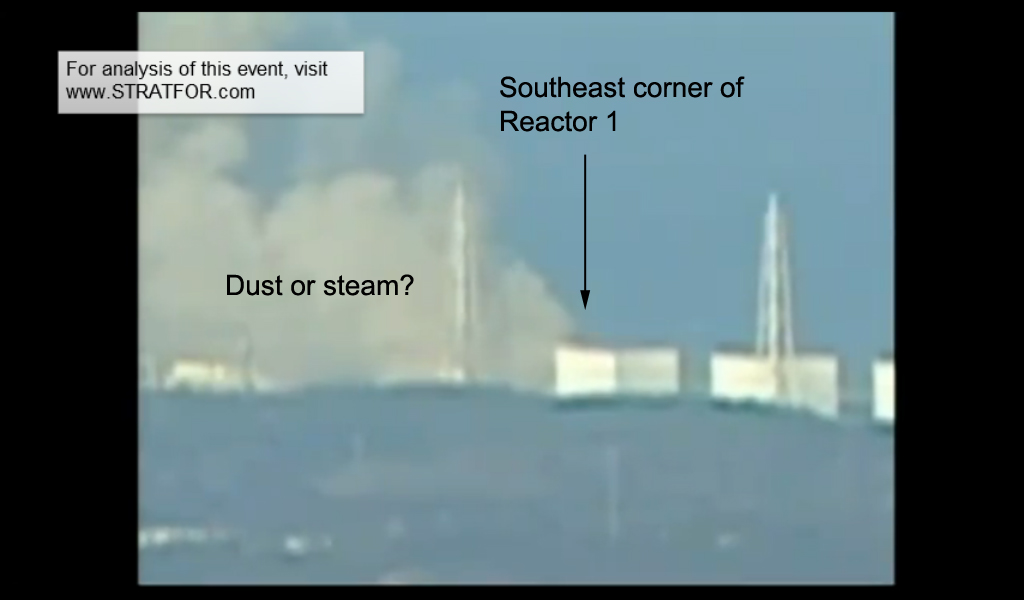
After approximately five seconds post- explosion the cloud is rising; the wind from the south- east is carrying the cloud inland. Because it continues to rise, it becomes more likely that the cloud is largely steam rather than dust or smoke. The cloud looks like a puffy, gray … cloud!

Figure 9, a few seconds later, the cloud has begun to drift to the north- west. Note the arrow which indicates the south- east corner of the reactor 1 building which is hidden behind the unit 2 building. Wind from the sea blows the cloud from right to left. If you watch the video carefully you can see the cloud evaporating at the top of the frame near the ‘Stratfor’ label. There is also a new cloud is forming from a spot where no reactor building would be.
Without a fire there can be no smoke. Dust does not evaporate, nor does new dust rise into the atmosphere without some force to push it. Here’s an ‘enhanced’ blow- up:

Figure 10 is a Photoshopped version of the reactor buildings. From the viewpoint of the camera. Reactor 2 is slightly in front and to the right of reactor 1. A vapor cloud could only originate from the blown up reactor building: if the steam explosion emerged from an area under the spent fuel gate (adjacent to item 14 on Figure 3), water in the spent fuel pools could have been blown onto the roof of the adjacent turbine building where it would then boil into steam vapor before it evaporated completely.
Dust or fumes from the reactor explosion would emerge from the reactor itself, not from the adjacent building. To me, the cloud is clearly a water- vapor/steam cloud.
The appearance taken by the cloud five seconds after the explosion indicates a steam explosion along with a nearly simultaneous hydrogen explosion. The presence of the both indicates a serious meltdown of the core.
Hydrogen was created by oxidation of the zirconium fuel rod cladding mixing with oxygen in the air of the containment.
Steam was created by the decay heat from the rods leading to excess pressures within the pressure vessel and suppression pool. Fuel overheated and melted into what water remained in the core causing an internal steam explosion. Steam blew through the pressure vessel’s weak spots, probably in the suppression pool area (Figure 4).
The incident @ Three Mile Island had a 1000 mw core emit 1000 cubic feet of hydrogen in a bubble that formed in that reactor pressure vessel. It was calculated at the time that the particular bubble contained explosive force equal to 3 tons of TNT. There is no doubt that reactor 1 could have produced enough hydrogen to cause the explosion at that reactor.
The creation of large amounts of hydrogen by zirconium reactions suggests the core of reactor 1 melted down to the same or greater degree than did the core @ TMI.
As steam blew out of the pressure vessel’s weak points, gases saturating the water in the suppression pool bubbled out. The effect would have been identical to the natural gas saturating the crude oil in the Deepwater Horizon well. As pressure was relieved, the gas bubbled out of the oil and the bubble expanded massively, blowing out the well.
The expanding hydrogen, oxygen and flashing steam bubbled out of the pressure vessel into the containment and thence to the service deck. Resulting explosive forces ‘blew out’ the flimsy steel walls and roof of the service deck shed.
The suppression pool is vulnerable to breakdown and is likely the weak link in the pressure vessel ‘complex’. It is a large, overwrought concrete and steel circular tube filled with mazes of plumbing. It was subjected to shaking in the earthquake as well as to stresses associated with core overheating. It is likely that all the explosions in all three reactors originated within or near the suppression pools.
The service deck itself appears to be intact with the reactor service plugs in place under the remains of the roof. The explosion’s horizontal axis suggests that explosive forces vented into the service area then expanded outward in all direction from the service area. There was insufficient force to blow the roof off from the building.

Figure 11 is a still image of the top of unit 1. You can see the roof of the service deck shed has fallen back onto the service deck, blocking the spend fuel pools.
Since the explosion the temperature within the pressure vessel has been variable, increasing on occasion to extreme 400° C for short periods. At the same time, the vessel does not hold pressure. The heat indicates that fuel is disordered and that criticality has taken place within what remains of the core.
The establishment suggests that “some partial fuel meltdowns” have taken place. I suggest that this reactor has suffered a fairly severe core meltdown which took place on the 12th of March.
Part II will examine the explosion in Reactor 3.