– Debtonomics: credit amplifying or triggering price changes.
– Debtonomics: the dollar/crude trade which determines the worth of both.
– Creeping dollar preference and amplified deflation.
– Debtonomics: ongoing collapse of the euro currency as a ‘going concern’.
– Bilateral international trade deals involving crude production that exclude the dollar.
The Greeks and the rest of Europe are in the middle of an energy crisis. Greece and the others are in the process of becoming ‘car-free Europe’. This is a process fraught with a great deal of struggle and despair as automobile possession is the central feature of modernity along with its ‘singular(ity)’ product.
There is more Euro-drama than the shrinking availability of gasoline, it’s a drama that cycles around the issuance of new debt (and its absence WaPo):
Greece, proponents of austerity say, has no one to blame but itself. After a decade of excessive borrowing and spending, evidence emerged in late 2009 that Greek officials had lied about the extent of the country’s whopping deficit. That lighted the first sparks of the European debt crisis, touching off a firestorm of investor panic that spread across Europe and is jeopardizing the global economy.European powers, led by fiscally conservative Germany, have been insisting that Greece correct years of mismanagement by enacting swift waves of cuts and other major economic reforms to regain the confidence of investors and ensure the integrity of the euro. Slashing the deficit quickly is essential to ushering in a sustainable future, they have argued, and the resulting social pain is necessary to impress on Greek politicians and society that such excesses should never happen again.
How many foolish errors are contained within the two paragraphs There is no such thing as ‘excessive borrowing and spending’, there is no one who can judge whether borrowing is excessive or not. Lying about past spending did not effect Greek credit by itself, there is no ‘magic line’ or magic number where debt morphs from good to bad. Investors did not panic, they moved deposits from some banks to others as they do periodically, it is the actions of administrators are forcing members of the Eurozone to brink of default as costs that would ordinarily be safely deferred are now brought immediately forward.
Germany isn’t conservative, it borrows against the accounts of its overseas customers. Mismanagement is on the part of the Germans rather than the Greeks who can see that their economy cannot support finance debts. There is no such thing as ‘investor confidence’ any more than there is ‘airplane passenger confidence’ to keep commercial jets in the air. Meanwhile, a ‘sustainable future’ is indeed being ushered in all around the world … one where there are no fuel-wasting automobiles, jet airlines, ‘modern’ military establishments and whatnot, the sorts of goods the sale of which make up the German economy!
The tax man strikes in Italy as the country runs afoul of its own finance rules.
In the debtonomy there are the two major segments, the production economy of goods and services and the finance economy. The goods sector is generally bound by conditions while finance is bound by rules.
It is self-evident that the output of physical things is governed by physical conditions. Geology, distance, availability of materials and weather, the inherent qualities of materials, all these and more determine the flow of inputs-to-goods and goods-to-markets as well as the availability of services. All things, all human affairs are subject to thermodynamics and entropy. The leverage provided by ‘artificial’ energy supplies effects object relationships over time but does not change their nature. We recognize the conditions and have to the most part have adapted to them … or refuse to do so, for good or ill.
Outside of the few conditions which are universal, the economy of finance and debt is governed by rules. The money-cost of money or interest rate is a rule as is the subordination of one form of debt to another. The process which results in the creation of currency is a consequence of rules. Taxes are rules along with the setting of interest rates. The product of the credit industry is debt, it is an abstraction not found anywhere else in nature. It is largely unaffected by physical forces or limits but is governed by advantage which is made manifest in the form of rules.
The conditions to which debt must submit relate to its creation on one hand and its maximum extent on the other. A reason for the rules in the first place is to counter finance conditions:
– Once debt is taken on at a level that has effects outside itself there is no turning back: new debt must continually be taken on as doing so is the means by which old debt is retired. This condition infers a second:
– The means to obtain credit and the means to manage must be organic to the particular finance economy and never external, it must be solely at the economy’s disposal and none other. To lack organic credit and the means to manage it — among these being a liquid native currency, a (fiscal) Treasury, a (monetary) central bank and distributary banks — puts the nation at the mercy of those who have these things, who would ration credit for their own advantage.
– Debt is always and without exception subject to the First Law: in that the costs of managing the surplus of debt increase along with it until at some point they exceed the surplus itself.
– Another condition is that debt is always quantitative, matters of debt are always matters of worth, never matters of quality or value. Debt is at best a substitute for capital, never capital itself.
Outside of these conditions, the finance economy’s functions are (be)set by rules, the general purpose of these is to favor larger enterprises over the smaller.
To retire debt is impossible, the debt economy must replace new debt for old. There are simply no other means to retire or service accumulated debts, any and all other means are inadequate. Even a completely industrialized state under the full-flowering of production cannot hope to retire its own debts. Speculative frenzies are inadequate, and in fact are the products of expanding debt rather than the cure for it. The idea that the products of the debt economy can be retired by ‘growth’ or GDP output or increase or anything else … is absurd.
Finance debts cannot be restructured, to even give the idea serious consideration is also absurd. The change the conditions of one part of the whole cannot do more than stir the leaves within a courtyard of a small building within an immense city.
Debts once taken on are too large to be inflated away, any analyst who makes this suggestion cannot be taken seriously. Debt is a system not an object, the currency denominating the debt is likewise a system. Rules that would be changed to permit inflation would be the same rules that effect new debt that is taken on. Both currency and debt exist as entries of account on ledgers or on electronic versions of ledgers. There is nothing concrete or unalterable about these entries, only their hold on the minds of those who keep the accounts. Changes in one significant part of an economy will effect other significant parts equally. Whatever technique would add zeros to the currency ledger (and by doing so reduce the currency’s worth) would cause the same zeros to be added to the ledger of new debts, no doubt by way of the same computer. The most likely outcome would be strangling debt service costs which would snuff out inflation at birth.
Those whose property is the debt are generally those whose property is the currency. Only debts that can be inflated away by inflation are those ‘fixed’ externally by way of foreign exchange.
The great fallacy is that finance debts are ‘things’ like spiders or lead weights that become excessive and must be done away with. Inflation aims to redenominate currency without redenominating debt at the same time so as to cause the debt to become less significant. What is not properly understood is that debt by itself has no ill significance, nor is there any particular size or amount of debt where it becomes harmful. Within finance, all carry costs are monetized. There is no ill effect of debt upon finance. There is no ‘magic line in the sand’ where an amount of debt suddenly becomes an intolerable burden to it. When debt’s costs are directed outside of finance it is because of improperly designed or applied rules or the result of sadistic policy aimed to oppress citizens.
It is only during an interruption or discontinuity of debt-replacement is there distress. The effect is on the carry cost of debt: the ordinary economy cannot bear debts’ burdens and will not lend in finance’s place. Without finance to bear finance’ burdens, all of the costs rush out into the open at once (which can be seen in Greece and across the Eurozone).
The solution is to remove the impediments to the creation of new debt: notice the effect of the LTRO upon the European debtonomy. Contrary to the alarms of the ignorant, the instruments by which old debt is replaced by new never tire. If they falter it is because the nation flirts with voluntary default which is political stupidity rather than the consequence of economics.
Because finance debt cannot be repaid or extinguished the state tends to become debts’ custodian. The debt-property of individuals and firms, both the debtors’ and the creditors’ are transferred to the state over time. When both sides of private debts are on the accounts of the state these are ‘dead money’ debts which can then be repudiated because they are also of no consequence to anyone.
Repudiation is the only possible way to extinguish finance debts. This is where the effects of The First Law emerges, when costs remain and nothing else, that the economy is so bound by them that reasonable justification exists for the entirety to be swept away. This appears to be underway in Greece and elsewhere in Europe where nothing remains of the euro but aggregated costs: the absurdity is that the amounts of debt in question are so small.
… the euro itself is not what is seems …
Japan, UK and the US appear to have come to terms with detonomics although some genuflection takes place periodically toward the unachievable goal of ‘repaying debts’ or ‘paying down’ the debts that now amount to the hundreds of trillions in whatever currencies. This gesturing is a form of public comedy, never meant to be taken seriously. Meanwhile, the actual limit to how much pyramided debt can be taken on exists far outside the arbitrary constraints that emerge from contradictory and counter-productive rules.
Behind the Mask
– The Debtonomy exists within a hall of mirrors. It is almost impossible to ‘see’ directly as its components masquerade as other components. This is by design as individuals comprehending the true nature of the industrial economy would refuse to labor under it, demanding the scheme support them.
– The Debtonomy has two components, a provision sector of goods and services and finance.
– The two components are integrated, the productive sector is the collateral for the product of the finance sector which is the primary operating sector.
– The productive sector isn’t productive, this is so generally by design. Production answers the dictates of fashion and nothing else. The production enterprises are supported by borrowing. Finance provides enterprise profits, to ‘entrepreneurs’ who are shills. Finance provides essential initial capital without which enterprises cannot be born. Finance provides required enterprise cash flow when it is not natively available. Fashionable enterprises which have no hope of gaining a productive return are supported entirely by borrowing over extended period. Given fashion demand — for supersonic jet fighters, for instance — tens of trillions in any currency can be borrowed without end.
– Enterprises can borrow against their own accounts, they can borrow against the accounts of their customers (who access debt through their own channels), they can also borrow against the account of the nation in the form of currency or national ‘money’ as well as against the accounts of others overseas in other currencies in ‘trades’ that favor the enterprises. This latter is what ‘globalization’ represents.
Industrial-scale enterprises require first and last credit in large amounts, goods-industry cannot exist without organic finance credit as a first condition. The difference between industrialized- and non-industrialized nations is native credit within the first and its absence within the second. All else being equal — resources, labor, infrastructure, market access, education of its managers, copyright/patent protections of inventions — the country with its own credit becomes the master while all others becomes the slaves.
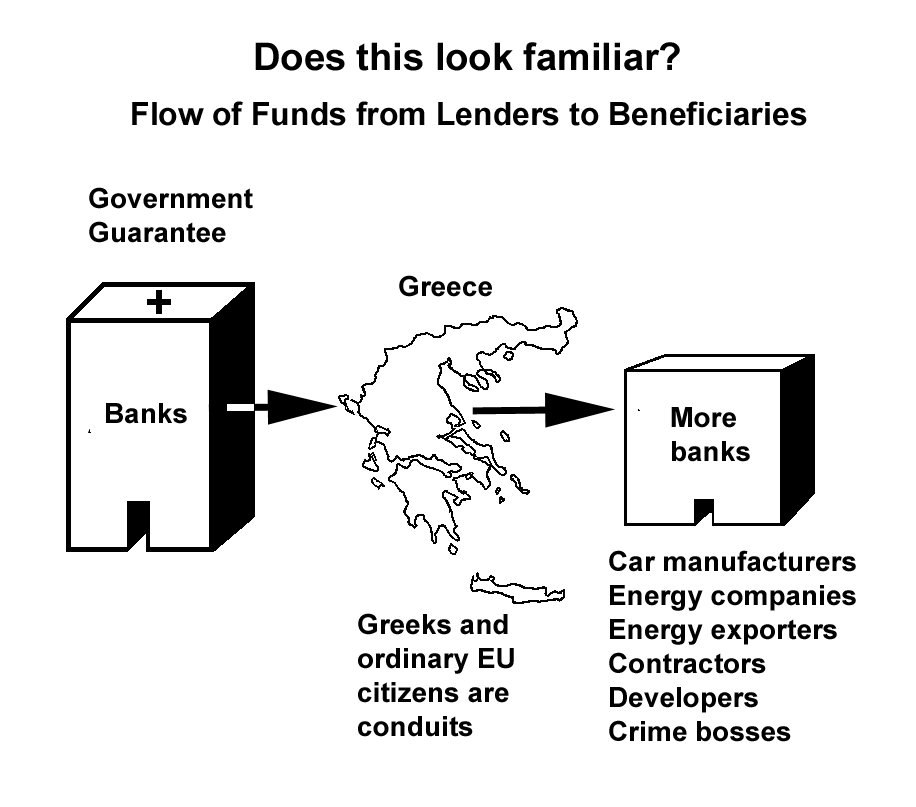
Figure 1: The criminal mind instinctively grasps in a hearbeat what the honest man must labor to understand. The man who cannot identify among the others the fool in the market is the fool in the market!
Taken in the light of globalization, the euro represented an immense increase both in the market for debt and the amount that could be made available. Prior to the introduction of the euro, each European was subject to the limits (rules) imposed by national currency regimes. Post-euro, every European had access to the credit of all the other Europeans at once. Clever lazy persons could live like aristocrats against the accounts of others until their dying days by simply borrowing as much as possible at once then rolling over these loans. Countries could do the same thing and did.
In figure 1, the credit of ‘all other Europeans at once’ is represented by the banks on the left ‘plus Government guarantee”. The recipient banks on the right are the servants of the manufacturers, exporters (including China), contractors, developers and crime bosses, recipients of the euros borrowed in the name of Greece’s population and other ordinary citizens. What was promised to the Greeks were empty platitudes, the ‘unity’, ‘common purpose’ and ‘progress’ bought and paid for with euro-denominated debt.
The credit-worthy elites acted as private equity firms, borrowing against the assets that were created to facilitate the loans. Whether the collateral was worth anything did not matter: those who would determine worth were either cronies or ‘experts’ of some faraway ‘European Union’. There was never the intention to create economic value, only to roll over the debts and sell ultimately to the (friendly) state leaving the citizens on the hook for repayment. Loading onto the citizens’ the burden that only finance could bear was a ‘finance innovation’ designed to crush them.
Even as this gigantic crime was underway — not just within Greece but across Europe — the euro was fatally flawed. Robbery could only have been the intent of the euro from the beginning for no other improvement was accomplished upon it after its issuance: The means to obtain credit and the means to manage must be organic to the particular finance economy and never external, it must be solely at the economy’s disposal and none other.
This was never done, neither is the euro nor the credit available under it native or organic to ANY European country or ALL of them.
This wasn’t a matter of administrative oversight. Knowledgeable individuals instructed the Europeans on the need for a fiscal structure and a true lender of last resort since the currency’s beginnings. The outcome has been to allow speculators to treat countries within the currency union as ‘foreign’, to selectively withhold credit from them. This is not panic, this is tactics practiced by the shrewd.
Limits To Credit
After a mere ten years of use the entire European currency union experiment stands at the edge of ruin with managers appearing powerless to effect the slide. The mere ten years: in that time the various enterprises have larded themselves with tens of trillions of euro-denominated debt. The issue of whether this debt is “too much debt” can be disposed with at once. Europe suffers from a lack of new credit to replace that which is maturing, not from costs of excess. What is taking place is contrary rules have run the European credit establishment aground and that Europeans lack organic credit establishments.
The Cost Of The Combined Greek Bailout Just Rose To €320 Billion In Secured Debt, Or 136% Of Greek GDP
Submitted by Tyler Durden – Zero Hedge
Some of our German readers may be laboring under the impression that following the €110 billion first Greek bailout agreed upon and executed in May 2010, the second Greek bailout would cost a “mere” €130 billion. Alas we have news for you – as of this morning, the formal cost of rescuing Greece for the adjusted adjusted adjusted second time has just risen to €145 billion, €175 billion, a whopping €210 billion, bringing the total explicit cost of all Greek bailout funds to date (and many more in store) to €320 billion. Which incidentally is a little more than Greek GDP (which however is declining rapidly) at 310 billion, only in dollars.
So as of today, merely the ratio of the Greek DIP loan (Debtor In Possession, because Greece is after all broke) has reached a whopping ratio of 136% Debt to GDP. This excludes any standing debt which is for all intents and purposes worthless. This is secured debt, which means that if every dollar in assets generating one dollar in GDP were to be liquidated and Greece sold off entirely in part or whole to Goldman Sachs et al, there would still be a 36% shortfall to the Troika, EFSF, ECB and whoever else funds the DIP loan (i.e., European and US taxpayers)! Another way of putting this disturbing fact is that global bankers now have a priming lien on 136% of Greek GDP – the entire country and then some now officially belongs to the world banking syndicate.
Consider that when evaluating Greek promises of reducing total debt to GDP to 120% in 2020, as it would mean wiping all existing “pre-petition debt” and paying off some of the DIP. Also keep in mind that Greece has roughly €240 billion in existing pre-petition debt, of which much will remain untouched as it is not held in Private hands (this is the debt which will see a major “haircut” – or not: all depends on the holdout lawsuits, the local vs non-local bonds and various other nuances discussed here). If you said this is beyond idiotic, you are right. It is not the impairment on the Greek “pre-petition’ debt that the market should be worried about – that clearly is 100% wiped out. It is how much the Troika DIP will have to charge off when the Greek 363 asset sale finally comes. This is also what Angela Merkel will say tomorrow when Greece shows up on its doorstep with the latest “revised” agreement from its parliament to take Europe’s money ahead of the March 20 D-Day. Because finally, after months (and to think we did the math for Die Frau back in July) Germany has done the math, and has reached the conclusion that letting Greece go is now the cheaper option.
To the ordinary German citizen, what began as a modest recapitalization of some small billions of euros has become a horror-show: tens of billions, now hundreds of billions then trillions are due without end. This is to replace euros that have vanished down the private equity/hedge fund rathole. (From Golem XIV, click on for big))
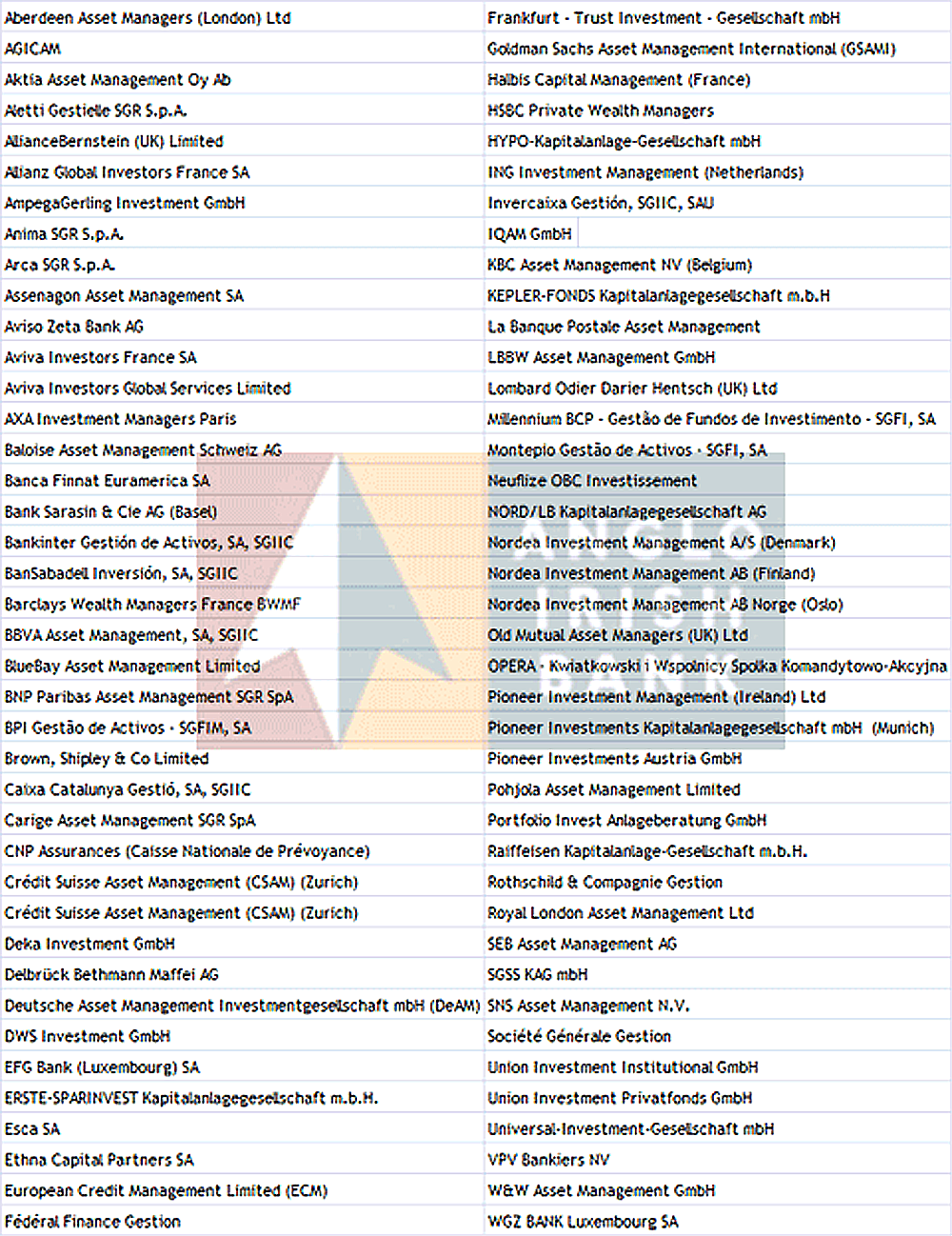
Figure 2: List of senior bondholders to Anglo-Irish Bank.
Says Golem,
“I only have figures for four of the seven. The largest, Union Investments of Germany, has a mere €165 billion in assets under management.The total assets under management which I was able to compile from publicly available figures is €20,871,150,000,000. (Twenty-point eight trillion euros) That is an underestimate because the bond holders who turn out to be Private and Swiss banks don’t publish any figures. So Anglo Irish’s ‘bond holders’ hold and invest MORE than 20.8 trillion euros. Guido lists those bond holders as holding between them 4 Billion euros in Anglo Irish bonds.
Now, in my opinion both figures are likely to be wrong. Certainly my figure is a large underestimate. But taking them at face value Anglo Irish would account for an one 5000th of the total assets being managed by all the bond holders. So would even a total default by Anglo Irish cause that much, let alone systemic, pain and risk? Why are the ‘Bond holders’ and the Irish government so concerned that the Irish people be forced to take the loss and pay the debts for them?
Now lets look at the other side of the equation, at Ireland itself. Well Ireland’s GDP before the crash, in 2008, was … drum roll please… €207 billion. Or 0.207 trillion.
The crime is ongoing. There is the Irish robbery and the Greek: the Spain and Italian robberies are to come. The names on the list are on the other side of the Great Euro Debt Expansion. The ordinary people are on the debt side of the ‘Debt equals Wealth’ equation while the superrich are on the other.
The EU is constrained by rules that stifle lending. Changing the rules would allow debt creation to function and end the ‘credit’ crisis. German managers must understand that the stifling of debt that causes the debt crisis, not its ongoing expansion.
So far the euro has not been a good bargain for its users:
Germany’s Carthaginian terms for GreeceThe austerity policy being forced on Greece by Germany and the eurozone cannot command democratic consent over time.
Ambrose Evans-Pritchard (Telegraph)
It is clear that Germany’s finance minister Wolfgang Schäuble wishes to expel Greece from the euro, calculating that Euroland is now strong enough to withstand contagion, and that the European Central Bank’s `Draghi bazooka’ for lenders has eliminated the risk of a financial collapse.
“We can’t keep sinking billions into a bottomless pit,” he said on Friday.
Earlier he was caught on camera telling his Portuguese colleague that Lisbon can expect softer terms on its rescue package but only once Europe has dealt harshly enough with Greece to satisfy German public opinion.
The old habits of ‘Lese Majeste’ and aristocratic hauteur die hard: the problems for the managers is that public discontent leads to the currency being abandoned, if not to any great effect by the Greeks, to certain, fatal effect by the Germans! Once the currency is gone, the debts are effectively repudiated and the trillions of euro-wealth are also extinguished.