What is underway in this world right now is more of the same. It’s a song: ‘La la-la- la-la … more of the same!
There is more of the same thievery on the part of the establishment, everywhere in the world. There is more of the same poverty, there is more of the same denial … There is more of the same advertising for unlimited resources, more of the same consumer sales, more of the same real estate rebounds, more of the same freeway lane-miles added to more of the same freeways …
More of the same hollow, pointless ‘progress’.
More of the same, the management systems the world has relied upon since the end of World War Two are breaking down but more applications of the same failed management approaches are underway. To support more of the same failures there is more of the same moral hazard, more of the same credit provision, more of the same propaganda and lies. There is more of the same breakages with more of the same exponentially increasing consequences. There is more of the same corruption, more of the same outright pillage and bullying.
There more of the same indifference and refusal to face reality. There is more of the same flight out of banking deposits into risky currency traps even as there is more of the same flight into banking deposits! There is more of the same sense of foreboding, that there is no way out of the traps that we have built for ourselves, that the end of the ‘good old days’ is right around the corner. At the same time, there is more of the same begging/wishing for more of the same ‘good old days’.
With more of the same taking place right now, less of the same will certainly be a whole lot worse. Pray thee Lord for more of the same.
More or the same makes life easy for the analyst even as it makes it more difficult. More of the same becomes very hard to become outraged about. More of the same evil: how do Alex Jones or Yves Smith remain enraged at the highest pitch day after day about more of the same perfidy? The government will be just as conniving next year as it was ten years ago, the big Wall Street banks will still shove more of the same blood funnels seeking more of the same easy payoffs and more of the same bonuses. Who really cares?
The market can offer more of the same a lot longer than you can remain solvent!
At the same time, more of the same analysis becomes very simple: readers can turn to older articles to see how the same really was when it first emerged. It’s more of the same now! It can’t get any easier!
Singularity = self-writing analytical articles!

Unknown photographer: Dr. Edward Chapotin house and his medical practice next door in 1915, on Woodward Avenue @ Woodbridge Street, from the Burton Historical Collection, Detroit Public Library- University of Michigan. Note the streetcar tracks on Woodward. This business/residence was located within a few blocks of the Detroit River.
More of the same lurks on both sides of the political divide from Richard Alford by way of Yves Smith, (Naked Capitalism):
Richard Alford: Fed Policy – (more of the same) Old Wine in New Bottles
Yves here. This is an important post, in that it describes how the Fed, despite the unconventional look of some of its measures, is using more extreme variants of traditional policy approaches, and why that is not such a hot idea.
One place where I quibble with Alford is in attributing the way Greenspan dropped short term rates dramatically in the early 1990s recession as driven by unemployment policy. At the time, there was considerable concern about the health and stability of banks in the US. It wasn’t just savings and loans that were hemorrhaging losses. Citibank nearly went under. Some major commercial banks in Texas and the Southwest had lent heavily to spec commercial real estate projects at just the wrong time. And although it was mainly foreign banks that hoovered up participations in LBO financings, like Campeau, that came a cropper, US financial firms had exposures as well. Greenspan’s driving short term rates to the floor created an extremely large spread between short and long term interest rates, enabling wounded banks to borrow short and lend long, and rebuild their capital bases out of artificially high profits.
Another quibble is at the very end, where Alford is correctly concerned about our sustained trade deficits, but also is unduly exercised about our fiscal deficits. They are in fact necessary and desirable as long as the business sector keeps net saving, which it did even in the years immediately preceding the crisis. If capitalists refuse to play their proper role and loot rather than dedicate resources to future growth, government has to step in. But as we are seeing now, what is unsustainable about this arrangement is the politics much more than the economics.
Here’s Alford:
But Have We Seen It All Before?For all their differences in perspective and emphasis, most of the opposing evaluations of the merits of Fed policy have one element in common: They all appear to be largely prisoners of a Phillips Curve mentality. Policy is set based only on the current levels of unemployment and inflation. Policymakers, economists and pundits do not look beyond near-term changes in unemployment and inflation when evaluate the risks and returns of alternative policy responses.
However, there may be a more troublesome risk attached to current monetary policy. The risk is that the current policy stance – low interest rates as well as QE- is reducing the probability of a return to self–sustaining economic growth … “
Alford is a very bright guy and he’s paid his dues within the money management ‘racket’. Yves = ditto. Nevertheless, it’s impossible to take either one seriously. What does ‘sustainable’ mean? More of the same tract houses? More of the same auto sales? More of the same insurance and finance? More of the same strip malls and Pizza Huts? More of the same F-35 fighter jets? More of the same coal mines, gas pipelines, VLCCs … how about more of the same airports? What is sustainable about any of this? How about those tens- of thousands of tombstone-like concrete towers in China? How many more-of-the-same vacant apartments are needed before the Chinese get to sustainability heaven?
How does everyone get there? There are seven billion of us meat-bags right now on Planet ‘E’ and only 15% have automobiles. Do we ‘arrive’ when 30% become automotive? How about 50%? Where do we put the 800 million or so extra cars? Where do we get the fuel for them? Does the US build another 55,000 mile interstate highway system to go along with the 55,000 mile system we already have? We cannot afford to fix our roads now! How is more of the same sustainable again?
‘Sustainable’ is gross abuse of the language. In order to ‘have’ our desired industrial goodies we must borrow. Our machines do not pay their own way. If they did there would be no debts as deploying machines would retire them. That they do not do so is self-evident. With thousands of millions of machines there is an exponential increase in debt required to assemble them and provide them with fuel. This is debt that even the entire world’s bloated finance establishment cannot provide.
Credit is a resource in the sense that it is a means to allocate other resources: with less of these other resources to allocate, adding credit becomes pointless and unaffordable. US recessions from 1970- onward were the result of fuel shortages- and price shocks including the current version. Even the modest credit demands of the earlier time periods … were breaking. Today’s high real credit requirements are destructive in and of themselves without the added blows of high fuel prices.
People must understand: the Glory Days are gone and never coming back … ! Santa Claus is not going to come down the chimney with some kind of industry … to take the human race by the hand and lead it into the Promised Land. Our collective future is binary: we are either joint-and severally destroyed by shortages and inability to adjust to them … or we escape destruction by the skin on our noses.
Watch what the plutocrats are doing right now! They know what’s going on because they can afford ‘intelligence’ and are ruthless enough to take advantage! They use the time remaining … to steal … then leave the rest of us to Mad Max.
It will take every single inner resource the human race possesses … clarity, honor, courage, perseverance, helpfulness, strength, wisdom … the willingness to endure tremendous suffering and hardship for decades and perhaps centuries … what is absent in popular culture particularly among finance analysts … it will take all of these things and more to escape our self-constructed annihilation.
Right now, this isn’t happening. There is too much fantasy thinking and denial about redistribution … what is there to redistribute, exactly? Deck chairs on the Titanic?
Here is another variation on the theme … from Bill Buckler @ ZeroHedge:
The Puppet Master – GovernmentFor hundreds if not thousands of years of human history, the vast majority were all too well aware that the government “lives” on the backs of the people. Today, that long-held knowledge has been astonishingly, successfully reversed. Today, the perceived “wisdom” is that the people live on the back of the government. In the realm of the history of ideas, it took many centuries to bring forward the idea that a life might be lived without constant kowtowing to government. It has only taken one century – the time since World War One – to all but totally submerge that legacy in a new wave of government dependency.
The old and tired phrase – “I’m from the government and I’m here to help you” – is met by as much derision as it has ever been when people bemoan the impositions of their rulers. But those same people rely on the government to insulate them from the consequences of any action they may choose to undertake.
The great myth is that our industrial economy is ‘productive’, that it is saddled temporarily by parasitic governments (fascists) or bankers (socialists). Get rid of one or the other and the industrial economy will spread its wings and fly off to consumer good paradise, taking the American Worker along with it.
This is false: the product of industrial economies is waste. Because waste is not a good there are no organic returns for industrial activities. Instead, the cost of the activities must be met with credit. To provide the needed credit there are bankers, to service the debts there are governments.
That this is so is self-evident: if industry was productive — if there was any product at all other than waste — there would be no crisis and no debts. Any shortfalls would be met by deploying additional machines, which would pay for themselves, thereby retiring their own debts … and ours besides.
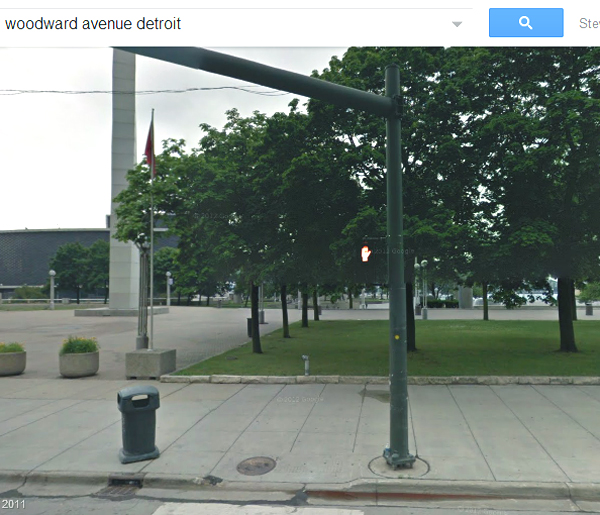
The intersection of Woodward Avenue and Woodbridge Street is long-gone, so are Doctor Chapotin’s restrained yet whimsical houses. All of them are replaced by the urban equivalent of the place-mat, the concrete pad and grassy area(s). Note the occasional tree.
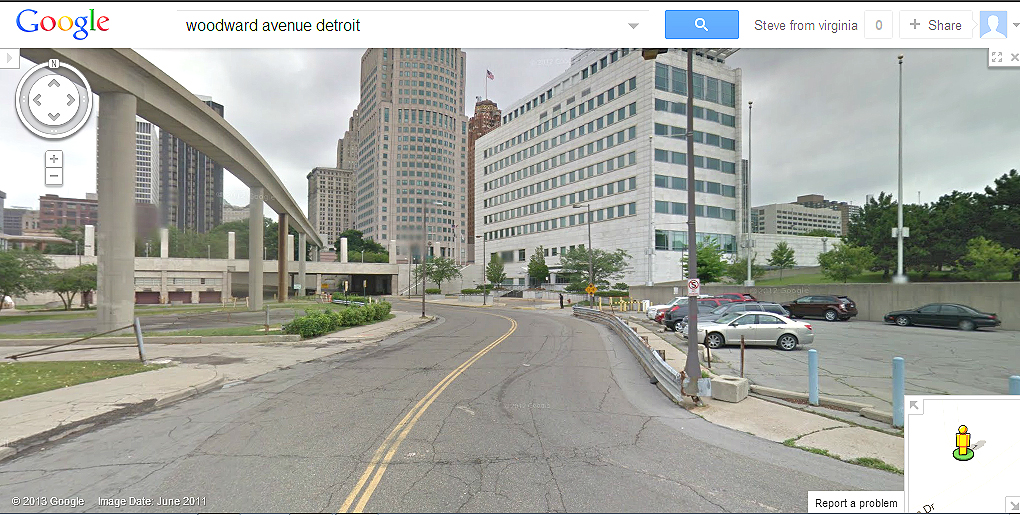
Forsaken and bleak … the backdrop for a homicide, here is the adjacent 1 Civic Center Plaza. Perhaps Chernobyl is more soulless, then again … perhaps not.
Today, there are more and more machines, these do not pay anything. Instead these machines must be subsidized by robbing from savers, retirees, workers and business customers. Meanwhile, the world’s economies are burdened by hundreds of trillions of dollars worth of non-repayable debt … taken on to build and run the machines.
Without credit, there is no industry. Meanwhile, our precious fleet of machines strip-mines the world of credit along with resources. This stripping process is underway right now in Europe and elsewhere … coming soon to your town! (It’s already happened if you live in Detroit.)
The underlying cause is centuries’ long destruction of resource capital. The consequence is diminishing resource throughput, diminished capital with a large and increasing scarcity premium attached to it. There is simply no more (of the same) capital to waste affordably. What capital remains is too valuable: the cost of retiring debts is greater than the worth of debts themselves. Whether the managers admit it or not, the markets right now are pricing the true costs of waste beyond the reach of today’s wasters … also tomorrow’s.
Because ‘more of the same waste’ is a physical process, it doesn’t matter who manages it, Austrian or Marxist, neo-Liberal or Friedmanite, salt-water or fresh-water. All of them will fail. Regardless of who is in charge there will always be less.
Don’t let the common sense baffle you! It’s not that hard to figure out. If prosperity = waste, nobody can promise prosperity any longer.
The ONLY solution is stringent energy- and resource conservation. There is no other solution, only evasions: to do nothing or to attempt more of the same waste means conservation will occur ‘by other means’. See ‘Cyprus’ as the latest example.