Ukraine hiccups, Russians double down on ‘blunder’, Pot meets Kettle.
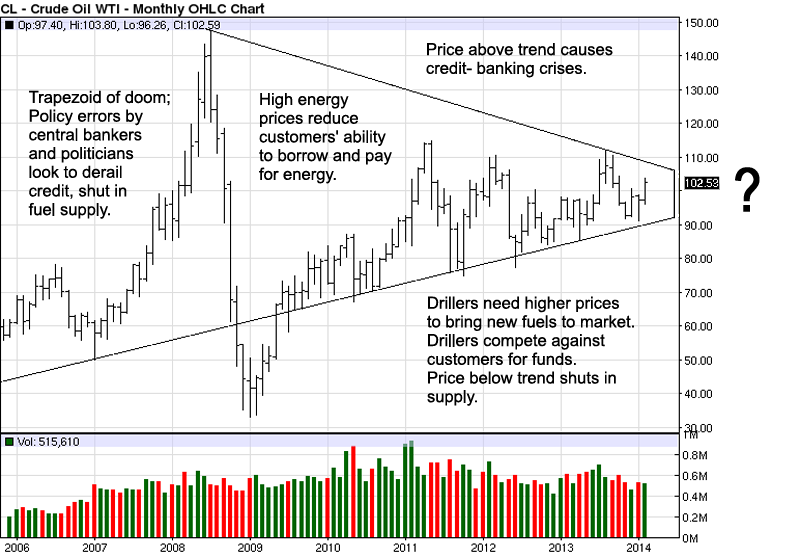
Figure 1; Cost vs. credit using WTI price from Commodity Charts.com, (click on for big). The premise of the Triangle of Doom is that fuel supply remains both plentiful and affordable until trends collide at the end of this year or beginning of 2015. This is a best-case scenario, with policy makers avoiding errors that damage credit or interfere with world petroleum extraction. Abenomics and the ongoing Russian fiasco in Ukraine look to be fatal errors, the best-case scenario has to be reconsidered, with the triangle morphing into a Trapezoid of Doom with a rapidly-approaching dead end.
Credit and fuel cannot be considered separately, one affects the other. Economic problems tend to be blamed on monetary misadventures, yet our economies run on petroleum … which has become both scarce and increasingly expensive since 2000. Credit is offered as a both a palliative and as a abstract substitute for fuel but it carries its own ballooning costs. Strains ricochet through credit system and emerge unpredictably, panic takes many forms. The obvious strategy is resource conservation yet the establishment holds it in the same regard as child pornography; the conservationist is never invited to the dinner party, doing without is never part of any discussion. Conservation is no fun, it isn’t trendy or chic, it means no shopping which is bad for business … which requires endless streams of capital to annihilate and more tycoons to worship.
The outcome is conservation by other means. The status quo is rotting away in real time right under everyone’s noses, Russian intervention in Ukraine is a small component of a very large and malignant whole. Wasteful business as usual is kaput, it has exhausted itself: capitalistic niceties — its fare-thee-wells and discrete robberies — are swept off the table; in place there is the sending in of the tanks with the refugees clogging the roads cheering.
As the world burns through its affordable fuel supply the credit regime falls apart undone by diminished returns. Our surplus-cost-management economy cannot allocate resources that don’t exist, when confronted by scarcity managers punt. The command economy replaces credit with brute force. This is the process that has slithered out of the shadows in Ukraine; it is also why the West is frantic to put the Russian genie back in the bottle, to cobble together a credit/finance solution to the Ukraine problem.
It is hard to know what to make out of what is underway in Ukraine. Putin has decided to rock the boat and is doing so with vigor. In a tightly coupled world with brittle-fragile credit markets and the Russian dependency on Western credit, it is possible Mr Putin does not understand the risks. On the other hand, being in the energy business, and absent the need to soothe an sugar saturated- over stimulated population of television watchers and cell-phone fingerers, he might realize that the jig is up. He certainly is aware that the West will sacrifice just about anything and anyone to preserve their precious lifestyles, creature comforts, automobiles and the fuel needed to run them.
Then, again, what can Putin win? Russia cannot conquer Ukraine or control it, that is obvious; its first best chance with Yanukovych failed. Putin’s second best chance is to offer Ukrainians a security detail that will not hesitate to shoot Ukrainians. Russian ascendency in Ukraine is a vanishing asset. Aside from its rapidly depleting mineral resources Russia is bankrupt, it cannot afford Ukraine as an imperial bauble any more than could the Soviet Union which could deploy much more massive force, structured around popular ideology … and much more massive natural resources.
Ukraine is the latest American intelligence fiasco; hundreds of billions of dollars have been squandered by agencies that have no clue. The same agencies certainly know in minute, personal detail what animal rights- and anti-fracking activists are up to but are caught out by Ukrainians first and then by the Russians. The US president and the rest of the US establishment are embarrassed even as they refuse to acknowledge it.
The media is a frenzy of conflicting information and inflamed nonsense. There are suggestions on how to torment the Russians as if this is something the US has been specifically entitled by Our Creator to do. What passes of leadership in the US is made up of banker- and auto industry lackeys; it drowns in hypocrisy. Our military has meddled at stupendous cost in the affairs of other countries since the end of World War Two for the benefit of these same industries; the Russians are imitating the US. Perhaps just once the United States should do nothing, not even discuss Russia or Ukraine. The Canadians are doing nothing, the Swiss and the Chinese are doing nothing, not a word comes from Japan. Why not sit back quietly and let Russian ambition dig its own grave?
Some of the intimations of meddling are just dumb; that US funding caused the popular revolution that unstrung Yanukovych, or hired neo-Nazis bent on reviving the Third Reich. Agitators and extremists have had their part, but the ground was- and is fertile for removing Yanukovych who is both a common thief and a pro-Moscow partisan. Neither the US nor the EU paid hundreds of thousands of demonstrators to crowd into Kiev and other Ukrainian cities. Popular revolutions have been underway around the globe since 2008, this has everything to do with the governments’ dwindling ability to provide luxury lifestyles including jobs for their teeming multitudes of educated- and thwarted children. Revolutionary skills require time, practice and opportunity to acquire, the young are learning; now, success. Ukraine’s children have managed at least for a brief interval to free their country from some of its odious tycoons. The youths do not understand at this moment that both the car-waste Western lifestyle and tycoons are unaffordable extravagances but they are learning and as such the children are dangerous. Part of Putin’s violent reaction is the push-back by tycoons and the status quo that supports- and rationalizes them. In this sense, the US- and EU bosses should be supporting Putin and encouraging him to crush Ukraine’s young people! This is class war, as Warren Buffett has insisted, and up to a few weeks ago the Buffett class was winning, now … not so sure!
The neo-Nazis are ascendent across Europe, in the US and elsewhere, certainly in Russia as well. The Nazis are willing to confront the corroded establishment where the rest are content to entertain themselves. Cartoonish and fearsome at the same time; the Nazis have no magic solutions to resource problems, they can no more deliver the American way of (wasteful) life than anyone else. All they can do is preside over decline then absorb their portion of the blame.
Ukraine’s problems are for their own citizens to solve, their first job is to form a new government, one that does not include US- and EU stooges or Goldman-Sachs alumni. Ukraine has been the place where both European and Russian empires have gone to die; no outside help is needed. The US has plenty of its own problems that are desperate for attention and investment including overdue preparations for hard times. Multi-billion dollar loan-slash-aid packages for Ukraine should be directed toward Detroit; it is long past time to make investments in our own for once.
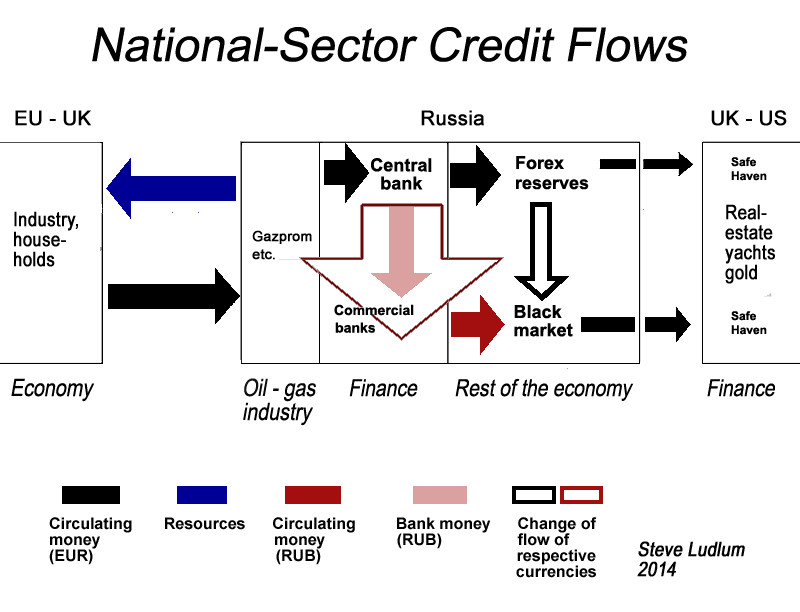
Figure 2: The Russian economy and finance is basically a money-laundering scheme that directs the returns from energy sales to tycoons. Funds flow from EU and UK banks by way of fuel customers to Gazprom and the Bank of Russia. Some funds are held as currency reserves, the rest flow to tycoons’ overseas accounts where they are used to purchase luxury real estate, yachts, artworks, gold and other easily exchangeable goods … The Bank of Russia uses overseas currency-in hand as collateral to refund roubles to commercial banks; these are distributed into the Russian economy. See ‘Debtonomics; Currency Crisis’ for an explanation of how the process works.
Russia lacks the ability to produce needed organic credit, it lacks infrastructure including strong banks, a freely tradeable currency, goodwill and the rule of law; instead there are weak banks, a rouble that circulates little outside of Russia, absence of trust and arbitrary rule by Putin. Because Russian credit is no good it requires external credit. Russia relies on the provision of European lenders acting indirectly through Russia’s overseas energy customers. Russia cannot support its own industry, which like industry everywhere, requires constant credit subsidy to function. A constant flow of new funds from overseas is necessary as the leakage to tycoon safe-havens is a collateral drain with an accompanying reduction in rouble purchasing power. If Russia holds onto its collateral the tycoons are starved of funds. The alternative is for the Bank of Russia to make unsecured loans in an attempt to ‘make good its purchasing power losses with volume’. The outcome is the vanishing lender of last resort and bank runs.
Unsecured rouble lending by Bank of Russia is indicated by red-outlined arrow. Russian banks are unable to distribute their own losses into the Russian economy, attempts to force such losses results is a vicious cycle- black market currency arbitrage and hyperinflation as in Argentina, Venezuela, Belarus, Iran and previously in Russia, itself. Citizens and speculators use whatever local currency they can get their hands on to ‘purchase’ the desired hard currency heedless of the affect on the exchange/inflation rate as indicated by the black-outlined arrow.
It is possible Russian foolishness will by itself trigger the exact crisis the Russians are desperate to avoid. Events that signal major economic turning points can be hard to identify as they occur, the background accompaniment tends to be rising interest rates:
On September 20, one day after a new high in the New York market (1929) — one which proved to be the interwar peak on the New York Times Index — the occasion presented itself. The Hatry empire collapsed in London. This was a series of companies, investment trusts and operating units with interests in photographic supplies, cameras, slot machines and small-loan companies, controlled by one Clarence Hatry. Caught up in the speculative fever, Hatry was having difficulty borrowing £8 million to buy United Steel and use it as a base for a wider coup in British steel. He tried to use fraudulent collateral from his various companies, was caught out and went into bankruptcy. Stock exchange dealings in the Hatry securities were suspended and the financier and several of his associates arrested. In the un-settlement, the bank of England rate was raised from 5.5- to 6.5 percent on September 26.
Apart from the Frankfurt Insurance Company in August and unlike other crashes, it was the only warning …
— Charles P Kindleberger, “The World in Depression, 1929-1939”
Putin looks to be the 21st century’s Clarence Hatry, whether the world or Russia can cope or not remains to be seen. Like Hatry, Putin has built a creaky empire out of a series of companies, investment trusts and operating units with interests in energy resources, pipelines, military hardware and ankle-breaking loan companies. Right now finance markets are pretending that nothing untoward has occurred. Then again:
It’s nerve-wracking to live in the historical moment of an epic turning point, especially when the great groaning garbage barge of late industrial civilization doesn’t turn quickly where you know it must, and you are left feeling naked and ashamed with your dark worldview, your careful preparations for a difficult future, and your scornful or tittering relatives reminding you each day what a ninny you are to worry about the tendings of events.
Persevere. There are worse things in this life than not being right exactly on schedule.
Ukraine looks to reduce its dependency on Russia by signing an agreement with Chevron to develop its oil and gas. The company will likely sell any Ukrainian gas it produces as quickly as possible leaving the country with the empty bag. There may also be gas reserves offshore but Ukraine needs a real government and Russia needs to grow up and act like adult. If Ukrainians used gas for heating and domestic, it would last a long time. Selling to Japan or UK for electric generation; not more than a couple of years..
Ukraine needs a plan how to make the fuel supply last: they need an ‘energy policy’. It is difficult to imagine anyone in charge in any country has heard of such a thing. They also need time and breathing space to implement it. Ukraine has been able to survive since the fall of the USSR by playing European and Russian insecurities against each other, by threatening the one side with political and economic alignment with the other so as to gain funds from both. It was the latest such maneuver that blew up so spectacularly in Yanukovych’s face. Poor Ukraine, it is too far from God and too close to Russia, too close to the European Union, the IMF and the European Central Bank. Any funds from the West will arrive with strings like spiders’ threads that the Ukrainians will find difficult- or impossible to unravel. Ukraine’s interim prime minister is the country’s ex-central banker. It relies on the handful of tycoons remaining in the country for political leverage. Every Ukrainian knows the proceeds of every Russian loan ends up in the pockets of oligarchs, the country’s assets are held as collateral, they ultimately fall to Gazprom and Russia or to European companies. In the meantime the world holds its breath …