There are several narratives within the energy space taking place right now that need to be paid close attention to. One reflects the cost of extracting new crude oil needed to replace barrels lost to depletion. These costs are increasing because the places where oil is found are at the bottom or the ocean, in difficult-to-drill formations or in hostile drilling environments. Above ground costs to oil producers are rising, too.
Another parallel narrative indicates the economy isn’t productive enough to support high oil prices: these are the same prices needed to bring new crude oil onto the market! (TFC Charts, click for big):

Figure 1: In happier times, a chart like this would indicate new supply. Not any more: world crude prices have steadily declined since early summer of this year when the market began to price in the end of Fed monetary stimulus- QE2. Economies in recession cannot spin off enough cash to bid up crude prices, meanwhile the credit markets are collapsing.
Credit from these stumbling markets is needed to support crude bids at extreme price levels. Like all other finance markets, the crude forward- and futures markets are places where credit is traded as part of the goods themselves. The price of crude is no different from the price of a house: the value of the margin used to buy (mortgage) is added to the cash-and-carry value (barrel oil or house). If you buy a $200k house or a $115 barrel of oil the credit needed is ‘priced into’ the house and each barrel of oil.
At $115, you need a mortgage to buy a barrel of oil!
Stresses in the credit markets ration its availability. No credit or ‘margin’ in the markets means diminished bids. Take away the mortgage and the $200k house is worth what it commands in the cash market. The house might be worth $50k! Take away margin and the barrel price also declines. How much it declines is determined by how much credit is in the market in the first place. When prices are high, bidders have to borrow. Collateral is built in: margin is the amplifier in what becomes a margin market. There are two problems with this state of affairs: a bidder cannot for long borrow beyond ability to repay and the expensive barrel of oil that is bought with credit is no more productive than the same barrel at a lower price!
The collateral value of a barrel of oil in the capital markets is different from the work value discovered by burning the barrel in a car. Credit is dangerous: it encourages bidders to exceed the limits of economic return. Here, the oil markets turn ‘subprime’ with collateral values running away: the danger is hard to discern until the uneconomic price is paid. Productivity is a hard school: there must be a return from the use of the bidder’s oil. If the oil is too expensive because it has been bid up with (speculators’) margin, there is no productive return and the bidder falls bankrupt.
The bankrupt in turn damages the credit mechanism itself: credit = credibility. Turn of the credit screw: the self-bankrupting/credit destroying process is underway right now in the EU, at a slower pace in the United States.
Vanished credit turns the bidder (demand) away from the fuel market. Credit rationing is a reason China and India (stuffed with Yank and European cash) can outbid credit-ruined Europeans for fuel. Michael Lewis observes bankrupt Greece wobbling at the edge of the petroleum abyss:
On the face of it, defaulting on their debts and walking away would seem a mad act: all Greek banks would instantly go bankrupt, the country would have no ability to pay for the many necessities it imports (oil, for instance), and the country would be punished for many years in the form of much higher interest rates,
No producer will want Greek paper money, nor that of Portugal, Eire, Spain and the rest; here is credit/currency destruction of crude oil demand, conservation by other means. It takes place unnoticed under everyone’s nose! There aren’t gas lines so nobody pays attention …
Europe is in the process of becoming automobile-free. Good riddance, terrible process: the credit calamity is the consequence of extremely high oil prices. The world’s petroleum use infrastructure is designed around super-cheap petroleum fuel to be wasted for entertainment purposes only. What Europe has done is go far into debt to ‘afford’ the unaffordable. This in turn has caused the entire debt regime to collapse under its own weight. Along with the autos will vanish the euro and the long dream of European unity. What a pity!
This is what the chart says, buddy!
Comes now another narrative: Professor Ugo Bardi’s suggesting the decline in fuel production won’t be gradual but precipitous. The term is ‘shark fin’: when there has been a gradual change in the rate of increased production, then a near-collapse taking place in the rate as production declines,(The Oil Drum):
So, let’s try to make a simple, mind-sized model that describes how an economic system exploits a non-renewable resource. We start with a stock that we call “Resources”. We assume that it is a stock of energy on the basis of the idea that energy can be transformed into other kinds of resources (say, metals) but not the reverse. The resource could be, for instance “crude oil”, which is the main resource on which our civilization is based. Then, we have another box that we call “Capital” that represents energy stocked in forms that can be utilized. We could say that this stock is a section of the economy; say, “the oil industry” or that it represents a whole civilization. Then we draw the flows of energy from the resource stock to the capital stock and to dissipation as low temperature heat, as the second law of thermodynamics commands. Here is the model.This is the same model that I showed in previous posts (e.g. here) but, here I turned it of 90 degrees clockwise in order to emphasize the fact that energy goes “down” from higher thermodynamic potentials to lower thermodynamic potentials; just like what water does in a bathtub or in a fountain. Unlike the case of a fountain or a bathtub, however, here the flow is governed by feedback: resources are transformed into capital in proportion to the amount of both Resources and Capital. Note also that the resource partly decays without producing anything (Rate3). That’s due to the inefficiency of the production process; think of oil spills or of natural gas vented and burned.
[…]
It seems that, indeed, we are missing an element that, instead, is present in the world models of “The Limits to Growth” study. What we are missing is pollution or, better said, the effects of pollution. In the simple model above, degraded energy is harmlessly dissipated to space; it has no effect on the other elements of the model. But we know that, in the real world, that is not true. Pollution has a cost: money and resources must be spent to fight it; be it water or air poisoning or effects such as global warming.
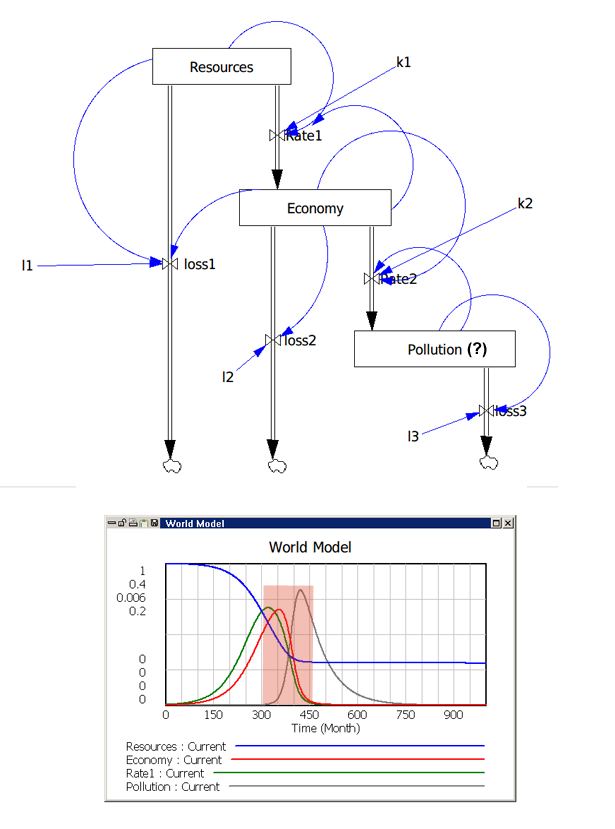
Figure 2: this is Professor Bardi’s flow diagram which shows how resources, the economy and pollution interact. He is looking for the process he calls ‘The Seneca Effect’, his term for the shark fin (in pink). His suggestion is pollution as the ‘cost’ that effects the rate of change in production. I don’t agree with this suggestion: regardless of the cost’s identity, he has effectively modeled it.
Here is a more reassuring establishment narrative by way of Daniel Yergin and the Wall Street Jounal, who is here speaking about M. King Hubbert:
By 2010, U.S. oil production was 3½ times higher than Hubbert had estimated: 5.5 million barrels per day versus Hubbert’s 1971 estimate of no more than 1.5 million barrels per day. Hardly a “minor deviation.”“Hubbert was imaginative and innovative,” recalled Peter Rose, who was Hubbert’s boss at the U.S. Geological Survey. But he had “no concept of technological change, economics or how new resource plays evolve. It was a very static view of the world.” Hubbert also assumed that there could be an accurate estimate of ultimately recoverable resources, when in fact it is a constantly moving target.
Hubbert insisted that price didn’t matter. Economics—the forces of supply and demand—were, he maintained, irrelevant to the finite physical cache of oil in the earth. But why would price—with all the messages that it sends to people about allocating resources and developing new technologies—apply in so many other realms but not in oil and gas production? Activity goes up when prices go up; activity goes down when prices go down. Higher prices stimulate innovation and encourage people to figure out ingenious new ways to increase supply.
The idea of “proved reserves” of oil isn’t just a physical concept, accounting for a fixed amount in the “storehouse.” It’s also an economic concept: how much can be recovered at prevailing prices. And it’s a technological concept, because advances in technology take resources that were not physically accessible and turn them into recoverable reserves.
In the oil and gas industry, technologies are constantly being developed to find new resources and to produce more—and more efficiently—from existing fields. In a typical oil field, only about 35% to 40% of the oil in place is produced using traditional methods.
Estimates for the total global stock of oil keep growing. The world has produced about one trillion barrels of oil since the start of the industry in the 19th century. Currently, it is thought that there are at least five trillion barrels of petroleum resources in the ground, of which 1.4 trillion are deemed technically and economically accessible enough to count as reserves (proved and probable).
Bardi and Yergin represent opposite sides of the same depletion argument. Bardi insists upon a precipitous decline in available petroleum fuel. Yergin doesn’t mention pollution, nor does he acknowledge any declines in production, insisting that better technology and clever bookkeeping makes fuel more available. He makes the ‘efficiency argument’, suggesting tech will allow more work to be done with each unit of energy production. This hopeful development would soothe demand rather than annihilate it.
Yergin’s argument doesn’t hold water: the key phrase is, “1.4 trillion are deemed technically and economically accessible …” Yergin does not give a price for ‘economical’ but current prices are clearly more than what the economy can afford. High fuel prices are self- correcting and are doing so with vengeance. Demand is blasted, not put to sleep. Where Yergin postulates new consumption efficiencies — which currently do not exist — high fuel prices are pounding the ‘thousand mile jobs’, big-car transportation and the rest of the fuel-waste economy into rubble.
One would think having an entire continent go bankrupt at a go somehow would register with Mr. Yergin, not without gas lines. These will appear soon enough, when Greeks have to buy their black-market gas with black-market euros!
The auto habitat which has been promoted as an economic necessity has emerged as a bottomless cost pit. Industries and sectors — not just in the US and the EU — are thrown into the fire: this includes the residential real estate sector worldwide. Gone are developers and speculators, housing-related retailers (whose clientèle is largely suburbanites), real estate lenders and construction companies. Fuel prices are currently beating this sector bloody in Canada, China and Australia after having done so in Eire, Greece, Spain, Japan and elsewhere. Real estate activity represents a substantial part of countries’ GDP, it isn’t wished away!
Problems aren’t limited to residential real estate: in 2008, high fuel prices put the dinosaur US auto industry into a coffin only for it to be resurrected as a low-wage zombie by virtue of taxpayer credit. Commercial real estate is quivering at the edge of the precipice. Airlines cannot escape the fuel price guillotine. Political ‘upsets’ taking place around the world have been a result of food price increases driven by fuel prices, for transport of ‘international’ rice and bread. The high costs are driving out marginal consumers, businesses which have exhausted their credit or whose customers have been forced to tighten their belts.
Fuel users fail, price support evaporates as customers don’t earn by the use of fuel. Under any conceivable ‘unable to earn’ circumstance, shortages accompanying low prices will be permanent. Oil that may be technically recoverable will be economically out of reach. Adjusting prices on the ‘sell side’ will have the identical effect on the ‘buy side’: there is no lowering the cost of production by adjusting money without the same adjustment effecting the ability of consumers to pay.
Bardi’s force is the (in)ability to pay rather than pollution. Oil produced prior to the economic peak in 1998 was recoverable at a diminishing cost. This ‘easy’ oil needed only conventional vertical wells on dry land within pipeline and tanker reach of refineries and users. Conventional barrels produced in ever-increasing quantities at diminishing marginal cost must now be replaced with scorchingly expensive deepwater, shale, kerogen or Arctic barrels. Instead of rising production there are rising prices that stifle it: prices needed to bring crude to the marketplace can only be afforded by a diminishing cadre of users.
A shrinking market which becomes too small to support any level of production …
Unrequited demand is being discovered in auto factories and among revolutionary youths much faster than oil reserves are ‘discovered’, both in new and existing fields.
The dynamic that matters here is not EROEI but Return On Consumption (ROC). Unless there is sufficient return gained from the use of crude oil, there isn’t enough economic support for more expensive production. As prices decline, the production falls from Bardi’s Seneca cliff.
ROC is the ‘dark side’ of EROEI: if the energy investment cost is too high or the return too low, there are shortages. We are at this point right now. People blame ‘speculators’ for the high oil prices and demand administrative action (manipulation). Blame directed toward speculators is misplaced: at the end of the day, every barrel of oil bought and sold in futures markets has to be delivered at a price to an end user. This is different from gold or other assets where the end-user is another speculator. An oil user must have a way to pay the price bid for that oil: Return on Consumption. If the funds for the bid are borrowed, the loan must be serviced and the principal repaid (unless the borrower/user is the Federal government). Business activity must pay for that oil.
With little in the way of ‘easy oil’ remaining to extract, the ‘shortage option’ emerges as ‘hard oil’ will become ‘too damned hard’! As demand is destroyed, so is the most expensive production. This has obvious ramifications and suggests an urgent approach toward conservation. Without (some) fuel there is danger of ‘without (some) food’. At the same time, if fuel prices remain at a high level, the alternate danger is food too expensive for many to afford.
At some point we need to look ourselves in the mirror and ask which will eat, us or our toys?