There are so many things going wrong at the same time it is hard to keep track of them all. Stock markets are down, the bond yields are down. Who cares? The people have ‘Doom Fatigue’. Whatever can get people back to oblivion soonest is what the country is looking for.
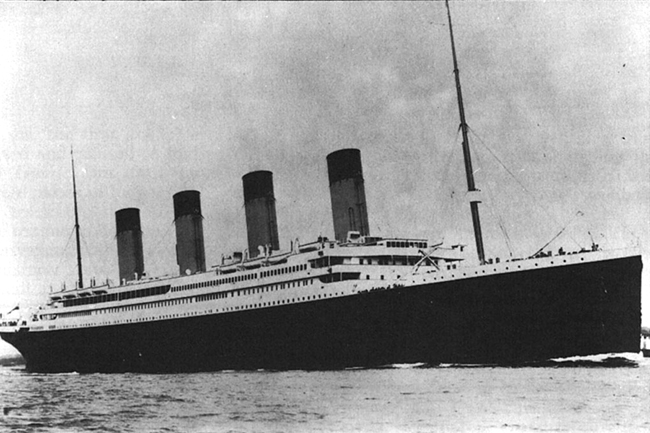
People want to make sure the Titanic is really sinking this time … before heading for lifeboats … or taking any other actions.
The establishment appears to have thrown in the towel. The central banks have exhausted the moral-hazard remedies such as QE and ZIRP. Interest rates have ceased to matter, except in downstream markets where they have become ‘default indicators’. What is left is brain-lock: all the countries in the world now desire to be exporters and all seek to devalue their currencies. How does that work?
Mark to fantasy accounting strategy of hiding worthless loans off balance sheet and lying about it isn’t working any more, either. The assumption now is that everyone in-and out of the markets is broke, no matter what their ‘books’ say.
Certainly there is to be more piddling manipulation to come — buying stock index futures contracts, buying and selling precious metals futures contracts, etc. — but who really cares at this point? The imbalances have been allowed to grow too large. The governments must realize that throwing money at problems caused by too much thrown money is counterproductive. At the same time, not throwing money is causing other problems, rather … there is too much and too little money at the same time!
Nobody is desperate enough for those in charge to start telling people (and themselves) the truth. Nobody risks speaking truth to the powers-that-be about debt, about energy or about climate change, To do so is politically incorrect, it would require that the establishment give up something. Sacrifice is unacceptable except for groups ‘elsewhere’ or outside the circles of self-dealing. Since the world is interconnected by design — for the benefit of the establishment itself — there is no ‘elsewhere’, anymore. Meanwhile, while this shuffle takes place, the climate, debt and energy dynamics have taken on a force all their own.
Climate malingering is a good example: where is the accounting? The small amount of profit gained by ‘home’ builders and auto manufacturers must be measured against the insurance cost of the damage inflicted by hurricanes, tornadoes, droughts and other climate-induced maladies. Climate along with energy waste and excess indebtedness are all self-solving problems. Apocalyptic floods and droughts are unnecessary: left to its own devices, Earth’s climate will simply become too unstable to allow profits. That is all the biosphere has to do … flick with a finger rather than smash with a fist.
Once the flicking is done, there is less activity putting carbon into the atmosphere.
The outcome of failure to implement a direct energy conservation policy is indirect conservation by other means, exhausted credit and the inability of the extraction industry to ‘purchase’ new fuel from the ground. Price increases since 1998 lifted proportionately less petroleum per year: if high prices cannot bring in more ‘product’, lower prices certainly won’t!
Too much debt leads to debt liquidation. What cannot be repaid by one borrower is due-and payable by all other borrowers within our interconnected ‘World of Elsewhere’. Because of the universality of debt there is no place to hide. Debt unwind adversely effects industrialization’s profits because it firms’ customers cannot buy while (energy) suppliers will not sell.
These dynamics are underway right now under everyone’s nose but nobody wants to talk about them. People are content to wait until that Titanic is further underwater …
In the soon-to-be ‘Late, Lamented’ EU, the establishment appears content to wait for Greece to drown If Greece had failed last year the cost would have been much more modest than what it will be when the country defaults in a few days or weeks from now. First casualty will be Greek banks which will fall instantly bankrupt. Euro- denominated capital and deposits will either be frozen or gone. Any euros within the Greek finance system will be committed toward repayment of Greek debts, hundreds of billions of which having been taken on since the crisis began.
This sheds a harsh light on the thievish behavior of both the Greek- and EU establishments.
The outcome of default will have Greeks unable to gain euros for love … and they will need increasing amounts of some kind of money. Nobody in the EU is talking about energy except to presumably pat themselves on the back for having hundreds of millions of tiny cars instead of hundreds of millions of somewhat larger cars. The outcome of a Greek default will be a Greece without cars as that country’s new currency will not be acceptable by petroleum exporters.
Then what?
Greeks will trade their currency for euros or dollars at black-market rates, which will amount to an ongoing exponential discount. Greece’s entry into the EU was about gaining an American (German) lifestyle of sybaritic auto waste while having ‘That Guy Behind the Tree’ pay for it. Ditto Portugal, Spain, Ireland and rest. What, again … does Germany export to the greater world? Now, this great auto experiment is unwinding. Even though Greece will be broke, it can always act as the middleman in different arbitrage trades.
Greeks will turn toward their highly-developed criminal underground to gain both euros and gasoline. Greek racketeers will trade contraband such as heroin, military weapons and ‘blondies’ for euros. Greece’s fuel demand is large, the demand for the new Greek currency will dramatically increase. With its non-credible government and a hopeless currency, Greece appears as an update of the Weimar Republic in 1922, standing at the bow of the Titanic. The Greek establishment will print and print some more as it devalues its internal debts as fast as possible. Greece’s external lenders will have to compete with Greek motorists for euros. The dynamic is the same as any pyramid scheme with those last in line to obtain euros having to pay the loan sharks much more than those who are ‘better positioned’. Greece is in the process of trading the misery of automobile-induced austerity for auto-induced hyperinflation. All of this will cost the Europeans more than what it would have to write off and forgive some Greek debts last year when the crisis first emerged.
This is what represents ‘progress’ in the 21st Century. Heaven forbid someone would propose voluntary liberation from automobiles and other energy wasting machines. Heaven forbid anyone suggest writing off debts and having bankers take a loss. Machines and fuel waste are why Greece and the other PIIGS are indebted to their necks in the first place! Instead of a managed shift from auto-waste, what is likely instead is European de-industrialization. Car makers in Germany have to make and sell a lot of them — to Greeks along with others — in order to stay in business. This is a reason why there was a euro to start with! Manufactures needed that captive market the currency union created then enforced. No customers with money means no profits for German car makers … then business failures rippling across Germany and the rest of the Union.
This is a big reason why the union is cracking down so hard on the core states’ customers! It has to otherwise the ‘guaranteed market share’ idea is kaput. Not only does the periphery have to buy the core’s products, it must go into debt to the core in order to do so. Meanwhile, the core is too invested in the predatory structure to let it crumble.
Yet crumble it must: the ‘credit shortage solution’ is applying itself to the problem of unaffordable energy waste.
Meanwhile, the ‘enlightened’ establishment pleads for more money for itself without explaining what added money would accomplish, other than tithes directed toward wealthy elites.
Doom!
Our economic nightmare is just beginning.John B. Judis (The New Republic)
TO EXTRICATE THEMSELVES from this mess, the United States and other leading nations … have to take the same kind of steps that the West took after World War II—steps that led to 25 years of prosperity. After World War II, governments came to play a much greater role in national economies, particularly in the United States. In 1929, U.S. federal spending accounted for 3.68 percent of GDP. During World War II, it rose to 43.6 percent; by the mid-’50s, it had leveled off between 17 and 23 percent. This spending helped complement private investment and sustain consumer demand.
In the future, the United States will once again have to raise rather than lower the level of federal spending as a percentage of GDP. Republicans want to cap spending at 19 percent of GDP, but, in the wake of the recession, it may have to hover between 25 and 30 percent or perhaps climb even higher. That’s because of an aging population that will need public services, the growing importance of publicly funded science and technology, the need to transform the nation’s energy and transportation networks, and the impact on employment of the trend toward automation in manufacturing and services. Even if the U.S. economy grows at a healthy pace, the private sector may not provide enough jobs.
The United States and other nations will also have to reform the world’s monetary system—again—in order to instill a sense that we, the world’s nations, are all in it together. Near the end of World War II, the United States, with Britain as a junior partner, established the Bretton Woods international monetary system. That eliminated a major source of instability and division that had arisen when the older British-based gold standard had broken down. The Bretton Woods system was based on the dollar’s equivalence to gold, but, unlike the older system, it allowed countries other than the United States to devalue or revalue their currencies and thereby reduce either their trade deficits or surpluses.
In the 1970s, Bretton Woods broke down. The new dollar-based system has fueled a succession of crises. It has been held together tenuously by a triangular relationship among the United States, Japan, and China in which the Asian countries have sought to maintain their export surpluses with the United States by keeping their currencies undervalued. Rather than exchanging their surplus dollars for their own currency, they have used the dollars to buy U.S. government or private securities. They have funded U.S. deficits, but also helped provide the money that inflated the housing bubble. As the recession set in, China, in particular, has been in a position to alleviate the crisis and to confound the paradox of thrift by substantially revaluing its currency, which would encourage exports from the United States and Europe—but it has balked at doing so. In effect, China, too, has followed a strategy of “beggar thy neighbor.”
Using the numbers in this clip — 30 percent of GDP over an “extended period” of five years — means an increase from the current 10% of GDP at $1.4 trillion to $4.2 trillion per year: this would amount to an additional $14 trillion during that time.
Would that much of an addition accomplish anything? There has been $1.8 trillion in Bush/Obama stimulus (the first Bush tax refund, TARP, the first Obama plan along with the recent April ‘plan’). This was over and above $4 trillion in ‘ordinary’ spending plus $11 trillion in cheap Fed loans guaranteed by the taxpayer. $4 trillion of that Fed lending is permanent expansion of its balance sheet including $1.8 trillions in direct purchases of mortgage-backed securities along with other kinds of trash.
What is there to show for this flood of money? The answer is 10% unemployment and tepid growth: there is no mourning for lost growth but this is what the stimulus was intended to produce! What if another problem is causing the loss of growth? Nobody wants to address this question.
If the problem is a shortage of money, $5.8 trillion in spending should have produced better results. Claiming to have avoided a ‘Second Great Depression’ is ingenuous, a better argument can be made that the recession that began in 2008 never ended.
What if we need much more than $14 trillion? What if we need $240 trillion? What is the correct amount of debt and who decides? Who pays this debt back and how are large amounts of debt serviced without borrowing even more to do so? Do analysts or politicians know how to count?
There is no convincing argument to be made that the economy can be stimulated with any amount of money because there is no convincing argument that our problems are caused by a money shortage. Up until 2008, the entire world was awash with cash, and yet the money economy fell apart. Why? Nobody is giving good answers. It is hard to see how economic success — high levels of employment, great asset wealth and increasing output — would evaporate because the central banks were not adding as much credit to the system as they could have been adding. By some accounts, banks added too much credit, at too low a cost, for too long a period of time.
All of a sudden, this has changed and money is too dear even though trillions more dollars, yuan and euros have been added to reserves or put into circulation. Can’t people make up their minds?
What is the government’s plan for spending $14 trillion in addition to the $8 trillion or so it is set to spend without any extra stimulus? There is none: throwing money adds to ‘accounts’ in distant lands while asset inflation drives up fuel costs. This in turn bankrupts the fuel dependent economy faster. This fuel equation is why stimulus fails.
The desired end product is not thought through: the demand from the establishment is for Americans to spend/waste more! How can this work? Americans have spent themselves into penury. For those who are solvent, what is there left to buy? In America and the rest of the world, the market for poisoned dog food from China is saturated. We are all choking on our so-called ‘prosperity’ and success.
America’s political wizards want to import Europe’s failed finance policies to the United States without explaining how these policies are going to work. They would need to show how any US austerity approach will differ from failed EU austerity. Both stimulus and austerity have appeared to have failed, completely, where is the ‘Plan B’? The outcome of failure is resource driven austerity. What to do?
So far there hasn’t been any discussion anywhere about a conservation alternative. This leaves failure as the most likely option with all the nations out for themselves, without any idea of how to proceed. Perhaps this is the plan, for the US and a few others to destabilize then exploit first one country then another in a failing attempt to scaffold the status quo. Europe is a petroleum energy debtor except for Norway and Denmark. These countries cannot and will not support the rest of the EUs energy deficits. The question becomes, who can?
Libya?
Into the lifeboats! The idea of grand strategy itself has been abandoned as the Titanic slips slowly beneath the waves …