“We are in the position of a man who has seized a wolf by the ears and dare not let him go.”
Friedrich Mellenthin (1943)
Figure 1: radiation map of the region surrounding the Fukushima Daiichi power station. Cumulative exposure is presumed to be for the year ending 2012. 20km exclusion zone is noted. (Click on chart for a sharper image: Radiation Safety Philippines)
Two months ongoing at the Fukushima Daiichi running sore and the ossified and corrupt Japanese establishment no closer to any kind of remediation now than they were on the night of March 12. Meanwhile, the blame- game starts with the Japanese Prime Minister denying he ordered the halt to sea- water injections into reactor unit 1 on the 12th of March:
Kan denies ordering TEPCO to stop seawater injection at reactorPrime Minister Naoto Kan on Monday denied having instructed Tokyo Electric Power Co to stop injecting seawater into the troubled No. 1 reactor at the Fukushima Daiichi nuclear power plant, brushing aside criticism that an alleged suspension order from him may have worsened the situation.
At a Diet session, Kan said while he ordered the Nuclear Safety Commission of Japan and TEPCO on March 12, a day after the mega earthquake and tsunami crippled the plant, to examine if the injection could rekindle a nuclear chain reaction in a state known as ‘‘recriticality,’’ he did not receive a report at that time that the injection had actually started.
‘‘I cannot have said ‘stop’ with regard to something that had not been reported to me,’’ the premier told the House of Representatives’ special committee on post-disaster reconstruction in response to Sadakazu Tanigaki, chief of the main opposition Liberal Democratic Party.
According to a document released by TEPCO, the injection started at 7:04 p.m. on March 12, stopped at 7:25 p.m. and resumed at 8:20 p.m., meaning that the operation had been suspended for 55 minutes.
On March 11, events instantly outran the Prime Minister- or anyone else’s ability to effect outcomes. Like so much else in our modern life, that opportunity had come and gone years previously, when the Japanese establishment ignored safety reports illuminating the vulnerability of conventional reactors to earthquakes and tsunamis.
Meanwhile, the hunt for a friction- free scapegoat intensifies. Kan needs to stay away from hotel rooms:
Worker error may have led to meltdownMinoru Matsutani and Masami Ito (Japan Times)
The emergency cooling system for reactor 1 at the Fukushima No. 1 nuclear plant may have been shut down manually before the tsunami hit on March 11, according to a Tokyo Electric Power Co. spokesman and documents recently released by the utility.
A part of the cooling system known as the isolation condenser was down for about three hours, which could have contributed to the reactor core’s meltdown.
The finding upends the government’s previous conclusion that the condenser was functioning normally on March 11.
“I learned (of the shutdown) through media reports today,” Chief Cabinet Secretary Yukio Edano told a news conference Tuesday. “We have asked the Nuclear and Industry Safety Agency and other bodies to give detailed analyses and reports (on that matter).”
NISA, the government agency that oversees nuclear plant operators, urged Tepco on Tuesday to provide a detailed explanation by May 23.
Tepco, Japan’s largest electricity supplier, disclosed internal documents and data Monday indicating the isolation condenser may have been manually shut down around 3 p.m. March 11 shortly after kicking in following the massive quake at 2:46 p.m. The plant was hit by tsunami around 3:30 p.m.
Pity the poor isolation condenser operator- man. He’s on the hook for hundreds of trillions in yen in damages — this on top of the lethal doses of radiation he very likely absorbed working in the reactor complex without proper safety equipment!
Neither TEPCO nor the Japanese government has a clue as to how to deal with these reactors. They wring their hands helplessly and spew bureaucratic ‘papers’ like the Federal Reserve.
Reprise: both entities have a clue but the price demanded is a ‘full- court press’ on the part of the entire nation along with a supporting international effort. This risks Japan’s solvency along with what remains of the nuclear industry’s credibility.
Japan’s sense of itself as a participant in the modernity enterprise of is also challenged. The business of the post-modern world is leisure and finance swindles, not humping lead bricks in a radiation suit, engaged in an Manichean struggle with an invisible something that causes your skin to slough off. Better to pretend the irradiated school-kids are alright.
Some sense: the Chinese under similar circumstances would lose no time throwing millions of hapless farm workers into the fire ‘for the good of the country Guangdong Nuclear Power Group. The progress narrative renders the Japanese establishment helpless. The strategy becomes for them to stick heads into the sand, punish a reactor underling and hope against all hope that pouring tens of thousands of tons of water into holes will ‘fix’ what is wrong.
Reports indicate a large release of radiation detected at the plant gate shortly before the tsunami struck. This means the reactor containment(s) were immediately compromised.
Radiation detected at the plant gate may have come from any reactor at the complex … or all of them.
The immediate aftermath of the earthquake was chaos. Critical items were non- functional including important instruments and valves.
Managers at the plant did not have authority to vent the reactor, When the decision was made to vent, operators were challenged by extremely high levels of radiation inside the containment building.
Arriving at the decision to pump of seawater into the reactors was also halting: reactor operators did not begin until after the reactor unit 1 had already melted down.
TEPCO was concerned first and foremost about its ‘investment’ and managers on site did not have authority to address the core emergencies.
Reactor unit 1 probably melted down a few hours after cooling systems stopped working.
Presumably, the local fire department was able to bring pumper trucks to the plant shortly after the earthquake although mention of this arrival has not been noted.
TEPCO negligence: ten thousand tons of slightly radioactive demineralized water (primary turbine drive fluid) in the Central Radioactive Waste Disposal Facility was available to be pumped by firetruck into the feedwater lines to cool the cores/spent fuel pools after the battery power/RCIC failed. This is excess condenser water, removed from reactors during maintenance. Three of the six reactors were shut down for that reason.
During reactor operation this water is boiled in the core; steam drives turbines. It carries some radioactivity but all operating reactors contain water with the same levels of radioactivity. The water in the CRWDF would have been no more radioactive than the water already within the 3 reactors and spent fuel pools.
This water was later dumped into the sea.
Cooling water cycled through by the cores would have been drained by way of relief valves back into Central Radioactive Waste Disposal Facility. 10k tons/cubic meters of water which would have provided sufficient mass to cool the three cores plus spent fuel pools until power was restored. Worst case scenario would have been a dozen fire trucks and hose lines to be disposed of as low- level radioactive waste. Managers simply ‘forgot’ about the tons of fresh water in CRWDF available as emergency coolant that was sitting right under their noses.
The foregoing presumes that cores, containments, pressure vessels and related plumbing were in a condition to contain and circulate coolant. The earthquake may have fatally damaged the reactors so that they would have melted down anyway.
More TEPCO negligence: operators ‘forgot’ about spent fuel in unit 4 until water had boiled away. They relied on rate tables and did not account for leaks in spent the fuel pool or its plumbing.
TEPCO pours water not knowing the condition of the cores or where they might be within the buildings. Water shields what remains of the cores. If the flow is interrupted, there is nothing between the cores’ intense radiation and the outside world. Overheating material can become critical and ‘reposition’ itself explosively. Core-melt meeting water is the stuff of steam explosions. Water also morphs to hydrogen and oxygen, it boils away or leaks carrying radiation and a toxic stew of isotopes away from the corium into the water table and the ocean. Some of the water floods the basements of the reactor buildings.
Given enough time and water, all of the cores’ energy will be carried to the outside world. No water and the outcome is the same. This is TEPCO’s dilemma.
The water flow is not a panacea. Radiation levels within the lower level of reactor unit 1 have skyrocketed to a mind- boggling 200 Sv/hr. (Figure 2):
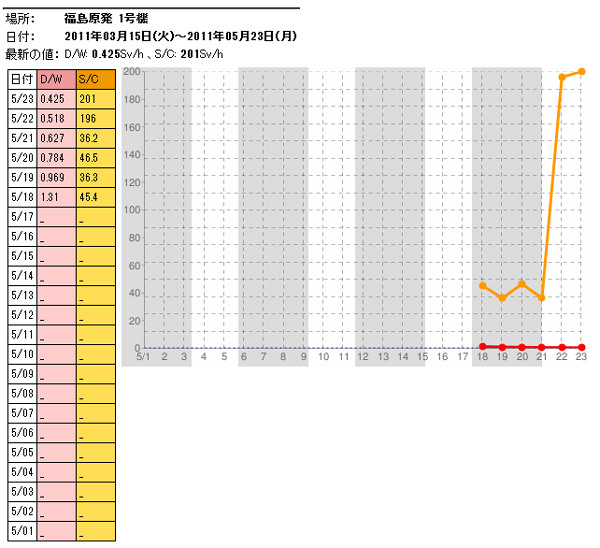
Having escaped their pressure vessels, the cores are burning their way through the concrete foundations of the three reactor buildings. This is the ‘why’ behind the sharp rise in radioactivity in the suppression pool area.
Temperature sensors built into the pressure vessels indicate high- but not extreme temperatures. The utility hopes that fuel remains within the pressure vessels and that water is providing some cooling. More likely is the hot material lies below the sensors which are measuring steam temperatures.
It’s also likely that many sensors don’t work.
All three plants were old, built in the 1970’s. The large nuclear stations are worn by hard use: their large thermal and radiation loads. Stresses accumulate over time.
Figure 3: Arnie Gundersen explains how containment vents were added to the GE Mark 1 BWR as a “band aid” 20 years after the plants built in order to prevent an explosion of the notoriously weak Mark 1 containment system.
The entire nuclear industry in Japan has a history of safety issues, cutting maintenance corners and covering up hardware defects.
The General Electric design has characteristics that leaves it vulnerable to a loss of coolant or power: a ‘station shutdown’.
The Fukushima/GE plants were at the end of a decades-long operating cycle meant that critical water and steam circulating systems were vulnerable to radiation stresses, corrosion, embrittlement and metal fatigue.
Critical safety systems were vulnerable, including the emergency generators and cables connecting these to pumps and valves. The systems represented complex chains of components: the failure of one component would compromise the entire chain.
The condition of the soil under the plant has not been revealed. It is likely that much if not all of the plant was built on fill or on unstable marine soils. It is possible that the containment structures are not fixed to the bedrock but on soil subject to liquefaction.
The earthquake shifted the land under the plant to the east and lowered it. It is reasonable that the concrete containment structures were cracked by the earthquake and that equipment was damaged.
Roads leading to the plant from the rest of the country were furrowed by the quake: nevertheless road transport of portable generators was possible within nine hours.
It’s likely the earthquake damaged vital systems, caused critical pipe breakage and cracked the containments. Explosions taking place during meltdown events certainly did done more damage.
Fssion products are distributed by way of ground water to sewers, waste treatment facilities, incinerators and finally bricks and concrete in Tokyo and elsewhere which become the heat sinks — along with the ocean — for Fukushima Daiichi.
Short- lived isotopes continue to be detected in increasing amounts far downrange of the plant. This indicates continuing criticality taking place.
And so the TEPCO soap opera spirals endlessly out of control, a malevolent reality program that is the stuff of nightmares …
…


There is as far as I can see no reasonable “Sarcophagus” plan that can work for Fuk-U-Shima. Its not like Chernobyl, Fuk-U-Shima sits on fundamentally unstable ground. I run a little Earthquake monitoring program on my laptop in the background all the time (I am a school teacher), nice 3D thing which shows me all current earthquakes through a 7 day period. I check it every so often during the day to see what’s shaking, so to speak. LOL. Japan has been “shaking” non-STOP since the Big One hit. Not little shakes either, 5-6 on the Richter scale mostly. Even if they did sacrifice lower Caste Buraku-min to pile lead bricks around this thing, its just a matter of time before whatever they build gets ground to dust in another Big One. Waste of time.
So I am going to pitch out another “solution” here, which is setting a Backfire. Its an outrageous solution, but the only one I think could really work. I think they need to evacuate Honshu Island, and detonate a 50 KT Hydrogen Bomb like the Tsar Bomba at Ground Zero of the Fuk-U-shima Reactors. This would Vaporize all the spent fuel and send it up high into the stratosphere, to be dispersed worldwide. This would result in marginal increase in backround radiation globally, and of course due to weather patterns some places would take a bigger hit than others, but at least all the poison won’t be concentrated in one spot. 50 years down the line, you might be able to start repopulating Honshu Island.
Other than this solution, Honshu is basically screwed. The whole water table will be poisoned over time, and the fisherie will go to hell. There is no way to sequester this stuff in such a geologically unstable location. The only way to get rid of it is to vaporize it and spread it out over the globe.
JMHO.
RE
Kyshtym disaster: same m.o.: don’t tell anyone till after everyone’s been irradiated and bury the data to protect the nuclear industry. Without nuclear power the continuation of the waste based economy would have been over by now.
Not sure about REngineer’s suggestion since you can’t evacuate Honshu island. Besides, can you imagine the Japanese PM telling the country he’s asked the Americans to bomb the site with a nuke? Mmmmm, no. Class warfare in Japan: those with money will get out of the danger zone.
It wasn’t that long ago that someone suggested we nuke the Deepwater Horizon site. Interesting that we should turn to nukes to ‘solve’ our problems. The finger pointing is just gettin’ started, fellas!
P.S. ‘Bee-stung lips’ – that’s harsh! http://www.powerthemagazine.com/conversations/whitney/index.html
<<>>
If you mean completely solving the problem, I am sure you are right. OTOH, either containing the spent fuel or moving it to a place where it can be property contained is better than nothing. Since there is 50x the amount of fuel vs Chernobyl, any attempt to scatter it would be 50x as dangerous. What most people don’t realize about Chernobyl is that the reactor had already burned itself out by the time it was enclosed. For sure, there is material that was irradiated still in there, but the fuel itself is not. Most of the fuel at the Japan site is still there. I’m guessing the best solution is to move the spent fuel rods to a better location if it can be done. Everything else needs to be entombed. Steve is right on when he says that the plan to rig up a new cooling system is DOA.
The recycle-the-water gig is just plain dumb. All the water poured in leaks right out. Good! The flow of water represents a flow of heat out of the reactors — along with massive amounts of radioactive material. BAD!
The earth and ocean are the heat sinks. Here is the problem: fixing the leaks so that water doesn’t leak means a) heat needs somewhere to go and b) the radioactive material also needs to go somewhere. The former is proposed to flow from commercially available (i.e. non- nuclear- grade) condensers/heat exchangers. The radioactives would be deposited onto the reactor building- and cycling equipment surfaces leaving fierce radiation on the cooling loop equipment. Right now the highest rates of radiation is within the pipes within the containments.
Cesium and Cobalt isotopes are powerful, long- lived gamma emitters. A foot of lead would be required to isolate the cooling equipment from personnel. How would cooling be fixed if some bit of gear (heat exchangers) breaks? The radiation will make things break (this is taking place right now, not spoken by TEPCO.) With hundreds of Sieverts per hour radiation being pumped from the cores the cooling loops would be unapproachable by anything, even robots.
A pipe or pump breakage would dump core radiation into the outside world!
The short cure is sand, boron and lead pumped into the cores as a form of slurry. It would displace the water: the cores would heat up but the lava would combine with the sand and lead. The bedrock would become the heat sink. The whole site needs to be surrounded by a cofferdam, not that large a project, actually.
I am working on a longer piece with a sketch of an approach. The key is to isolate the melt from the world.
Meanwhile, EU debt problems look to be fatal and a denouement around some corner or other. Munis? Ha- hahaha!
About the jump in radioactivity inside the unit 1 containment: According to TEPCO the sensors are suspect. In addition to that, the data was mislabeled, as both columns were for different instruments inside the dry well (A and B of D/W). The suppression chamber figures (A and B of S/C) remained between 0.98 and 1.04 Sv/h during the past week.
According to the data reported by METI, D/W instrument B did read 196 Sv/h on 5/22, but it is reported back at 33.1 Sv/h on 5/23, not 201 as listed above. You can check the daily figures at http://www.nisa.meti.go.jp/english/ and checking “Fukushima Dai-ichi Nuclear Power Station Major Parameters of the Plant” for a given date. The “CAMS radiation monitors” is what you want.
While it is clearly disturbing if the sensor data is unreliable, a sudden drop of D/W radiation levels after the spike would not be consistent with a core dropped through the bottom of the pressure vessel. More than two months after the shutdown and subsequent meltdown the decay heat should have dropped off considerably, with more than 99% of the iodine 131 already decayed. The corium is likely to still include all of the boron carbide from the control rods, which will make recriticality less likely, especially given the lack of moderator (water) in this configuration.
Contamination inside and in the bottom of the reactors from a leaking containment will be an ongoing problem, but it’s unlikely to have wide reaching consequences again in the way the fall-out clouds did that rained down on Iitate-mura and other towns to the North-West and West of the plant after the #2 suppression chamber blew up.
Blowing up site w/ a large bomba: this is a meme floating around the internet, another version is underground test that allows site to be swallowed by the ground with the sea rushing in. Hmmm … what is taking place in this world is variations on the meltdown theme: Macondo, Wall Street, EU … now Fukushima. The identical dynamic exists of dissolved boundaries and irreconcilable imbalances leading to endless can- kicking/rationalizing. All wait anxiously until ‘Great God Growth’ arrives on sleigh/raindeer in the nick of time to solve all with credit cards and $12 crude.
The large prob is no growth will arrive. What next?
The medium prob is … what if a bomba works? The prescription would be repeated. There are 500 other reactors that are in the process of being stranded by expensive energy and declining industrial returns, non-tendable over the long haul. A poor world will board up malfunctioning or unprofitable reactors then walk away. Once melted then bombed … reactor fuel + stored fuel + reactor material isotopes + bomb material x 500. OUCH!
Götterdämmerung … did I spell that right?
An effort to learn how to recover and denature escaped cores is a good future enterprise. Prob here is the nuke industry is in denial — believe it or not. The industry has sold itself on the premise of ‘no meltdowns … ever’ which is the conceit that TEPCO has been promoting from March 11. Best to learn how to approach and contain escaped fuel materials and decommission ruined reactors cheaply. It is a more difficult approach but practice will make perfect.
More on this later …
Joe Wein has a great blog from Japan: check it out and bookmark:
http://www.joewein.net/blog/
The different readings/non- readings have been confusing everyone including the ‘experts’. A lot of gadgets are ???? The UN team in Tokyo was flummoxed by the high radiation reading (according to Huffington Post) but that controversy was simply edited away: http://is.gd/81rdcf
Hey! I do that, too! Flummoxing AND editing …
A good first step for all reactors is to design and install ‘worst case’ robust instrumentation with off- site monitoring capability. ‘Black boxes’ are needed. Problem is that operators don’t want the public to know what goes on inside a core running amok. The public needs to (get off its rear end and) demand this. Those 500 reactors are ticking time bombs.
Seems the vents on the 3 reactors failed when needed. US BWR reactors have these same vents …
Here is a study of corium and components post- meltdown:
http://www.sar-net.org/upload/2-5_ermsar08paper2-5-b4c.pdf
There are more of these online: I was looking for sources of core hydrogen outside of zirconium/steam reactions. When cores melt all the hardware dissolves into the pot. Crap comes out with multiple (baleful) chemical interactions. Some isotopes will poison the reactions while others — NaCl from seawater??? — will moderate them. Fukushima is a science experiment in real time x 3. Can’t follow what is going on b/c there is no instrumentation!
Will the reactors spontaneously cool themselves? This is interesting b/c I recall Chernobyl stopped burning/melting after 5 days. Why? I’m not sure anyone knows the answer. Hopefully, something similar will take place @ Fukushima. Problem w/ dat: a renewed enthusiasm on the part of ‘Reactors Inc’ for hundreds more reactors. Something less than the annihilation of Japan’s economy and a Honshu- sized ‘dead zone’ will be bullish for nukes: “Hey! Meltdowns aren’t so bad … right?”
A world haunted by the ghost of Ann Coulter.
Here is TEPCO’s main page on the reactor conditions (in Japanese). Click around and find stuff that is interesting as most have graphics that are self- explanatory:
http://www.tepco.co.jp/nu/fukushima-np/
Obviously the logistics of evacuting Honshu would be pretty difficult, not to mention doing the sales job that you have to Destroy the Village in order to Save it. However, I think doing so would fairly well convince people the downside on Nuke energy is more than they would be willing to bear in their backyards.
On the problem of all the REST of the reactors currently harboring tons of spent fuel, at least for the moment it is still under control, so this stuff also you need to figure out where to put it where it will do the least damage.
My suggestion here would be to bring it all to a location on earth alredy with thoroughly depleted land and water table, like say the Sahara desert. Then you take the stuff and pump it all DOWN into the depleted Oil Wells in that neighborhood. You can’t grow anything in the Sahara anyhow, and without any water to dissolve the salts, the stuff can decay for a few millenia in relative isolation. Of course some gasses might escape the containment, but again these would rather quickly disperse into the atmosphere and only marginally increase background radiation world wide.
The other though I had would be to drill in a subduction zone right near major plate boundaries and pump the stuff down in the rock there. Then it would gradually get rolled into the Mantle and probably not spit back up out of a volcano until it had completely decayed in a million years or so. Using the slowest geological processes of the earth and locating the material as far from where it can do harm seems to me to be the best way to go here.
RE