More good stuff is taking place at the Wonderful Nuclear Resort Fukushima:
- TEPCO says plants won’t be in ‘cold shutdown’ by the end of the year after all. Have a nice day!
- TEPCO readings point to a massive increase in Iodine 131 in seawater outside the plant, from 5,200 Bequerels/Liter to 24,000 Bq/L. High levels of radioisotopes are found in areas outside the 20 km exclusion zone.
- TEPCO instruments indicate reactor unit 3 is starting to heat up again even with an flood of 13.5 cubic meters of water injected into it every hour.
- TEPCO jury- rig at unit 5 tempts fate as pump fails then repair is put off for 15 hours. Of course, nobody at the Fukushima Spa bothers to inform anyone until after the fact that the reactor in ‘cold shutdown’ was close to boiling.
- Tropical storm Songda passed over Fukushima Bar and Grill apparently without causing another meltdown. How many bullets have the Japanese dodged at Fukushima since March 11th?
Decay Heat, Bitchez!
How many more can they dodge?
Here is what the clock on the wall is saying, first about the delay in ‘shutting the plant down’:
TEPCO official admits there will be “major delay” to contain crisis because of triple meltdown (Energy News/Japan Times)Stabilizing the crisis at the Fukushima No. 1 power plant by the end of the year may be impossible, senior officials at Tokyo Electric Power Co. said Sunday, throwing a monkey wrench into plans to let evacuees return to their homes near the plant.
The confirmation of core meltdowns hitting reactors 1 through 3, accompanied by breaches to the critical pressure vessels that hold the nuclear fuel, has led officials to believe that “there will be a major delay to work” to contain the situation, one official said.
Tepco, the plant’s operator, announced on April 17 its road map for bringing the troubled reactors into a cold shutdown within six to nine months.
… on May 12, it was confirmed that a meltdown had occurred at the No. 1 reactor, forcing the utility to abandon the water entombment idea and try to install a new cooling system that decontaminates and recycles the radioactive water flooding the reactor’s turbine building instead.
Given that the contaminated water has leaked from the No. 1 reactor’s containment vessel, a Tepco official said, “We must first determine where it is leaking and seal it.”
This is complete ass- hattery on TEPCO’s part as there is no way anyone or thing can ‘seal’ any but the easiest leaks and TEPCO management knows it. The leaks are underneath the massive reactors, beneath the water- flow, in radiation environments that are hostile for humans and human- designed machinery other than a few, specially constructed robots.
The rad- proof robots available cannot work underwater and underground at the same time. TEPCO cannot even find the leaks: it does not know which reactor is leaking or if all of them are! It cannot locate the cores within the reactor buildings or determine what these cores are doing.
TEPCOs insistence on the ‘fixing leaks’ fairy tale indicates the company has no idea: the crisis is managing the company. The question is how long before the government fires TEPCO and installs competent management?
Under what horrific circumstance will this ‘regime change’ take place?
The delay allows radiation to accumulate outside the plant:
Fukushima Risks Chernobyl ‘Dead Zone’Yuriy Humber and Stuart Biggs (Bloomberg)
Radioactive soil in pockets of areas near Japan’s crippled nuclear plant have reached the same level as Chernobyl, where a “dead zone” remains 25 years after the reactor in the former Soviet Union exploded.
Soil samples in areas outside the 20-kilometer (12 miles) exclusion zone around the Fukushima plant measured more than 1.48 million becquerels a square meter, the standard used for evacuating residents after the Chernobyl accident, Tomio Kawata, a fellow at the Nuclear Waste Management Organization of Japan, said in a research report published May 24 and given to the government.
Radiation from the plant has spread over 600 square kilometers (230 square miles), according to the report. The extent of contamination shows the government must move fast to avoid the same future for the area around Tokyo Electric Power Co.’s Fukushima Dai-Ichi plant as Chernobyl, scientists said. Technology has improved since the 1980s, meaning soil can be decontaminated with chemicals or by planting crops to absorb radioactive materials, allowing residents to return.
Soil samples showed one site with radiation from Cesium-137 exceeding 5 million becquerels per square meter about 25 kilometers to the northwest of the Fukushima plant, according to Kawata’s study. Five more sites about 30 kilometers from Dai- Ichi showed radiation exceeding 1.48 million becquerels per square meter.
When asked to comment on the report today, Tokyo Electric spokesman Tetsuya Terasawa said the radiation levels are in line with those found after a nuclear bomb test, which disperses plutonium. He declined to comment further.
Here are the sea- water contamination charts. Readings don’t necessarily relate to particular reactors as all are conjoined within the complex. Most of the water is being pumped into unit 3 so it makes sense that reactor is the source of the high radiation. (TEPCO, click on chart for larger image):
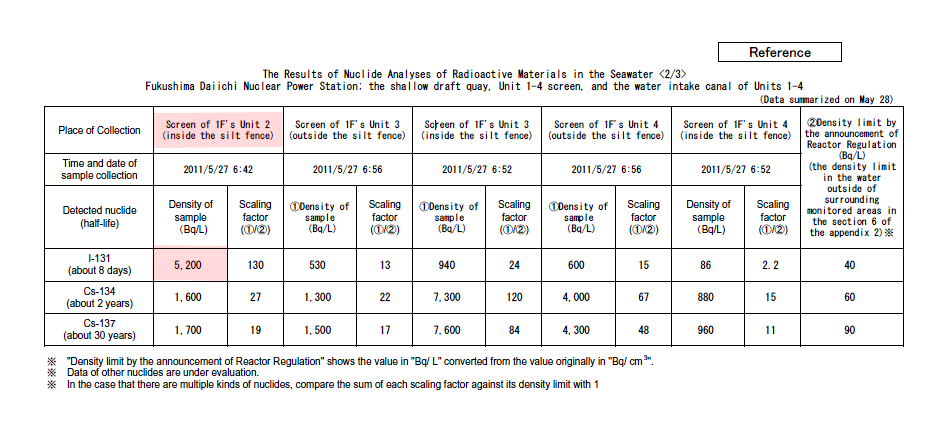
Figure 1: this was from the 27th of May, the following was from the 29th: (Click on image for sharper image):
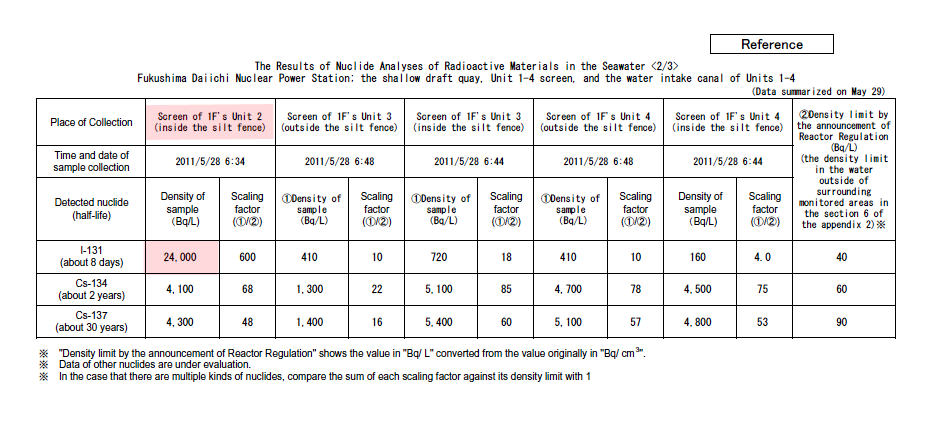
Figure 2: Sharp rise to 24,000 Bq/L is meaningful. Half- life of 131I is a bit over 8 days. Generally, activity declines to small levels over a period of 10 to 13 half- lives. Iodine isotopes are volatile, released after reactivity. A method to determine reactivity is to measure the ratio of 131I to longer- lived 137Cs. An increase in Iodine relative to Cesium indicates that a nuclear reaction — criticality — is taking place somewhere within the ruins.
This TEPCO chart is of reactor temperatures in troublesome unit 3 (click on image for larger version):
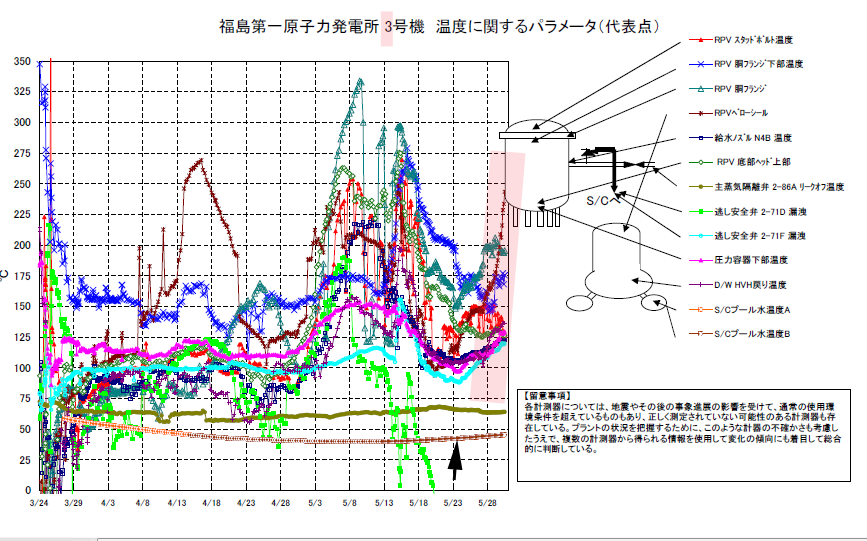
Figure 3: The pink area indicates the most recent rise in temps with some sensors at the top of the ‘pressure vessel’ increasing dramatically. Pay attention to the line indicated by the black arrow. This is a sensor in the suppression pool and is an indicator of the overall temperature of the reactor building. Whatever is going on in unit 3 is slowly heating up the immense reactor building itself … which has 13.5 metric tons of cold water being poured into it every hour (click on image for a larger version):
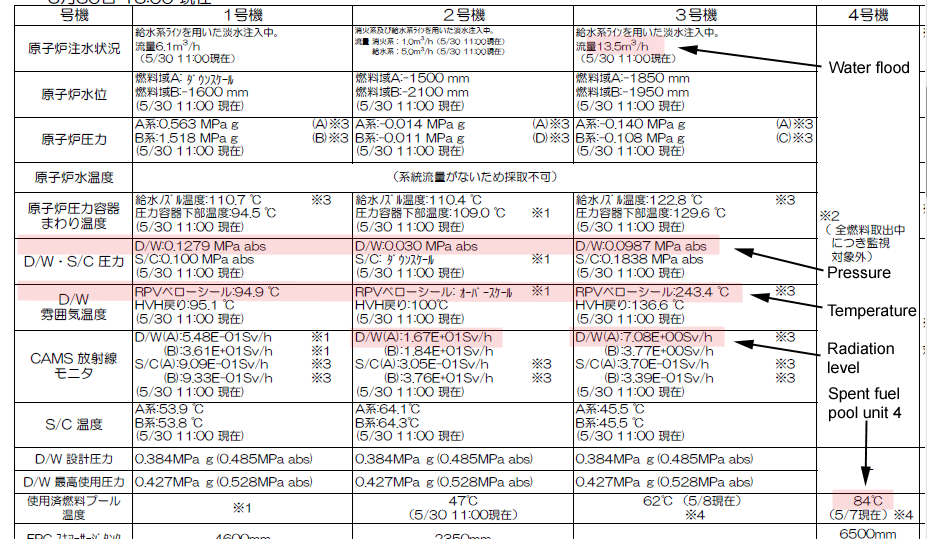
Figure 4: TEPCO is manfully pumping that water! It seems all they know how to do. Despite this water flood, the temperature is over twice boiling: 243C. This heat is in a reactor with minuscule pressure which indicates a reactor ‘containment’ in name only.
Also note the high temperature in the reactor unit 4 spent fuel pool.
While all this excitement has been taking place the service water pump circulating seawater into the heat exchanger used to cool the core of reactor unit 5 failed Saturday due to “Fouling”.
Pump failure nearly brings No. 5 to a boil
Tepco installs backup unit 15 hours later for halted reactorReiji Yoshida (Japan Times)
The seawater pump in the cooling system for the Fukushima power plant’s No. 5 reactor broke down Saturday evening, prompting repair crews to install a backup pump 15 hours later on Sunday afternoon, Tokyo Electric Power Co. said.
Tepco discovered the pump had stopped at 9 p.m. Saturday but didn’t announce it to the public until Sunday morning.
The beleaguered utility said it notified the local and central governments of the situation on Saturday evening.
The seawater pump was set up after the reactor’s original pumps were knocked out by the March 11 earthquake and tsunami. It was part of the critical Residual Heat Removal System that was later used to safely ease the reactor into a cold shutdown on March 20.
It’s hard to know where to begin with this. First is the delay in starting repairs, assuming there would be no problems with the replacement pump and that emergency water injection would work as advertised. As per usual, TEPCO only notified the greater world when it suited arrogant TEPCO.
Right now it doesn’t appear that any great change is going to take place in Japan until something catastrophic takes place. The candidate as usual is reactor unit 3 with its boiling core in an undisclosed location. Of course, there is nothing to be done, we are all sinners now in the hands of an angry nuclear god …
>>>>