The lack of urgency in Japan regarding the ‘Fuku-sham-a Meltdown Madness’ is astounding. The Japanese are facing unspeakable consequences. A not- quite worst case scenario will have Tokyo or much of the main Japanese island of Honshu queasily ‘habitable’ for years to centuries with a large ‘dead zone’ surrounding the N- plants.
A worst- case will poison the entire country along with the atmosphere and the Pacific ocean food chain and the ocean itself.
Where is the world on this? Where is the International Atomic Energy Agency?
In Japan, patting TEPCO and the Japanese government on the back!
The Chinese aren’t saying a word because they are in the process of building a hundred of their own cardboard-box reactors. South Korea and post- Soviet Russia are nuclear consumers. Nobody cares about what North Korea thinks about anything.
Nuclear disasters lead inevitably to the reactor disaster cover-ups. Fuku-shame-a is an existential threat to the industry. For this reason, the industry’s government promoters dare not speak to the facts too loudly or appear to respond to them.
- The Japanese government is AWOL. Prime Minister Kan has announced his resignation but has given no firm date for it.
- TEPCO falls farther behind in the water-pumping race against itself, The establishment clearly has no clue.
- Every passing day brings closer the inevitable calamity: a prompt criticality within a reactor, a steam explosion, a more powerful hydrogen explosion, the collapse of a reactor building, a spent fuel fire leading to a ‘large release’ at one time of intense radiation (+100 Sieverts) that causes a hard-to-deny number of instant fatalities among the plant workers … or something else much worse, all of the above.
- TEPCO’s puny efforts have failed to ‘stabilize’ anything. They have produced some colorful graphics but these are meaningless.
- TEPCO never says how much radioactivity is in the waste-water.
Inquiring minds would like to know …
Fukushima Water Has More Radiation Than Released Into Air(Bloomberg) — The water level in basements and trenches at Tokyo Electric Power Co.’s Fukushima plant rose and may contain more radiation than is known to have been released into the atmosphere in the worst nuclear crisis since Chernobyl.
The amount of contaminated water rose to about 105 million liters (28 million gallons) from 100 million liters on May 18, and may start overflowing after June 20, the company known as Tepco said in a statement today. Radiation in the water is estimated at 720,000 terabecquerels, general manager Junichi Matsumoto said at a media briefing in Tokyo.
Tepco has pumped millions of liters of water to cool three reactors that melted down at the Fukushima Dai-Ichi station after the March 11 earthquake and tsunami knocked out power and backup generators, crippling its cooling systems. With Japan’s rainy season in full swing, heavy downpours threaten to flood the plant and leak more radiation into the sea, soil and air.
“The risk of overflow is as serious as the meltdown of reactor fuel rods that’s already happened,” Tetsuo Ito, the head of the Atomic Energy Research Institute at Kinki University in western Japan, said in a phone interview. “Tepco should’ve acknowledged this risk weeks ago and could’ve taken any urgent measures.”
It has never been enough for a country to simply have … electricity. There has to be electricity that conforms to a cultural ideal; American-style ‘Tail- Fin Capitalism’. Within modernity, it is not enough to have enough, there must be excess … so there is a plenitude to waste.
Modernity appears to defy diminishing returns. This is a large part of modernity’s appeal: it pretends to void Steve’s First Law of Economics which has surplus- management costs rising faster than the value of the surplus itself. The waste- based economy turns the surplus- cost defect on its head. As a cultural — rather than an economic — asset, greed (surplus) becomes a cost- free good that rationalizes other goods’ cost- free waste.
It is modernity’s persistent and hopeful illusion of goods and waste that has undermined the processes that would allow modernity’s excesses to self-correct. ‘Endless growth’ becomes modernity’s marching song as it limps toward the abyss, with growth itself masquerading as its own cost- free good.
Meanwhile, back at the reality ranch the costs of surplus electricity multiply like cockroaches. What about all the other reactors @ Fukushima? What about the other 50 reactors in Japan? What happens to these fifty reactors after Japan becomes too radioactive to comfortably endure, or too poor to afford reactor maintenance? All of this eludes public discussion, which presumes the immediate past extending endlessly/effortlessly into the waste- endowed future.
Once the current ‘rough spot’ gets past itself, that is …
Modernity promises a future of yellow- brick super-highways lined on both sides with electricity- driven ‘progress’. The Japanese have determinedly unlearned their own history as part of the ‘progress process’. Beginning when US Admiral Perry and his ‘Black Ships’ appeared in Tokyo Bay in 1853, the country has made one Faustian agreement after the other with industrial modernity, all of which have brutally failed.
Japan’s nuclear bargain is set to turn out no better than all the others. Yet modernity succeeds by its ‘act of positive forgetting’ which insists the past in all of its iterations is a thing devoid of value. Modernity’s past failures never matter because only a truncated, undeveloped form of modernity has ever been allowed to exist … that form being ‘The Past’ itself! Like Catholic transcendentalism, the tautology/circular logic of modernity exists always out of reach within the future, one that conveniently never arrives to challenge modernity’s own claims upon it.
‘Action words’ that emerge like demons from the modernity’s nuclear cauldron speak to incomprehensible truths: ‘meltdown’, ‘radiation’, ‘fissile’, ‘Cherenkov’, ‘criticality’; this is the new-technocratic banality of evil-speak. People cannot endure the power of ideas that grasp the hand and snatch into the void: horrors of their childrens’ monstrous deformities, of inedible food as ashes- in the mouths of the starving, of skin sloughing off and teeth falling out, of dead organs rotting within living bodies and of freakish cancers. This is cyborg/post- humanoid terror that orbits in dimensions outside the fear of tooth and claw we are all born with.
This is also the ‘innovation’ of the post- food stamp, poverty- based ‘Niewe Economy’ that we have built for ourselves. Caught between pet devils, humans curl into the fetal position rejecting all responsibilities. We have ‘evolved’ into larvae in the laboratory of easy credit and 24 hour convenience, constantly orienting ourselves toward the shiny: neon/LED blinking advertising signs, parking garages with 24 hour illumination, the flat-screen televisions with ‘vacant’ on and uber- chic maglev bullet trains that go from nowhere to nowhere faster than do the current bullet trains.
The Japanese crisis response is easy to understand from the cultural standpoint, incomprehensible from the standpoint of physics. Occasionally, children are required to stop playing and conquer fears so as to escape large consequences. The Soviets may have over-reacted at Chernobyl but they understood physics. By relocating hundreds of thousands of people and by putting hundreds of thousands more to work clearing the site they were responding to the dynamic imposed by splitting atoms — leaving the various cultural/political constituencies to take care of themselves.
By acting as they did, the Soviets insured a margin of safety for the other three RBMK reactors at the Chernobyl site and other reactors elsewhere. The three could have all melted down and exploded but didn’t. Meanwhile, the politics did indeed take care … the Soviet Union itself melted down on realized surplus- electricity costs that the reactors had incurred behind the Soviet’s military- industrial facade.
TEPCO is running out of time. They need to start pumping that sand, boron and lead grit into the reactors in place of some of the water. The solid material will displace water at the bottoms of the reactor containments, stopping the leaks and perhaps quelling ongoing reactions at the same time. As the cores heat increases beneath sand- boron layers the solid material will act the same way as the water flows do now, insulating the what remains of the core from water or steam that remains in the reactor buildings. Insulating the core would make a steam explosion less likely. As more sand, boron and lead are added to the containments, water would be pumped out of the buildings and treated. Adding new water would not be required.
Sand and boron can be added with just enough water to cause it to flow easily through the piping currently being used to pump water into the containments.
If the cores cannot be accessed by existing plumbing, then holes must be drilled through the concrete containment walls to allow concrete pumps to force the sand mix into the containments.
The Japanese also need to start building a sheet- pile cofferdam around the entire facility to prevent the radioactive water from leaking though the ground into the water table or the ocean.
None of this is rocket science. Meanwhile, the country is whistling past the graveyard: reactor unit 3 is bubbling away (please click on image for a clearer image):

The temperature trend in this reactor unit is rising. Keep in mind that much of Fukushima’s instrumentation was damaged of destroyed by the earthquake and subsequent meltdowns/explosions. Individual instrument readings are not reliable.
Nobody has any idea where the core of this unit is located. Nobody has entered the building since a crew spent ten minutes inside on May 18.
Here is the breakout on reactor unit 1.
Its temperature trend is rising too, (click on the image for a sharper version):
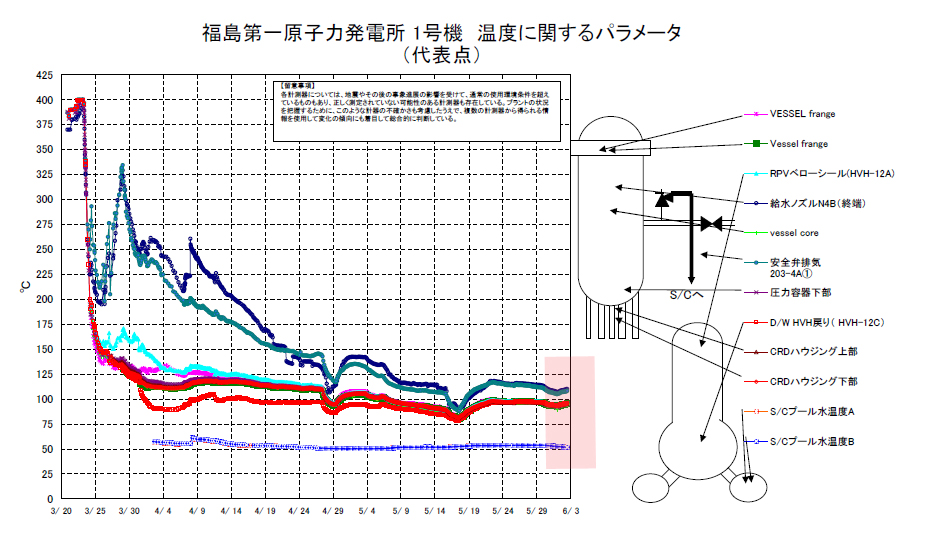
There are fewer instrument readings, due to long period of zero- cooling, extreme temperatures and pressures during the night of the 12th when the reactor unit melted down then exploded. The pink area indicates a rising trend although this could be a fluctuation due to the flow of water through the reactor.
Because nobody knows where the cores are located or in what condition they are in, it is hard to determine whether there is effective cooling or not. If the cores have completely melted down, the pressure vessels would be empty tubes, completely open at the bottom, subject to rising temperatures from steam or from the molten cores, themselves.
Here is reactor unit 2: (click on the image for a larger version):
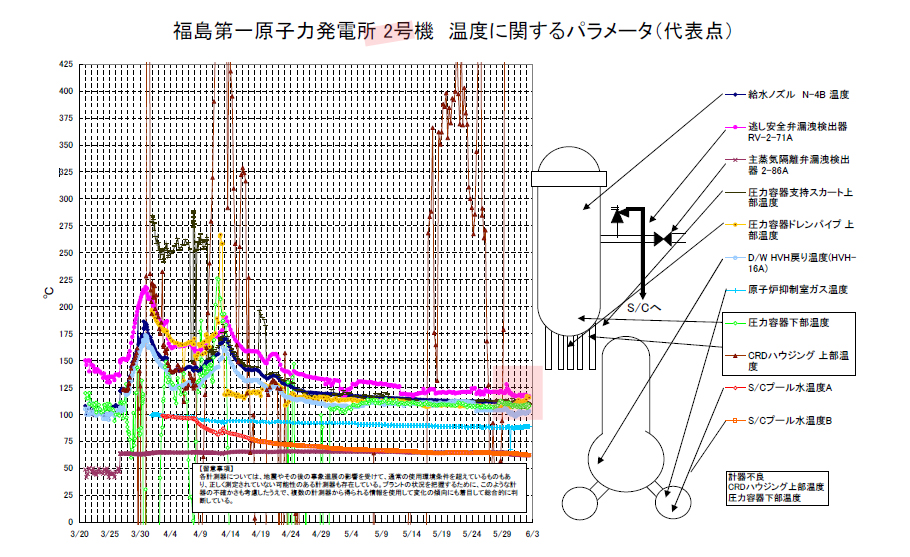
The temperature reading from one of the sensors at the bottom of (what is left of) the pressure vessel fluctuates wildly. The temperature is also on the borderline. Judging from temperatures, unit 3 is reactive. Units 1 and 2 may be critical as temperatures are above boiling point of water with a lot of water being pumped into the PVs.
Physics indicates the remnants of Japan’s nuclear/cultural ‘self’ will vanish when the next important item breaks. There are no nuclear industry prerogatives left to preserve, only shadows. There are fatal problems everywhere within the Fukushima site. The Japanese can accept the institutional cost and buy some time for the rest of their nuclear plants or follow the current strategy and lose everything.
Japan will have no choice but to bring to bear every resource it commands to assault these reactors. This is not simply the subjective speculation by a layman thousands of comfortable miles away, rather it is common sense. The force at work is entropy. The reactor cores and spent fuel represent concentrated energy far in excess of means to on hand to contain it. TEPCO and the Japanese government refuse to assemble adequate tools with which to manage the entropy process. Energy dissipation takes place whether the establishment acknowledges the facts of it or not.
The only thing to be done is to create a form of informal containment that can slowly dissipate enough of the intense energy being emitted so as to keep the bulk of the energy separated from the outside world.
The water could do this if the containments were leak free. The containments would become over-sized spent fuel pools, in addition to the pre- existing pools. Over a decade or so the fuel would cool after which time the fuel mass could then be removed.
The containments’ fractured states makes water containment impossible. There have been non- stop earthquakes and aftershocks of the Great March 11 earthquake. The water flow since March 12 is eroding the containments and the ground beneath them, compromising the reactor buildings’ foundations. The explosions within the reactors damaged the containments and piping. Instead of being pools, the reactor buildings are sieves.
TEPCO had extreme difficulties repairing water leaks that were out in the open/accessible. It is hard to see how TEPCO intends to fix the large leaks under the containments or within the drywells and suppression pools. The buildings — not the containments — are too radioactive to spend more than ten minutes or less inside. Conditions within the containments themselves by TEPCO’s own reports are lethal, within minutes or seconds. Workers are rapidly accumulating doses under current conditions. How will massive repair projects take place with TEPCO’s minuscule staffs?
TEPCO’s approach to keeping radiation contained is sheer idiocy: to build plastic tents around the reactor buildings. These tents will undoubtedly keep moths out of the reactors. What about typhoons?
The TEPCO crew has convinced themselves they are dealing with decay heat from shut-down reactors. The isotope ratios and the heat in both unit 3 and the spent fuel pool in unit 4 indicate something more energetic than decay is taking place.
The Japanese are content to wait until its too late to attack these reactors. This is a form of contentment that the Japanese are sure to regret.