
US Navy photographer: Guided missile cruiser USS Leyte Gulf in Atlantic Ocean
A few random thoughts about the political drama taking place in Washington .. and in Brussels as well:
– What people have to understand about our world is that it isn’t what it was of ten years ago. Austerity is here. There is no choice between austerity and ‘something else’. Our choice is between a managed form of austerity or the ‘naturally imposed’ variety. The managed form that makes best use of our human resources while the disorderly form is imposed upon us by events.
– Our best resources are our ingenuity and creativity, our willingness to sacrifice for the common good and our discipline. None of these are on display within the establishment which is intent on preserving its prerogatives.
– We are in the middle of a petroleum crisis that has emerged or manifested itself within credit. Relatively scarce fuel is becoming more expensive in both nominal and real terms. The economies are frantically jettisoning other costs — union wages, retirement benefits, interest income or yields, health care, government services — in order to afford fuel. Some costs such as high wage manufacturing jobs in the US have already been shoved overboard. Teachers, municipal workers, pension benefits and health care are all on the gangplank. We can buy fuel or we can have ‘other things’ but we cannot ‘have it all’ anymore.
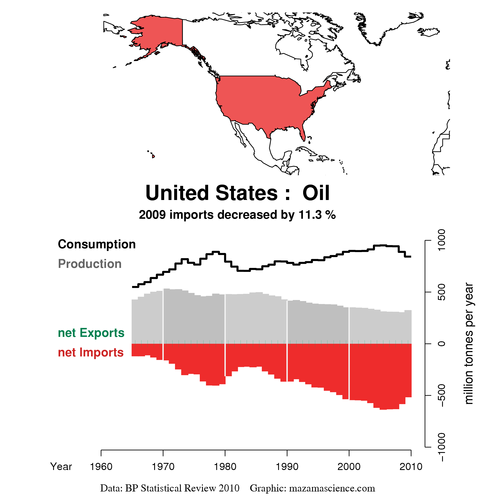
Figure 1: This is the petroleum ‘balance sheet’ for the United States by way of Jonathan Callahan’s Energy Export Databrowser.
– Even though the US produces large amounts of domestic petroleum fuel it must import at great cost two-thirds of the petroleum it consumes. Funds have been borrowed to obtain fuel as well as to create the means to use (waste) it. The US has been living far beyond its energy means — as an entitlement — and is now an ‘energy insolvent’. America’s energy use cannot service its energy debts. If the US was not insolvent there would have been no need to take so much expensive finance debt as an ‘energy substitute’.
– If the progress narrative was something other than a myth the use of energy would have earned the US sufficient returns to pay its energy tab out of petty cash.
– The US is much like Italy which cannot produce enough oil for its own use, nor can it profit by what it uses (wastes). America must borrow so that it can continue to import more fuel (to waste) continually digging a deeper debt hole for itself.
– The subtext of the political argument is the death of ‘Too Big to Fail’: that various big business are too large and systemically important to be allowed by the Federal government to fail yet the government itself is somehow small enough to fail.
– The human race has learned grudgingly over centuries of bitter experience the folly of waging war against other humans. Now, the war is directed against nature and arithmetic. What is taking place in Washington and Wall Street and the EU and elsewhere is war waged against exponents.
As a side note: We are also waging all out war against our own atmosphere which has done nothing to provoke our wrath other than to support life on our little space ship.
– The blue line on the following graph represents Federal outlays while the red line represents receipts; taxes and fees. The ongoing recession has cut receipts — this is what 5+ million unemployed cost the government in forgone taxes. Meanwhile, the ongoing care and feeding of these same unemployed persons is shifted to the blue line.
– Also in the blue line are bailout payments to Wall Street since 2008. These bailouts don’t seem to have effected receipts:
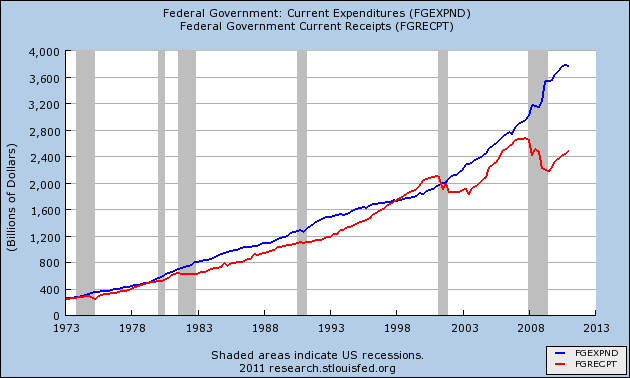
Figure 2: The gap between Federal government receipts and outlays by St Louis Fed (FRED).
– The amounts under controversy are substantial, roughly a trillion- and a half dollars per year. The current recession is a big change from previous recessions that had little effect on expenditures one way or another.
– Reinhart and Rogoff make the economic argument for constraining debt:
Our empirical research on the history of financial crises and the relationship between growth and public liabilities supports the view that current debt trajectories are a risk to long-term growth and stability, with many advanced economies already reaching or exceeding the important marker of 90 percent of GDP. Nevertheless, many prominent public intellectuals continue to argue that debt phobia is wildly overblown. Countries such as the U.S., Japan and the U.K. aren’t like Greece, nor does the market treat them as such.Indeed, there is a growing perception that today’s low interest rates for the debt of advanced economies offer a compelling reason to begin another round of massive fiscal stimulus. If Asian nations are spinning off huge excess savings partly as a byproduct of measures that effectively force low- income savers to put their money in bank accounts with low government-imposed interest-rate ceilings — why not take advantage of the cheap money?
Although we agree that governments must exercise caution in gradually reducing crisis-response spending, we think it would be folly to take comfort in today’s low borrowing costs, much less to interpret them as an “all clear” signal for a further explosion of debt.
– The system is trapped in a conundrum: In order for the economies to grow according to Reinhart and Rogoff the level of debt must be reduced. At the same time the debt cannot be paid down without growth.
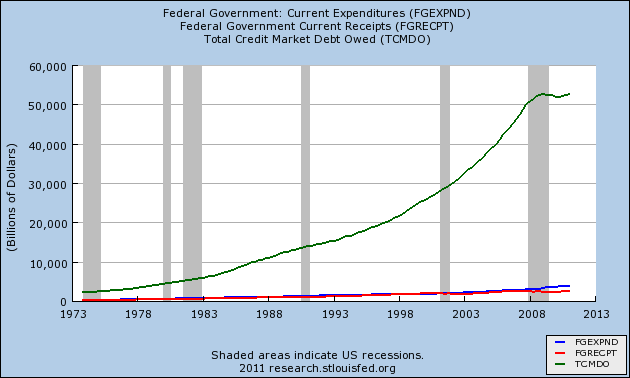
Figure 3: The total public and private debt ‘leveraged’ against the Federal budget, the Federal expenditures are insignificant against the totality of public and private debt. The blue and red lines in this graph are the same expenses and receipts as in figure 2.
– It’s not just the Federal budget and operations at risk. A default would obviously effect service of Federal debt, it would also interfere with service of the $55 trillion public and private debt! That little dip in the green line at the top of the FRED chart is the credit deleveraging which took place beginning in 2008. It also indicates how little deleveraging has taken place and how much more is required to bring credit service costs to a level that a petroleum constrained economy can support.
– The very small amount of deleveraging was able to cause a great deal of economic pain What has been keeping further deleveraging from taking place has been the Federal deficit. The ‘poor’ recipients of Federal ‘largess’ have been conduits directing funds ultimately to service debt, which is the ‘property’ of finance. Whether Federal ‘free fiat’ is sent to individuals or corporations or paid directly to banks, the flow is always toward finance.
– Any public deficit is private surplus. The establishment’s efforts to ensure continuing private surplus — so as to continue to service private interests’ gigantic debts — is acting to undermine the the public deficit- service of private interests’ gigantic debts!
– From ‘Stupid Irony’ department: The total debt service @ an average yield of approximately 3.5% on $55 trillion is roughly the same size of the US budget deficit: $1.9 trillion vs. $1.4 trillion. To service the private/public debt the establishment demands that non- debt liabilities such as Social Security and Medicare be reduced (eliminated) and that the government’s cash flow be directed entirely toward debt service — while threatening to cut off debt service if its demands aren’t met!
– Wall Street ‘Does the Paulson’, threatening a disorderly deleveraging without Federal concessions on Federal expenditures. doing what Wall Street wants would shrink rather than expand the ability of the government expenditures to service Wall Street’s debts! The establishment has put itself into a box that it does not have the wit to walk out of.
The result is a financial schizophrenia extending across the political spectrum from the Tea Party to Tim Geithner at the Treasury and Ben Bernanke at the Fed. It seems bizarre that the most reasonable understanding of why the 2008 bank crisis did not require a vast public subsidy for Wall Street occurred at Monday’s Republican presidential debate on June 13, by none other than Congressional Tea Party leader Michele Bachmann – who had boasted in a Wall Street Journal interview two days earlier, on Saturday, that she voted against the Troubled Asset Relief Program (TARP) “both times.”She complains that no one bothered to ask about the constitutionality of these extraordinary interventions into the financial markets.
“During a recent hearing I asked Secretary [Timothy] Geithner three times where the constitution authorized the Treasury’s actions [just [giving] the Treasury a $700 billion blank check], and his response was, ‘Well, Congress passed the law.’ …With TARP, the government blew through the Constitutional stop sign and decided ‘Whatever it takes, that’s what we’re going to do.’”
Clarifying her position regarding her willingness to see the banks fail, she explained:
I would have. People think when you have a, quote, ‘bank failure,’ that that is the end of the bank. And it isn’t necessarily. A normal way that the American free market system has worked is that we have a process of unwinding. It’s called bankruptcy. It doesn’t mean, necessarily, that the industry is eclipsed or that it’s gone. Often times, the phoenix rises out of the ashes.
There were easily enough sound loans and assets in the banks to cover deposits insured by the FDIC – but not enough to pay their counterparties in the “casino capitalist” category of their transactions. This super-computerized financial horse racing is what the bailout was about, not bread-and-butter retail and business banking or insurance.
It all seems reminiscent of the 1968 presidential campaign. The economic discussion back then between Democrat Hubert Humphrey and Republican Richard Nixon was so tepid that it prompted journalist Eric Hoffer to ask why only a southern cracker, third-party candidate Alabama Governor George Wallace, was talking about the real issues. We seem to be in a similar state in preparation for the 2012 campaign, with junk economics on both sides.
– The establishment’s right hand is arm- wrestling with its left while the ‘default’ position is … just that. The step after is a liquidity shortage … the chaotic deleveraging of the $55 trillion begins …
It’s a measly $20 billion per week in Federal ‘magic beans’ that props up the debt service key man. Yes, the Federal Reserve will provide liquidity, but can the (broke) Treasury guarantee money- and repo markets?
– Instead of futile meetings with various ‘leaders’ in the White House, why not take a page from Franklin Roosevelt’s presidency one step further and hold meetings on a Navy ship. A cruiser such as the USS Leyte Gulf could be used to haul the establishment’s ‘leaders’ up and down the Atlantic Coast until an agreement is reached. No lobbyists, no strippers, no pollsters, no porn, no television, no ‘political advisors’: only dedicated young men and women serving their country. A few weeks at sea would wash away the cynicism and perhaps the example of service set by Navy personnel might cause an awakening.
Then again, it might not.