Finance crises have tended in the past to be dramatic affairs. A critical (‘systemically important’) firm or bank fails and the investors/gamblers across markets race at once to close accounts, retrieve what cash they can and exit before others ‘beat them to it’ … The idea is to re-enter later … when it is safe to do so … to gain the free lunches in the future … like those enjoyed in the past.
If you see a Swiss banker jump out a window, jump after him. There’s surely money in it.— Voltaire
Speculators race to sell, there isn’t enough circulating money to satisfy all of them … and there is madness! The desire to gain cash confronts the certainty there is no cash to be had. Soon enough, the entire country is emptied out of currency by the speculators … and it is still not enough. There is hand-wringing, wailing and window jumping.
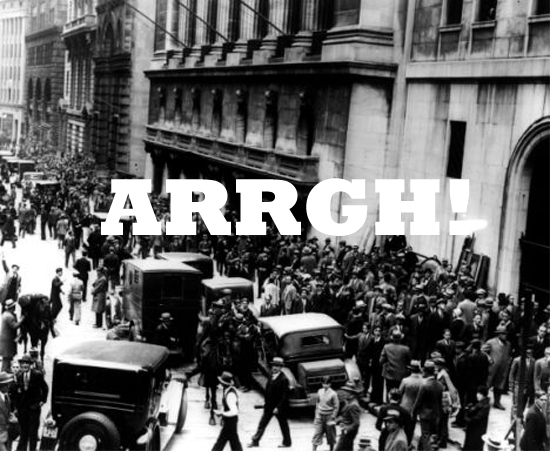
The New York Stock Exchange on Black Tuesday, October 29, 1929 (Unknown photographer). The Mother of All Money Panics: Wall Street financiers lost billions of dollars in the course of a single day when all of them attempted to exit the market at once.
Manias, panics and crashes are expressions of the ‘Paradox of Thrift’, which states that one-way markets — all buyers or all sellers (or all savers) — cannot exist without severe consequences. A market where all participants are buyers means a market that is ultimately deprived of them. Everyone who is willing to buy has done so: no one remains able to ‘buy from the buyers’. A market where all are thrifty is one where money is ‘saved’ out of circulation so that day-to-day business becomes impossible. A market crash occurs when free-spenders are forced by conditions … to be thrifty all at once!
It can be said that what has overtaken the United States is a condition where all Americans have been consumers and there are too few savers: the paradox of non-thrift. Americans are forced into penury on account of it, there has been too much business, goods have been over-consumed, goods-markets are saturated. Businesses cannot endure periods when there is no consumption and they fail, the outcome is the same as too much thrift. Instead of a shortage of currency, there is the shortage of timely demand.
When panics occur, the Establishment strategy has been for banks to deploy reserves, for governments to print money and depreciate it, for central banks to offer credit and force interest rates lower along with other strategies that make more money- and credit available. One of the new strategies is to offer lies by establishment figures in the media. The aim is to add new buyers to suddenly-thrifty markets, to span the interval until demand returns … to preserve gamblers’ illusory gains and prolong the mania that precedes the crash as long as possible … or to replace one mania with another. These strategies offer diminishing returns, problems multiply after they are deployed over and over. When effects of easing ‘wear off’ and lose effectiveness there is nothing to prevent the certainty of loss from engulfing all markets and running wild until speculative gains everywhere are entirely erased.
The only tactic that has not been attempted so far is for governments to issue currency and thereby extinguish/repudiate debts. Doing so does not support speculators so this instrument is not considered … so far. When the economy of the world is made up entirely of the schemes of gamblers there is little to be gained by quashing them.
Thrift is a form of class warfare against the wealthy … who borrow their fortunes and thereby require circulating money to flow to them so that their stupendous debts might be serviced: the non-wealthy are the support for the tycoons. By saving, the non-wealthy deny the tycoons funds, the tycoons are ruined by their own creditors, the creditors are likewise ruined.
Strategies are severely constrained by currency pegs and/or currency redeemability. For one country or group of countries takes steps to ease policy requires all the other countries to do the same. This interconnectedness allows crises to take new, unfamiliar forms, for panics emerge in markets that are not necessarily speculative.

Figure 1: Gasoline price heat map from GasBuddy.com. Gas prices in California are shooting through the roof. Instead of speculators trying to buy all the currency at once drivers in California are panicking, trying to buy all the gasoline at once.
Gasoline prices in California are high as a result of fuel shortages elsewhere in the world. Because of the ‘relationship’ between dollars and other currencies, consequences emerge in California where residents are able to stump up for the pricier gas. In other parts of the world, folks are addressing the structural shortage of fuel by not buying. Horrors!
Californians create the shortage the same time they battle its effects by destroying every bit of gasoline they buy! Californians are trapped: if they continue to drive they push the cost of gasoline to the level where demand is ‘effected’ and the price cannot be met. At the same time, Californians cannot afford to stop driving, they have too much invested in the process. Aside from the speculating, the entire economy of the state — as well as the rest of the developed world — revolves around buying and using cars for everything.
The human race is in the process of polishing off the Mother Of All Free Lunches, a multi-million year-to-produce petroleum resource consumed for the most part in less than 100 years … with nothing to show for it, (TFC Charts: click on for big):
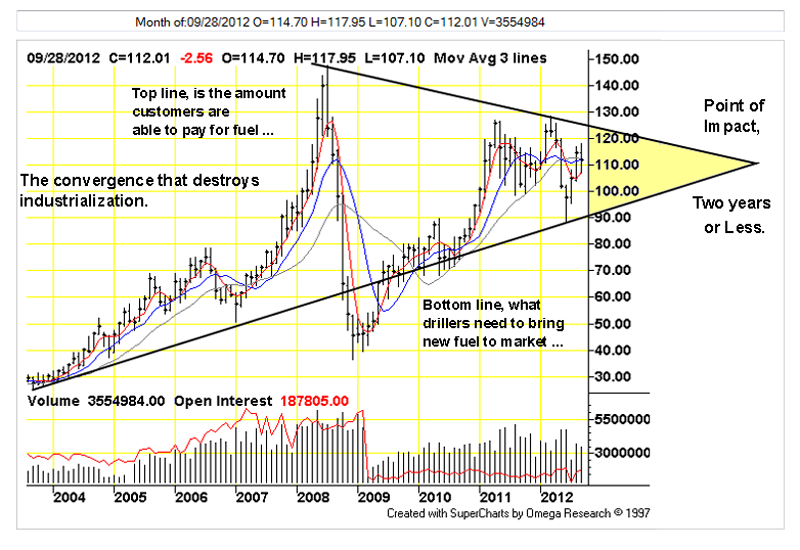
Figure 2: Brent crude continuous front-month weekly futures’ prices. The maximum price customers can afford to pay for fuel decreases while the price required to bring crude to market continuously increases. The current price at any given time is too high, firms fail and customers are left with diminished discretionary income. At the same time, the current price is too low to allow drillers to complete the increasing numbers of wells in difficult areas that are needed to keep pace with demand- plus depletion in older wells.
High prices strand consumption infrastructure. Low prices strand the drillers … When prices are ‘low’, the high priced reserves become unavailable. At some near point in the future both the too high- and the too low prices will be the same … then it’s game over. From the chart it looks to be about two years in the future … all else being the same. If conditions change, the price will plunge and oil shortages intensify. Under no possible circumstance will our pauperizing meat-grinder-economy be able to afford higher real costs: resource waste is unproductive everywhere but at the margins, so is the debt taken on to subsidize it, (Gregor Macdonald):
The Federal Reserve is probably not ready to take the aggressive plunge into Nominal GDP Targeting, but it likely will.Such a policy, which received wider attention during Ben Bernanke’s Congressional questioning last year and was also highlighted this year in a paper delivered at the Jackson Hole conference (Woodford, opens to PDF), has not caught any visible traction with Washington policy makers possibly because it’s seen as either too radical, or simply too new.
However, after four years of broad reflationary policy (and another year to come) failing to meaningfully spur U.S. employment growth, the Fed may be willing to try such measures by late next year, 2013.
What’s ‘exciting’ about the emergence of NGDP Targeting into mainstream economic thinking is that, once implemented, it will provide a real-world test of reflationary policy’s final effort to combat the forces that have led to the end of strong, economic growth. The appearance of the Woodford paper (link above) further highlights the reality that endless amounts of cheap capital will be provided to restart economies, now that we are in energy transition, with the world having lost its cheap oil. The battle between credit and natural resources will be renewed.
What will be the effect on global natural resource extraction in an era of NGDP Targeting?
Simple. All of the remaining fossil-fuel BTUs will be extracted on an accelerated basis, and governments will race to provide the capital to do so.
The proposition is that more loans can command capital to appear: analysts assume that changes in the rules governing finance can change conditions on- and under the ground. Central banks offer loans used to gain capital but not capital itself, which requires work to extract and make usable. Additional work is required due to the ‘destroyed capital’ effect and continually diminished capital concentrations.
Debtonomics indicates industrial enterprises cannot pay for themselves but require constant debt subsidy. Firms borrow to be born, they must borrow to enrich their owners as well as meet day-to-day expenses plus expanding costs of servicing legacy debt. In Gregor’s own terms, enterprises must compete with their own lenders for the funds needed to gain capital. As long as the corpse of industrialization appears to have some life, it will never escape its creditors’ claims. The purpose of targeting therefore is not to provide what it cannot but to prevent the creditor claims from cascading: to prevent borrowers from becoming ‘instantly thrifty’.
Gregor’s article acknowledges the existence of rationing by price, he doesn’t say whether it works or not. If it does then fuel prices must decline (rationing effecting consumption). If it doesn’t, the rationing mechanism becomes actual shortages, the necessary resources slip out of reach … businesses fail … the ability to bid prices and meet them by way of credit diminishes … which puts more resources out of reach.
By the way, shortages that are the consequence of un-affordability are permanent.
In Europe, China and elsewhere, property speculators are imploding: real estate is a fuel consumption enterprise. Enough of world’s demand is collapsing right this minute to knock $10 a barrel from the crude price even after all forms of easing by all central bankers. Subtract a few dollars more and oil production begins to be shut in as unaffordable. This leaves older sources that are depleting fast … to satisfy consumption.
The endgame is taking place in real time right now. The problem is not with mismanaged industrialization but with industrialization itself. The process cannibalizes irreplaceable capital leaving useless junk as the return.
Gregor sez:
… the energy-funding requirements to run a flat global economy will still necessitate that we extract enormous volumes of fossil fuels each year. And that is precisely what will happen as long as aggressive reflationary policy is pursued.
The assumption is that the ‘aggressive reflationary policies’ are going to make the physical fuel extraction process less costly relative to the rest of the economy. NGDP targeting is a mirage, its promoters either don’t understand how central banks work — or they don’t care. If NGDP targeting pushes on some prices, it will press on all of them together. The cost of fuel relative to other prices — its ‘real’ price — will continue to increase.
To reach some indicated nominal Gross Domestic Product (NGDP), central banks must attempt to create inflation. They must offer unsecured loans: that is, they must create additional ‘money’. To create inflation they must create circulating money which they cannot do by themselves. In the first place, central banks are collateral constrained: if a central bank offers unsecured loans under current conditions (insolvent banking systems) they don’t create inflation, they become insolvent themselves … just like their banking clients and for the exact same reason! In the place of ‘reflation’ there are depositor runs (underway). This is because there are no real lenders of last resort, only a constellation of banks destroyed by leverage. Carried forward, there are runs out of the currency and system collapse (see ‘euro’).
Meanwhile, circulating money is just that: money that changes hands. This is outside the reach of central banks which cannot control the intentions of customers or of creditors who hold the greatest claims against money. Adding central bank ‘money’ adds to creditor claims without necessarily increasing the amounts of funds changing hands … the process defeats itself! There is nothing new under the sun: tomorrow’s central bank credit is yesterday’s private sector credit. NGDP targeting is a conjurers trick to pull a rabbit out of a hat.
Reflation is a sure-to-fail attempt to retrieve extinguished capital. At the same time, nothing of value has been gained in exchange for the capital. What remains of our free lunch is largely inaccessible: what Gregor and NGDP economists suggest is that expanding central bank balance sheets will make vanished capital magically reappear, this is a not going to happen.
Vanishing resources do not allow for resources to be depleted faster. The ‘rising prices create reserves’ argument is defective: the expensive reserves are difficult to get at, easy to extract reserves are gone. If fuel prices decline to $20 per barrel it isn’t because there are four or five new Saudi Arabias producing an oil surplus, it is because there are few customers with funds and little demand remaining in a largely de-industrialized world.
Speculation in any market is by nature a zero-sum operation: there are free lunches for a few, reduced rations for the rest. A panic is the inevitable longer-term consequence of all the lunches having been devoured. We’ve enjoyed the Mother of All Free Lunches, now it’s gone …


A quote from an article i had read before yours (from http://www.naturalnews.com/037454_gas_prices_California_collapse.html):
“I bet most Californians had no idea the gasoline supply across their entire state depends on a couple of high-voltage wires feeding a single refinery in Torrance. That’s how amazingly fragile California’s energy infrastructure really is. There are no pipelines from other states! When California’s refineries go out, they’re out!”
If it was electricity that was to be conserved rather than gasoline, one could simply re-implement “Voltage Reduction”, as during the energy “crisis” of the early 2000’s.
Quoted from Dr. Wattenburg’s site: http://wattenburg.us/energyresearch.html
“This is the California Energy Commission (CEC) technical report filed by Dr. Bill Wattenburg in March 2005. The major California utilities had previously attempted to squash the main voltage reduction conclusions of this report in proceedings before the California Public Utilities Commission in 2001-2002. Then CEC staff members refused to publish this report for over a year. Among other things, they tried to do the handiwork for the utilities by insisting that the entire section on Voltage Reduction , Appendix IV, be removed because they claimed “it was not within the scope of the contract work. ” The CEC finally published this report without change in June 2006 after they were challenged with legal action for attempting to falsify a scientific report which was paid for and is the property of the State of California. ”
*Dr Willard H. (Bill) Wattenburg is a senior research scientist at the Research Foundation, California State University, Chico; and a scientific consultant for the University of California Lawrence Livermore National Laboratory and many other institutions. He is a former nuclear weapons designer at the Lawrence Livermore National Laboratory; a former member of the US Air Force Scientific Advisory Board; and a former UC Berkeley professor of electrical engineering.”
Quoted from page 88-89 of http://www.energy.ca.gov/2006publications/CEC-500-2006-058/CEC-500-2006-058.PDF
(study paid for by Californian tax dollars)
“7. Why Utilities and Power Companies Don’t Like EVR
The memo below to the governor’s office in June 2001 contains the opinions and suggestions offered by the principal investigator on how and why the utilities and power providers do not like EVR and how to deal with the power providers during the California energy crisis. These opinions were solicited by the governor’s staff. The events of the summer of 2001 did not prove them to be wrong.
June 23, 2001
To: Dr. Art Rosenfeld, Commissioner ENERGY COMMISSION
Kurt Schuparra, Governor’s Office
From: Dr. Bill Wattenburg
Subject: The Power Producers Game Plan for California
My sources within the private power producers tell me that they plan to be
on their good behavior and ready to supply all the power they are capable of
producing at any time during this summer. Then they will wait until demand
exceeds maximum available supply and they can prove that their hands are
clean when the blackouts come. They are surprised about the amount that the
public has conserved, but they know this is only temporary until the sense of
crisis passes. Then the demand will return.
However, they are very unhappy about what we are planning with
voltage reduction. They are getting a lot of heat from the power and
utility industry organizations because voltage reduction could be used by
other states across the country if it is done in California. They know that a
17
drop of no more than 5% from 120 volts nominal makes no difference to
customers. They don’t want the general public and state PUC agencies
around the country to learn for sure that voltages can be reduced easily
and safely. They don’t want an outcry from the general public and the
media who could believe that voltages have been kept unnecessarily high
– even during the past horribly expensive crises — just to increase utility
profits (true to some extent).”
I sincerely appreciate your site, your thought-provoking analysis & dire warnings.
Follow the rabbit; my friend.
I could be wrong, but if I remember correct, as the voltage (difference of potential) drops, the current (electron flow) increases. It is the current (amps) that is the problem, and voltage drops leads to current spikes which trips circuit breakers and melts wires and starts fires. The electrons flow on the outside of the wire – so dropping the voltage would mean thicker transmission lines – or more strands – and devices would need to be re-engineered for the reduced voltage.
I don’t think this is the magic elixer you are looking for, and dropping the voltage, even slightly, would cause a lot of problems.
Quoted from enicar666: “trips circuit breakers and melts wires and starts fires”
…
“devices would need to be re-engineered for the reduced voltage.”
Quoted from page 87: “In sworn and documented testimony, a parade of utility
executives and representatives used the argument that the utilities would be sued by customers with “sensitive equipment” that could be harmed by lowering voltage to 117 volts. (But they could not describe a single piece of such “sensitive equipment.”)
They also testified that industrial motors might draw excessive current at lower voltages. They did not tell the PUC commissioner that the motor manufacturers own specification sheets show that all motors on the market today operate more efficiently at 210 to 220 volts than 240 volts, with only a very slight drop in power output. This is equivalent to 105 to 110 volts on “120 volt circuits.” The regulation requested by the governor only asked for voltage reduction to 117 volts at the least.
The principle investigator testified (see Section 9 below) and gave the hearing
officer the low voltage test data from the Load Reduction Switch project presented herein. He also testified that, on his own time, he had tested a wide range of industrial motors to verify that the motors actually run better and cooler at the voltages much lower than those requested for EVR (this had to be done on weekends when factories were idle.) Still, “expert witnesses” offered by the utilities insisted that damage could be done by lowering voltages even 2 ½ % for short periods of time during emergencies (transcripts of PUC hearings, October 2001). What is curious about this “expert testimony” is that swings in power demand on the electrical grid often lower line voltages more than 2 ½ % during normal times. ”
This is no “magic-elixar”, it is proven fact. It’s in the report; please read it. It opened my eyes, too.
EVR is a real tool for utilities in an emergency. It WAS used to alleviate the artificial “crisis”, and Californian tax dollars paid for it. That is why it is available through the California Energy Commission.
Quoted (again) from “UNANTICIPATED DISCOVERY OF EMERGENCY VOLTAGE REDUCTION FOR GRID PROTECTION”; pages 88-90 http://www.energy.ca.gov/2006publications/CEC-500-2006-058/CEC-500-2006-058.PDF:
“CEC staff members refused to publish this report for over a year. Among other things, they tried to do the handiwork for the utilities by insisting that the entire section on Voltage Reduction , Appendix IV, be removed because they claimed “it was not within the scope of the contract work. ” The CEC finally published this report without change in June 2006 after they were challenged with legal action for attempting to falsify a scientific report which was paid for and is the property of the State of California.”
…
“8. Latest proposals to the ENERGY COMMISSION to plan for using EVR during power emergencies with supporting data:
Abstract of an April 2004 Proposal to the California Energy Commission to Develop an Emergency Voltage Reduction Plan to Prevent a Collapse of the West Coast Electrical Grid. This proposal was made to the California Energy Commission PIER staff shortly after the issuance of the official report on the causes of the northeast blackout on August 14, 2003.
By Dr. Bill Wattenburg
April 5, 2004
The purpose of this project is to develop an emergency response plan that will prevent collapse of the west coast electrical grid as happened with the northeast grid on August 14, 2004. The major emergency response procedure to be investigated is wide-area voltage reduction (VR). VR can rapidly decrease the demand load on the grid so that power plants and transmission lines will not automatically disconnect and cause ripple-effect collapse of the grid.
Overcoming power industry and utility arguments against emergency voltage reduction will require proving that all customer appliances and commercial equipment operate very well at 110 to 115 volt levels (220 to 230 volt equivalent) with no danger or damage to the equipment — certainly for short periods of time to decrease an overload on the grid. Laboratory and field tests of appliances and commercial equipment operated at low voltage will be done in a fashion and over a long enough period of time (many months of continuous operation) that the results cannot be discounted by so-called experts who conjure up fears of equipment failure with the slightest reduction of voltage, even though our previous extensive tests at the PG&E lab and manufacturer’s specifications say otherwise. PG&E will not allow us to publish the data taken at their lab in 2001. Hence, we must redo these tests to verify the 2001 results.
To the extent necessary, customer voltages around the state will be monitored for at least a year to determine where and when voltage levels can be safely lowered during emergencies.
When deemed appropriate by the CEC, emergency response procedures to
prevent grid collapse will be proposed to utilities and power providers. ”
I apologize to the administrator for straying off-topic.
I jumped the gun and should have read the article.
Ohm’s law still stands. “Ohm’s law states that the current through a conductor between two points is directly proportional to the potential difference across the two points. Introducing the constant of proportionality, the resistance,[1] one arrives at the usual mathematical equation that describes this relationship:[2]”
I = \frac{V}{R}
http://en.wikipedia.org/wiki/Ohm%27s_law
Quoted from “UNANTICIPATED DISCOVERY OF EMERGENCY VOLTAGE REDUCTION FOR GRID PROTECTION”; page 15:
“Mode 2 LRS
When activated, the mode 2 LRS disconnects one leg of the 120-240-volt power lines coming into the power meter servicing a building, just like the mode
1 LRS. But then, the mode 2 LRS connects the “dead leg” going to the building’s power panel to the “live leg” so that both legs have the same inphase
120-volt power. Hence, all 240 volt power in the building is cut off and all 240 appliances stop drawing any current or power. All 120-volt circuits in the
building have in-phase 120-volt power coming from both sides of the power panel. This produces no low voltage on any 120-volt circuits, but it presents
another problem. The problem is that the mode 2 LRS can produce an excessive current in the neutral line of any “branch circuit” in a building. The
common neutral of a branch circuit can overheat and cause a fire. This problem with the mode 2 LRS did not seem to be solvable in the beginning ( that is why
the mode 1 LRS was tested first in hope that it could be used).”
Many buildings contain what are called “branch circuits” which are two 120-volt circuits which share a common neutral wire (three-wire #12 with a
ground is commonly used). The two circuits are connected to different 120-legs at the power panel with a common neutral. The current flowing in one of the 120- volt branch circuits is 180 degrees out of phase with the current flowing in the other 120-volt circuit. Hence, the return currents flowing in the common neutral cancel each other rather than add to each other. But when mode 2 LRS operation connects the two 120-volt legs together at the power panel, the return currents flowing in a branch circuit neutral are in-phase and add together. This means that the current in the common neutral of a branch circuit can greatly exceed safe levels. Even though the current in each of the two branch circuits does not exceed the circuit breaker limit at the power panel, the common
neutral wire can overheat and cause a fire. This problem had to be solved before the mode 2 LRS could ever be installed in the field. “
Reading on, it claims a current limiting device was made and patented – but is it practical? Is it realistic? Was it ever real-world tested? Lots of claims being made by arm-chair self-educated engineers.
NO. Most likely, the device would cause more problems than it would solve, and any fires would result in costly lawsuits.
There is still No Free Lunch.
Pingback: via +risa bear on FB. » Why Aren't You Outraged?
Pingback: Mother Of All Free Lunches … | Doomstead Diner
Cross Posted on the Doomstead Diner @
http://www.doomsteaddiner.org/blog/2012/10/08/mother-of-all-free-lunches/
Don’t worry about the Californicators. They can Skateboard to work.
RE
MaddyMaxy is inescapable in places near the equator (overcrowded, steady weather, present oriented culture). On paper, California always looked like a top candidate, perhaps no.1 considering the dependence on cars.
Mad Max only lasts until the fuel is gone then it is gangs on bicycles or on foot … muttering angrily, no doubt.
The old idea was to beat swords into plowshares, it’s hard to see what cars are going to beaten into.
Industrial agriculture has destroyed the top soil where practiced. Take away the industrial “green revolution” goodies (phosphorus and natural gas fertilizer) and the effects of modern agriculture on the soil/ecosystem will become all to clear. To late for plow shares; at least on a large scale.
Industrial civilization has flown to high in the sky to land without our collective airship (cheap oil). When the ponzi scheme ends and the oil stops flowing the airship will crash. Then we reap the whirlwind of the hubris and ignorance of many human generations who have been working in a frenzied state to achieve complete separation and domination over the natural world.
Behold a pale horse whose rider is death…….
A very good point which deserves more attention from the survival minded. Without fossil fuel input, intensive farming would collapse. It would take many years before the damaged soils would be capable of supporting even the most benign forms of agriculture.
There are big problems everywhere. Even old-school subsistence agriculture taking place in less-developed areas is entirely dependent upon synthetic, petro-based fertilizers and pesticides to gain higher yields. Part of this dependency is due to ‘Green Revolution’ crop plants and the desire to produce more animal feed or other cash crops. The push for yield in turn amplifies the cycle of commercial input dependency.
In more advanced countries, the topsoil is stripped away for property development, large areas are paved over or used as building sites, or contaminated with industrial chemicals/metals.
Few are educated in the art of soil replenishment. The infrastructure needed to expand the scale of this art does not exist. Soil building takes place on nature’s time frame not the industrial ‘get rich quick’ frame, so it ‘isn’t important’.
As far as I know, there is little planning on a national level in any advanced countries to respond properly to a food shortage resulting from a fuel shortage. See Rick Munroe/Energy Bulletin.
Water excess/shortages are looming particularly in areas dependent upon glacial meltwater. California and elsewhere in the West have in the past had super-droughts when there has been no rain or snow for fifty years or more. South Asia is monsoon dependent. Alongside droughts and in the same areas, there are massive and increasing floods. There is little farmers can do to cope with such adverse conditions.
Another problem is improper (cheaply done) irrigation techniques. Evaporation of irrigation water causes salts to build up in topsoils rendering them alkali and useless for growing plants. Expensive sub-soil drainage is necessary for the flow of irrigation water to carry salts away. Long periods of irrigation results in desertification.
Over-dependence on irrigation as well as industrial use competition exhausts aquifers.
Dependence on monocultures of certain basic crops diminishes field bio-diversity, reduces the numbers of pollinators, increases the numbers of pests, decreases the effectiveness of pesticides with time and ends with diminishing yields.
Bio-engineered GMO crop varieties are proving to be expensive, no more productive than conventional hybrids, limit the farmer to GMO producers for seed. The plants are susceptible to diseases, and application has paralleled an increase in highly aggressive ‘superweeds’ that are immune to common herbicides.
Need for biofuels puts excess strain on soils particularly marginal varieties in tropics that are quickly exhausted by nutrient-hungry biofuel crops. The same is true with non-fuel fiber crops such as cotton, flax and tobacco.
Non-traditional (non-chemical) agriculture is highly variable depending on location. The time needed for a farmer to learn how to produce from a particular parcel in a particular area is often greater than the farmer can afford to invest. Generally, farmers live very dangerously as financial entities from year to year depending upon prior years’ yields. Two failed crops in a row is generally fatal for farmers, this leads to over-dependence upon chemicals inputs and conventional ‘one-size-fits-all’ farming approaches which are inappropriate in the longer term but are generally the only way a farmer can stay in business.
Farming is dependent upon outside income on the part of farmers and their families. This income includes commodity price subsidies, also part time employment outside the farm. Rising unemployment puts more farmers in jeopardy as outside income diminishes and farm crops cannot pay farmers’ expenses.
Price for farm land is increasing however young persons desiring to become farmers cannot afford to become farmers, much of the available land is held by property speculators looking to develop housing. The land is not farmed, the land is not available and the price is too high while the speculators are gone not to return in anyone’s lifetime.
There is more …
that concisely sums up the current state of Ag, steve indeed. nothing a couple generation of “weeds” couldn’t fix though (in most cases). the key to survival is to learn to love and live with the weeds and determine how they can be used to sustain life. iin essence, to redefine what is considered a “crop”. the youtube series “eat the weeds” is a good start.
“Few are educated in the art of soil replenishment. The infrastructure needed to expand the scale of this art does not exist.”
ah yes, my favorite topic. imo, the most critically important thing we should focus our time & efforts at the moment. the ironic thing is that it is deceptively more simple than most think. yes, nature is on its own time frame, but there are easy ways to give it a jumpstart. the key is 2 ingredients : rock dust & sea water, both of which are plentiful with the only costs being transportation, which is why it’s critical to start asap while we still have cheap access to the black gold.
I’ve just finished reading ‘Dies the Fire’ by S.M. Stirling. In it, they fabricate weapons from leaf springs of abandoned vehicles. Characters and militia alike ride bicycles as horses gradually enter the picture.
The Triangle of Doom: It seems to me that we will never reach the Point of Impact because risk increases over time. The more we wedge ourselves in, the greater the risk of moving to the upside or the downside, or both in quick succession. Thoughts anyone?
jb, you will have to further explain the triangle of doom theory? are you projecting a steady-state of low-energy consumption (industrialism ion fumes)? do you mean too risky to scale up or down-cycle?
There is a moralistic tinge to this discussion which I will sidestep altogether. It doesn’t matter whether you like modern industrialism or think it’s bad for people or the planet. That has no effect on the shape of the curve. What does have an effect is the stock and flow of the major fossil fuels — crude oil, natural gas, and coal. The USA, for example, has enough of all three to run a low-grade industrial agricultural output for decades. Costs may be high, there may be rolling brownouts and abandoned suburbs, and fewer cars, but there is so much room to reduce waste that I think that modernity can lurch along without a Mad Max outcome. Even if some major cities are abandoned and ghost towns crop up, food can be distributed and sewage facilities powered. Rationing can happening without collapse.
The larger concern for modernity is not oil, but phosphorus (P). Peak P is projected around 2040. As this article points out, there are substitutes for oil, but not for P in the agricultural cycle. Food and water are the issues for the back half of this century, not cars and TVs. We are going to have to learn to recycle our own waste, literally, in order to feed ourselves.
http://phosphorusfutures.net/files/1_P_DCordell.pdf
All the above presumes proper management, something not in evidence …
I can see endless attempts to revive ‘the good ol’ days’ whenever there are surpluses … the time when everyone had it all.
It’s hard to think of a cultural force that can compete on the level field with consumerism and pop-culture. Even when exhausted and discredited, these things have potency. Consumerism certainly is more appealing than any you-are-going-to-hell religion.
Nobody is doubting that we have a good deal of oil. What is in question is do we have enough cheap oil to feed the ponzi financial/economic systems so that they do not crash.
The only way I see us avoiding a crash is to grow the economy without taking on much debt; how it use to be in the golden days of industrialism. Peak oil per capita hit in around 1978 and industrial economies/nations have been taking on unsustainable debt ever since to juice GDP.
We are not going to run out of oil. We are out of cheap enough oil to sustain waste based industrial civilization however and when the current credit creating ponzi crashes we will lose the ability to finance industrial civilization. Which is the end game because only the ability to generate massive amounts of debt/credit have been keeping industrial system afloat.
Head for the lifeboats folks.
Such an age never existed, all industry requires debt, they require it simply to be, industries’ customers need debt in order to obtain industrialists’ goods: the industry borrows against the accounts of their customers, thereby.
If the industry does not borrow against their own accounts or those of their customers it is by way of government (against state accounts or those of the citizens by way of currency) or against overseas trading partners’ accounts.
The greatest of all lies is that industry is productive: that it can pay its own way. This has been propaganda of the masters from the beginning, to justify their lordship over the rest, to convert every possible thing into money that they would keep and the rest would die to obtain.
Industry is collateral for debts that are taken on by the masters for themselves. Industry produces nothing of value, it destroys value to replace it with money. Collateral is rationalization: the lenders are cohorts of the industrial masters, one segment supports the other. Debts are problematic when they themselves cease being productive, that is, debt that is taken on does nothing but retire and service old debts leaving nothing for the masters or anything else. Are debts non-productive now? Certainly they appear to be in Europe. Elsewhere is hard to say.
Slightly off-topic, interesting article by Orlov ‘n’ Kropotkin:
http://cluborlov.blogspot.com/2012/10/in-praise-of-anarchy-part-ii.html#more
The Triangle of Doom!
http://www.economic-undertow.com/wp-content/uploads/2012/08/CBL-0818121.png
http://www.economic-undertow.com/2012/08/20/affordability/
It’s I.M. Stirling.
The Bicyles last only as long as the chains and tires and brakes.
The Horses only last if people breed them faster than they eat them.
We have a lot of Reverse Engineering to do before we climb out of this hole, if we can even climb out at all.
RE
http://doomsteaddiner.org
Cars will be beaten into … with stones, in praise of the “Boom-Boom Baby-Gods of Outer Space” who ruled the Universe and went to “TheMars” and back on a steel bird, but then lost their soul into the darkness of space and got angry and cursed the Nukas so that skin falls of your bones when you go where the night light spirits dance (I’m still working on my cargo cult imaginative skills). 🙂
Cars will be beaten into swords.
As a medievalist, cars made good reenactment armour
The purpose of the PIiGS is to buy time for the Core……..so that they can restructure their economies.
The longer we stay withen the Euro the longer the extraction process….the more time the core has to rejig its systems.
vimeo.com/31197882
fr.wikipedia.org/wiki/Tramway_de_Besançon
Notice the “Spanish” CAF trams are being assembled north of the Pyrennes.
http://en.wikipedia.org/wiki/Bagnères-de-Bigorre
The core countries can continue to manipulate local elites such as the Irish large farmers which have grown fat and dependent on the now almost dry Euro Tit and are willing to do anything and everything to sustain this bounty at the expense of the nation. (this was the first Euro victory of the 1970s…..feed the powerful east coast farmers and dump the weak west coast small farmers and fishermen)
http://www.rte.ie/news/2012/1009/farmers-dublin-demonstration.html
Meanwhile the Germans can sell more BMW 3Ds in Ireland (770 units this year)
BMW 316d
* Price: From £27,255 (as tested) (UK price)
* Engine: 2.0-litre 4cyl turbodiesel
* Transmission: Eight-speed automatic, rear-wheel drive
* Power/torque: 114bhp/260Nm
* 0-62mph: 11.2 seconds
* Top speed: 126mph
* Economy: 64.2mpg
* CO2: 117g/km
rather then Volkswagen UPS (248)
Price: £10,390 (UK price)
* Engine: 1.0-litre 3cyl, 74bhp
* Transmission: Five-speed manual, front-wheel drive
* 0-62mph: 13.2 seconds
* Top speed: 106mph
* Fuel economy: 60.1mpg
* CO2: 108g/km
for 3 ~ times the cost (they both have similar fuel consumption figures) which means more fuel is available for them to waste or invest at home in Germany.
The PIigs are both borderline retarded and corrupt.
With the local elite running away from national sov policies at the max speed possible as it does not conform to their short term Euro bank / wage interest.
Its beyond sick – this EU Frankenstein experiment.
It has destroyed both Spain and Ireland , the landscape of these countries and its people.
The local fishermen who were first shafted in the 70s in the interests of external fleets and local big farmers are fighting back …risking prosecution.
http://www.rte.ie/news/2012/1004/monkfish-wexford-seamus-oflaherty.html
The outlines of how this will play out in America are starting to form. We now have over 4 years of experience and knowledge, especially to people who have payed attention in the blogosphere and read sites like this one. This is invaluable, do not underestimate it. Think about just how much we have learned! In 2007 most us were flying blind, let’s admit it.
America will play the cards it has…fossil fuel reserves and a massive military/police complex. Don’t expect, or prepare for, Mad Max. You’ll be disappointed. Instead there will people happily crowding 4/5 to a car, with one biweekly trip to the remaining big grocers (Walmart a few others) for their allotment of bread. And they will wait 4 hours to get it, and won’t complain. Most of it will be “paid for” by food stamps. Watching over the procession will be young men and thugs, provided with free weapons by the defense contractors. They’ll gain employment and a sense of power, and the corporations will get the sale…win-win. Nobody will complain, we’ll be too hungry to do so.
As this occurs on the ground, a disconnect will emerge between conditions on the ground and the promises of the TV set and commercials. This will get harder and harder to ignore each year, so instead we’ll get blasted with 24/7 reports on some calamity or another happening in some God forsaken desert or third world country. The propaganda will switch from “all optimistic” to “doom and gloom, but OUT THERE” in a second, which will keep most in line.
Industries which were once booming but are nonessential and secondary to the real power (fossil fuel, finance, and military) will be allowed to fail; tech and healthcare come immediately to mind. Silicon Valley will be bust as will most of the hospitals across the country (the latter rightly so). If you have a job within these areas, milk it for all it’s worth but expect to be unemployed and redundant within 10-15 years.
And so we’ll muddle on, until the inevitably of life processes catches up to every one of us. The board was layed out and the pieces set by people that the vast majority of us have never met, long ago. 2008 was check. We’ll see checkmate should we live long enough. And by then there really won’t be much to do, right?
As Steve says, who wants old time religion.
Dolph said:
“Think about just how much we have learned! In 2007 most us were flying blind, let’s admit it.”
That’s true in my case. Until 2007, I thought I was going to make a difference in the world, albeit a small one. But nonetheless, it gave me purpose. Having learned what I have since then, I am still dumbfounded by the sheer idiocy of western industrial civilization.
Today I got a reminder while watching this interview with M. King Hubbert called ‘Health Facilities and the Energy Crisis’ : http://vimeo.com/19340602 . At the 25 min. mark he switches to a chart of ‘Fossil Fuels in Human History.’ Seeing this is like getting sliced by one of Steve’s antique katanas.
The Nightmare Gasoline Price Chart Scenario

August UK trade balance data show a big oil trade balance deficit that month – bigger then most quarters during Y 2010
Y2010 Q1 : £-358m August 2012 : £-1,659
Q2 :£-701m
Q3 :£-2,417m
Q4 :£-1,243m
its total goods balance Jan -Aug (inc oil) is already £ – 70,655m so it will most likely shoot past the Y2011 100 billion goods deficit this year.
with a £ – 9,884m real goods deficit in August alone.
London is a gigantic British – European consumption goods vacuum cleaner.
http://www.rail.dbschenker.co.uk/
DB Schenker Rail launches second weekly rail freight service between UK and Poland
Tuesday 09 October 2012
“DB Schenker Rail has strengthened trading links between the UK and Poland with the introduction of a second weekly rail freight service between the two countries.
Globalisation explained…….. from UK offical stats?
The early 70s explosion and the Big Bang explosion of 86 (3.20)
http://www.youtube.com/watch?v=Pbj9auFz9Ck
Simple really
The UK went into current account deficit in 84………it ran North sea and other oil through the PIigs to get a income return on the Grot shit produced.
The UK has always earned a income on the outside world.
In Q2 it had a negative Income of $5.5 Billion.
THIS IS BIG NEWS.
There is talk of them reducing their transfers section of the current account i.e. the euro farm payment scheme which will have a very negative consequences on its two most important neighbours – the big farming countries of Ireland & France.
A world of shit is coming down the tracks.
The UK before the IMF arrived…….
http://www.youtube.com/watch?v=D1DCyJxHfOo
And after
http://www.youtube.com/watch?v=JacGZ4LxK-0
After meeting McNamara Denis Healy became “convinced” the F 111 was cheaper.
Jenkins : the Americans wanted many things……….
Barnes Wallace and the great neutered leap
Re: Orlov’s essay on anarchy
Anarchy does not work, or it would have been spotted flourishing in the wild. Orlov censors comments that criticize the feasibility of anarchy, and some high profile doctors use the term agrarian anarchy, which is in the same oxymoronic boat as sustainable growth. All anarchic communities that have been spotted are either HG or pastoral, or at least don’t store grass seeds.
In the observable world, as opposed to dead bearded guys’ books, not much can survive hidden from the plague of agriculture for long. Maybe in the Virginia Mountains there were/are still some anarchic communities, but that’s about it, and they were called “inbred hillbillies” last time I checked.
Slavery and Serfdom, that’s the only way forward for humanity since the Greatest Unlearnable Mistake 10,000 years ago. Sucks big time, I know.
“Unlearnable” should read: impossible to unlearn.
Very sad , rail tour / demonstration.
http://www.youtube.com/watch?v=xk2IdBH5Zaw
Peloponnese metre-gauge network belonged since its construction to the former SPAP-ΣΠΑΠ (Piraeus-Athens-Peloponnese Railways) until 1962 when they were merged to OSE-ΟΣΕ (Hellenic State Railways). All service on network was suspended in 2011 (expect “Rack Railway” Diakopto-Kalavrita,Suburban railway of Patra and local service of Katakolo-Ancient Olimpia).
Excursion train 7460 Tripoli-Kalamata-Pirgos.
People from Greece & Ireland just don’t understand that they are worth more dead then alive under this Euro regime.
The same thing happened in Ireland in the 60s. The once prosperous Protestant west Cork town of Bandon was cut off by a Feana Fail soldier of destiny (Todd Andrews) who mindlessly copied the British cuts of the 1960’s, partially because the rail system defined British rule for his narrow little mind. Ironic and twisted yes ?
Now this is all that remains:
http://www.flickr.com/photos/finnyus/7767103728/
£96,000 (1960) pounds were spent to close the line according to the Cork Dork speaking (not me)
http://www.youtube.com/watch?v=dRpYINMPpgw
People are now spending 25,000 euros + on frugal diesel German cars so as to just move around. No commons means you spend more on stuff.
The cores tactics and their dependence on Banks credit which is used to buy the cores products is as clear as day.
Greece will be a success in their eyes so long as the last remaining resources are spent on simply vital BMWs.
(Edited)
The UK ONS has some mildly interesting documents on capital accounts
entitled
Capital stock, capital consumption and non financial balance sheets, 2003 ,2004 ,2005 etc etc.
The caveats are interesting
These Chronicle the change from a nation state war economy to a extreme market state.
1961 : British telecom & post office reclassified as public corporations
1983 :start of privatisation era (1984 – Uk enters current account deficit ,coincidence ? )
1989 : water and sewage privatised.
1992 : NHS restructured into trusts.
Heres how it works : the UK goes into current account deficit , in particular real goods deficit – the real resourses from these external goods is used to bid up the price of non productive assets such as houses and stuff via credit hyperinflation.
The capital assets of the country appear to increase but the internal productive capacity of the country tanks. (the house price rises are the result of external increases in productive capacity
Eventually after 30~ years of this policey the external resourses from other countries is exhausted , to keep up its “asset” prices it must lay waste to other countries consumption – think Ireland & Spain.
This surplus consumption is directed into UK asset prices ,sustaining the Ponzi for just a bit longer.
It may just may be in the UK & US narrow interest to sustain their monetary policey if you are of a zero sum like game disposition given their extreme real goods trade deficit.
The UK for example has got Germany by the balls as so much excess luxury car capacity flows into the streets of London.
This is game theory played at the highest level possible.
Once banks played nation states off against each other , now its playing market states against each other – at its core it is the same Phenomena
http://www.ons.gov.uk/ons/dcp29904_241335.pdf
refer to 1. : A more detailed stat bulletin
The first graph is very interesting.
Residential buildings & financial assets of households forms the bulk of these assets.
But if you think of these assets as claims on external wealth or productive capacity outside the UK the extreme nature of the UK becomes all too real.
This is why the Q2 net drop in income of £5.5 billion is so important for the UK.
It must destroy Ireland and Spain to sustain real goods coming into the UK but this action also destroys its income.
Its a Catch 22.
PS . Its clearly in the short term interest of the UK to continue its policy of burning every village as long as its internal asset prices rise faster then its loss of external income.
But that is a Malthusian dynamic……in the past it lead to a thing called WAR.
What happens in this world of market states is anyones guess but most states were market states prior to the Great war.
That war was caused by a run on the BoE as America became both China & Saudi Arabia in one monster package.
No such country exists today.
@Steve
I seem to recall you saying that German bund purchase for non residents was a mugs game as the monetary system would renationalize under a break-up scenario.
http://www.voxeu.org/article/how-germany-can-avoid-wealth-losses-if-eurozone-breaks-limit-conversion-german-residents
But what would this do for German yields ?
The price of capital in Germany would enter the stratophere would it not ?
This likely event is not covered in the above piece.
Germany would have to rejig its economy for internal consumption but have no capital to do so……
No money for trams etc etc.
PS But perhaps a Irishman with only deposits in a German bank rather then Bunds will experience a loss.
Interesting times……
Who will get shafted ?
Dork, you cannot lend anonymously to a country. A contract is signed with all the particulars noted including governing authority and associated rules. If you are an individual offering circulating money, the borrowing country knows who you are and where you and your are from. If ‘you’ are a finance institution making a ledger-loan to a country, the source of funds is obviously noted.
It becomes as much a political as an economic decision who gets repaid and in what form. If Germany re-denominates it will have the choice of limiting its exposure — by offering d-marks to Germans only . It can also offer a currency bailout to the deadbeats who forced re-denomination in the first place, a bailout that would bankrupt Germany. That is why the smart set is getting out of the euro altogether. It’s wishful thinking the Germans are going to extend exorbitant privilege to a bunch of non-Germans, there is no reason outside a defunct and unraveling trade union to do so. Germany cannot risk the d-mark turning into ‘euro 2.0′.
Of course, this will cause a gigantic mess. Germany will face not only euro-denominated claims arising from the unraveling of the EU, it will face massive forex claims due the overseas float of euros. Everyone with a fistful of euro will demand d-marks … and repayment of euro-denominated loans in d-marks (same thing, basically). It is fatal to the country if it offers d-marks, fatal if it doesn’t … to not necessarily the same groups of people.
If Germany re-denominates into local currencies, the EU countries and exporters holding euros will be smashed … China in particular. China’s currency reserves are its fuel supply. China can’t buy a billion tons of coal with drachmas.
On the other hand, if Germany re-denominates all funds into d-marks, a bankrupting amount of Europe’s euro liabilities become Germany’s. That country would be exiting the EU to escape these liabilities, not to take them on in another form.
If Germany re-denominates, depositors and other lenders would have the choice of a voucher that is due-and-payable in the lenders’ native currency or the central bank will swap ‘funds’ and the lender will receive a convenient check. Will this happen? Look for depositor exit out of German banks … and yes, higher interest rates.
Household Net Worthless – Poverty Here We Come
http://chartistfriendfrompittsburgh.blogspot.com/2012/10/household-net-worthless-poverty-here-we.html
Yes back in 2008 / 2009 I could not really understand the Bund fetish starting in Ireland as everything was /is so integrated.
“The smart guys” in Ireland were buying the stuff but the Germans blew it on more mercantile grot anyway.
This was a real export of capital to Germany wasted.
I think Germany will come out the worst in this although there will be few winners as they have orbited a entire planet of grot around the Rhine industrial system , becoming ever more efficient but also more fragile.
Their only hope it seems is sov UK & US staying on top of this and buying their high quality Rhine Grot while torching Italy & Spain which they seem to be doing.
This new axis of the Alps to London seems to be directing what little oil capital remains to this geographical area via Spanish & Italian extraction.
Its such a lack of ambition really but works up to a point given the extreme corruption withen the PIigs political systems.
The shut down trams down south to build more up North strategy.
This tram ran for 2 weeks in 2011 and then stopped for lack of symbolic tokens because of the capital investment / debt build up as if the debt claims were real or something , meanwhile they burn real diesel to maintain the fiction of these claims.
Its truely absurd.
es.wikipedia.org/wiki/Tranvía_de_Jaén
http://www.vialibre-ffe.com/noticias.asp?not=9164
Whatever about the Spanish I always thought the Italians were smarter then this.
http://www.youtube.com/watch?v=qOs6RdO4H6A
What a waste !!
It looked so busy during those 2 short weeks (maybe free tickets)
http://www.youtube.com/watch?v=gZmPh3b6yfM
Although the street traffic looks very heavy perhaps as a result of bad traffic management measures and the tram lines large footprint.
But if you think private cars have no business wasting petrol in the centre of town……
Maybe what scares the germans is that the spainish hold a bit more wealth then they have given their manic export fetish & colder central heating intensive country.
Spain is really different from Ireland in at least some of its recent investments work withen a semi national euro economy of early 1980s vintage but obviously it needs the shipping lanes to remain open and stuff.
More evidence of the London Berlin link.
http://icsolihull.icnetwork.co.uk/news/national/tm_headline=cable-warns-of-euro-fail-war-threat%26method=full%26objectid=32030346%26siteid=91411-name_page.html
I am beginning to think Sterlings value is a perfect shadow of the eurozone – given its extreme real goods deficit with the continent.
There is really nothing of consequence remaining in the UK , see Adam Curtiss stuff looking back at 70s & 80s UK.
UK claims on wealth is almost all outside of its political but not financial control.
This is the real reason for the cutting off of PIig consumption – the UK wants the products of the Rhine and Germany needs the UK to prevent Industrial collapse and social chaos.
The Irish finance department produces useful no bullshit stuff now and again.
http://www.finance.gov.ie/
see – Budget and Economic Statistics Oct 2012
Table 2 (central fund services section) shows the true leverage in the Irish economy as a % of GNP
Y1985 : 12.7 % or 7.87 to 1 leverage
Y2007 : 2.4 % or 41.66 to 1 leverage
Y2011 : 6.9 % or 14.49 to 1 leverage
Table 34 – imports classified by category of use (with oil sub section)
Y1984 : 1,240.7 million Euro or 11% of all goods
Y1988 : 493.1 million ( through) or 3.8 % of all goods
This was both the oil glut period and a very large reduction in Irish oil use. (mini depression)
Y1998 : 736.3 million (second trough) or 1.9% of all goods
Y2008 : 4,913 million (collapse level ?) or 8.5% of all goods
Y2009 : 3,299 million or 7.3% of all goods
Y2011 : 5,323 million ? or 11% of all goods.
Just to give you a scale & feel for these figures we will perhaps import 1.3 ~ billion of road vehicles this year.
Capital goods such as cars is subtracted to pay for rising food and energy.
Whats different about this crisis over the 80s is that states are now full market rather then nation states and appear to want to dump high value / low input oil capital goods to pay for metaphysical oil debt.
Crazy.
No surprises from the most recent ACEA car sales report.
In September, the EU* recorded a total of 1,099,264 new cars, or 10.8% less than in the same month a year ago. Looking at the major markets, the British was the only one to expand, while Germany (-10.9%), France (-17.9%), Italy (-25.7%) and Spain (-36.8%) all faced a double-digit downturn.
From January to September, the EU* market shrank by 7.6%, compared to the first nine months of 2011. Results were diverse across markets, as the UK posted growth (+4.3%), while Germany saw its demand fall by 1.8% and Spain (-11.0%), France (-13.8%) and Italy (-20.5%) contracted more severely. ”
The British are the last men standing with a credit note…………they are simply wasting Europe to a point they are getting negative income from the rest of the world (which is almost unheard of in the UK as they have always earned a income from the planet)
Steve,
I think you would be interested in this article:
http://liminalhack.wordpress.com/2012/09/05/black-gold/
mansoor h. khan
Pingback: Paradox of Grift … | Economic Undertow