The Defunct Politics of More


Triangle of Doom 100113

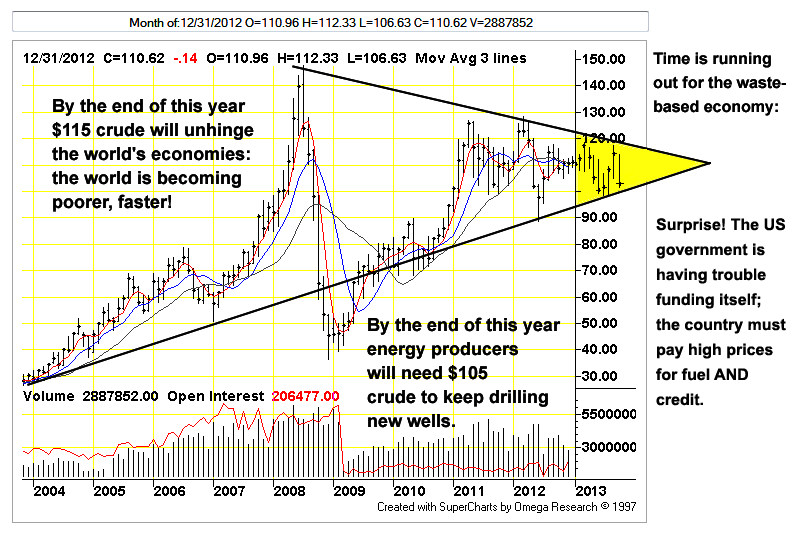
The ‘Almost-but-not-quite Goldilocks Oil Price’: not so costly as to torpedo the world’s economies at once but costly enough to strangle them slowly (click on for big). Costly enough to assure drillers of a profit for their hard-to-gain crude, never costly enough to bring extra-cheap crude onto the marketplace as during the ‘Good Old Days’ …

Costly crude = non-costly crude: if you cannot wrap your minds around the foregoing paradox, don’t worry. None of the ‘Brand X’ analysts are able to do so, either: “”We had to destroy the village in order to save it!”

This small notice appeared in a major media outlet;

Cyprus’ energy minister says that a gas field off the country’s southern coast contains between 3.6 and 5 trillion cubic feet (0.1-0.14 trillion cubic meters) of natural gas, noticeably less than an earlier estimate.

A 2011 estimate put the size of the field -— being developed by U.S. firm Noble Energy Inc. and its Israeli partners Delek and Avner -— at 5-8 trillion cubic feet.

The initial rosy estimates of available ‘reserves’ invariably shrink; this reduction takes place before the first drops of petroleum- or the first cubic millimeters of natural gas are out of the ground. There are technical reasons behind this but real issue has to do with finance. Initial estimates are always made large enough to guarantee funding for the necessary infrastructure; everything else by necessity follows along behind.

21st century petroleum extraction has become one of the world’s most expensive industrial enterprises along with nuclear power and military. As with these others infrastructure must always be built first. This would appear to be self-evident but appearances are deceiving: the crude and other resources are presumed to spurt themselves out of the ground at our pleasure after some hand-waving and utterance of the magic words ‘fracking’, ‘deepwater’ and ‘technology’.

Petroleum cannot bootstrap itself and hasn’t been able to since the Rockefeller era. There was never enough petroleum available early on to create and support petroleum extraction, what enabled the pioneer wildcatters was the nation’s gigantic coal industry. We could extract crude oil because we had an industrial base. Inventors were ready to design- and steel mills and factories were in place to produce the inexpensive rotary rigs used to gain the crude bounty lying out of reach in the super-giant fields of Texas, Oklahoma and California. Those were indeed the good old days: the highest quality sweet crudes were to be found in porous, easy to drill free-flowing formations relatively close to the surface, on dry land with good year-round climate, near transportation, refining and ultimately customers. At the same time, the infant automobile industry was producing what looked to be unlimited fuel demand — cash flow — as fast as highways could be built and banks could provide credit.

The crude oil added to the coal energy represented a colossal surplus that had the effect of driving the price of all energy products to the cost of production. Energy became a ‘loss-leader’ for the consumption side of the economy, perpetually cheap fuels became an American entitlement that is in force today. Nevertheless, without an industrial base the crude surplus would not have been available. Oil reservoirs were well beyond the reach of hand-dug wells.

The coal industry was only partly able to bootstrap its self. Large coal deposits could be found early on near the surface. Coal mining required agriculture, firewood and human labor. Farmers created enough food to allow the surplus labor to delve deeply within the earth chasing coal seams rather than farm. With time, coal provided the necessary energy for miners to dig more ‘efficiently’: fewer farmers and more coal. Instead of claustrophobic and dangerous underground mines there were gigantic open pits made possible by explosives, steam engines and railroads.

Eventually there were diminished returns to mechanized mining; the coal seams were exhausted, greater efforts were needed to retrieve less coal: the bootstrap started running in reverse.

Fast-forward and we have painted ourselves into a technology corner. Relentlessly increasing real costs are ‘baked into’ the petroleum cake. We retrieve hard-to-get oil by wasting ever increasing amounts of oil that is slightly easier to get. Petroleum isn’t a stock, it’s a chain of increasingly expensive flows, every link dependent upon all the others.

Analysts insist peak oil isn’t about ‘running out’ and that there will always be oil available. Without relatively cheap petroleum and a high-tech industrial base there is no way to access the expensive crudes needed to replace those already depleted … any more than Welsh miners and pit ponies could possibly gain natural gas from Cyprus’ Mediterranean waters.

Deepwater gas fields require a massive up-front expenditure in dynamic positioning drillships, undersea robots and well-control hardware, gas separators, processing plants and a network of pipelines along with the factories needed to create all of these things. Drillships are nor made in garages by entrepreneurs but in a handful of gigantic specialized shipyards by companies with multi-decade experience building such things. They are not pulled out of the air ‘from nothing’; every drillship in the world today is conceptually dependent upon every one built before. Ship building is an institution rather than simply a mechanical process; the products are not just ships but the continually improved means to design and build them. This must be so otherwise there would be no deep water oil drilling at all. There are too many chances within the drilling process for company-killing failures, the greatest of these; not being able to retrieve enough oil with the newly-purchased ship to pay for it.

Every bit of infrastructure must be in place and paid for before the Cyprus gas enterprise turns its first dollar. Customer dollars in turn are dependent upon the amount of credit these customers have available to them. This in turn is dependent on how much credit is left over after the drillers have taken their share! Our new credit economy can be difficult to understand because it is in many ways paradoxical; drillers depend on their customers as a source of credit at the same time they compete with them. We don’t recognize a contest for credit because consumption is never considered to be a component of energy production. We intently focus extracting more supply in order to overcome shortages without considering why there are shortages in the first place.

Because Cyprus’ gas industry cannot bootstrap itself it must oversell and borrow. With time, the Cypriot’s necessary fuel supply will be unaffordable if it isn’t so already. Cyprus will fall further into debt even as it is already bankrupt. Its natural gas will either be exhausted for a pittance or unaffordable to end users … whereby it will remain in the ground; the drilling endeavor will be a bust.

Humans consume petroleum to gain two things: waste and empty feel-good abstractions such as ‘prosperity’, ‘freedom’, ‘growth’, ‘progress’, presumably Godliness and proper manners. Waste is self-explanatory, the rest can be hard to grasp. Growth, etc. are not things. They can only be experienced vicariously by way of television and the gloating overlordship of billionaire tycoons whose luxurious idleness is gained at the expense of everyone else. None of these abstractions can be held in the hand, they can only be inferred- or referred to relative to other empty abstractions, or to other real resources that shrink like petroleum. Prosperity has become an inventory of disposable novelties. Freedom is the sensation that occurs when sitting in a traffic jam. Growth is like a football score with an exception: there is no clear public understanding what happens when the growth wins.

Progress is war by other means …


— The flaming Tesla, an apt symbol of our vulnerable failed technological paradigm. The fiasco underway in Washington right now is a failure of government, not necessarily a failure of particular components of a particular government but rather the generalized failure of the the modern technocratic state itself. What technocrats are able to do now is manage their own bankruptcy. They are limited to do anything else because they were designed around the modern premise of continual ‘more’: more resources to gobble, more growth, more business, money and credit … more waste, more political power and influence. Theirs is the ‘Politics of More’, which has been stealthily rendered obsolete by events, by their own prior management success.

Governments are now faced with problems they are ill-equipped to solve. Questioning problems is by itself destabilizing because of the ominous implications. Discussing energy implies there is a shortage. Discussing default implies that one is underway. Policy ceases to exist because words needed to frame the policy dare not be spoken. The analog is Walter Bagehot’s observation about finance, “Every banker knows that if he has to prove that he is worthy of credit, however good may be his arguments, in fact his credit is gone …” Every effort our politicians make to prove their credibility undermines it.

That governments are unwilling to solve their self-created crises does not mean they cannot be solved, it is just that our ‘more’ economic and political solutions are inappropriate to changing times. We need solutions devised around the necessity for less in all things. We throw around the term ‘efficiency’ but the more useful approach is restraint. Americans consider themselves conservatives, our governments are filled with them. Some of these governments should start conserving. The alternative is self-solutions; indirect conservation by other means driven by events.

It’s not too hard to notice how close to the edge we really are. The triangle of doom is nothing other than the corner we have painted ourselves into. Every component of the world economy must function flawlessly, policy makers must avoid errors. Even so there is little time left before the cost of extracting fuel — driven by the necessary extent of our industrial base — runs higher than what customers can afford. This can be safely estimated to occur at the end of next year.

If the managers err, credit will likely be affected first although direct energy shortages are a possibility. Fatal management error could occur next week, uncertain customers would be unable or unwilling to borrow … fuel prices would decline. Unable to borrow, the entire industrial base — not just the petroleum segment — would be stranded like over-mortgaged house purchasers were in 2007. Oil production starting with the least productive would be shut in: the deep-water, the arctic, the tight- heavy oils and bitumen production, biofuels. When consumers have no credit they cannot bid prices higher or afford to take deliveries, whether there is a fuel shortage does not matter if fuel users have no money, falling fuel supply cannot grant more credit or make it available to consumers, neither can ‘artificial shortages’ caused by OPEC or others.

Reduced fuel supply would then strand consumption dependent firms such as real estate, auto making, trucking, airlines and tourism; business failures would reduce credit which in turn would reduce available fuel supplies in a self-reinforcing cycle. The danger that lurks behind the ongoing charade in Washington, DC, is that an inadvertent ‘technical default’ would look like the real thing and credit system would delever in a panic. Borrowing costs particularly for short-term credit would quickly escalate out of reach; there would be a rapid return of the Great Finance Crisis … with the central banks’ policy rates already at the lower bound, with them already buying securities, with governments either embracing fiscal austerity or having it forced upon them by force of events.

Painted into a corner: even full-on fiscal and monetary easing directed toward individuals would have little effect other than to kick the proverbial can, but only so far! Even now, there are visibly diminished returns to increased credit flows; the real costs of energy extraction relentlessly increase, the real returns on energy consumption remain at zero … the costs of energy added to the cost of additional credit become too burdensome to bear.

Moderns have gotten used to more, we have known nothing else. We’ve been stupendously lucky; our entire lives, our parents’ lives and generations into the past, from the beginning of the Enlightenment and the founding of the republic onward … every American has had available some measure of more. Even during the depths of the Great Depression, Americans in general lived better than their counterparts did a hundred years’ previously … even though there were far more Americans in the 1930s than in the 1830s. Now we are confronted with less, something alien to moderns as the tropics would be to a walrus. Our economy emerged to manage the costs associated with increased surpluses. Now all the surpluses are questionable, are false assumptions or claims made against phantoms. We need to embrace a new conceptual approach … and do so in a big hurry.

How do we reinvent our society? Creativity is going to save us, not repeating the same errors, making greater efforts until we exhaust ourselves …

22 thoughts on “The Defunct Politics of More

  1. carlostheobscure

    Because of the U.S. profligacy with energy, i think there is more slack in the system than this essay allows (in the sense that end users could pay considerably more for petrol and electric while scrambling to be more efficient). Where the failure of the “politics of more” is coming to the forefront is in our financial arrangements (with their extreme rent seeking behavior) in sectors like industrial medicine/health insurance, telecommunications, etc, punitive tax and regulatory regimes for citizens/small businesses, etc. I am with n. foss on this one, i guess – i think we will see a blow off on the financial arrangements which will seize up commerce rather than any prolonged period of physical shortages.

    1. I1

      Yes. The high interest rates initiated in the early eighties have performed as a sort of financial battery since that time. They could be tweaked by the fed at will to goose the mega-machine. Now, a regime of increasing interest rates may be physically impossible. How could they rise in an era of increasing energy scarcity?

  2. Reverse Engineer

    If we can Crater demand in Japan and Europe by cutting off their Credit first, we can have all the Oil they use for Happy Motoring for another cupla years!

    On other fronts, how do you see a technical default playing out? You think it will trip any CDS?

    Also, Steve-Fans, we’ll have a Teaser Podcast with Steve up on the Diner this weekend. Full podcast to be recorded next week I believe on his flashy new Apple.

    RE

    1. steve from virginia Post author

      Structured finance is in better shape than it was in 2008. Why? Because the collapse that year pretty much destroyed structured finance particularly on the mortgage side. What remains is anchored to US-guaranteed instruments such as agency MBS (Fannie and Ginnie for instance). That stuff won’t default.

      Assuming a default takes place portfolio managers and banks would have to ‘adjust’ their balance sheets as a default would reduce the worth of the collateral they are required to hold. There would be ‘adjustments’ which might cause overnight credit to become very pricey. If Treasuries are defaulted upon, what is a risk-free security?

      Money funds might ‘break the buck’ which was a threatened catastrophe back in 2008, not so much now. $85 bn in Fed credit per month does make a difference.

      Keep in mind, the US is ‘good for coupon payments and any shortfall(s) would be made up once the political grandstanding is done with. The US isn’t ‘broke’ like Greece, it’s being silly. The ongoing silliness does cause more official credibility to bleed away.

  3. rcg1950

    I often find that seeing the same thing from a slightly different perspective is helpful for a fuller understanding. I ran across a Nate Hagens article a couple of weeks ago that basically is saying the same thing as Steve. Complete article at URL below. I’ve heavily excerpted what I think are his most salient points that complement Steve’s thesis.

    http://www.resilience.org/stories/2013-09-16/twenty-important-concepts-i-wasn-t-taught-in-business-school-part-i

    “At the average hourly US wage rate … almost $500,000 of labor can be substituted by the latent energy in one barrel of oil that costs us $100. Unbeknownst to most stock and bond researchers on Wall Street, this is the real ‘Trade’.”

    “The vast majority of our industrial processes and activities are the result of this ‘Trade’. We applied large amounts of extremely cheap fossil carbon to tasks humans used to do manually. And we invented many many more. Each time it was an extremely inefficient trade from the perspective of energy (much more energy used) but even more extremely profitable from the perspective of human society. “

    “Everything we do will become more expensive if we cannot reduce the energy consumption of specific processes faster than prices grow. Yet, financial texts continue to view economic activity as a function of infinite money creation rather than a function of capped energy stocks and finite energy flows.”

    “We increasingly have to issue more debt to keep up with the declining benefit of the “Trade”, lest aggregate demand plunge.”

    “Energy and finite natural resources are our real cost of capital. In the short and intermediate run, dollars function as energy, as we can use them to contract and pay for anything we want, including energy and energy production. They SEEM like the limiters. But in the long run, accelerating credit creation obscures the engine of the whole enterprise – the ‘burning of the energy’. Credit cannot create energy, but it does allow continued energy extraction and much (needed) higher prices than were credit unavailable. At some point in the past 40 years we crossed a discrete threshold of ‘not enough money’ in the system to ‘not enough cheap energy’ in the system, which then in turn necessitated more money. After this point, new credit increasingly added ‘lodestone’ to its previous role of lubricant. Though its hard to imagine, if society had disallowed debt circa 1975 (e.g. required banks to have 100% Tier 2 capital and reserves) OR if we had some natural resource tether – like gold – to our money supply since then, global oil production and GDP would likely have peaked 20-30 years ago (and we’d have a lot more of the sub 50$ tranche left). As such, focus on oil and gas production numbers isn’t too helpful without incorporating credit forecasts and integrating affordability for societies at different price tranches.”

    “Debt temporarily makes gross energy feel like net energy as a larger amount of energy is burned despite higher prices, lower wages and profits. … But over time, as debt increases gross energy but net energy stays constant or declines, a larger % of our economy becomes involved in the energy sector.
    In the last 10 years the global credit market has grown at 12% per year allowing GDP growth of only 3.5% and increasing global crude oil production less than 1% annually. We’re so used to running on various treadmills that the landscape doesn’t look all too scary. But since 2008, despite energies fundamental role in economic growth, it is access to credit that is supporting our economies, in a surreal, permanent, Faustian bargain sort of way. As long as interest rates (govt borrowing costs) are low and market participants accept it, this can go on for quite a long time, all the while burning through the next tranche of extractable carbon and getting reduced benefits from the “Trade” creating other societal pressures. I don’t expect the government takeover of the credit mechanism to stop, but if it does, both oil production and oil prices will be quite a bit lower. Money can’t create energy, it can only extract it faster.”

  4. ben

    “How do we reinvent our society? Creativity is going to save us, not repeating the same errors, making greater efforts until we exhaust ourselves …”
    -SFV

    from afar i believe golden dawn has a great deal going for it. initially it may be industrial in the majority, but this is negotiable (and surely tactical among its cutting edge) because the arc of history will not bend towards that. when it talks of the State, it is referring, metaphysically, to a collective social state.

    the golden dawn party leader, ilias kasidiaris, was recently arrested due to a ploy by the establishment to liken him to hitler. xaameriki, a leader of the american expat golden dawn movement, when questioned about kasidiaris’ likening golden dawn to a school, xaameriki replied, “The school of Golden Dawn is the school of your people: your family, friends, and your soil, this is all you need to know to stand up like a man. That’s how I’d interpret it.”

    take a look at their platform if you haven’t already. i think it’s a damn, damn good early attempt, an order of magnitude in higher consciousness than occupy’s well-meaning, synthetic consciousness could muster, that knew not how to begin to strike at the root:

    http://golden-dawn-international-newsroom.blogspot.com/p/our-identity.html

    the swastika in the form golden dawn uses is an ancient greek symbol representing, among other things, perpetual motion, or as the party describes it, incessant evolution..

    1. ben

      I got mixed up. kasidiaris isn’t the golden dawn party leader. that’s nicos michaloliakos. kasidiaris is the younger rising star who was briefly jailed for slapping around a female political counterpart on television. she hit him first!

      last week kasidiaris was just about to become the mayor of athens by a landslide, but then he was jailed again, along with the rest of the GD leadership, because of the murder of a leftist rapper for which GD was indirectly implicated, a murder suggestive of the fact that neoliberal president samaras and his overlords proved their credibility by opening a window when the going got stuffy.

      http://hat4uk.wordpress.com/2013/09/27/greece-exclusive-murder-of-leftist-pavlos-fyssas-was-a-set-up-sources/

      1. steve from virginia Post author

        Golden Dawn = Greek ‘Niewe Nazi’ anti-immigrant, ultra-nationalist hate group. Maybe yr thinking of Falun Gong … I don’t understand the appeal of the hate groups, maybe it’s the style, that goose-steppy thing. They have nothing to offer but petty crime … and mass murder.

        I doubt the Hells Angels have much to offer either, but they are supposed to be fun to hang around with.

      2. ben

        modernity has given ethnocentrism a bad name relative to itself, nevermind the fact that modernity is a secular european ethnocentrism. ethnocentrism can’t hold a candle to true tribalism, since it’s but a mere civilizational facsimile of it, but it sure as hell beats the defunct politics of more. organic societies have a single set of values, and golden dawn has some seemingly earnest hellenic aspirations, so to me it looks at this point like a too-big and reactionary relocalization project. but who can blame them there, in the thick of things. the bad apples are for the ethnic cleansing.

        ethnocentric racialism and racism are two different things. one hates the other doesn’t.

        I bet that the golden dawn voting bloc is much more romantic nationalist than neo-nazi.

        http://en.wikipedia.org/wiki/Romantic_nationalism

      3. Ellen Anderson

        Romanticism is only one expression of modernism. It probably is fun and an effective personal solution to the boredom and ugliness of modern life.
        These silly men (mostly) are going to run out of gas and food just like the rest of us. I am sure that they will entertain themselves by spouting nonsense and doing mischief while they wait for the end.

      4. Ross

        Steve, you sound naive claiming you can’t understand the appeal of hate groups.

        Everything is falling apart and well-dressed men with faces like yours offer you a place of belonging maybe even three hots and a cot if only you’ll club the brown guy? Seriously? You don’t see how the politically, economically and socially destitute would sign up for that over and over and over?

        They offer camaraderie, belonging, social and ethnic cohesion, community, social services, social support, economic support, economic opportunity (crime pays…).

        The appeal is sitting on your plate, steaming hot or it’s some crumpled up Euros in your pocket. And a familiar face.

      5. ben

        Ellen, to just say that romanticism is historically a modern expression is to ignore it’s pre-modern ideals. sure they’re mostly gonna run out of gas and food.

        Ross, I think that’s a bit facile. that’s a miniscule amount of what’s going on, malicious and individualistic clubbing of brown guys. then to suggest that violence explicitly gets you food and belonging in return from golden dawn is bullshit. your three hots and a cot come from infinitely more structural clubbings; how superior it is to have official conduits between you and them.

      6. steve from virginia Post author

        Ross …

        Hate groups propose to redistribute upward in the place of ongoing — failing — redistribution regimes. The failure is not in the regime but rather shortages of what it is to be distributed. When you say these groups offer ‘camaraderie, belonging, social and ethnic cohesion, community, social services, social support, economic support, economic opportunity … ‘ they are lying, they cannot offer anything different from the other ‘brand X’ redistribution agents, they can’t pull rabbits out hats.

        They do offer sanctioned violence and killing which are both self-defeating. To be marginally effective the killings must represent a larger existential threat to a broader population than alternative regimes. Killing a handful of persons would not distinguish the Nazis from their Wiemar alternatives … or from the French. Only by ruthlessly killing thousands could the Nazis differentiate themselves from their competitors. At the same time they assured their own downfall as they had nothing to offer other than empty abstractions … along with slavery and bullets. ‘Existential threat’ is not a product.

        Who would be willing to act altruistically … to further another’s racial ‘purity’? Success on the terms of the Nazi is to diminish purity: empires are polyglots. The Nazis and today’s wannabes are simply violent gangsters, like the Capone mob. Yes, being a ‘made man’ like Billy Batts might have some local — and very fleeting — cachet, only until he’s imprisoned, shot, beaten or stabbed to death. The made man does not contribute anything, not even security or ‘protection’ because his existence is destabilizing. There is always someone out there who wants to be a bigger, stronger, tougher, more violent made man.

        Gains from gangsterism are evanescent, exist only in the most immediate term of terms and are outweighed by costs. BTW, the brown guys club just as hard and with the same effect as the non-brown guys. Given the same resources they have 50-50% chance to win, then the tables turn.

        Success in the world that is rapidly approaching will flow from cooperation and collaboration, not by way of gangsters, warlords or different forms of sanctioned assault.

  5. Pingback: The Defunct Politics of More – http://t.co/dNUJ6GW… | http://www.thedeflationtimes.com

  6. christiangustafson

    Hyperinflation, bitchez!

    But first we need the wrecking-ball of a good old-fashioned deflationary collapse.

    I still have specu-vestor friends who are bearish but who do not get the full point of the Peak Oil and the collapse and the cannibalism in the America.

    I’m forwarding the link to Steve’s piece to them this weekend. Read or die!

  7. ben

    “Success in the world that is rapidly approaching will flow from cooperation and collaboration, not by way of gangsters, warlords or different forms of sanctioned assault.”

    but from an anthropological perspective within the context of resource scarcity, success and ethnocentrism (that balances cooperation and competition) are mutually inclusive.

    aren’t we all gravitating towards those who are into a loosely monocultural self-determination?

    “To be marginally effective the killings must represent a larger existential threat to a broader population than alternative regimes.”

    not necessarily, if GD’s platform, which entails an (altogether too-optimistic) cuban-like transition to self-sufficiency, represents a larger existential hope to a broader population than alternative regimes, thereby counterbalancing some of the existential threat that’s inevitably accompanies control systems.

    1. ben

      Ross, sorry for being rude. i understand and respect where you’re coming from.

      and sorry for all the posts. one last one, in defense of this controversial (wayward?) position.

      what appears most adaptive about GD’s militant ethnocentrism is that it looks like a (too-)large, self-determined attempt at the front-running of multicultural collapse (orlovian collapsing-first) stemming from the knowledge that civil war and chaotic ethnic cleansing invariably follows multicultural collapse. is it not a type of facing the future? i’m not saying it’s pretty, the storm front aspect of it, but warriors are warriors, surely almost all societies have them, most decide they need them, and must therefore cooperate with them. to collectively steel themselves societies actually have to steel themselves. greece has a front row seat to the iraqi, libyan, egyptian and syrian ethic cleansings, all foreign-influenced.

    2. steve from virginia Post author

      ” … but from an anthropological perspective … “

      Are you an anthropologist?

      ” … aren’t we all gravitating towards those who are into a loosely monocultural self-determination?”

      No.

      Where have you been for the last 50 years or so? Nazis don’t ever offer hope, only vengeance. There is always a score to settle with ‘back-stabbers’. The more back-stabbers are killed, the more are discovered needing to be killed. Eventually, entire countries and regions become concentration camps, murder becomes currency: Soviet Union, East Germany, Kampuchea, Myanmar … also North Korea, the Balkans. Also, Muslim Brotherhood, Hezbollah, Ustashe in Croatia and SLA in Syria. If Golden Dawn comes to power in Greece there will be a reign of terror in that country … these groups become muscle for politicians, then death-squads.

      There are hundreds of junior-wannabe-niewe Nazi groups all over the world; they are a durable and poisonous weed cultivated in modernity’s once-fertile soil. Don’t ever fool yourself, the Greek Nazis offer theft and murder for pleasure disguised as policy, nothing more.

      Niewe Nazi theory is internally logical, like determinism, but it is also completely false.

  8. ben

    this is, by a wide margin, the most popular comment under a sorkin debt-standoff article in the nyt today.

    “Socrates
    Downtown Verona NJ

    The United States should have let the South secede.

    The Northern Union would be another Germany today.

    The parasitic Confederacy would be another fundamentalist, third-world backwater today.”

    http://dealbook.nytimes.com/2013/10/07/no-way-u-s-would-allow-debt-default-dont-bet-on-it/?_r=0

    democrats: blue hate group or unionist romantic nationalists? both!

    bankers: greedy or populist heroes? both!

Comments are closed.