“We are in the position of a man who has seized a wolf by the ears and dare not let him go.”
Friedrich Mellenthin (1943)

Figure 1: radiation map of the region surrounding the Fukushima Daiichi power station. Cumulative exposure is presumed to be for the year ending 2012. 20km exclusion zone is noted. (Click on chart for a sharper image: Radiation Safety Philippines)
Two months ongoing at the Fukushima Daiichi running sore and the ossified and corrupt Japanese establishment no closer to any kind of remediation now than they were on the night of March 12. Meanwhile, the blame- game starts with the Japanese Prime Minister denying he ordered the halt to sea- water injections into reactor unit 1 on the 12th of March:
Kan denies ordering TEPCO to stop seawater injection at reactorPrime Minister Naoto Kan on Monday denied having instructed Tokyo Electric Power Co to stop injecting seawater into the troubled No. 1 reactor at the Fukushima Daiichi nuclear power plant, brushing aside criticism that an alleged suspension order from him may have worsened the situation.
At a Diet session, Kan said while he ordered the Nuclear Safety Commission of Japan and TEPCO on March 12, a day after the mega earthquake and tsunami crippled the plant, to examine if the injection could rekindle a nuclear chain reaction in a state known as ‘‘recriticality,’’ he did not receive a report at that time that the injection had actually started.
‘‘I cannot have said ‘stop’ with regard to something that had not been reported to me,’’ the premier told the House of Representatives’ special committee on post-disaster reconstruction in response to Sadakazu Tanigaki, chief of the main opposition Liberal Democratic Party.
According to a document released by TEPCO, the injection started at 7:04 p.m. on March 12, stopped at 7:25 p.m. and resumed at 8:20 p.m., meaning that the operation had been suspended for 55 minutes.
On March 11, events instantly outran the Prime Minister- or anyone else’s ability to effect outcomes. Like so much else in our modern life, that opportunity had come and gone years previously, when the Japanese establishment ignored safety reports illuminating the vulnerability of conventional reactors to earthquakes and tsunamis.
Meanwhile, the hunt for a friction- free scapegoat intensifies. Kan needs to stay away from hotel rooms:
Worker error may have led to meltdownMinoru Matsutani and Masami Ito (Japan Times)
The emergency cooling system for reactor 1 at the Fukushima No. 1 nuclear plant may have been shut down manually before the tsunami hit on March 11, according to a Tokyo Electric Power Co. spokesman and documents recently released by the utility.
A part of the cooling system known as the isolation condenser was down for about three hours, which could have contributed to the reactor core’s meltdown.
The finding upends the government’s previous conclusion that the condenser was functioning normally on March 11.
“I learned (of the shutdown) through media reports today,” Chief Cabinet Secretary Yukio Edano told a news conference Tuesday. “We have asked the Nuclear and Industry Safety Agency and other bodies to give detailed analyses and reports (on that matter).”
NISA, the government agency that oversees nuclear plant operators, urged Tepco on Tuesday to provide a detailed explanation by May 23.
Tepco, Japan’s largest electricity supplier, disclosed internal documents and data Monday indicating the isolation condenser may have been manually shut down around 3 p.m. March 11 shortly after kicking in following the massive quake at 2:46 p.m. The plant was hit by tsunami around 3:30 p.m.
Pity the poor isolation condenser operator- man. He’s on the hook for hundreds of trillions in yen in damages — this on top of the lethal doses of radiation he very likely absorbed working in the reactor complex without proper safety equipment!
Neither TEPCO nor the Japanese government has a clue as to how to deal with these reactors. They wring their hands helplessly and spew bureaucratic ‘papers’ like the Federal Reserve.
Reprise: both entities have a clue but the price demanded is a ‘full- court press’ on the part of the entire nation along with a supporting international effort. This risks Japan’s solvency along with what remains of the nuclear industry’s credibility.
Japan’s sense of itself as a participant in the modernity enterprise of is also challenged. The business of the post-modern world is leisure and finance swindles, not humping lead bricks in a radiation suit, engaged in an Manichean struggle with an invisible something that causes your skin to slough off. Better to pretend the irradiated school-kids are alright.
Some sense: the Chinese under similar circumstances would lose no time throwing millions of hapless farm workers into the fire ‘for the good of the country Guangdong Nuclear Power Group. The progress narrative renders the Japanese establishment helpless. The strategy becomes for them to stick heads into the sand, punish a reactor underling and hope against all hope that pouring tens of thousands of tons of water into holes will ‘fix’ what is wrong.
Reports indicate a large release of radiation detected at the plant gate shortly before the tsunami struck. This means the reactor containment(s) were immediately compromised.
Radiation detected at the plant gate may have come from any reactor at the complex … or all of them.
The immediate aftermath of the earthquake was chaos. Critical items were non- functional including important instruments and valves.
Managers at the plant did not have authority to vent the reactor, When the decision was made to vent, operators were challenged by extremely high levels of radiation inside the containment building.
Arriving at the decision to pump of seawater into the reactors was also halting: reactor operators did not begin until after the reactor unit 1 had already melted down.
TEPCO was concerned first and foremost about its ‘investment’ and managers on site did not have authority to address the core emergencies.
Reactor unit 1 probably melted down a few hours after cooling systems stopped working.
Presumably, the local fire department was able to bring pumper trucks to the plant shortly after the earthquake although mention of this arrival has not been noted.
TEPCO negligence: ten thousand tons of slightly radioactive demineralized water (primary turbine drive fluid) in the Central Radioactive Waste Disposal Facility was available to be pumped by firetruck into the feedwater lines to cool the cores/spent fuel pools after the battery power/RCIC failed. This is excess condenser water, removed from reactors during maintenance. Three of the six reactors were shut down for that reason.
During reactor operation this water is boiled in the core; steam drives turbines. It carries some radioactivity but all operating reactors contain water with the same levels of radioactivity. The water in the CRWDF would have been no more radioactive than the water already within the 3 reactors and spent fuel pools.
This water was later dumped into the sea.
Cooling water cycled through by the cores would have been drained by way of relief valves back into Central Radioactive Waste Disposal Facility. 10k tons/cubic meters of water which would have provided sufficient mass to cool the three cores plus spent fuel pools until power was restored. Worst case scenario would have been a dozen fire trucks and hose lines to be disposed of as low- level radioactive waste. Managers simply ‘forgot’ about the tons of fresh water in CRWDF available as emergency coolant that was sitting right under their noses.
The foregoing presumes that cores, containments, pressure vessels and related plumbing were in a condition to contain and circulate coolant. The earthquake may have fatally damaged the reactors so that they would have melted down anyway.
More TEPCO negligence: operators ‘forgot’ about spent fuel in unit 4 until water had boiled away. They relied on rate tables and did not account for leaks in spent the fuel pool or its plumbing.
TEPCO pours water not knowing the condition of the cores or where they might be within the buildings. Water shields what remains of the cores. If the flow is interrupted, there is nothing between the cores’ intense radiation and the outside world. Overheating material can become critical and ‘reposition’ itself explosively. Core-melt meeting water is the stuff of steam explosions. Water also morphs to hydrogen and oxygen, it boils away or leaks carrying radiation and a toxic stew of isotopes away from the corium into the water table and the ocean. Some of the water floods the basements of the reactor buildings.
Given enough time and water, all of the cores’ energy will be carried to the outside world. No water and the outcome is the same. This is TEPCO’s dilemma.
The water flow is not a panacea. Radiation levels within the lower level of reactor unit 1 have skyrocketed to a mind- boggling 200 Sv/hr. (Figure 2):
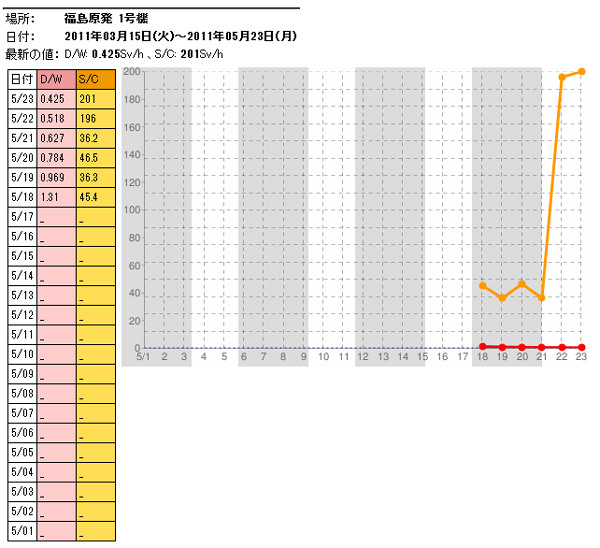
Having escaped their pressure vessels, the cores are burning their way through the concrete foundations of the three reactor buildings. This is the ‘why’ behind the sharp rise in radioactivity in the suppression pool area.
Temperature sensors built into the pressure vessels indicate high- but not extreme temperatures. The utility hopes that fuel remains within the pressure vessels and that water is providing some cooling. More likely is the hot material lies below the sensors which are measuring steam temperatures.
It’s also likely that many sensors don’t work.
All three plants were old, built in the 1970’s. The large nuclear stations are worn by hard use: their large thermal and radiation loads. Stresses accumulate over time.
Figure 3: Arnie Gundersen explains how containment vents were added to the GE Mark 1 BWR as a “band aid” 20 years after the plants built in order to prevent an explosion of the notoriously weak Mark 1 containment system.
The entire nuclear industry in Japan has a history of safety issues, cutting maintenance corners and covering up hardware defects.
The General Electric design has characteristics that leaves it vulnerable to a loss of coolant or power: a ‘station shutdown’.
The Fukushima/GE plants were at the end of a decades-long operating cycle meant that critical water and steam circulating systems were vulnerable to radiation stresses, corrosion, embrittlement and metal fatigue.
Critical safety systems were vulnerable, including the emergency generators and cables connecting these to pumps and valves. The systems represented complex chains of components: the failure of one component would compromise the entire chain.
The condition of the soil under the plant has not been revealed. It is likely that much if not all of the plant was built on fill or on unstable marine soils. It is possible that the containment structures are not fixed to the bedrock but on soil subject to liquefaction.
The earthquake shifted the land under the plant to the east and lowered it. It is reasonable that the concrete containment structures were cracked by the earthquake and that equipment was damaged.
Roads leading to the plant from the rest of the country were furrowed by the quake: nevertheless road transport of portable generators was possible within nine hours.
It’s likely the earthquake damaged vital systems, caused critical pipe breakage and cracked the containments. Explosions taking place during meltdown events certainly did done more damage.
Fssion products are distributed by way of ground water to sewers, waste treatment facilities, incinerators and finally bricks and concrete in Tokyo and elsewhere which become the heat sinks — along with the ocean — for Fukushima Daiichi.
Short- lived isotopes continue to be detected in increasing amounts far downrange of the plant. This indicates continuing criticality taking place.
And so the TEPCO soap opera spirals endlessly out of control, a malevolent reality program that is the stuff of nightmares …
…