Nobody can keep up, the wild swings in markets from ‘Risk On’ to ‘Risk Off’ over periods of a few hours.
Gold is down $100 on Day One, on Day Three it’s up $70. Can’t people make up their minds? Do the ‘fundamentals’ of what basically are blocks of yellowish lead change that much from day-to-day?
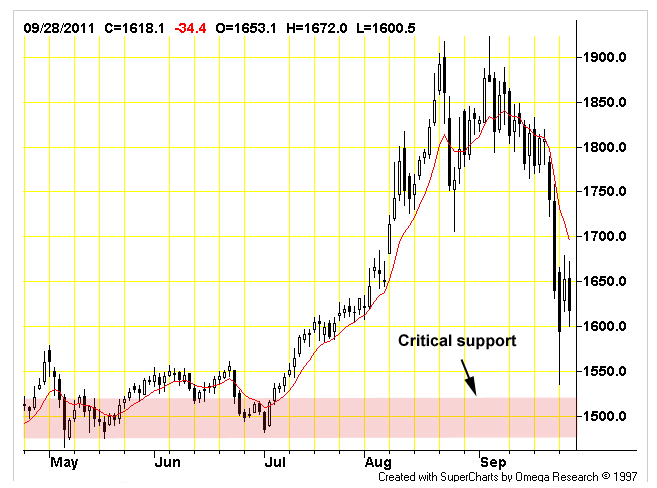
Figure 1: Current month gold contract, day to day by TFC Charts. You are a trader, you want to make some money, what do you do? The gold fundamentals are pretty simple: there is less gold available in the markets ongoing while demand increases, ‘Peak Gold’: there is no ‘economic speed limit’ to the price of gold. This is unlike the price of crude oil, which is effected by itself, high crude prices undermine support for high crude prices. Gold at $50 per ounce has the same economic implications as $5 million per ounce.
In 2010, an ounce of weapons-grade plutonium oxide PuOH cost $162,726.13. Oh woe, the dollar!
Long gold looks a lot different from long crude or stocks of any kind. Capital fleeing markets for ‘safety’ has few places to go: Singapore, Norway, yen, Treasuries, gold. I hate China except to short it: I’m not wild about silver, it appears to be in a bear market, yet it is too volatile to short except for ‘insiders’ who can see what other traders are up to. Silver being an industrial commodity like copper has something to do with the bear trend. Industrial demand for silver is added to the speculative demand from ‘financiers’. As industrial demand for fuel declines, so does some of the demand for silver.
BTW, I own both gold and silver but mostly cash, a post-industrial ‘Big Swinging Something or Other’ with ‘not-so vast fortune’ and damned- poor trading instincts. Nevertheless, gold is a good cash hedge. If the dollar value against something plummets, the value of gold against the same item rises and vice-versa. Both the cash and the gold must be traded for ‘the thing’ at the same time, otherwise the hedge does not work. Potential hedgers must know this, simply buying ‘fetish’ gold is a hobby (darts) or personality disorder (binge drinking), not investment or trading.
In the ‘Good Old Days’ that we are racing back toward as fast as our oil resources are squandered, gold was swapped for real estate or used to settle overseas bills of exchange. Folks put large piles of gold onto creaky (sailing) ships and wished the hopeful ‘Bon Voyage!’ It isn’t hard to see some sort of reversion to gold settlements in lieu of letters of credit, particularly as (all) the various banks emerge into the light of day as scoundrels never to be trusted.
At some point our gold/dollar inverse correlation will change, probably not before crude prices drop below production costs and there are shortages.
High dollar value will be the cause of the drop in production as well as the outcome of it: there will be less fuel and fewer dollars/pesos/’whatevers’ with which to buy fuel. Fuel availability will be spotty, cash will be closely held for the time when a fuel truck arrives and the beloved jalopy can again be pressed into some sort of ‘service’. Under these circumstances, the cost of juice will always be just a little bit out of reach, perhaps more than a little depending upon circumstances. There is no easy way for the world to escape from the ‘resource debt’ trap.
An identical trap existed in the early 1930s with gold, rather than petroleum, as the object of desperate necessity. Reasons were political and economic. WWI reparations and war debts were to be settled in gold. Gold was the reserve currency, the universal standard of value by which all other values were measured. Gold was hard to get and the demand for it was intense: the high price meant decreasing amounts of available gold. Interest rate arbitrage between banks and banking systems became the means to obtain: high- then higher interest rates fueled annihilating deflation among countries frantic to gain gold. Ultimately, the world had no choice but to go ‘cast off golden fetters’ or witness total industrial implosion. Adhering to an absurd bookkeeping regime for its own sake had taken a dozen countries into default and unemployment in many others was unbearably high. This was before ‘benefits’ and counter-cyclicals, the jobless and their families were on their own.
Out of ‘own’ came Hitler and the economic prostration of the West, the tyrants looked toward plunder as an alternative to vanished commerce with no force adequate to restrain them. Ending gold money rigidities put an end to deflation but not quickly enough for the world to escape total war.
Any escape we might make from the petroleum-driven rigidities will require a similar ‘going off’ oil … where doing so is both the consequence of strategy as well as the outcome of letting things run their course, of having no strategy at all! Right now, a non-strategy of denial and wishing is taking place both in the (neo)liberal West and its imitators elsewhere. One reason for the flight into gold is the current leadership vacuum. Zero-strategy strips confidence away from the management that requires confidence to function. Given anarchy, gold-driven deflation looks just as promising as the oil-driven alternative.
A part of the price of gold is the production cost per ounce which is dependent on the price of crude:
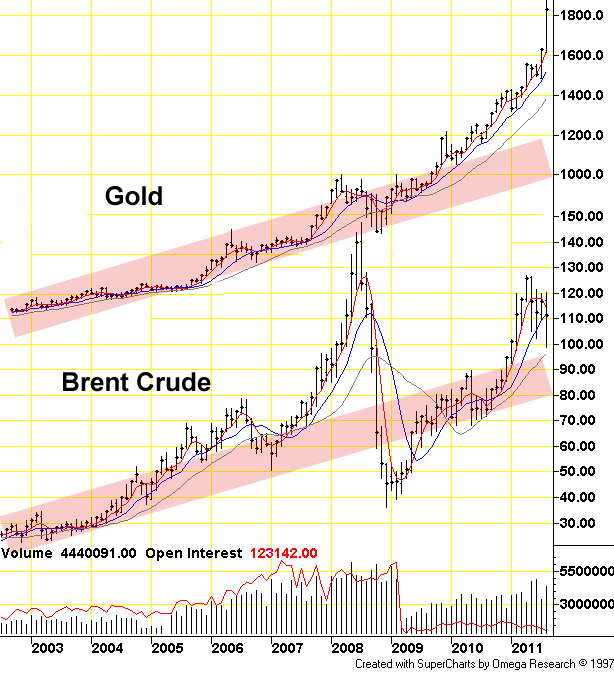
Figure 2: Looking at this chart of monthly gold- and Brent crude contracts: the gold price reflects the crude price, which is a large part of the cost of fuel needed to bring gold to market.
The vast majority of all gold mined since the beginning of ‘history’ is still in human hands. As with all things marginal, the price of the ‘new gold’ — mined yesterday with giant fuel guzzling machines — is also the price of the old gold.
Theory: when crude supplies shrink the amount of gold mined will diminish, pushing up the price.
Both crude and gold have ‘gotten ahead of themselves’. The last crude price spike was a product of Bernanke’s QE policy that was announced last summer. The experiment ended as the QE price for crude quickly became the ‘too agonizing’ price for crude. Oil prices have been steadily declining since the April spike reflecting the declining ability of the world economy to ante up. Bernanke’s stab at relevance was monetary policy’s last hurrah. Manipulating the value of money cannot create new crude where none inexpensively exists, in our present world with the tools we have in our hands, only conservation can accomplish this bringing of new crude.
Any money supply increase that is able to effect the fuel price will proportionately and adversely effect labor ‘price’. In general, business profits are borrowed, wages and debt service are paid out of cash flow. The borrowed profits are hoarded, the service costs and principal obligations fobbed off onto labor: wages and purchasing power are diminished as a consequence. Increasing the money supply only makes sense when there are idle fuel supplies that ‘new’ money can put to use. The rise in the price of crude since 2003 indicates diminishing reserves relative to demand. Nevertheless, money authorities drink the Kool Aid and assume that great quantities of oil are waiting impatiently for the additional funds. The same authorities are befuddled by increasing unemployment and declining wages. They cannot accept that funds that should flow to labor flow instead toward African and Middle Eastern petro-hoodlums and tax-evading energy multi-nationals.
Beginning in 2002, the price of crude climbed from $25 per barrel to $115 for the same barrel, an increase of 460%. During the same period, gold increased from roughly $300 per ounce to the current $1700, an increase of 560%. Arguments are made that the price increases of both crude and gold — along with other commodities — is due to general currency devaluation. This argument is extended to one that has currencies themselves becoming useless because they are ‘fiat’, because the monetary authorities insist upon continually issuing more of it.
Gold as a currency as opposed to gold as a finance asset causes the greatest amount of misunderstanding. Arguments that currencies or ‘fiat currencies’ will fail are entirely incorrect. Individual currencies come and go. There are more countries, with them come more currencies. Nations vanish due to conquest or division, their currencies vanish also. The arrival of the euro replaced a number of minor currencies. Many of these currencies will reappear after the Eurozone restructures. Countries also choose to use the US dollar. No country has gold as a currency or uses a gold-backed currency: Switzerland was the last in 2000. Now the franc races the euro toward currency softness. Hard, ‘honest money’ currencies: nobody wants them, they are too deflationary.
it is hard to see any new gold currencies appearing any time soon, particularly when so many countries have so much external debt. Any debtor with a gold currency would see it vanish instantly into the vaults of the creditor country. The only way for a country (such as the US) to issue a gold-backed hard currency would be for it to default or repudiate its debts, first. The resulting hyper-depression would make a hard currency unnecessary, any old paper at all would be ‘hard’. It was this external indebtedness of America to France during the Vietnam war that ended the Breton-Woods accord that promised dollar-gold convertibility.
The dollar is becoming a hard currency anyway: the exchange value of crude gives dollars value, this value is set every single day by millions of motorists putting gas in their cars. As drivers shift to ‘more broke’ there will be less gas and lower gas prices … and a more valuable dollar.
All currencies are fiat otherwise nobody would accept them. This is what ‘fiat’ means: the assignment of a common value or set of values! A government can only produce an instrument of exchange, it cannot produce value. A government’s ‘fiat’ only extends so far. Outside the reach of official ‘fiat’ the user fiat begins. This is the only fiat that matters. Users of an instrument fix currency values, they do so continuously by use. That this is so is evidenced by the rejection of US dollar coins.
Currencies are conveniences, they are proxies for goods that are hard to move or bulky, dangerous or dispersed, hip, sexy or diseased. Currency allows a value to be fixed on time. If a particular currency ‘fails’ it’s because another is more popular (by fiat) or the replacement is more easily obtained at less cost. Both deflation and inflation are expressions of currency preference, of one ‘fiat’ proxy for goods over another ‘fiat’ proxy. Currencies are popularity contests: If gold circulates, it cannot have value greater than any other currency that would replace it. If a gold currency has more value than a substitute paper currency it will not circulate. I’m not making this up, it’s ‘Gresham’s Law’: gold’s ‘intrinsic’ value is generally greater than what can be substituted in its place. At this point, gold ceases being currency and becomes a finance asset. This process is what took place around the world and in the US particularly during the early 1930s. It is also taking place right now where gold does not even circulate within the various metals markets where it is supposedly traded!
At bottom are two distinct trends. One is deflation. The other is the worldwide hunt for safety. Deflation is indicated by the ongoing crude bear market since 2008. The bullish price trend that ran from 1999 to 2009 will decline as money- and economic systems ‘get smaller’. Declining fuel prices will reduce support for high gold prices. Deflation will erode price support. Scarce fuel will make new gold harder to extract. Supply and (constrained) demand will push gold prices (relatively) higher. Capital will continue to leak out of risk assets. Capital roll-over — from deleveraging hedge funds escaping the mortgage debt debacle — powered the great crude bull in 2008. As hedgies race away from Euro debt and Chinese inflation, some cash will be invested in gold if only for diversification purposes. Watch to see if the rest of the world panics or gold ‘production’ zeros. Gold prices might go stratospheric.
Gold prices may also go lower if gold is sold out to make margin. This happened in 2008 as asset deleveraging took hold across all markets.
Is gold risky? You can lose money speculating in gold. Is gold less risky than other assets? You will never lose everything. Hold some gold and some cash, the time might come that gold declines, other assets will decline as well, the cash you will be holding would be worth that much more!